Daughter of Fire (불의 딸, Im Kwon-taek, 1983)

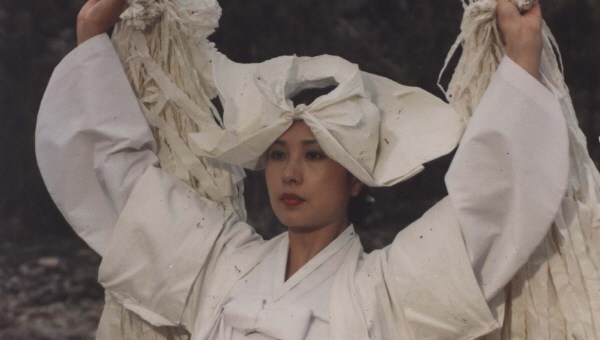
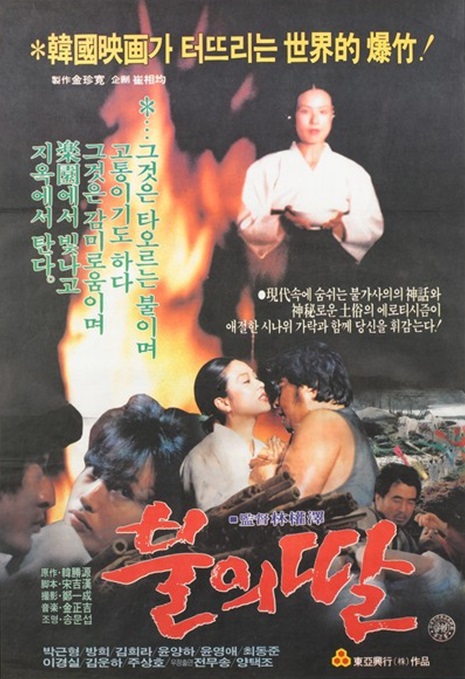
“Doctor, is it possible in our modern society for someone to suffer from that kind of illness?” the conflicted hero of Im Kwon-taek’s Daughter of Fire (불의 딸, Bul-ui ttal) asks his psychologist, plagued by nightmares of the mother who abandoned him at 11 and suffering what seems to him to be the call to shamanism, only what place could such a backward and superstitious practice have in “our modern society?”. In many ways, it’s exactly that question which Im seems to find so essential, implying in a sense that even in the politically repressive but increasingly prosperous Korea of the late ‘70s that they have perhaps lost something of their essential Koreanness in their abandonment of their ancestral beliefs in favour of modern “sophistication”.

Listening to his troubles, the disinterested psychiatrist reassures Hae-joon that it’s just a “minor neurosis” caused by “frustration” which can easily be cured. On his way home, however, Hae-joon is accosted by an older woman dressed in shaman’s clothing who addresses him as a son, reminding him that he has the blood of shamans running in his veins and try as he might he’ll never be able to escape it. Her intervention perhaps links back to an earlier encounter with the pastor at his wife’s church who explained to him that his wife is at the end of her tether, embarrassed by his lack of faith believing that it reflects badly on her as a religious woman hoping to lead others towards the lord if she cannot at least count her husband among the saved. So great is her distress that she has apparently even considered divorce. This is perhaps one reason Hae-joon is so keen to exorcise his shamanistic desires, though it’s also clear that his presence in his home is intensely resented, his wife later only warmly greeting him by hoping that he’ll be able to let go of his “dark and diabolical life” for something brighter and more cheerful, ie her religion though the grey uniformity and intense oppression of her practice only make her words seem more ironic. 

The pressing problem in his family is that his daughter is also sickly, seemingly with whatever it is which afflicts Hae-joon. She has begun sleepwalking and later suffers with fits and seizures which to a certain way of thinking imply the onset of her shamanistic consciousness. Hae-joon’s Christian family, in a touch of extreme irony, are convinced that an exorcism in the form of a laying on of hands will cure her, yet they like many others view the ritualised religious practice of the shaman as a backward relic of the superstitious past. The ironic juxtaposition is rammed home when Hae-joon is sent to cover a supposed miracle for his newspaper that his wife and her friends from church regard as the second act of Moses, standing ramrod straight and singing hymns while a noisy festival of shamanic song and dance occurs further along the beach apparently a rite to appease both the sea god and the vengeful spirit of an old woman accidentally left behind when her community migrated to another island to escape an onslaught of tigers. Stuck in the middle, Hae-joon exasperatedly explains to his photographer that this parting of the seas isn’t any kind of miracle at all, merely a natural result of low tide revealing that which would normally be hidden. 

Yet despite his unsatisfactory visit with the psychologist, Hae-joon becomes increasingly convinced that only by finding his mother can he come to understand what it is that afflicts him. Speaking to the various men who knew her from the step-father he later ran away from to escape his abuse after his mother disappeared, to a blacksmith who cared for him as an infant, and the men she knew after, Hae-joon begins to understand something of her elemental rage. Driven “mad” by the murder of her lover by the Japanese under the occupation, she wandered the land looking for fire to exorcise her suffering only later to lose that too when the oppressive Park Chung-hee regime outlawed shamanism entirely in his push towards modernity. Consumed by the fires of the times in which she lived, there was no place in which she could be at peace and nor will there be for Hae-joon or for his daughter until they embrace the legacy of shamanism within. 

“Shamanism will not disappear and die” Hae-joon later adds, now able to see that there is or at least could be a place for it in “our modern society” or perhaps that it’s the modern society which must change in order to accommodate it. Despite his long association with depictions of Buddhism, it is the shaman which Im considered the foundation of Korean culture, something he evidently thinks in danger to the perils of a false “modernity”, Hae-joon eventually professing his concerns that without it Korea will forever be oppressed by foreign influence. Only by accepting the shaman within himself can he hope to find freedom in an oppressive society. 


Daughter of Fire streams in the UK until 11th November as part of this year’s London Korean Film Festival.

The Sea Knows (玄海灘은 알고 있다 / 현해탄은 알고 있다, Kim Ki-young, 1961)

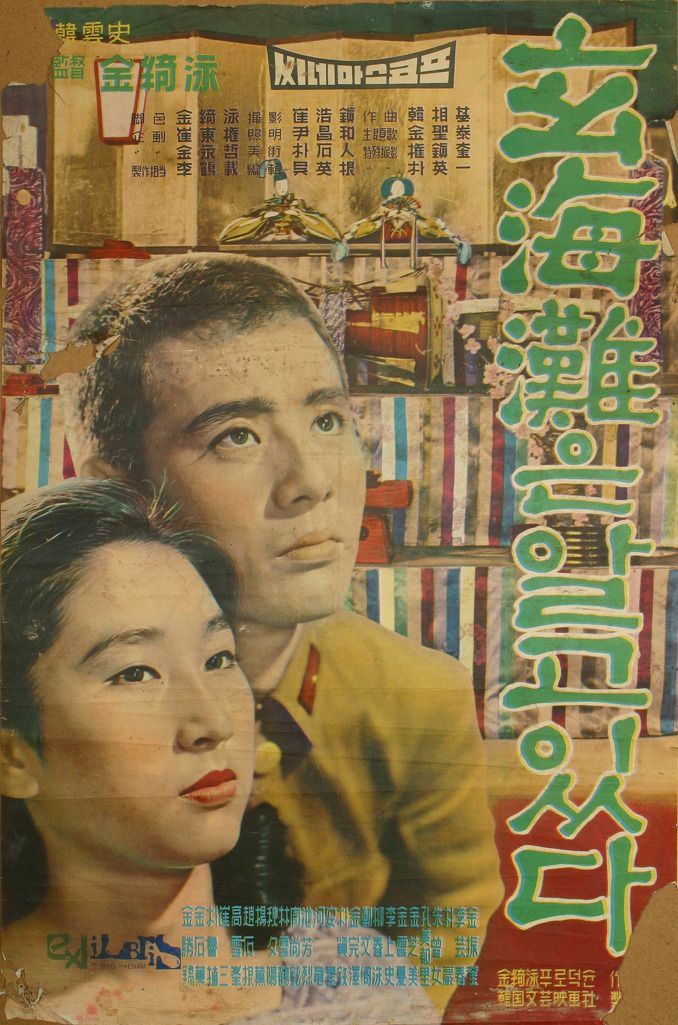
The Sea Knows posterThe Korea of 1961 was a land in flux. The corrupt regime of Rhee Syngman had been brought to its knees following mass protests regarding the rigged 1960 elections but hopes for a new democracy were cut short when military General Park Chung-hee staged a coup, later declaring himself president for life and continuing his authoritarian rule until he was assassinated by one of his own subordinates. Kim Ki-young’s The Sea Knows (玄海灘은 알고 있다 / 현해탄은 알고 있다, Hyeonhaetaneun Algoitta) arrived perhaps at just the right time, ducking under the radar before the Motion Picture Law of 1962 would forever change the industry and if not prevent at least frustrate any attempt to discuss the controversial themes at the heart of Kim’s drama. The Sea Knows is, like much of Kim’s work, a tale of power and desire only this time on a wider scale as he examines the complicated relationship between Korea and Japan as mediated through romantic melodrama.

We open in 1944. Korean student Aro-un (Kim Wun-ha) has been conscripted into the Japanese army following an incident in which he embarrassed a high-ranking official (something which has made him a local hero at home). Despite the fact that Korea has been inducted into the Japanese empire and Koreans are now sons of the emperor too, the regular Japanese troops are not exactly grateful for service of their brethren from across the sea. Koreans are a pain, they decry. They’re always going on about justice and fairness. They won’t just shut up and take their lumps like regular Japanese soldiers. The “50 year tradition” of the Japanese army is to break the will of new recruits through violence, strip them of their individuality, and reduce them to a finely tuned hive mind.

Needless to say, Aro-un is not eager to comply. There’s a strong strain of homoeroticism in the strangely camp banter between the higher-ups. At the first inspection the commanding officer takes a good look at Aro-un, decides he resembles a “cute puppy” and recommends he come to his room to get some “biscuits”. Meanwhile a particularly sadistic NCO, Mori (Lee Ye-chun), pinches the chest of Aro-run’s judo champion friend Inoue (Lee Sang-sa) and decides he’ll not be an easy target – unlike the short and wiry Aro-un who is too righteous to know what’s good for him. Mori, an insecure and under qualified NCO, makes use of men like Aro-un to entrench his own position through the “50 year tradition” of military discipline. The humiliations mount until Aro-un is forced to lick Mori’s excrement encrusted boots in punishment for having failed to polish them to his satisfaction.

Yet, unlike in the majority of Korean films dealing with war and occupation, the Japanese are not universally bad – there are many just like Aro-un who are uncomfortable with the militarist line and are doing what they can to resist, albeit often passively. Aro-un’s university friend, Nakamura (Kim Jin-kyu), is just such a man, turning down the possibilities of promotion to avoid endorsing the regime while acknowledging that there is little more he can do to free himself from it. It’s through Nakamura that Aro-un meets his own source of salvation in the unlikely figure of a young Japanese woman – Nakamura’s sister Hideko (Gong Midori). Hideko originally betrays the common prejudice against Koreans in claiming that the perpetrators of a nearby robbery were most likely Korean seeing as Koreans can’t get jobs and therefore have no other options than to steal, though in retrospect perhaps her assertions were a more logical comment on poverty and entrenched oppression than they were on racial stereotyping.

Hideko is, as Aro-un later points out, a very unusual Japanese woman. A free spirit, she finds herself drawn to Aro-un and is committed to pursuing a course of true feeling over that laid down by the codes of her society, choosing his sensitivity over the brutalisation of her militarist nation. War, Aro-un muses philosophically, is about the manipulation of the present. Love is about the foundation of a future. Yet there is also something dark and imbalanced even in their otherwise pure romance as each finds themselves becoming a symbol of suffering and violence. Aro-un is drawn to Hideko’s unexpected warmth as she sheds tears for his suffering on hearing of his various degradations, seeing no difference in the tears of a Japanese woman and those of his Korean mother who each felt his pain as their own, but Hideko’s insistence on hearing of his latest humiliations almost takes on a sadistic quality as the pair become bound by suffering as much as by innocent connection.

Kim’s central tenet is a bold one for the increasingly volatile world of 1961, making a case for borderless connection over nationalistic chest thumping and championing the resilience of the human spirit as well as the enduring power of love as a counter to the horrors of war. War is, in another of Aro-un’s philosophical musings, just something that happens to you and makes enemies of those who might have been friends. Making extensive use of stock footage and model shots, Kim plunges Aro-un into a fiery hell from which only love and will can save him. An unexpectedly nuanced but no less harrowing tale of wartime brutalisation and spiritual resistance, The Sea Knows is an impassioned plea for humanity in an inhumane age in which there are no heroes and no villains, only victims and resistors caught in a vast web of power and madness.


The Sea Knows was screened as part of the Korean Cultural Centre’s Korean Film Nights 2018: Rebels with a Cause series. You can also watch it online for free courtesy of the Korean Film Archive’s YouTube channel. The existing print is, however, incomplete and badly damaged – four sequences in which there is picture but no sound or sound but no picture are missing / unsubtitled in the online version but are present in the restoration.