Many Happy Returns (教祖誕生, Toshihiro Tenma, 1993)

Cults, or “new religion” organisations as they’re euphemistically known, proliferated in Japan after the war. Though people may have joined them out of loneliness in search of new families or communities, the numbers only seemed to increase in the era of high prosperity as a sense of spiritual emptiness countered the age of consumerism. Coming in 1993 and based on Takeshi Kitano’s own novel, Many Happy Returns Toshihiro Tenma’s (教祖誕生, Kyoso Tanjo) approaches the issue with a genial humour that likely became impossible two years later with the involvement of Aum in the Tokyo subway attack.

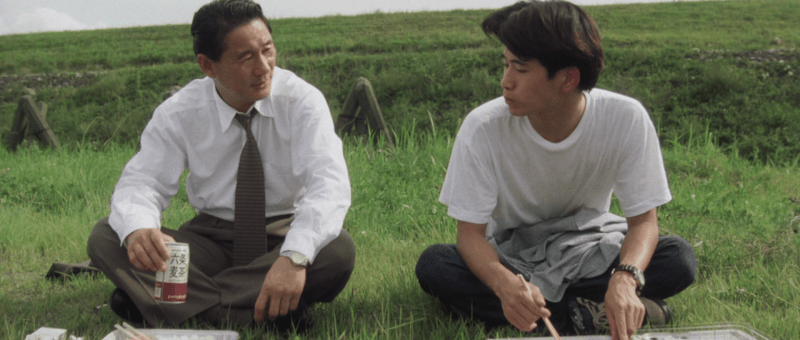
Kazuo (Masato Hagiwara), a wandering young man, asks himself why people join join cults while insisting that all looks so fake but later becomes fascinated with them himself. He can tell that the elderly woman who can suddenly walk again after an encounter with the leader (Masami Shimojo) is probably a plant, but is intrigued rather than outraged. Shiba (Takeshi Kitano), the actual “leader” of the group, tells him that it doesn’t matter. The leader healed the lady before at some point in the past, and they’re just reenacting it to show the power of god, which doesn’t really make sense, but it seems to satisfy Kazuo for the moment. 

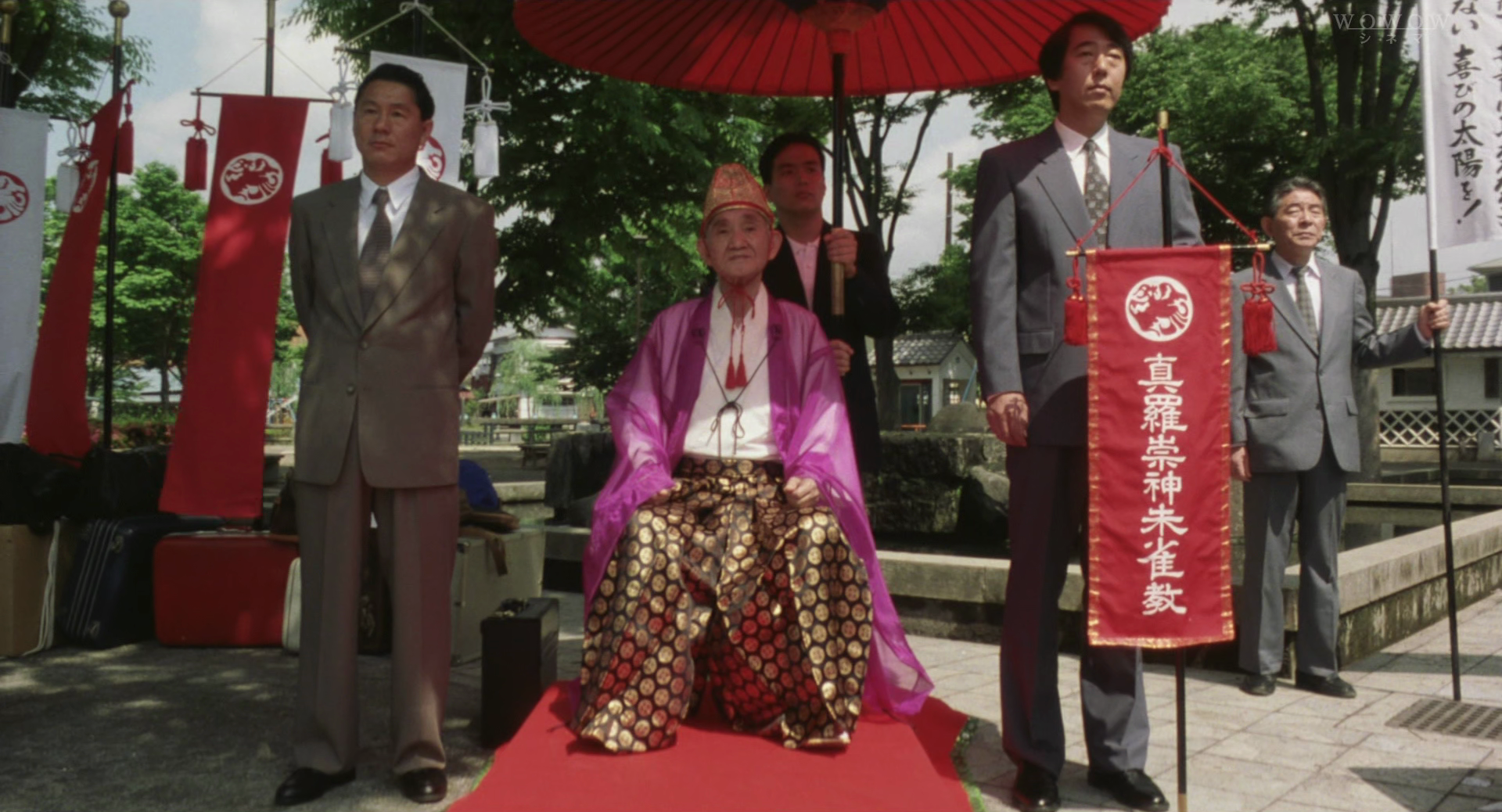
Of course, Shiba and Go (Ittoku Kishibe) are just a pair of yakuza types running a religious cult as a business to fleece money out of vulnerable people in the countryside by making them think their leader can make all their problems better. The only thing is, Shiba and Go seem to be the only ones who know it’s all fake while current leader has started to believe that he actually has real healing powers despite using an electricity generator to create the sparks of energy flying from his hands during his healing sessions. Though the old lady in a wheelchair is a plant, the leader sometimes agrees to heal other people who request it, which could end up backfiring if Shiba can’t find a way to fake the miracle.

After becoming alarmed that the Leader is too into his religious speeches and has fallen victim to his own patter despite obviously knowing that it’s all made up, Shiba and Go pay him to leave the cult but are then left with a dilemma over how to appoint a successor. Komamura (Koji Tamaki), who’d tried to undermine Shiba’s leadership, is a religious zealot who joined the cult to be closer to god. He objects to Shiba’s godless ways, and while Shiba briefly considers making him the leader to keep him quiet, ends up appointing Kazuo who only recently started tagging along with the cult.

Though Kazuo was originally only interested in the cult precisely because it was fake, once he becomes the leader he starts to think it’s real too. He takes his responsibilities seriously, which means of course that he threatens Shiba’s position and is torn between the real nature of cult which he knows to be a cynical way of making money by exploiting vulnerable people, and the genuine religiosity of Komamura. To look the part and boost his confidence, he starts undertaking ascetic practices such as bathing in waterfalls and going on long, isolated retreats during which he also fasts. Shiba and Go, meanwhile, stuff their faces at a local Chinese restaurant in an orgy of consumerism.

Kazuo asks Shiba if the believes in god, but Shiba counters him by asking what his idea of “god” is. Kazuo believes that “god” heals the sick and helps those in trouble, but Shiba points out that that’s never actually happened, while at least their made-up religion helped some people, so in a way it’s more godlike than actual god. In any case, Shiba’s god is probably consumerism, but unlike Go it seems he has a degree of uncertainty and entertains the possibility that some kind of god really exists and will punish him for his wrongdoing and lack of faith. When he is attacked and ends up killing someone, Kazuo tells him that it’s his punishment for denying god and chasing after money which Shiba eventually concedes to be true. Nevertheless, the closing scenes find him starting again by reuniting with the previous leader, now dressed as a catholic priest, to offer the same patter about healing miracles while warning about false cults and fake religions. Kazuo, meanwhile, has fully accepted the role of an emissary of god by kicking out Go for not taking the religion seriously while preparing to meet his own apotheosis in a sold out show attended by people who, like he once was, are spiritually lost and ironically looking for something that means more than money in this increasingly empty society.


Trailer (no subtitles)
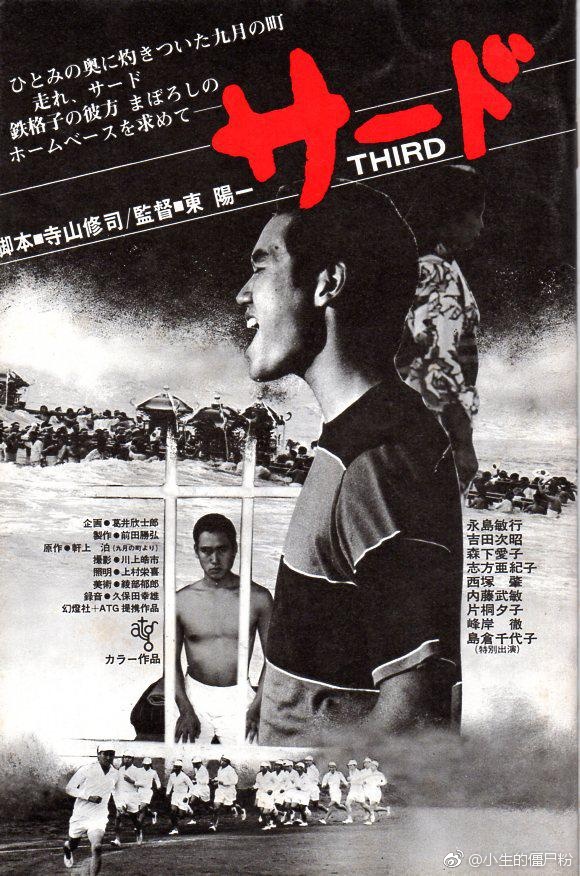
Third Base (サード, Yoichi Higashi, 1978)

third posterJapanese cinema of the 1970s is a highly charged affair. Stories of alienated youth and nihilistic denials of future possibility predominate as the (usually) male protagonist assesses his place within a rigid and conformist society and often comes to the conclusion that there is none for him. While political turmoil continues to undermine these deeply held values of social conformity and passive acceptance, young men suffer individually and in private until, that is, they find themselves punished by society for the transgressions it causes them to commit. Scripted by Shuji Terayama and adapted from a novel by Haku Kenjo, Yoichi Higashi’s Third Base (サード, Third) is the story of one such young man who has found himself confined to a reformatory with no hope for the future and no direction in which to run.

Seno (Toshiyuki Nagashima), known as “Third”, is an inmate at Kanto – Asahi Reform School. Like most of the other boys, Third is in for violent crime – in his case, murder, and is not exactly a model pupil. In fact, he’s currently in solitary after fighting with another boy who spat in his soup. Though the atmosphere of the school is severe with an emphasis on slightly militarised discipline, it is also progressive and geared towards finding out why these young men came to exhibit such unwelcome behaviours and how they might be able to overcome them. Hence, the fight is not only punished with solitary confinement but a group discussion among all present during which both Seno and the other boy are encouraged to recognise the various ways in which they are both at fault.

A strange thought experiment in Seno’s diary causes mild alarm to one of the staff at the school. “The connection between a car and a spring – which goes around more?” – the doctor is confused by this unusual sentence but on being asked to elaborate Seno makes clear he’s talking about a wind up car. When you wind it up the wheels go round but if you hold the spring the car will turn, and if you hold the car the spring will turn. This is the relationship Seno was puzzled by – which one is turning the other. The doctor draws the conclusion that the “spring” is juvenile delinquency and the car is society, but Seno insists he’s just talking about a toy car.

Yet there is something in it. Some of the boys are inside because of economic oppression, entering lives of crime through lack of other options but there are also upperclass boys in here too who have never been hungry and have no reason to steal. Another of the staff tells a disinterested Third about a relative of his who ended up in a reform school despite coming from an “elite” home. The boy claims he rebelled because “there is no such thing as equality – it is simply a word to make people feel better”. His crimes were intended to expose a societal lie. Likewise, the boy turned the same logic on murder claiming that wars and genocide were abhorrent, but individualist murders were “beautiful”. A short while later the young man took his own life – presumably something the reform school staff are eager Third does not do.

Suicide is a choice which is presented to Third – when one of the other boys runs off during outdoor labour, he hangs himself in the woods rather than try to escape. Third’s nickname is inspired by his position on the baseball field – third base, which he says he played neither well or badly. It is also an ironic comment on his existence in which he is neither one thing nor another, at odds in the free world and among those other outsiders imprisoned in the reformatory. Yet suicide is an idea Third rejects. Considering the other boy’s fate, Third feels himself to be running in “another direction”, wanting to live but not knowing how. A recurrent dream finds him on the baseball field, running the bases only to find there is no home plate. What Third wants is to locate his home base, to finally find his place in the world where he can belong and be accepted, but until he knows where it is he’ll just be running without aim or purpose.

Running in his mind, Third is imprisoned but only through his confinement does he learn to find the world “beautiful”. His cellmate has a similar thought but confesses he’s begun to find his hope “boring”, that freedom only inspires hopelessness. It’s this sense of ennui and apathy which pushes these young men towards violence and frustration, unable to find a more productive way to propel themselves forward and getting stuck at the bottom of the pile in a society which tries to straightjacket them into lives which are both undesirable and unattainable. Running still, Third does seem to have found a potential solution in instructing his breathless running mate to move at his own pace – embracing individualism over social conformity. Nevertheless, home base seems an elusive destination and Third will be a longtime running if ever he really does find his place in an essentially uncaring society.


Original trailer (no subtitles)