

According to an undertaker in Noriko Yuasa’s darkly comic drama Performing Kaoru’s Funeral (カオルの葬式, Kaoru no Ososhiki) death is a kind of natural disaster. Despite the sometimes farcical going ons at this particular funeral, he does indeed have point in the sense of inevitable tragedy that the colours events as a dejected middle-aged man attempts to clarify his memories while overseeing the funeral of a woman he was once married to but evidently had not seen in many years.
To this extent, as the title says, Jun is “performing” Kaoru’s funeral though perhaps it’s true enough that there’s always an degree of performance in involved. As Kaoru’s young daughter, also named Kaoru, says, no one here believes in god or Buddha and this ritualised mourning process doesn’t seem to be helping her process her grief. From time to time, Yuasa cuts back to a Bruegel-esque image of a painting of hell complete with demons staring pots with people in boiling water suggesting that this too is a kind of purgatorial hellscape.
Suddenly tasked with MCing his former wife’s funeral Jun takes it with good grace if also a little confusion. Guests mainly seem to be using it as an opportunity to vent their dissatisfaction or settle old grievances. The atmosphere is strange, somehow fraught and otherworldly while the other guests seem to treat Jun as an interloper never really considering that he may be grieving too. The ritualised act of performing the funeral causes him to remember his married life along with the woman who seems to have remained an enigma to him and may have done so to everyone.
Once an aspiring actor, Jun is now a defeated figure employed as a driver for girls working at a Soapland. Before receiving the call about the funeral he’s beaten up by a pair of gangsters after intervening when one of them tried to assault the girl he was driving. Presented in a boxy square, Jun’s flashback memories have an unreal quality as if his marriage was a kind of fairytale or a dream he was woken from too soon. Kaoru’s decision to make him the chief mourner at her funeral may in a sense have been ironic, a final acknowledgement of the role he played in her life but also grants him a valuable opportunity to set the past to rest and perhaps begin to move on.
For some of the other guests, however, that doesn’t quite seem to be the case. Some lie about their relationship with Kaoru or else cause unexpected trouble in venting a petty grievance. A rival screenwriter turns up to get drunk and make catty remarks, while a middle-aged man also uses the occasion to lay into his daughter-in-law with a lengthy misogynistic rant about his unmanly son’s inability to manage his wife. Little Kaoru seems largely left on her own, expected to carry out these rituals while grieving for her mother with no real support. A small subplot revolves around the potential candidates for her father, but none of them, bar perhaps Indonesian restaurant owner Wayan and Jun himself who claims she cannot be his pays much attention to her.
After opening with a grim scene of Kaoru on the slab, much the action is accompained by the urgent sound of something ticking as if marking out the passage of time while lending a sense of urgency to something that is no longer really urgent. Brought together by her deaths, the guests each have their own relationship with the deceased and like Jun and little Kaoru perhaps begin to process their grief and move step forward though in other ways also the opposite in one’s near literal inability to let go. The girl Jun had been escorting found an abandoned urn on the train and took it home with a kind of perverse delight musing on the reasons someone might leave their urn behind. In a way, that’s what Jun is trying to do, let his past drift away, Kaoru somehow setting him free to start living his life again after he sees her off. As the screenwriter said every script has to have a moment of catharsis and Yuasa’s tragicomic tale does indeed have its share of melancholy poignancy but ends on a bittersweet note of thank you and farewell as Jun and little Kaoru sail off into a new future having laid the past to rest.
Performing Kaoru’s Funeral screened as part of this year’s Osaka Asian Film Festival.
Original trailer (English subtitles)
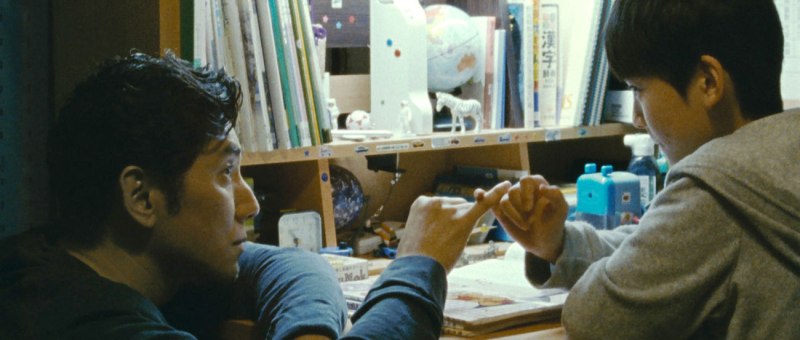
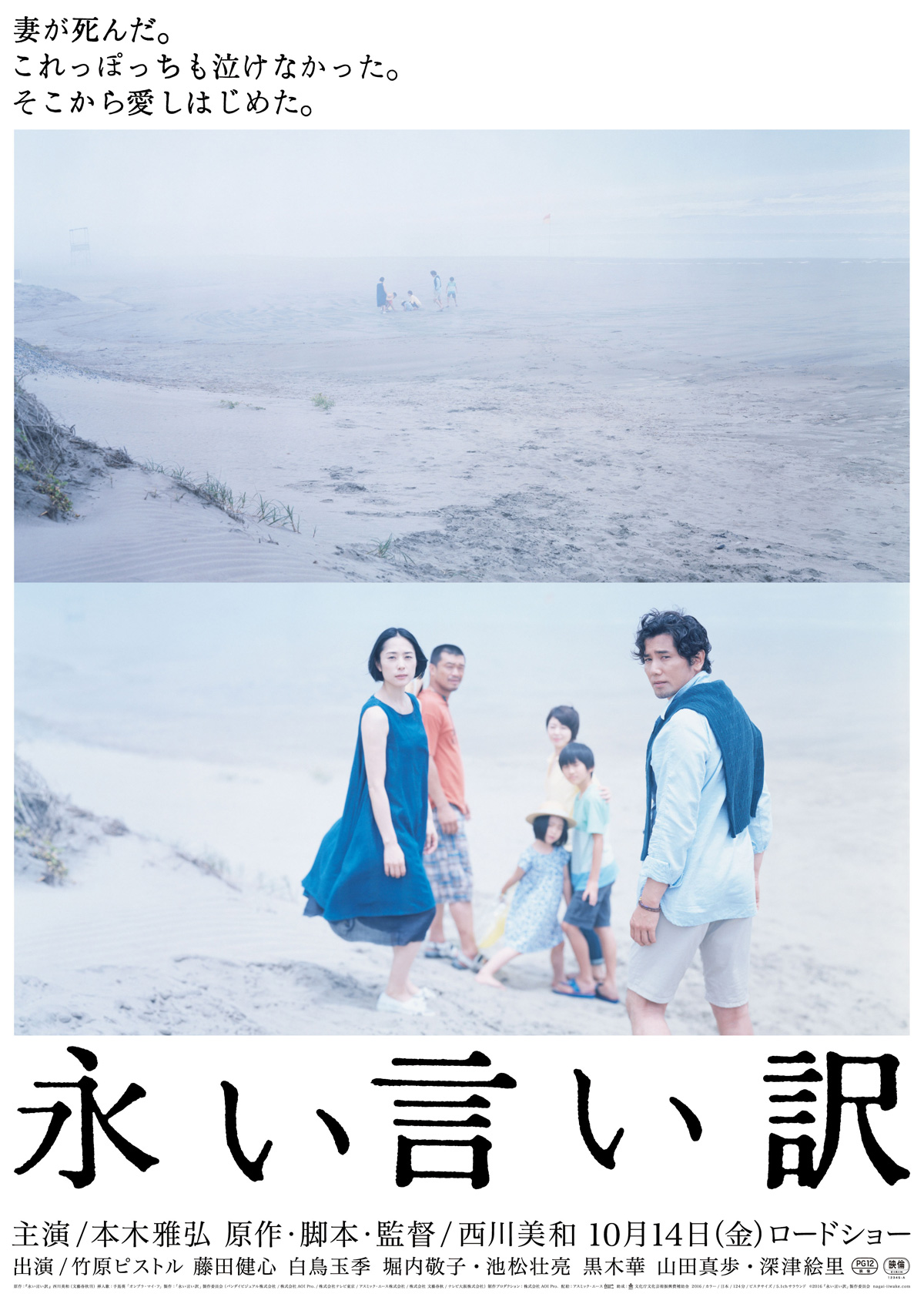 Self disgust is self obsession as the old adage goes. It certainly seems to ring true for the “hero” of Miwa Nishikawa’s latest feature, The Long Excuse (永い言い訳, Nagai Iiwake) , in which she adapts her own Naoki Prize nominated novel. In part inspired by the devastating earthquake which struck Japan in March 2011, The Long Excuse is a tale of grief deferred but also one of redemption and self recognition as this same refusal to grieve forces a self-centred novelist to remember that other people also exist in the world and have their own lives, emotions, and broken futures to dwell on.
 Windows on Worlds