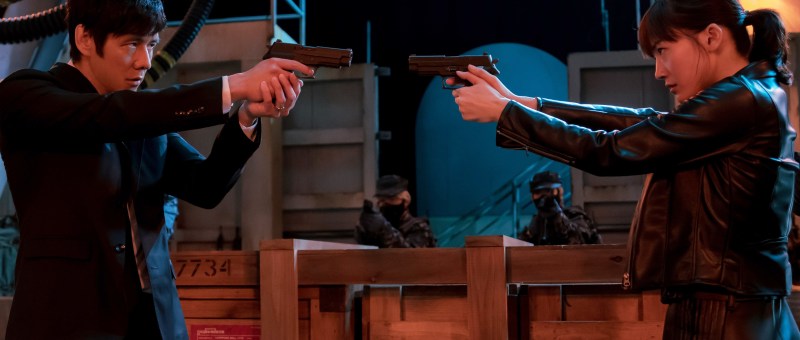
(Ab)normal Desire (正欲, Yoshiyuki Kishi, 2023)

There’s a pun embedded in the Japanese title of Yoshiyuki Kishi’s heartfelt drama (Ab)normal Desire in that first character in the word for “sexual desire” (seiyoku, 性欲) has been replaced by one that can be read the same but has the meaning of “correct”, or “proper”. But “normal” is also relative construct that implies conformance with the majority even if that may not actually be the case. As one of the protagonists later remarks “everyone is pervy” though they themselves feel such a degree of shame and otherness that it’s largely prevented them from living any kind of life at all.

In that sense it may be hard to understand why a fetish for water would invite such severe self-loathing in that it causes no harm to others if admittedly resulting in ridicule if exposed. Then again, society can be a fierce watchdog. Department store shop assistant Natsuki (Yui Aragaki) is taken to task by her pregnant colleague who refuses to take her seriously when she says she’s not really interested in getting a boyfriend before giving her a lecture about her biological clock. Though Natsuki appears uninterested in her vacant prattling, the woman later becomes upset and harshly tells her that she was only trying to be “nice” because she felt “sorry” for her and that making people be nice to you in this way is actually a form of harassment which, whichever way you look at it, is some particularly twisted logic.

Her alienation seems to stem from the fact that she feels “abnormal” and that her fetish for water is a part of herself she must be careful to hide. Her parents watch a news report on Tokyo Rainbow Pride and marvel at the idea that there are now choices other than marriage and children but even among the young there remains confusion and shame amid an inability to reconcile the seemingly opposing concepts of “normality” and “diversity” as they struggle to define themselves. A plan to have a male dancer who usually dances in a masculine style dance in a more feminine way backfires when he points out that asking someone to dance in a way they don’t want to doesn’t really do much to advance “diversity”.

But diversity isn’t considered an ideal by all and parents of young children find themselves confused and conflicted when their kids begin to reject conventionality at an early age by asking to withdraw themselves from school and instead focus on other kinds of education that align with their interests. Challenged by his wife about why he never listens to their son’s concerns, prosecutor Hiroki (Goro Inagaki) replies that he should “just be normal” and later describes people who are “unable to live normal lives” as bugs in the system which must eradicated. A symbol of lingering authoritarianism, Hiroki is an intensely conservative man obsessed with properness who thinks it’s his job to decide which crimes everyone is guilty of rather than make any attempt to understand the world around him outside of binary terms like right and wrong or normal and abnormal. When his assistant passes him information on fetishes as a potential explanation for the case of a man who repeatedly steals taps, he simply rolls his eyes and dismisses it.

Yet he perhaps has his own fears and internalised shame as evidenced by his outrage on discovering that another man has been coming to the house to help his wife with tech setup for their son’s new outlet in livestreaming and not only that, he was able to blow up the balloons that Hiroki himself failed to inflate. It’s his rigid authoritarianism that eventually alienates his wife and son who come to see him only as an oppressive bully unable to accept anything that differs from his own definition of “normal”. Finally, he’s the one who is isolated, imprisoned by his own repression and lack of understanding or unwillingness to accept those around him.

Even so, despite its positive messages that no one should feel themselves alone or that society has no place for them the film muddies the waters by introducing fetishes that are necessarily problematic in that they cause harm to others who do not or cannot consent and could not and should not be accepted by mainstream society though oddly those that have them seem to feel less shame only fearing being caught because acting on their desires is against both moral and judicial laws. In any case, in discovering togetherness, that they are not alone, those who feel their desires to be “abnormal” can begin to ease their loneliness and find a place for themselves in an often judgemental world.


(Ab)normal Desire screened as part of this year’s Toronto Japanese Film Festival.

Original trailer (English subtitles)
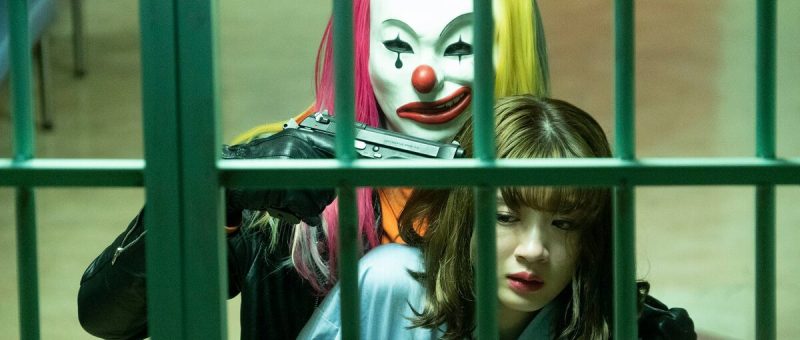
Masked Ward (仮面病棟, Hisashi Kimura, 2020)

“This hospital is…abnormal” according to locum doctor Hayami (Kentaro Sakaguchi) as he begins to discover dark goings on while trapped in a former psychiatric home after being taken hostage by a man in a clown mask. Based on the medical mystery novel by Mikito Chinen, Masked Ward (仮面病棟, Kamen Byoto) is partly a meditation on guilt and grief and partly an attack on backroom eugenics in an often judgemental and potentially corrupt society, if wrapped up in a wilfully silly B-movie crime thriller. 

Still on a temporary sabbatical following a bereavement, Dr. Hayami is recruited by an old friend, Kosakai (Ryohei Ohtani), to cover a night shift at a long term care hospital mostly catering to patients living with dementia. It has to be said the hospital itself has an instantly creepy aura, the police who later arrive describing it as looking like a prison which is apt because no one ever thought to remove the bars from the interior intended to keep “dangerous” patients from escaping. Even so, Hayami is repeatedly assured that nothing ever happens here and most likely he won’t need to come out of his room. Unfortunately that proves to be bad advice because not long after he settles in, a man in a clown mask turns up with a young woman he apparently himself shot but now wants patched up thereafter taking everyone present hostage while hiding out from police who have instituted a manhunt after he robbed a convenience store at gunpoint. 

You’d have to admit it looks a bit suspicious that all of this happened the very night that Hayami is in charge, especially as it’s suggested he may bear a grudge towards head doctor Tadokoro (Masanobu Takashima) as he was the one who refused to admit Hayami’s late girlfriend Yoko (Izumi Fujimoto) who was killed in a car accident in which Hayami was driving. Then again, as Hayami says, what would be the point in that? Suffering frequent flashbacks he subconsciously links the young woman, Hitomi (Mei Nagano), with Yoko determined in a sense to save her instead while trying to figure out what exactly is going on in this very weird medical institution and what the clown is trying to achieve with his random siege. 

The creepiness of the hospital is already well established with its former psychiatric institution vibes, something only enhanced on the discovery of an apparently disused operating theatre which is no grimy basement filled with rusty equipment but appears to have been refurbished recently and is sparklingly clean. It doesn’t really take a genius to figure out what’s been going on in there or why evil head doctor Tadokoro doesn’t want to call the police, but it does call into question not just his own ethics but those of the wider medical profession as he advances a series of eugenicist justifications for his decisions insisting that some lives are not worth saving while those of the elite who “can’t bear to wait” obviously are. Many of those in their beds have no names, taking those only of the area in which they were found supposedly with no identification, and are receiving only basic care otherwise forgotten by an indifferent society while hypocritical politicians offer platitudes about equality, superficially insisting that every citizen should have the right to live, to be protected, and to have a future.  

Even so Kimura can’t quite decide how seriously he wants to treat the darkness at the film’s centre, embracing the outlandishness of the material through a series of B-movie cliches from eerie handheld photography in the creepiness of the of the empty hospital corridors to literal lightning effects and foreshadowing so heavy it almost feels ironic. Yet the tone is at the same time earnest and slightly naive, the police apparently minded to cover the whole thing up due to pressure from above while Hayami is otherwise free to blow the whistle by getting the media involved with a press conference beamed directly onto a big inner-city screen in the middle of a presidential campaign speech all of which seems faintly unlikely given how far they were prepared to go keep the conspiracy secret while one wonders if he’d really be able to get so much attention so quickly even having recovered the secret documents proving his claims are true. In any case, his speech is only really intended for an audience of one as he says pretty much the same thing as the duplicitous politician only he really means it while urging those who’ve been irreparably harmed to give up their hate and try to move on sharing feelings and hopes rather than anger and resentment which is a nice message but perhaps also not especially helpful in holding those who’ve misused their power to account. 


Masked Ward streams until 27th February in several territories as part of Japanese Film Festival Online 2022.

Original trailer (English sutbtitles)

Caution, Hazardous Wife: The Movie (奥様は、取り扱い注意, Toya Sato, 2021) [Fantasia 2021]

Perhaps in some ways out of step with the times, the 2017 Nippon TV drama Caution, Hazardous Wife (奥様は、取り扱い注意, Okusama wa, Toriatsukai Chui), like the earlier Secret Agent Erika, saw top assassin Nami (Haruka Ayase) fake her own death in order to live a “normal” life as an “ordinary housewife” married to “boring salaryman” Yuki (Hidetoshi Nishijima). Nami could not however resist using her skills for good and bravely took on a local yakuza gang who’d been running a suburban prostitution ring through employing handsome gigolos to seduce emotionally neglected housewives and thereafter blackmailing them into sex work. The series ended on a cliffhanger in which, spoiler alert, Nami was confronted by her husband who turned out to be a Public Security Bureau officer originally tasked with monitoring her before genuinely falling in love.

This brief background recap is useful but not strictly necessary in approaching the series’ big screen incarnation, Caution, Hazardous Wife: The Movie, which ironically assumes the audience knows Nami’s secret backstory but also obfuscates it in picking up 18 months after the cliffhanger to find her now living as “Kumi” in a tranquil seaside town having apparently lost her memory. The town will not remain tranquil for long, however, as a mayoral race is about to bring tensions to the fore in the polarising issue of a prospective methane hydrate plant the authorities insist is necessary to revive the area’s moribund economy while others worry about industrial pollution and its effects on the local sea life. Unsurprisingly, the events will turn out to have a connection to Nami’s past while she struggles to regain her lost memories and preserve the peaceful, ordinary life with her husband which is all she’s ever really wanted. 

Though some might find it somewhat conservative that what Nami wants is to become a conventional housewife, what she’s looking for is the stability of the “normal” life she’s never known. As such, she may not actually want to regain her memories, preferring to go on living as Kumi who has perfected the housewife skills which so eluded Nami including becoming a top cook, for as long as possible. Yuki, meanwhile, now living as high school teacher Yuji, feels something similar having been ordered to “deal with” his wife if she remembers who she is but refuses to become a PSB asset. 

Upping production values from the TV drama, Sato keeps Nami in the dark for as long as possible though her sense of social responsibility remains just as strong as she bravely intervenes when coming across a gang of teens taunting a boy with homophobic slurs for having a pink coin curse, later becoming concerned on witnessing the leader of the opposition to the plant being attacked by thugs in an attempt to intimidate him out of his decision to stand as a rival candidate to the incumbent mayor. Nevertheless, he allows space for plenty of dramatic action scenes including flashbacks to Nami’s career as an international assassin while the final set piece also throws in some bickering marital comedy before turning unexpectedly dark.  

Regaining her memories, Nami’s inner conflict is in her complicated relationship with Yuki wondering if he ever really loved the “real” her or if he perhaps preferred Kumi the docile Stepford wife, which is ironically the cover identity she’d longed to construct. Conflicted and suspecting his wife may have remembered who she really is, Yuki tells her to forget about the past but also that his feelings won’t change and she should be free to be herself but as Nami later realises the past won’t let her go and the peaceful life she’d dreamed of might be harder to preserve than she’d previously thought even as she commits herself to embracing the life she has now because her relationship with Yuki is the most important thing to her despite her lingering doubt. 

Touching on a few hot button issues from industrial pollution and environmental concerns to economic decline and rural depopulation, Sato nevertheless returns to the outlandish absurdity of the TV drama as Nami finds herself facing off against Russian gangsters while exposing a plot by shady conglomerates to exploit a small-town desire for better access to jobs and infrastructure, along with judicial corruption and electoral interference. Nevertheless, the hometown spirit eventually wins out even if Nami finds herself on the run once again though having gained a little more emotional clarity. 


Caution, Hazardous Wife: The Movie streamed as part of this year’s Fantasia International Film Festival. The original TV series is also available to stream with English subtitles (along with those in several other languages) in many territories via Viki.

International trailer (English subtitles)