Every Trick In The Book (鳩の撃退法, Hideta Takahata, 2021)

A down on his luck writer finds himself at the centre of a mystery only how much is truth and how much “fiction”? Based on the novel by Shogo Sato, Hideta Takahata’s Every Trick in the Book (鳩の撃退法, Hato no gekitai-ho) ponders the possibilities of literature as the hero seems to create a fictional world around him in which it is largely unclear whether he is solving a real world mystery or simply imagining one based on his impressions of the strange characters he encounters through the course of his everyday life.

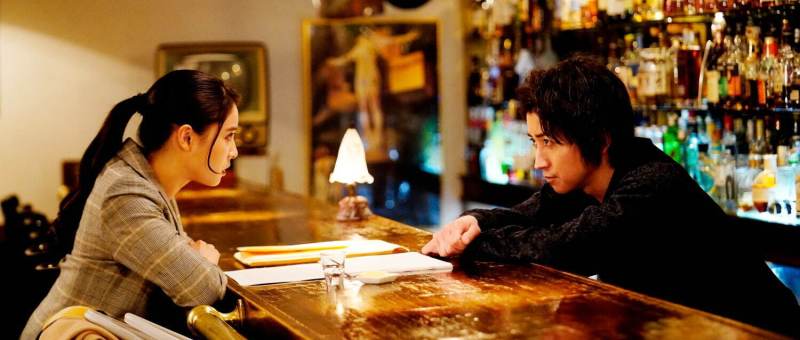
That everyday life is however eventful just in itself. Tsuda (Tatsuya Fujiwara) once won a prestigious literary prize and was destined to become a popular author but hasn’t written anything of note for some time and in fact now largely works as a driver ferrying sex workers around on behalf of his shady boss. The mystery begins when he approaches a man, a rare solo reader in an overnight cafe, and promises to lend him a copy of Peter and Wendy by JM Barrie only to later discover that the man went missing along with his wife and the daughter he had explained was fathered by another man. 

Like many of his subsequent encounters it isn’t entirely clear if this meeting really took place or at least as Tsuda said it did or is only part of the novel he is beginning to write. The man, Hideyoshi (Shunsuke Kazama), asks him if it’s a novelist’s habit to begin imagining backstories for everyone he sets eyes on and there may well be some of that even as Tsuda is fond of claiming that amazing things happen around us every day to which we are mostly oblivious. Still, Tsuda probably didn’t expect to be pulled into the orbit of local gangster Kurata (Etsushi Toyokawa) after accidentally passing on counterfeit currency he found by chance. It’s true that most of what’s happening to him is the result of a series of bizarre coincidences or cosmic confluence which has accidentally united this collection of people in an unintended mystery which Tsuda intends to solve in either literal or literary terms. 

“It’s all a novelist can do” he later claims in trying to write a better ending for “characters” he has come to like than the one he assumes they “actually” met. But then his editor Nahomi (Tao Tsuchiya) chief worry is that, like his previous novel, Tsuda’s story will contain too much of the “literal” truth which could cause his publishers some legal problems. Part of the reason Tsuda left the industry is apparently because his last book was inspired by a real life affair which was then considered somewhat hurtful and defamatory. For that reason it comes as quite a blow to Nahomi as she begins to investigate and discovers that much of Tsuda’s story lines up with “real” places and events, but then again as he says if you can draw connections between known facts then you begin to see a “hidden” truth which may in its own way be merely his invention. 

The film’s Japanese title translates more literally as something like “how to fend off a dove” which does indeed have its share of irony especially considering the meaning the dove symbolism turns out to have in the film but perhaps also hints at the essential absurdity of trying to fight back against something that is otherwise harmless and in fact represents peace. Tsuda may be onto something and nothing, embracing the bizarre serendipity of a writer’s life while trying to recover his creative mojo but embellishing it with more danger and strangeness than it actually has to offer. Then again as his editor discovers, there really is an incinerator it seems anyone can just walk up and use to burn whatever they want including dead bodies, while people in general are full of duplicities all of which keeps the “fake” money circulating as people use it to try to buy things that can’t really be bought. Hideyoshi calls them “miracles”, embracing the strange serendipity of his life as an orphan longing for a family to call his own and unexpectedly finding one which is “real” in someways and “fiction” and in others. Then again, if you believe in something does it really matter if it’s “real” or not? Hideyoshi and Tsuda might say it doesn’t, the publishing company’s lawyers might feel differently, but it seems there really are amazing things going on around us every day if only you stop to look. 


Original trailer (English subtitles)

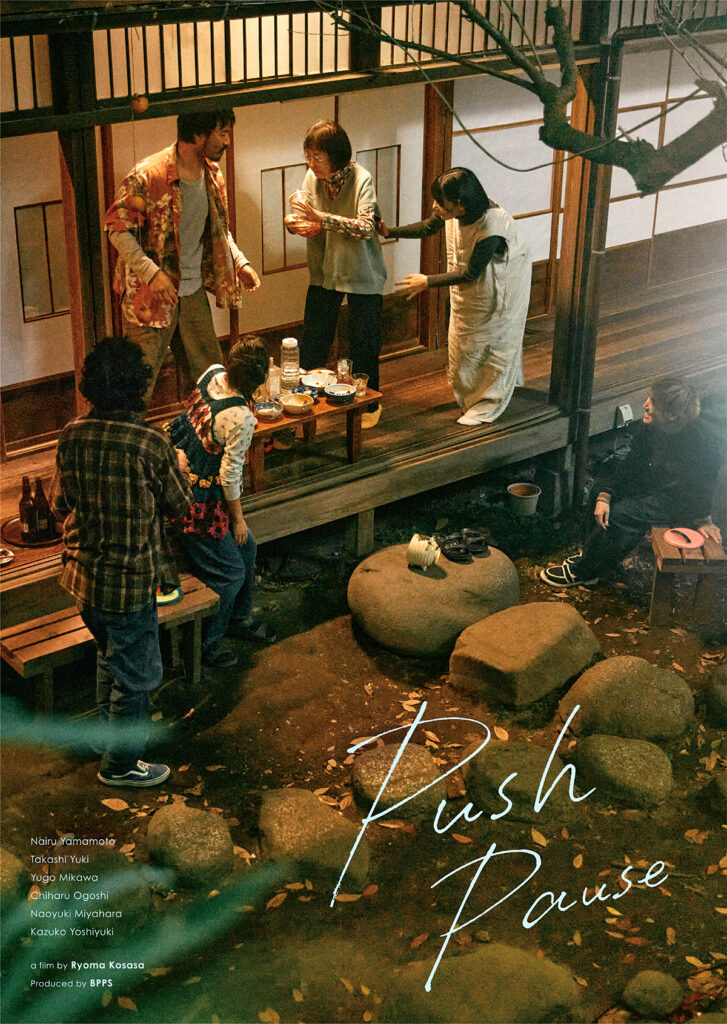
Push Pause (ココでのはなし, Ryoma Kosasa, 2023)

A small hotel becomes a refuge for those “struggling with the everyday” according to live-in helper Utako in Ryoma Kosasa’s heartwarming drama, Push Pause (ココでのはなし, Kokoro de no Hanashi). As she said, most of their customers are there because they’re uncertain of something and looking to take take some time out for reflection, much as she is while otherwise taking advantage of the tranquil and unjudgemental space of the inn along with the comfort it offers.

Guest House Coco is however suffering too amid the post-pandemic decline in custom. Th owner Hirofumi, attempts to sell his bike to pick up some extra cash only to discover it worth much less than he thought. The first of their guests, Tamotsu, is struggling for similar reasons seeing as the owner of the batting cages where he works is considering closing down as customers continue to stay away leaving him floundering for new direction. Helping an old friend move brings him into contact with someone he worked with for the Paralympics, but it only seems to fuel his sense of insecurity reflecting that unlike his friend he has no talents or ambitions and isn’t sure he wants to return to work for with him because it only makes him feel bad.

For Xiaolu, meanwhile, she’s dealing with issues as of a different order while house hunting in Tokyo ahead of a job transfer. Though her colleague had agreed to help her, he suddenly tells her he’d rather she didn’t come mostly it seems because he’s afraid she’ll expose him as an otaku thanks to their shared love of anime and people in the office will make fun of him. But then he also drops in that most of his colleagues are subtly racist, even insensitively adding that Xiaolu doesn’t “look Chinese” on first glance especially as her Japanese is so good unwittingly exposing his own latent prejudice. Her parents in China keep calling her to come home especially as her grandmother is in poor health leaving Xiaolu feeling guilty and now slightly unwanted unsure if it’s a good idea to accept the transfer or even remain in Japan at all.

Even Izumi, a permanet resident of the guest house, accidentally hurts her feelings in innocently asking if she’s from China on hearing her name though as it turns out Izumi was herself born in Manchuria and apparently a war orphan though in truth she seems nowhere near old enough to have been born in the 1940s. In any case, Izumi is the beating heart of Coco providing the warm and homely environment that sets people at their ease and makes them feel welcome and accepted. As she tells Xiaolu, fate has a way of bringing people together or at least getting them where they need to be so they can make an informed choice about their futures.

That’s why she echoes the title of the film in giving some advice to the young from a position of age in telling them that it’s alright to slow down, take a few moments to think things through rather than feeling as if they need to charge ahead. According to her, youth is just a part of your life that doesn’t even last very long so there’s no need to rush through it which seems like valuable advice to near middle-aged inn owner Hirofumi who is considering proposing to his girlfriend but is uncertain because she has children already and he isn’t sure they’ll accept him. Utako too has her own problems she’s in part been hiding from in leaving her home town to hole up in the inn. 

As if bearing out the sense of community that arises at there, Utako reveals that they stay in contact with their guests giving them the sense of a secure place to return to where they’ll always be accepted and cared for. Thanks to the support of the others at the Coco, each of them begin to find new directions in their lives and are able to proceed with more confidence and certainty. Warmhearted and empathetic Kosasa’s gentle drama is and ode to the quiet solidarity and unexpected connections that arise between people each struggling with the everyday but finding new strength in each other.


Onoda: 10,000 Nights in the Jungle (Onoda, 10 000 nuits dans la jungle, Arthur Harari, 2021)

For most people, the Pacific War ended in 1945. For Hiroo Onoda it may in a sense never have ended though he laid down his arms in 1974, 30 years after his initial dispatch, having spent the intervening three decades pursuing guerrilla warfare in the Philippine jungle the last two of them entirely alone. Arthur Harari’s three-hour existential epic, Onoda: 10,000 Nights in the Jungle (Onoda, 10 000 nuits dans la jungle), explores the psychological dimensions of his quasi-religious conviction in the righteousness of a mission which is in one sense no more than to survive along with his refusal to accept that the war is over and his personal struggle has been pointless. 

Immediately in opening the film in 1974 with a young man identified only as a “tourist” (Taiga Nakano) arriving on the island in search of Onoda (Kanji Tsuda), Harari draws a direct contrast between these two arrivals and subsequent departures. As he says, the Tourist is just that in town for a specific purpose after which he will leave and though you might be able to say the same of Onoda who came to the island of Lubang in late 1944 his reality was very different. On luring him out of the jungle by playing the patriotic war song he had sung with the other soldiers who unlike him accepted the surrender, the Tourist poignantly tells Onoda that he has travelled to over 50 countries whereas Onoda in a certain sense has never left Japan. “This island belongs to us” he’s fond of insisting seeing it as a piece of the Japanese empire which others are trying to take from him but he alone must defend. 

As we discover, the young Onoda (Yuya Endo) had wanted to become a pilot but washed out of the training program because of a fear of heights and was subsequently put forward for a kamikaze squadron. The irony of his life is that he is a man who refused to die for the emperor, his will to survive bringing him to the attention of Major Taniguchi (Issey Ogata) of the notorious Nakano spy school who sells his students a line that they are the good guys helping to liberate East Asia from Western imperialism. Trained in guerrilla warfare part of Onoda’s mission is to foster an uprising in the local population whom he assumes will also oppose American influence never realising that he is in fact a part of a destructive colonising force they will also seek to repel not least because of the way they have been treated by Japanese forces. 

Onoda’s first meeting with his captain on arriving on Lubang is interrupted by the arrival of the mayor of a nearby town who has come to complain that Japanese soldiers have been stealing food supplies from local farmers. This comes as a surprise to Onoda who is obviously not fully aware of the reality on the ground. His initial orders are largely ignored by the remaining NCOs who get up and leave during his briefing knowing that what he’s proposing is impossible. These men are already battle weary, many of them are sick, and they are running low on supplies. Onoda is 22 and fresh faced, arriving full of energy and patriotic zeal assuming these men are simply lazy or lack ideological commitment. He has no grounds to wield authority and no combat experience that would permit him to understand the circumstances in which he finds himself. In an especial irony, his first kill occurs after the war has (for everyone else) ended and he will himself go on to commit acts of atrocity against the local population which he justifies as acts of war. 

The military song which he is fond of singing celebrates there being no more bandits, yet banditry is essentially what he has been reduced to calling into question any idea of heroism which might be attributed to his refusal to accept the wartime defeat. In his Nakano spy school training, Onoda had been encouraged to ignore the accepted rules of war, that all is permissible in the pursuit of victory. He is also told that the prize for the “secret war” he is conducting will be a “secret glory” that goes unrecognised by others while he alone will possess true integrity in knowing that he never wavered in his mission. Yet there is something in him which weakens when he encounters the Tourist and is told that most of Japan believes him to be dead, rendering his struggle an irrelevance. 

He begins to admit the concept of surrender but only if given new orders from Taniguchi whose contradictory teachings have informed the course of his life, yet Taniguchi like many of his generation in the Japan of 1974 does not want to face his wartime past. The bookshop he now runs sells no military books and he claims not to remember Onoda or Lubang refusing his responsibility for his role in the conflict now filled with shame and regret. Yet it’s also possible that Onoda misunderstood the nature of the mission he’d been assigned, that in saving him from the kamikaze squadron because he did not want to die, Taniguchi gave him only one order – to survive. “You do not have the right to die” he reminds the recruits while giving them the ultra-individualist mantra that they must be their own officers which is in essence the paradoxical instruction to obey no orders but their own meaning that Onoda was always free to accept defeat. 

The psychological consequences of doing so, however, may have been too great. Coming of age in a militarised society, he already feels himself emasculated and embarrassed by his failure to become a pilot essentially because he is afraid to die. An awkward meeting with his father (played by film director Nobuhiro Suwa) resembles that of a Spartan woman sending her son to war with the instruction to return with his shield or on it. To return in defeat is psychologically impossible and suicide forbidden and so the only choice is inertia. In this Onoda may be hiding in the jungle unable to face a post-war future, descending into delusional conspiracy when presented with evidence that the war is over choosing to see the attempts of others to discourage him from his mission as proof of its importance, as if he and the remaining soldier sticking with him are key players in geopolitical manoeuvring worthy of such an elaborate plot. To believe the world is wrong is easier than to accept that he’s wasted his life in service of a mistaken ideal while failing to prove himself a man by the standards of a heavily militarised society. 

He’s tempted out of his delusion only by the Tourist who confronts him with the face of a new Japan entirely unknown to him, a Japan of economic prosperity, of the Shinkansen, of democracy. Being taken off the island means he must finally leave his dreams and delusions behind to enter a new post-war reality. Harari frames the island of Lubang as a psychological realm, the topography of Onoda’s delusion, but is also mindful of the islanders living outside it whom Onoda terrorises under the justification of war no better than a bandit in his quest for survival. In Harari’s oneiric landscapes, Onoda’s vistas are forever haunted by the spectres of his latent regret in the reflections of the boy he once was who came to Lubang to prove himself a man only to leave it a ghost. 


Onoda: 10,000 Nights in the Jungle opens in UK cinemas April 15 courtesy of Third Window Films. It will also be released on blu-ray May 16 in a set which also features an interview with actor Kanji Tsuda plus an interview with director Arthur Harari, DOP Tom Harari and assistant director Benjamin Papin.

Original trailer (English subtitles)