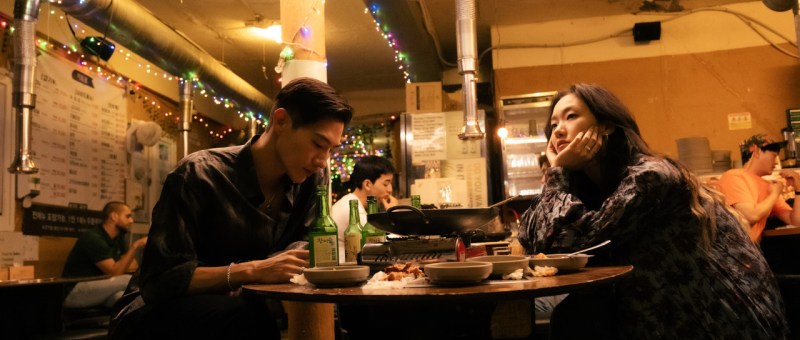

Love in the Big City (대도시의 사랑법, E.oni, 2024)

“How can being yourself be your weakness?” asks a young woman who, more than anything else, is defiantly herself, to a young man who indeed is anything but. The heroes of E.oni’s Love in the Big City (대도시의 사랑법, Daedosiui sarangbeop), adapted from the acclaimed novel by Park Sang-young, are in some ways on parallel journeys that somehow weave through and around each other as they each try to navigate an often hostile society that has no place either of them.

For aspiring writer and in the film’s early stretches student of French literature Heung-soo (Noh Sang-hyun), his “weakness” is that he’s gay and though he seems to have accepted this about himself is firmly in the closet. Free spirited Jae-hee (Kim Go-eun) who spent her teenage years abroad in France catches him making out with their professor but couldn’t care less though Heung-soo rebuffs her attempts at friendship fearing they’re akin to a kind of blackmail or that she plans to out him to their fellow students. It’s not until Jae-hee is publicly shamed when it’s rumoured a topless photo being shared online is of her that the pair finally become friends. Sick of the curious stares and covert giggles, she lifts her shirt in front of the class to prove it isn’t her, earning the nickname “crazy bitch”.

Her response is the exact opposite of Heung-soo. She claims her freedom by baring all, being defiantly herself and outwardly at least little caring for what others think of her while Heung-soo makes himself invisible and says nothing harbouring intense fear of being exposed. They are each in their way pariahs. Heung-soo because of his sexuality which is still unacceptable to many in the fiercely conformist society of South Korea in which Christian religious bodies still have huge influence and loudly oppose LGBTQ+ rights and freedoms. Heung-soo’s widowed mother is also intensely religious and having stumbled on one of his stories about a crush on a classmate is aware that he is gay but does not speak of it and continues to believe he will be “cured”. This is perhaps why she keeps urging him to do his military service believing it will make a man out of him.

For all of these reasons, it’s not surprising that Heung-soo is unwilling to live his life openly as a gay man because of the prejudice he knows he will face from those around him. Jae-hee, by contrast, refuses to hide and lives the way she wants to but is shamed by those who feel a woman should live in a certain way which is to say quietly, politely, and obediently. A man she thought was a boyfriend while he thought of her as a bit on the side publicly slut shames her and asks what sort of idiot would want to date a woman like her. Though we first meet her as a confident, rebellious student we see her gradually beaten down by the world around her and the demands of corporate culture. Considering marrying a man she may not actually like because it’s what you do, she stares sadly at a middle-aged woman opposite her on the train dressed in a near identical outfit and the comfortable shoes that are psychologically at least uncomfortable for Jae-hee in representing her capitulation to the properness of mainstream society. 

Her degradation continues to the extent that she finds herself in a relationship with a domineering, intensely patriarchal man who later turns violent when she tries to leave him. E often cross cuts and juxtaposes Heung-soo’s and Jae-hee’s experiences as they each suffer similar blows and indeed violence from a macho society if in different ways and for different reasons while having only their intense bond as fellow outsiders to rely on. This really is the love in the big city, a deeply felt platonic and unconditional love between two people who essentially have no one else. It’s through this love that each comes to love and accept themselves, Heung-soo eventually gaining the courage to fully embrace his authentic self while Jae-hee finally regains her independent spirit and refuses to let others shame her while standing up both for the LGBTQ+ community and the young woman she once was at the mercy of a male-dominated corporate culture. Warm and often funny, the film paints contemporary Seoul as an outwardly oppressive city of enforced conformity but equally discovers small pockets of freedom and joy along with the wholesome comfort of true friendship and self-acceptance.


Love in the Big City screened as part of this year’s London Korean Film Festival.

International trailer (English subtitles)

Baseball Girl (야구소녀, Choi Yun-tae, 2019)

According to the title card which opens Choi Yun-tae’s Baseball Girl (야구소녀, Yagoosonyeo), an obscure regulation in the founding principles of the Korean Baseball League placed a bar on players who were “biologically non-male”, a ban which was struck down in 1996 allowing women to play professionally though attitudes it seems are much harder to change than regulations. In contrast to the grand tradition of Korean sports dramas, the contest is not a game but the right to play in one and the opposing team not talented rivals but sneering sexism and a conformist society. 

Joo Soo-in (Lee Joo-young) made the papers as the first girl to play in her high school team in over 20 years. Casting an eye around her room we see her trophies and discover that she is a talented pitcher known for top speed fastballs, but then as others seem to put it her balls are only fast “for a girl”. All she’s ever dreamed of is playing professionally and, after all, there’s nothing in the rulebook to say she can’t but that’s all anyone ever tells her. Why can’t I? she asks them, but the only answer they have for her is that it simply isn’t done. Lined up with her teammates following a meeting with a scout from the big leagues, Soo-in watches as only one of her friends, Jeong-ho (Kwak Dong-yeon), is picked. The others all walk off with resignation, accepting that they’ll need to find alternate careers but Soo-in doesn’t back down. 

Soo-in’s determination places her at odds with her working class family, her harried mother (Yum Hye-ran) continually insisting that she’s being childish and unreasonable and should give up her dreams to do something more practical with her life or risk becoming like her father (Song Young-Kyu) who is perpetually unemployed, unable to provide for the family while repeatedly failing the exam to become a licensed estate agent. There’s no shame in giving up when there’s no chance of success, her mother tells her, aligning her quest with her father’s as an egotistical act of prideful selfishness. As a teenage girl, however, Soo-in cannot help but feel the slight of her parents’ lack of support, resenting her mother’s understandable prioritisation of the ability to earn as she pushes Soo-in towards taking an office job in the factory where she works right out of high school in the belief that she’s helping her towards an economically stable life. 

Meanwhile, the new coach on the team, Jin-tae (Lee Joon-Hyuk), is quick to sideline her, viewing her as ridiculous and deluded. It’s not because you’re a girl, he tells her, it’s that you aren’t good enough, paradoxically insisting that she never could be because of the “limitations” of her female body which make it impossible for her to compete with men who also, as he points out, are extremely unlikely to make it as professional players. She tells him that he’s wrong, vowing to pitch at a speed unheard of, certain that if achieved the leagues would have to take her. Jin-tae has problems of his own, a never was player who wasted his youth trying to turn pro, became an alcoholic, and ruined his marriage. It’s understandable that his experiences have turned him cynical and mean, but something about Jin-soo’s determination, along with her strong skillset, begins to move him. Maybe he thinks it’s hopeless too, but it would be wrong to deny her the right to try. 

The biggest battle Soo-in faces, however, is from other players. Jeong-ho relates how in their little league days she was the only girl on the team and the kids mercilessly bullied her in part because the coach told them having a woman around was bad luck and made them all do intensive training to encourage her to quit. Jin-tae tries to get his scout friend to get her a tryout for a professional team, but he makes no secret of his distaste for the idea, exasperatedly complaining that Soo-in doesn’t look like a ball player (i.e., not a man, small and slight) only to later offer her an insulting token job as a figurehead for a “Woman’s Baseball Project” designed to make his big league team look more progressive than it really is. At her big try out, the guys in the dug out snigger and laugh, making fun of the batter who was struck out by “a girl” while the other coach congratulates her suggesting that she must have “trained with the boys” before giving her some unsolicited advice. 

As she tells the director of the big league team, baseball is for everyone. Her femininity is not a strength or a weakness, it simply is. She might not be as fast or as strong, but she’s smart, and brute force is not the point of the game. Some tell to her give up, that she should just play in the women’s leagues as a “hobby”, and perhaps at times Soo-in doubts herself but as Jin-tae tells her, other girls can dream because she showed them it was possible when she overcame huge prejudice to play on her high school team. Yet for Soo-in with every success it will only get harder. Even so she won’t give in, playing hardball with a relentlessly patriarchal society as she insists on the right to follow her dreams wherever they may take her.


Baseball Girl streams in the US via the Smart Cinema app until Sept.12 as part of this year’s New York Asian Film Festival.

Original trailer (English subtitles)