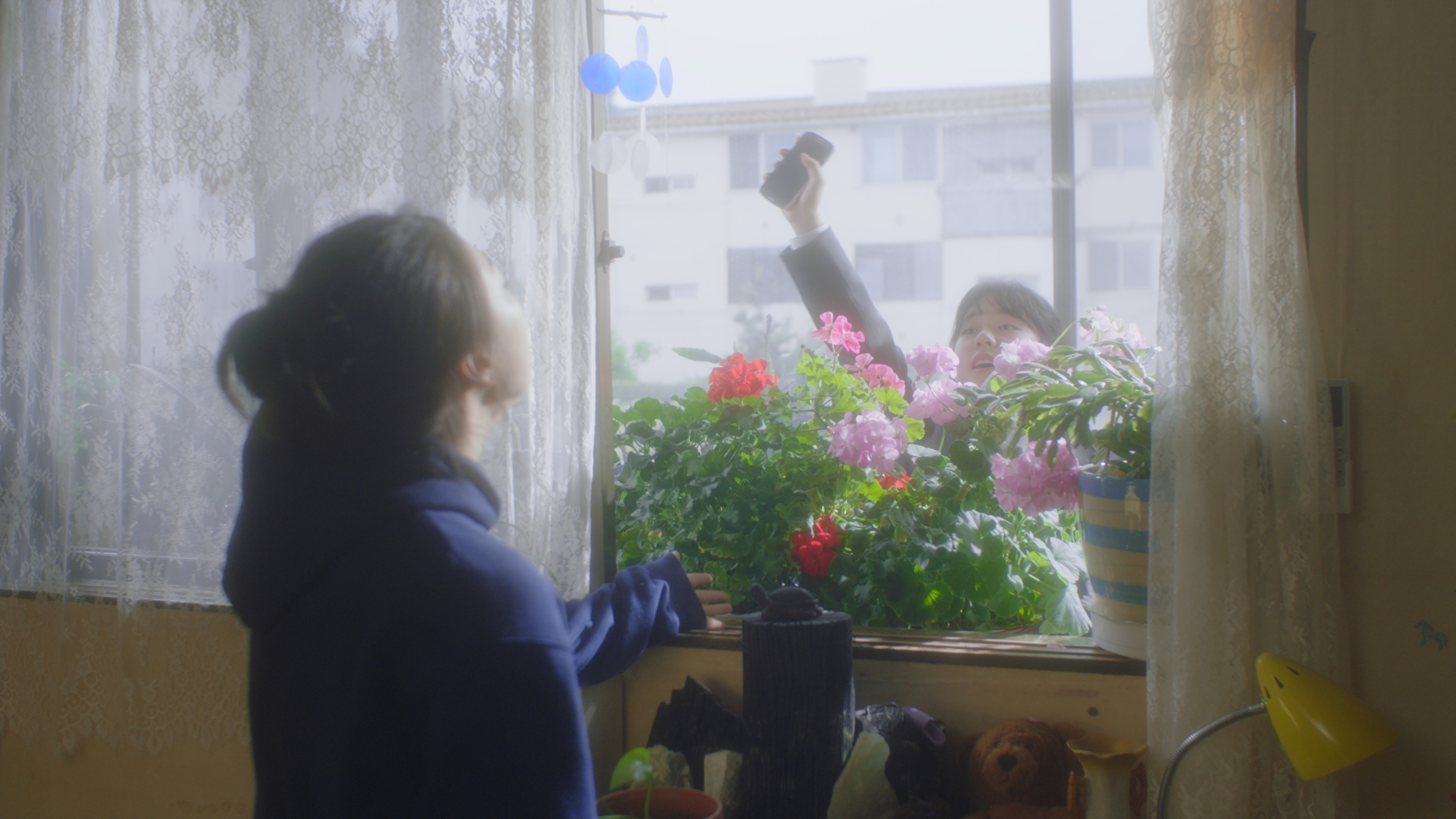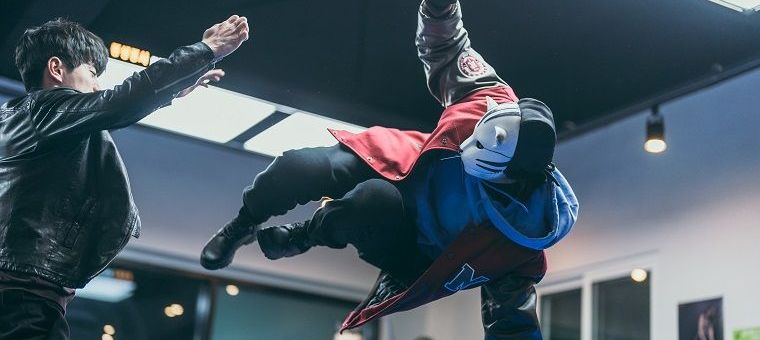
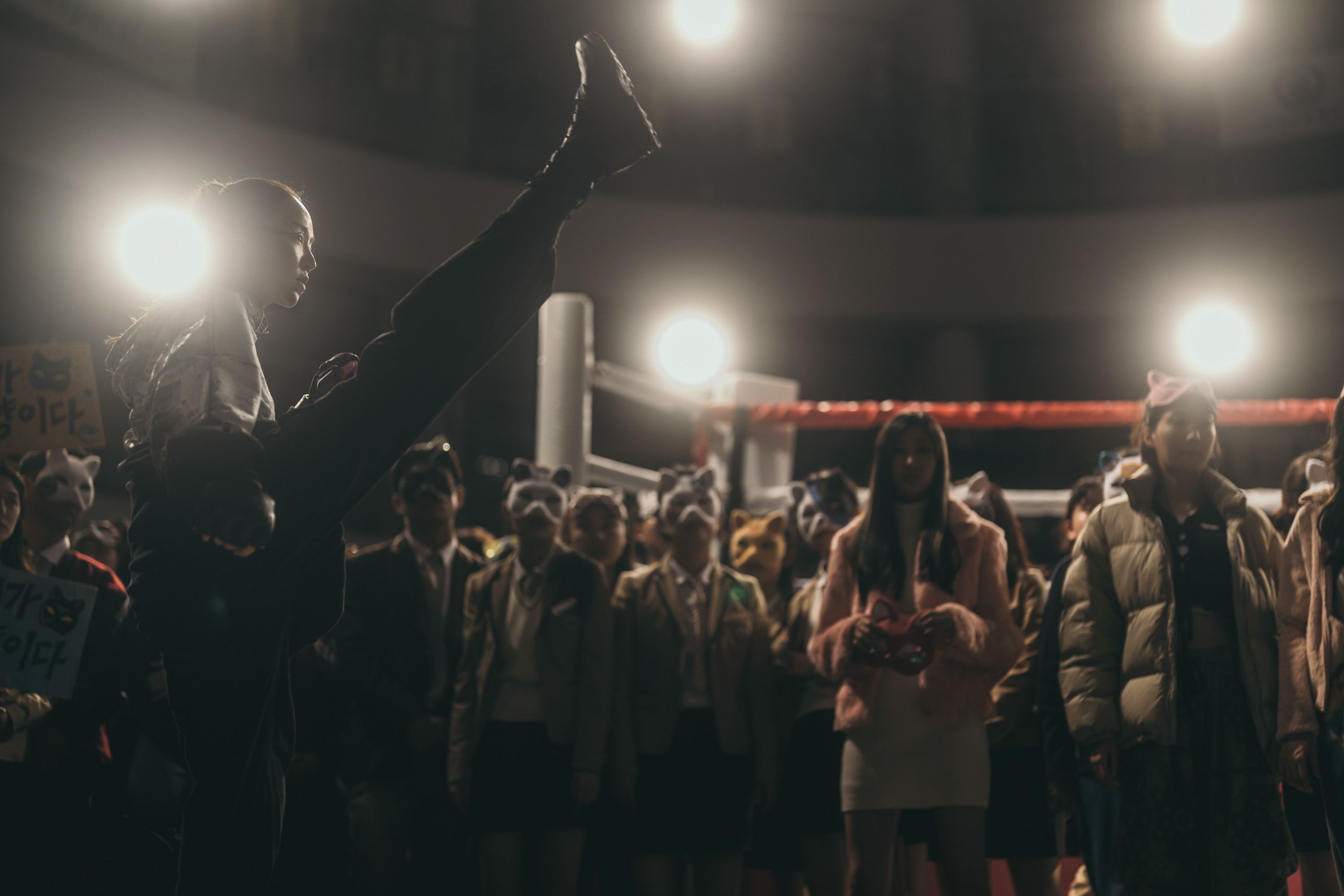
Brave Citizen (용감한 시민, Park Jin-pyo, 2023) [Fantasia 2024]

There’s an intentional irony in the mantra teacher Si-min (Shin Hae-Sun) is fond of repeating that “If you do nothing, nothing will happen,” in that on the one hand it means that until people decide to act a dissatisfying status quo will continue, but on the other it may also seem threatening implying that if only you keep quiet nothing will happen to you. The main thrust of Park Jin-pyo’s webtoon adaptation Brave Citizen (용감한 시민) does seem to be that abuses of power take place because so few people are willing to challenge them or indeed to stand up for those who cannot stand up for themselves.

That’s something Si-min discovers when a student comes to her and says he’s being harassed by notorious bully Su-kang (Lee Jun-Young). A former boxer/martial artist, Si-min is on a temp contract and evidently waited quite some time to be offered a position so takes it to heart when her boss, Mrs Lee (Cha Chung-Hwa), warns her not make waves and jeopardise her hopes of being hired full-time. Somewhat cynical she tries to talk herself out of standing up for him, talking herself into turning a blind eye to injustice as nothing to do with her but at the end of the day she isn’t someone who can just sit by and take it nor watch as others are harmed while Su-kang goes unchallenged. 

He’s unchallenged largely due to the socio-economic conditions of contemporary Korea in which the wealthy and well-connected are able to live above the law. When one of Su-kang’s victims tries to report him to the police, they are the ones who end up accused of making a false report while Su-kang gets off scot free because he counts judges and prosecutors among his relatives while his mother is a prominent lawyer. His family apparently also donate large amounts of money to the school, which has won a series of “anti-bullying awards,” which is why he can’t be expelled. Si-min’s predecessor took her own life because of Su-kang’s bullying while pretty much everyone is scared stiff of him.

It’s for these reasons that Si-min turns to violence in the hope of giving Su-kan a little “off-site education” and perhaps you can’t blame her when faced with such intransigence from compromised authority. Yet standing up for the students is also a way of learning to stand up for herself, not to succumb to turning a blind eye to injustice simply because it’s more convenient. It’s this wilful suppression of one’s rage towards the persistent injustices of society that ends up spreading them, a continuous chain of abuse in which people take out their frustrations on those unable to defend themselves like the drunk man who yells at Si-min in the street and comes to realise he’s picked on the wrong person. 

Then again, when questioned why he behaves this way Su-kang only answers that “it’s fun”. It’s difficult to believe he would be insecure in his status, yet he persistently mocks those he sees as socially inferior, “nobodies” and ”hobos”, as opposed to elites like himself. The suggestion is that he and his friends have become this way because of a lack of boundaries and a sense of invincibility, which is partly what annoys him so much about an intervention from an authoritarian figure such as Si-min over whom he has no authority because she has decided not to grant it to him. 

This might be what makes her a “brave citizen,” the name of an award granted to ordinary people working in favour of justice that her father had once won after otherwise ruining his life through unwisely guaranteeing a loan and being left on the hook for paying it back. Embracing the absurdity of the webtoon, Park goes big and bold painting the inequalities of the contemporary society in stark relief while injecting a sense of catharsis into Si-min’s attempts to smack some sense into the bullies while rediscovering her own desire to challenge injustice rather than remain complicit with it even if it is personally inconvenient. Her rebellion encourages others to do the same while robbing the bullies of their privileged position and exposing them to the consequences of their actions. Of course, fighting violence with violence may not be the best solution but does at least allow Si-min to make the most of what she has and to recover the self that had been beaten down and defeated but is now capable of fighting back both for herself and others.


Brave Citizen screened as part of this year’s Fantasia International Film Festival.

International trailer (English subtitles)
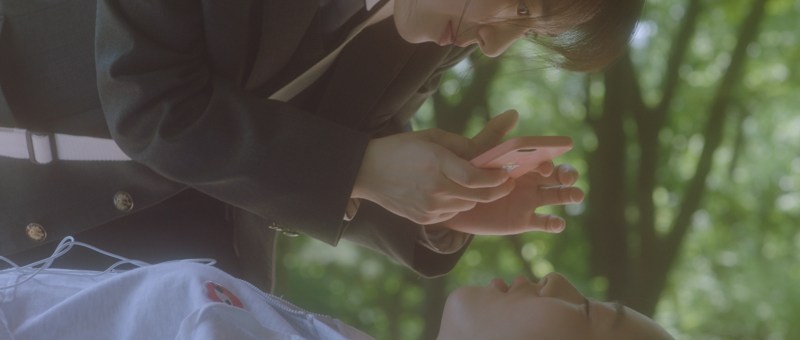
The Dream Songs (너와 나, Cho Hyun-chul, 2022)

Teenage friends wrestle with a sense of mortality, frustrated longing, and future anxiety in the etherial feature debut from actor Cho Hyun-chul, The Dream Songs (너와 나, Neo wa Na). Set shortly before the 2014 Sewol ferry disaster and shot in a washed out soft focus with a hazy nostalgic quality, the oneiric drama finds its conflicted heroine coming to an appreciation of the solipsistic qualities of obsessive love while preparing to cross the line between adolescence and adulthood in fearing she may not return from her upcoming trip or that the her that returns will not be same and the world will have moved on without her. 

The trip is only four days, but for Sam (Park Hye-su) it represents the end of her adolescence and the beginning of adulthood. As the film opens, she wakes up in her classroom after having a disturbing dream that something bad is going to happen to her best friend Ha-eun (Kim Si-eun) who is currently in the hospital though only for broken leg after being hit by pedal bike on a zebra crossing. So upset is she, that Sam manages to convince her teacher to let her leave early to verify that Ha-eun is OK with her own eyes and try to convince her to come on the school trip to Jeju with her, broken leg and all, so that whatever happens happens to them together. 

In the repeated dream imagery, it’s being left on her own that Sam seems to fear. She doesn’t want to be the only one who survives or the only one who dies and leaves her friend behind though as she confesses there was something that felt peaceful in her dream on looking at a corpse that might have been her own. The school trip to Jeju is one that many teenagers take in a quite literal rite of passage, but it’s also tinged with additional anxiety in the painful reminders of the 2014 Sewol Ferry disaster, directly referenced via a radio broadcast, in which many school children taking the trip from the area where the film takes place lost their lives. Sam’s impending sense of foreboding causes her to reevaluate her relationships and especially that with her best friend Ha-eun for whom she has developed romantic feelings she is unsure can be returned. Afraid to leave without saying anything but also worried she may be rejected and end up imploding the friendship too, Sam’s internalised conflict ironically blinds to her Ha-eun’s individual suffering in having recently lost her pet dog as well as her disappointment on missing out on the trip while recovering from her accident. 

Cho frequently lands on the image of clocks, often stopped, which hint at time running out while there are frequent allusions to death and drowning from the bird Sam finds on the ground by the school to the girls’ final parting seemingly taking place in front of a stranger’s funeral with mourners talking outside while people carry funeral wreaths directly past them. While the lines between dream and reality continue to blur, Sam sees images of herself in the two little girls playing together in the park and another with her grandmother who “saves” a toy dinosaur from drowning in an environment in which it is unable to survive. She and Ha-eun chase a lost dog and eventually end up on opposite sides of a fence which is the outcome Sam most feared, but are eventually reunited and able to have a more emotionally honest conversation now that Sam has come to an understanding of the self-involved qualities of her romantic obsession. 

Even so, for the first part of the film it isn’t entirely clear if Sam’s feelings are indeed romantic or if it’s more a case of intense teenage friendship that causes her to be jealous of others that might be spending time with Ha-eun while preoccupied with the identity of the mysterious “Humbaba” whom Ha-eun apparently wanted to kiss in a diary entry Sam was presumably not intended to read. Sam’s feelings are made clear in a letter she doesn’t have the courage to send while she seems to fear that time may slip away from her and Ha-eun won’t be there when she returns from her trip. Yet what she ends up awakening to is more like self love, or at least no longer fearing “Joy” will fly away from her when she’s not looking. Cho’s hazy, poetic coming-of-age drama excels in capturing the joyful quality of teenage female friendship and diffidence of first love if tinged with a note of melancholy nostalgia in the wake of a devastating loss.


The Dream Songs screened as part of BFI Flare 2023

Original trailer (English subtitles)