The Starting Point (원점, Lee Man-hee, 1967)

A hired thug and a sex worker dreaming of a new life are set on a collision course at mountain retreat in Lee Man-hee’s noirish thriller, Starting Point (원점, Wonjeom). A melancholy existential drama, the film nevertheless has a darkly comic absurdity and becomes for a time almost a satire of changing sexual mores and the anxiety surrounding the post-war population explosion while simultaneously hinting at corporate corruption in economically straitened times. 

Played in near total silence, the opening pre-credits scenes find the otherwise unnamed (the name given in the promotional material is never spoken) lackey (Shin Seong-il) raiding an office building with the intention of retrieving some mysterious documents the people who hire him later claim threaten to expose their “seven-year-secret”. The Lackey takes time to smoke a cigarette and read through some of the papers before putting them into a briefcase to make his escape but is soon met by a man with a rifle who challenges him. A fight ensues on the staircase from which the Lackey is able to escape, activating a rolling gate to get out of the building. But the other man keeps coming after him, managing to cling on the briefcase while his neck is crushed by the unstoppable motion of the shutter. 

Mirroring him, the unnamed Sex Worker (Moon Hee) is also intruded in a wordless sequence shot with the kind of realism seen in American independent and European arthouse cinema as she stares forlornly at the pretty dresses behind the glass in a small boutique before sadly making her way towards a streetlight near the Choseon Hotel where she wordlessly picks up a customer through suggestive looks and gestures. 

The Lackey knows too much, which is why his bosses want to take him out but for unclear reasons Mr Choi comes up with a bizarre and convoluted scheme which involves hiring the Sex Worker to pose as the Lackey’s wife during a honeymoon getaway to Mt. Seorak. What the Lackey thinks is going on or why the mountain is important is never really explained just like the nature of the seven-year-secret, but once there the film changes tack becoming a kind of ensemble mystery as the various guests each become suspicious of one another while the Lackey and the Sex Worker slowly fall in love for real perhaps bonding their mutual sense of existential peril and outsider status. 

In the liminal space of the mountain, both fear rejection by those around them who come to represent mainstream society, the Lackey because he has killed and Sex Worker because of her profession. Ironically, one of the other guests is a dodgy gynaecologist who makes a point of saying that most of his clients are sex workers from around the Choseon Hotel at least implying that he regularly performs abortions. He recognises the Sex Worker as a previous patient and tries to take advantage of her sexually but commits a breach of medical ethics by leaking her profession to the rest of the group who then shun her. When the planned camping trip encounters a snag seeing as only two tents have been provided and the obvious solution is for men to take one and the women the other, the women all immediately leave on the Sex Worker’s arrival refusing a share a space with a “fallen woman” in case they are somehow tainted by her shame. 

But then, the goings on at the mountain inn are strange in themselves. A middle-aged man who inexplicably doesn’t seem to have encountered a transistor radio before accidentally tunes into a news broadcast discussing the effectiveness of the contraceptive pill while the young people dance with wild abandon to music they don’t really understand. Meanwhile, the gynaecologist wades in when another of the women experiences terrible stomach pains insisting that he is “familiar with women’s issues” and informs the husband that his wife is pregnant which is confuses him because they only married the day before and he’s been a good boy so the news is perplexing. He spends the rest of the film counting dates on his fingers and at one point attempts to hang himself certain that his wife must have slept with another man before their wedding instead of maybe considering that the dodgy gynaecologist may be mistaken.  

When the couples are divided into separate tents, one guest quips that it’ll be good for keeping the birth rate down hinting at an anxiety about a new sexual freedom among the young coupled with the impact of the ongoing baby boom and its economic implications. The gynaecologist’s wife is the first to join in with the youngsters, but she’s also a rabid penny pincher making sure the newlywed husband pays for her husband’s treatment of his wife while intensely jealous constantly trying to keep the randy doctor’s attention off the other women. The sense of economic anxiety is echoed in the Sex Worker’s melancholy longing onto looking into the shop window while dreaming of opening her own hair salon though sex work is the only way she can support herself and leaves her with intense shame that like the Lackey exiles her from mainstream society. 

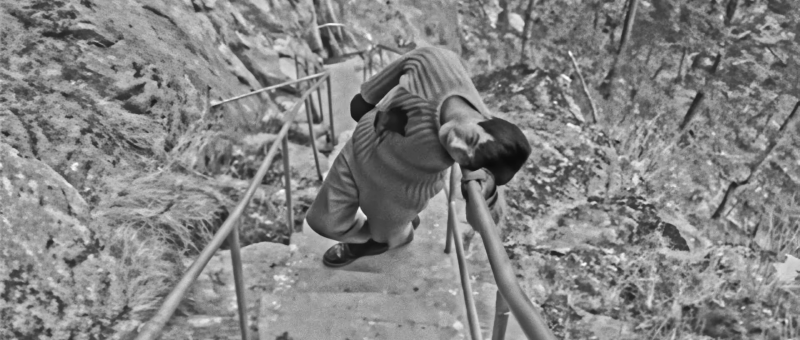
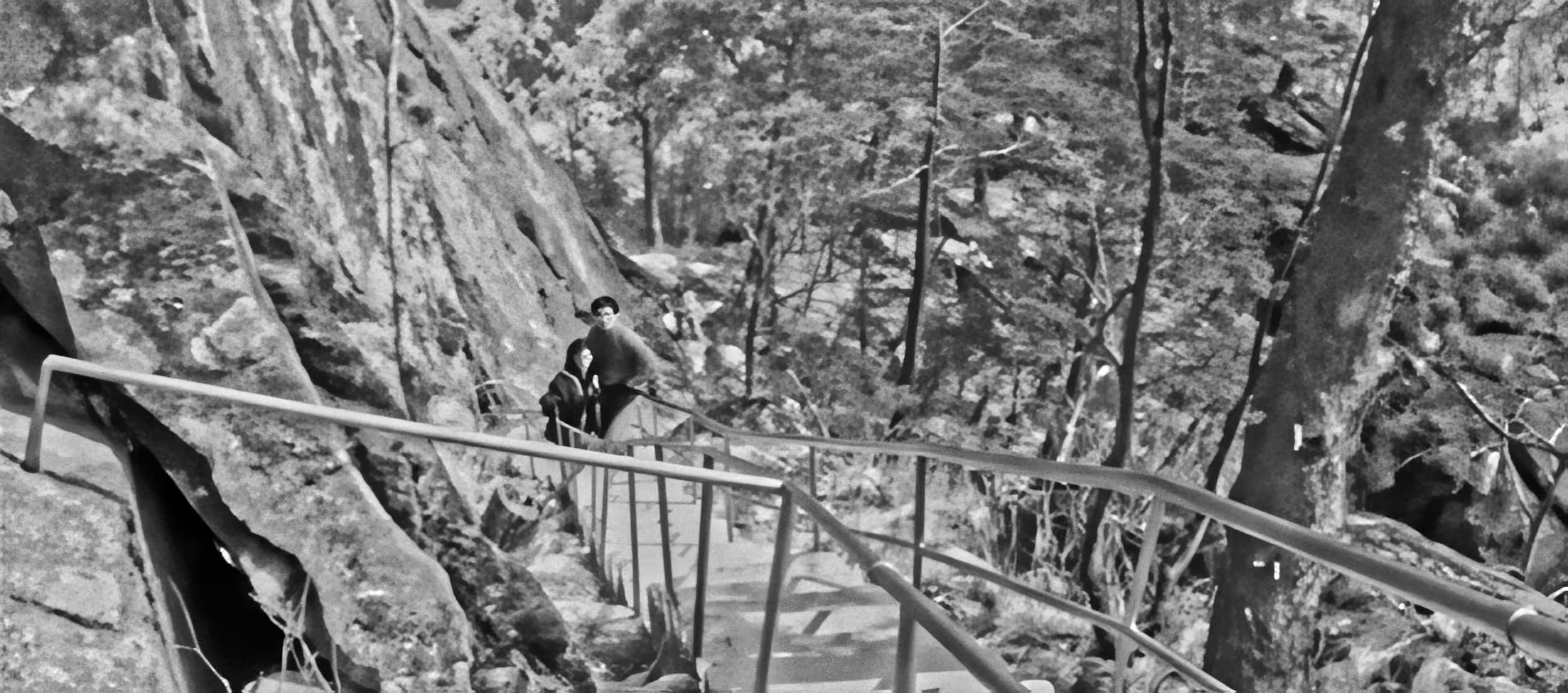
As she says while embracing her covert identity as a cheerful newlywed, she’s been looking up all her life and would like to look down for once which she ironically does atop the stairway on which the Lackey fights his existential battle with Choi and his minions. They each want to find a way to get off the mountain and return to the world, but are prevented from doing so by the forces that pursue them and will not let them go. Finally questioned, the Sex Worker is forced to admit that she knows nothing about the Lackey, not his name or where he lived or what he did for a living, only that he did not hate her which is as close to a declaration of love as it might be possible to get in this cold and dark world of exploitation and violence. Lee films with a noirish intensity and melancholy fatalism as the pair attempt to fight back against the forces which constrain them with the pureness of their love but later discover that, as they feared, all that is left to them are painful memories of momentary happiness. 

The Hand of Fate (運命의 손 / 운명의 손, Han Hyung-mo, 1954)

Hand of fate poster 2

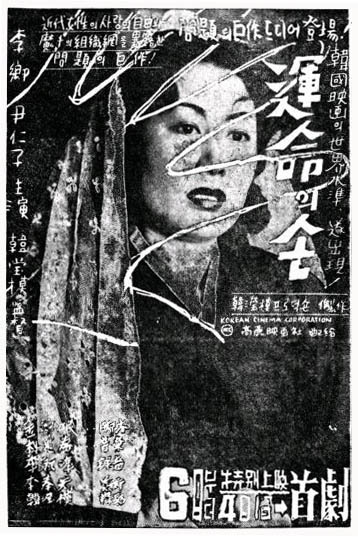
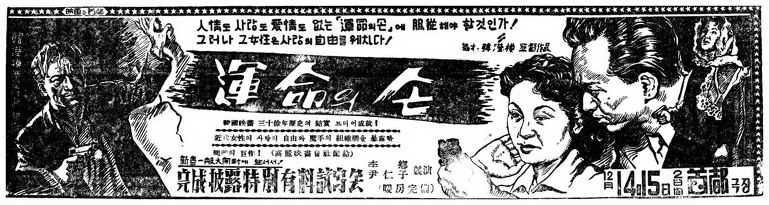
The kinds of directors who tend to garner retrospectives and reappraisals are perhaps those who lean closer to our own ideological biases. Even in the tightening censorship of the 1960s, Korean directors like Kim Soo-yong and Lee Man-hee were able to subtly undercut the prevailing conservatism of their times. Director Han Hyung-mo, by contrast, was a committed rightist whose films express a distinct intolerance towards liberalism, women’s rights, and the Communist North. Han, like many directors of his generation, studied filmmaking in Japan near the end of the Colonial era and began his career as a cinematographer. His first film, Breaking the Wall released in 1949, is sometimes described as the first Korean anti-communist film. Returning to narrative filmmaking after serving as a documentarian during the Korean War, Han’s Hand of Fate (運命의 손 / 운명의 손, Unmyeong-ui Son, AKA Hand of Destiny) released in 1954 is not perhaps as rabidly anti-communist as might be expected but makes clear that there can be no redemption for an ideologically compromised woman.

Jung-ae (Yu In-ja), a North Korean spy posing as a bar girl in the South, enjoys a life of comparative freedom and luxury but remains committed to her mission. When the police bring a wounded student, Yong-chul (Lee Hyang), to her door one day as a possible suspect in a robbery she’d previously reported to them, she takes pity on the man and tells the police to let him go. She brings him into her apartment, treats his wounds, and feeds him. For some reason she develops an attraction for the melancholy student and so when she spots Yong-chul working on a construction site, Jung-ae takes him out on the town, buys him a new suit and shoes, and eventually begins a relationship with him. Professional habits die hard, however, and so when she rifles through his wallet she is disturbed to find his military intelligence ID card and discover he is really a spy catcher.

Released in 1954, Hand of Fate is a product of the immediate post-war era and is in fact one of the very few surviving films from that year. Nevertheless, it takes its cues very much from international cinema and particularly from American and European noir and spy films in its fatalistic trajectories and uncharacteristically murky worldview. Though Han includes mild anti-communist sentiment in Jung-ae’s eventual disillusionment with the “Communist Party’s hackneyed methods”, the fact that she is a spy for the North is almost incidental for much of the film, the conflict being not that she is a Communist and therefore evil but on a much simpler level that she is required to straddle a difficult ideological divide. Of course, the force that shakes her loyalty is love and in this Han reaffirms her womanliness in simultaneously making emotion both her weakness and the best weapon against the rigidity of Communism. Then again, rightists aren’t so keen on emotion either and so romance must fail.

Both Jung-ae and Yong-chul come to the conclusion that their only mistake was falling in love – not so much with an “enemy” but across an impossible border presented by the 38th Parallel. The futility of the love is laid firmly at the feet of a destructive division imposed by outside powers which painfully separates two parts of one whole. “We love each other, why can’t we be together?” Yong-chul asks, still unaware that Jung-ae is the female spy he’s been looking for. “You’re so close to me now”, Jung-ae adds later, “Why have we been so far apart?”, lamenting that the wall which has kept them at a distance from one another has been largely illusionary and has now been destroyed if only in terms of personal ideology. Rather than the demonisation of the North which would define the anti-communist film, it is the pain of the division which is the real enemy though in contrast to other similarly themed films, Han suggests a clean break might be the best solution rather than holding out hope for reunification.

Meanwhile, the pair work at cross purposes in misattributing the suffering of the other to culturally defined, gender-specific stigmas. Yong-chul assumes Jung-ae’s misery is down to being a “fallen woman”, that as a sex worker she worries she has lost the right to love him (he is keen to assure her that she hasn’t and there’s nothing wrong her life choices – a liberality that stands in contrast to the film’s subtle condemnation of Jung-ae on just this fact as a woman who uses her body as a tool of war), when really she is caught in an impossible position in having fallen in love with a man she will probably have to kill. Before discovering his real occupation, Jung-ae assumed Yong-chul’s misery was down to his poverty. She feels the manual job he takes to support himself through college is beneath him, indulging in a stigma towards blue collar workers which seems odd for a committed communist, and wants to “save” him by restoring him to his rightful social class with her money which she earned in a way she fears he may think immoral.

Despite Han’s fierce conservatism, Hand of Fate features the first on screen kiss in Korean cinema history but where it is undoubtedly romantic, it is also dark and fatalist. In keeping with the title and the noirish atmosphere, the narrative trajectory leads only to tragedy in which the division will be maintained with the South in the ascendent. Jung-ae’s ideological fracturing leaves her with nowhere to turn, while Han’s overly conservative viewpoint will not allow her to find peace or resolution not only because of her Communist roots but because of being an “immoral” and “vulgar” woman as she describes herself early on. Described as “An epoch-marking, ambitious work in the history of Korean Cinema”, Hand of Fate is indeed a bold experiment, opening with a tense, dialogue free sequence of spy craft and danger even if it later overdoes the expressionism with climactic thunderstorms and overly literal bombs (not to mention the constant hand imagery), offering a dark and noirish vision of a divided future in which the pain and suffering caused by the division will continue with the only “hope” that the wall will eventually become a fading scar.


The Hand of Fate is available on English subtitled DVD courtesy of the Korean Film Archive which also includes a special documentary, a video essay by film scholar Kim Jong-won, and an interview with art director Non In-taek, as well as a bilingual booklet featuring a brief commentary on the film and an essay by the Korean Film Archive’s Jo Jun-hyung. Also available to view via the Korean Film Archive’s YouTube Channel.

Brief clip (dialogue free)