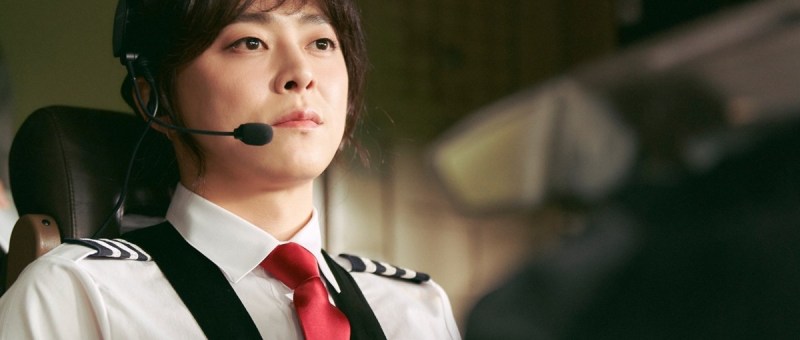

“You can’t say things like that anymore,” the men of Pilot (파일럿) are fond of chuckling but still they think them and on a baseline level are unable to understand what’s wrong with what they see as merely offering a compliment. Adapted from the 2012 Swedish film Cockpit, Kim Han-gyul’s non-romcom takes its cues from films like Tootsie and Mrs Doubtfire to explore the inherent sexism and misogyny at the heart of contemporary Korean society if perhaps problematically doing so through the means of a male redemption story.
In any case, Han Jung-woo (Jo Jung-suk) is mindless more than anything else later claiming that sometimes it’s better “to say yes and go with the flow” than risk creating unpleasantness. Seemingly excelling at everything, he graduated top his class at the Korean Air Force Academy and was fought over by several large airlines becoming a minor celebrity and apparent pilot influencer. But behind the scenes, he’s somewhat false and self-involved as evidenced by his attempt to show off a video of himself tearfully paying tribute to his mother for raising him and his sister alone but refusing to answer a telephone call from her at the same time. His celebrity fame comes back to bite him when a video of team dinner in which he rejected his boss’ comment about the new intake of stewardesses not being pretty enough by referring to them as a beautiful bouquet is leaked online. The clip goes viral with his boss getting the brunt of the abuse and while he is not visible many are able to identify him by his voice. The airline soon goes bust and unsurprisingly no one else is willing to hire him.
The issue is that neither his boss nor Jung-woo understand what was wrong with what they said. They just parrot back that what they said was nice so they can’t see the problem with it but fail to understand that their comments are demeaning because they belittle women’s talents and reduce them to objects for male appreciation. Hyun-seok (Shin Seung-ho), who attended the Air Force Academy with Jung-woo, gets him an interview at his airline but it’s run by a female CEO (Seo Jae-hee) who happens to be the sister of his old boss and is apparently on a mission to make her company more egalitarian by having at least 50% female pilots so she’s only hiring women. Nevertheless, she also asks sexist questions at the interview looking closely at a female candidate’s age and asking her if she is married or in a relationship, whether she intends to have children and when. The female candidate fires back a pre-prepared speech that she’s uninterested in marriage and is not planning to have her eggs frozen or anything like that so she can devote herself fully to the job.
Hyun-seok expresses sympathy, echoing Jung-woo’s earlier comment that all that matters in flying is skill and people should be hired for their merits not their gender. But it’s impossible not to read into his words that he thinks women are inherently not as capable as men and wouldn’t be getting the job at all if it weren’t for this affirmative action, which is to say it’s all about gender after all and only men are suited to the job. He says as much later on when the plane he’s piloting runs into trouble while he’s unwittingly co-piloted by Jung-woo in his female persona Jung-mi, having posed as a woman in order to pass the interview. “Men should step up during times of emergency, not women,” he screams while losing the plot as the plane plunges and refusing to hand over the controls to his female co-pilot until Jung-woo takes them by force.
Despite being slightly younger and believing himself to be a modern man, Hyun-seok is still incredibly sexist and openly flirts with Jung-mi to the point of sexual harassment even while she bluntly tells him that she isn’t interested. Jung-woo had been flattered and overjoyed the first time someone called him “miss” on the street and alluded to his unconventional, broad-shouldered beauty but quickly discovers that that gets old and becomes aware of how “annoying” or even scary some men can be in their entitled treatment of women, and by extension the various ways in which his own treatment of women may not have been appropriate. Becoming Jung-mi allows him to become himself, rediscovering his love of flying no longer so hung up on the external validation of internet fame and more interested in and considerate of those around him in the absence of the kind of toxic masculinity that infects men like Hyun-seok.
Though his wife divorces him when he loses his job if more because of his persistent emotional neglect than disappointment or financial worry, he becomes more aware of and sympathetic towards his son who, just as he had says yes and goes with the flow by saying a toy aeroplane was fine despite having been engrossed in the Barbie aisle seconds before but presumably afraid of disappointing his father if he told him he’d rather have a doll instead. Nevertheless, the film strangely refuses to engage with ideas of gender and sexuality and becoming Jung-mi does not really unlock Jung-woo’s femininity even if it evidently makes him a better and more considerate person, while his sometime love interest Seul-gi (Lee Ju-myoung) is more or less queer coded and her attempts to stand up for herself as a woman and an equal are not always well respected by the film. Even so the betrayal of CEO Noh who is revealed to be a ruthless businesswomen perfectly willing to exploit other women and throw them under the bus if necessary highlights the ways in which entrenched patriarchy pits women against each other.
Thus the underlying misogyny of the present society is fully exposed, if ironically by a man experiencing what it is really like to live as a woman which is to be ignored and disrespected, judged by appealingness to men and obedient temperament while skills go undervalued or worse are viewed as a threat to often fragile masculinity. Though the film largely avoids making Jung-woo’s cross-dressing a joke in itself, it does find humour in the absurdity of the demands of performative femininity in a rigid and conformist society in which a woman is rarely permitted to sit in the cockpit of her own life.
International trailer (Simplified Chinese & English subtitles)
 Windows on Worlds