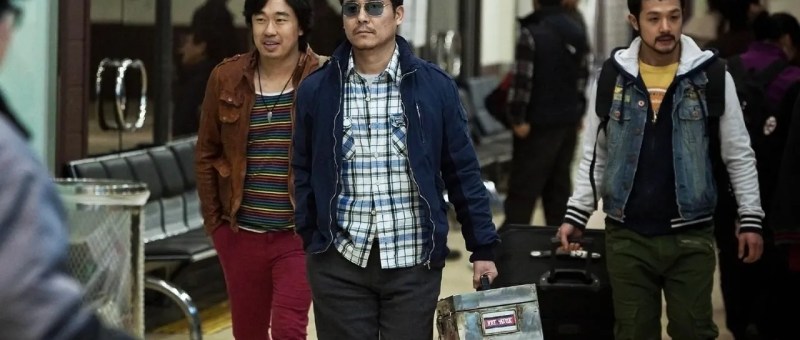
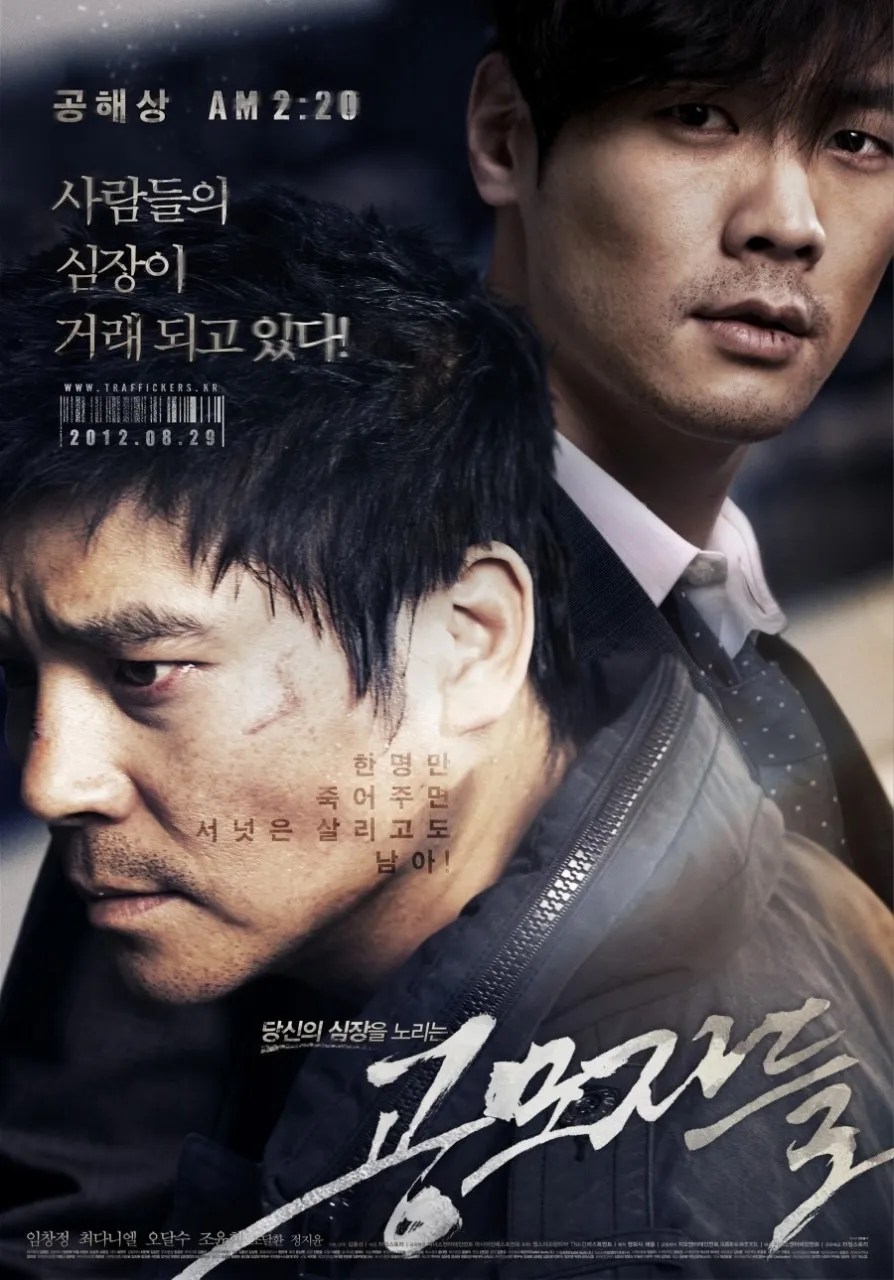
Traffickers (공모자들, Kim Hong-sun, 2012)

The one with money and power wins. The ones without it lose everything they’ve got. In many ways, it’s the overriding message of contemporary Korean cinema, but the words take on an even darker hue when uttered by the villain of Kim Hong-sun’s illegal organ transplant drama, Traffickers (공모자들, Gongmojadeul). The film’s Korean title, Conspirators, hints at the ways that this world reduces everyone to one degree or another to something less than human as they chase often small dreams of health, comfort, and happiness, in which the central conspiracy comes to stand in for a world ruled by power and money.

Young-gyu (Im Chang-jung) used to be an organ trafficker, but gave up that side of his business when his best friend was killed by a victim who woke up unexpectedly and tried to escape. Since then, he’s smuggled moderately less inhuman things and has developed a crush on a young woman who works on the ticket counter at the port. Yu-ri (Jo Yoon-hee) has a sick father who needs a transplant, but the one was lined up for is cancelled at the last minute apparently because she neglected to inform them of an issue which gave them an excuse to pull out in what seems to be a suggestion that the list is being manipulated. Fearing her only option is the black market, Yu-ri is in desperate need of money and turn to one of Young-gyu’s acquaintances, the leader of a Chinese gang. To get her the money Young-gyu decides to pull one last job, but soon finds himself in over his head as his new target turns out to have a connection to his past.

The film never really goes into Yu-ri’s decision get her father a black market transplant but rather focuses on her desperation as someone who has been frozen out of the legitimate system which itself already prioritises those with means to fight for better or more efficient treatment. It’s not clear if she is aware that the organ may come from someone who has been killed deliberately for that purpose, or if she knew but decided her father’s life was more important than theirs. Nor is it clear if she’s thought through the repercussions of indebting herself to gangsters for some of whom organ harvesting is just another means of debt collection. In any case, all she really cares about is saving her father and it seems she is willing to do whatever that takes. 

To that extent, what they prey on is desperation. The gangsters don’t expect their victims to ask too many questions, because this is all illegal anyway and they’re already at their last resort to save a loved one’s life. That said, it seems strange that they would choose Chae-hee (Jung Ji-yoon), a young woman who uses a wheelchair and thinks she’s just going to China on holiday, who is travelling with her husband, to be their next victim given that there is obviously someone who is going to be looking for her. They generally assume most of their other victims won’t be missed and write them off as those of little consequence swallowed by a dog-eat-dog world. It seems that part of the gangster’s motivation is that they don’t want to become victims themselves so have chosen the path of violence and inhumanity. 

But despite his occupation, Young-gyu is conflicted about the bloodiness of his work and on realising that he has a connection to Chae-hee begins to want to save her while equally wanting to save Yu-ri and her father. The traffickers have, however, sold them all false promise in that it’s mainly the people who were trying to buy transplants that end up becoming victims and it’s not actually clear who is getting any of these organs until a final suggestion that they’re actually going to rich people in Korea who wanted to jump the transplant queue, meaning people like Yu-ri and and her father lose out twice over. Organ trafficking works hand in hand with life insurance scams looking to make money off human misery while rich elderly men buy the blood and organs of young ones in a kind of human sacrifice they think will return their youth and and vitality in an one the nose metaphor for how the older generation oppresses the young. In this bleak and nihilistic world, the film suggests that its villain was right. The ones with money and power win, while those without are quite literally consumed and exploited by a corrupt and inhuman system. 


Trailer (English subtitles
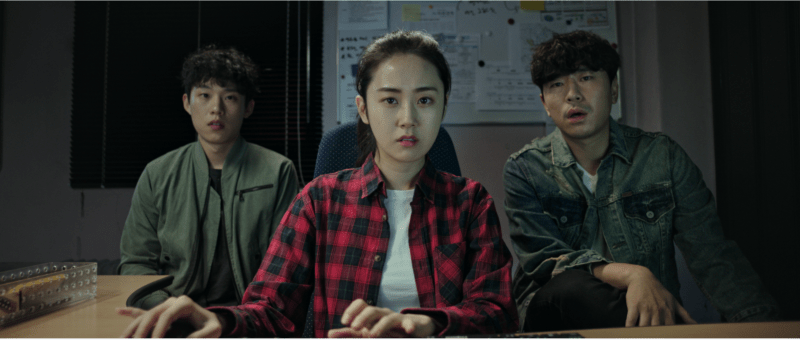
Search Out (서치 아웃, Kwak Jung, 2020)

A trio of disillusioned youngsters kick back against Hell Joseon by chasing down an internet serial killer in Kwak Jung’s dark cyber thriller, Search Out (서치 아웃). As the title implies, the three are each looking for something to tell them that they still have time, their dreams are still achievable, and their lives are worth living, yet as they discover there are those keen to convince them otherwise including a mysterious online presence who seemingly takes advantage of those already in despair and pushes them towards a dark and irreversible decision. 

The hero, Jun-hyeok (Kim Sung-cheol), is currently job hunting while working part-time in a convenience store. His best friend, Seong-min (Lee Si-eon) is desperate to join the police force but having trouble passing the civil service exams. To pass the time, Jun-hyeok also does odd jobs for people who need help under the pseudonym “Genie” via his social media accounts, but when he’s unexpectedly approached by a woman in the same boarding house who tells him that she’s in a dark place and needs someone to talk to, he turns her down out of embarrassment afraid that his “real” identity might be exposed and ashamed to admit that “Genie” is just regular guy who can’t get a job. Unfortunately, however, the young woman is later found dead in an apparent suicide. 

Consumed with guilt, Jun-hyeok tries to ease his conscience but accidentally stumbles across a weird account the young woman had been interacting with shortly before she died. “Ereshkigal” asks all the wrong questions of those already in a dark place, probing them about the meaning of life and whether their lives are really worth living before, as Jun-hyeok later realises, blackmailing them into completing various “missions”. Paradoxically, Jun-hyeok’s quest to stop the mysterious online threat is partly a way of absolving himself of guilt while simultaneously fighting back against those same feelings of despair that he too feels as a young man who can’t seem to get his foot on the ladder, rudely insulted by a cocky high school kid for being an “adult” still doing a student’s job. 

Seong-min feels much the same, indulging his love of justice as a man who just wants to protect and serve and feels it’s unfair he’s being prevented from doing so because he struggles with paperwork when his true strengths lie in the field. Turning to a private detective when the police won’t listen to them, the guys team up with frustrated hacker Noo-rie (Heo Ga-yoon) who like them also feels as if she’s stagnating, slumming it with a shady job at the detective agency when she obviously has major IT skills. A psychiatrist Jun-hyeok meets through his Genie job warns them that the killer may be leveraging his victims’ feelings of despair to convince them that the only way to escape suffering is through death. Despite himself, it’s a sentiment that Jun-hyeok can well understand. 

Like other young people his age, he attempts to mask his sense of loneliness through social media, another weakness the killer sees fit to exploit. Yet as a potential suspect later points out, “it’s fun to peek at others’ private lives” exposing himself as a banal voyeur while simultaneously revealing the unexpected vulnerability of those who live online. In any case, the final revelations are perhaps expected, and not, in the way they bare out the inequalities of the contemporary Korean society. Jun-hyeok starts to wonder if it really was all his fault from the very beginning as his own not quite innocent but largely accidental moment of social media notoriety may have had unintended, unforeseen consequences even as he sought a kind of justice in exposing wrongdoing by the rich and powerful. 

Nevertheless, as Seong-min is fond of saying, “you must do what’s right. You must bring justice”. Others might argue that it’s “natural to kill others to survive”, but the trio at least prefer mutual solidarity as they work together to take down the killer while fighting their own demons along with the continued indifference of the authorities which are supposed to protect them. Partly a treatise on why you should be more careful about what you post online and how you interact with others in general, Kwak’s steely thriller is also a story of three young people searching out a reason to live and finding it largely in each other as they come to an acceptance of life’s ambiguities but also of their right to define them for themselves. 


Search Out streams in the US March 24 – 28 as part of the 12th season of Asian Pop-Up Cinema.

International trailer (English subtitles)