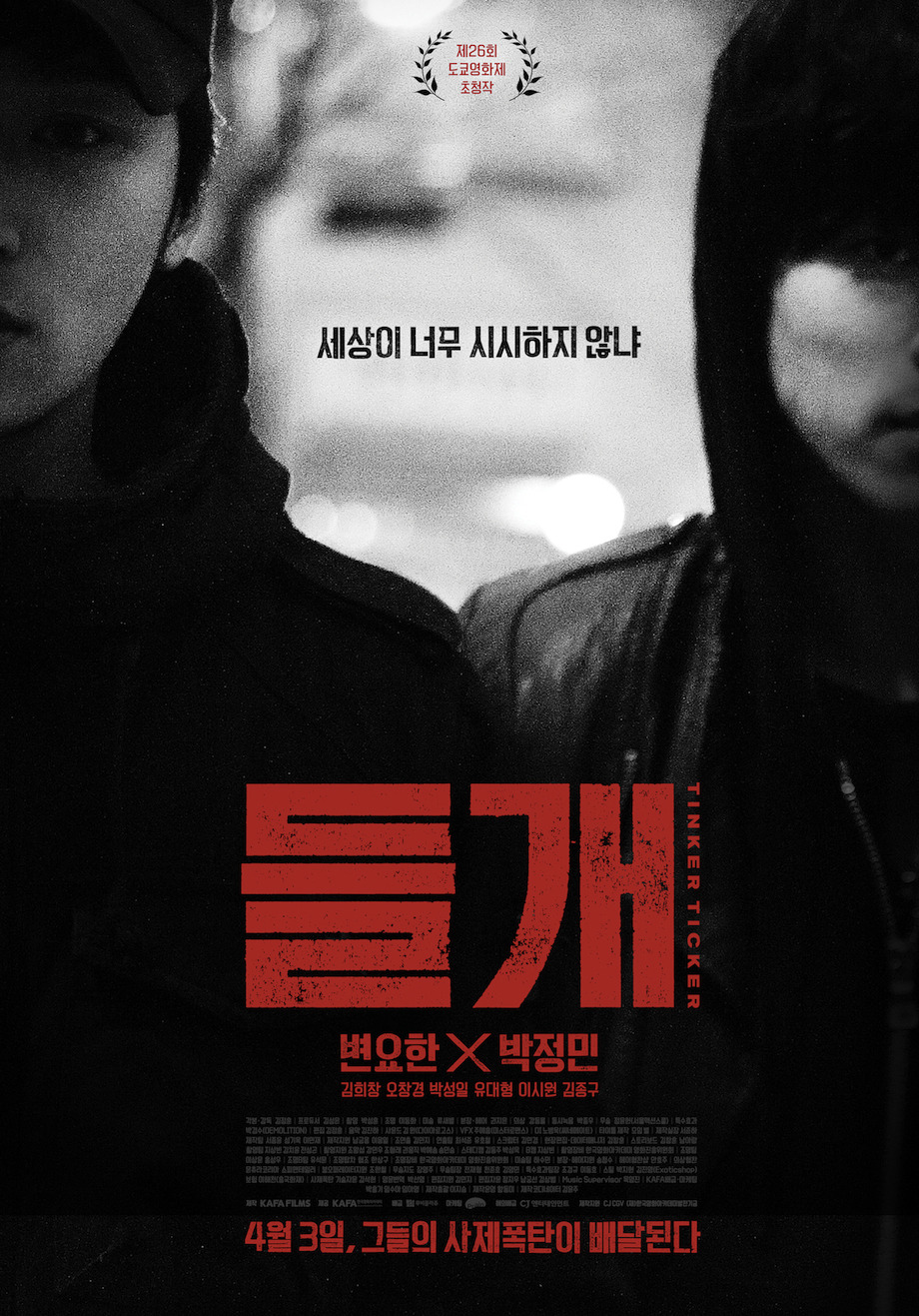
Tinker Ticker (들개, Kim Jung-hoon, 2013)

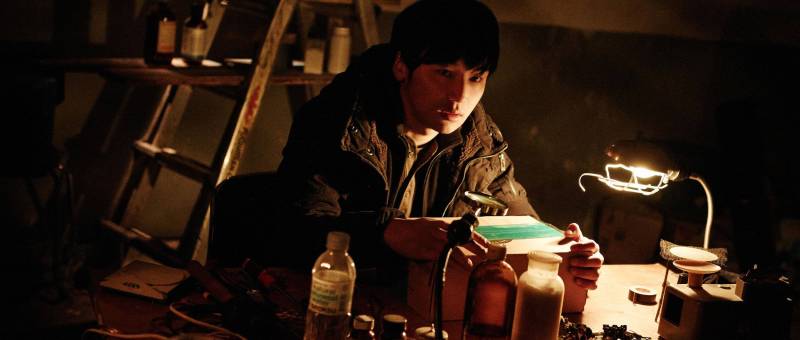
A jaded young man finds himself torn between continuing to fight the system and a total capitulation to it in Kim Jung-hoon’s explosive debut feature Tinker Ticker (들개, Deul-gae). Fit to explode, Jung-gu (Byun Yo-han) takes his revenge on a bullying culture by literally blowing it to hell but after a spell in juvenile detention emerges meek and mild, lacking in resistance and apparently willing to undergo whatever degradations are asked of him in order to achieve conventional success. 

Having placed a bomb in the car of a teacher who was abusive towards him, Jung-gu was caught and sent to prison with the unfortunate consequence that he can no longer study chemistry as he’s been banned from using dangerous substances. He repeatedly attends job interviews where he is asked bizarre and invasive questions, but can only find work as a post-graduate teaching assistant to a marketing professor who, like his teacher, largely abuses his position to humiliate him. To ease his frustrations, Jung-gu makes bombs at home but offers to send them out on the internet for free on the condition that the recipient actually use them.

His life changes when he runs into rebellious drop out Hyo-min (Park Jung-min) who is done with capitulation and fully committed to bucking the system. Seemingly from a wealthy family, he’s cut ties with his parents and lives a squalid life in a bedsit while continuing to attend university lectures despite having been expelled. Jun-gu sends one of the bombs to him to see what would happen and though Hyo-min seemed like he was going to simply throw it away he ends up blowing up a van which ironically has the CJ Films logo on the side.

Hyo-min in a sense represents Jung-gu’s rage and resentment towards the system that oppresses him along with a desire for anarchic autonomy while he conversely leans closer to a conventional corporate existence by willingly debasing himself before his sleazy boss Professor Baek (Kim Hee-chang) who asks him to act unethically by “revising” the results of his research so they can secure funding and do a back door deal with his long-standing contact Mr. Kim. Baek also forces him to drink beer that’s been drained through his sock as part of a bizarre hazing ritual while otherwise running him down or insulting him at the office. 

Hyo-min tries to goad Jun-gu into blowing up his attempts at conventionality by taking out Baek, but he continues to vacillate apparently still interested in becoming a corporate drone whatever the personal cost. “I don’t want you to become dull,” a slightly spruced up Hyo-min later insists in trying to push Jung-gu into killing Baek, while Jung-gu isn’t sure which life he wants torpedo. In any case, he seems incredibly ashamed of his criminal past and wary of others finding out about it not just because of its practical consequences for his employment but on a personal level. If he wants to transition fully to the life of a soulless salaryman he’ll need to kill the Hyo-min within him and remove all traces of resistance and individuality.

Despite having promised to do so, none of the other men who request the bombs actually use them perhaps like Jung-gu lacking the ability to follow through but enjoying the power of having the ability to burn the world even if they’ll never use it. Jung-gu’s bombing fixation is indeed in its way passive, a vicarious thrill in the ability to cause havoc for no real purpose but not really doing anything with it all while his resentment grows in parallel with his desire to be accepted by mainstream society. Hyo-min eventually comes to the conclusion that nothing really changes, and it both and doesn’t for Jung-gu who finds himself succumbing to the consumerist desires of a capitalistic society willing to debase himself, and later humiliate others, to claim his rightful place on the corporate ladder. Kim takes aim at the pressure cooker society, implying that these young men are in themselves almost ready to explode in their twin resentments and jealousies while ultimately complicit in their own oppression in wilfully stepping in to a corporate straitjacket even at the cost of their freedom and individuality. 


Tinker Ticker screened as part of this year’s London Korean Film Festival.

International trailer (English subtitles)

V.I.P. (브이아이피, Park Hoon-jung, 2017)

V.I.P. posterIn New World, Park Hoon-jung provided a bleak overview of creeping corruption with the absolute certainty that the forces of darkness will always win over those of the light, but with V.I.P. (브이아이피) he turns his attentions away from South Korea’s hellish gangland society to examine the effect of geopolitical concerns on the lives of ordinary citizens. He does this by positioning South Korea’s two biggest international concerns – America and The North, as twin manipulators with his home nation caught in the middle, trapped between the need to preserve allies and defend against enemies. The “enemy” here is a sociopathic serial killer allowed to get away with his crimes at home because of his elite status and then again abroad as a key informant of the American intelligence services.

Beginning at the end with a weary man accepting a gun and striding into a rundown building in Hong Kong, Park jumps back a few years to North Korea where an innocent schoolgirl is grabbed by a gang of three boys on a peaceful country road. Not only do they brutally rape and kill the girl, but they even go so far as to massacre her entire family. Police Chief Lee (Park Hee-Soon) identifies the killer as Kim Gwang-il (Lee Jong-Suk), son of a high ranking official. His boss closes the case; Gwang-il is untouchable. Lee is demoted and sent to a fertiliser plant.

A couple of years later similar crimes begin occurring in the South and maverick policeman Chae (Kim Myung-min), temporarily reinstated after being suspended for his violent ways, is handed the case after his superior apparently “commits suicide”. Like Lee, who eventually makes contact with Chae having followed his quarry to the South, Chae identifies Gwang-il and is prevented from arresting him but this time by South Korean intelligence services who were partly responsible for Gwang-il’s defection working closely with America’s CIA and the very greasy Agent Gray (Peter Stormare).

Like many Korean films of recent times the central point of concern is in the ability of the rich and powerful to do whatever they please and get away with it because their special status makes them untouchable. Park scores a double a whammy when he casts his villain both as an elitist and as a North Korean though he draws no connection between life in a brutalising regime and the desire to inflict violence.

This is a violent tale and the violence on show is sickening, often needlessly so. After showing us the aftermath of what happened to the innocent teenage girl in the prologue and then to her entire family including a five year old brother, there was really no need to go into detail but Park eventually includes a horrifying scene of Gwang-il garrotting his victim in an elegant drawing room right underneath the portraits of the Kims hanging proudly on the wall. The scene is problematic for several reasons but the biggest of them is in the depiction of the naked female body covered in blood and bruises while Park’s minions stand naked around her, pale and unstained by her blood, each of the actors carefully hiding their genitals from the camera. The victim, who has no lines other than a final plea not to kill her, is the only real female presence in the film save for one female police officer who is seen briefly and only appears to become another potential victim for Gwang-il.

The real ire is saved not for Gwang-il but for the intelligence services who lack the backbone to stop him. The Americans, or more precisely a need to placate them, are the major motivator – a fact which takes on additional irony considering Gwang-il is the North Korean threat the US is supposed to be helping to mitigate. It remains unclear why the CIA would be allowing Gwang-il free reign to live as a regular citizen given that he supposedly has important information regarding North Korean finances which is the reason the Americans are helping him defect, rather than keeping him safely contained and preventing him from committing heinous crimes all over the world which, apart from anything else, threaten to cause huge embarrassment to everyone involved. Still, Agent Gray lives up to his name in his general sleaziness and the intense implication that he is playing his own long game which may have nothing to do with country or protocol.

Park’s decision to structure the film in several chapters each with a different title card often works against him, taking the momentum of his procedural and occasionally proving confusing. Loosely, Park ties the stories of three men together – the idealistic North Korean officer who wants to see justice done, the grizzled cop with a noble heart, and the conflicted NIS officer realising the unforeseen consequences of his attempts to play politics for career advancement, but he fails to weave their fates into anything more than an extremely pessimistic exploration of hidden geopolitical oppression. Final shootout aside, V.I.P. is a grimy, politically questionable thriller which irritates in its narrative sluggishness and leaves a sour taste in the mouth in its own indifference to its villains’ crimes in favour of his V.I.P. status as the representative of an entirely different existential threat.


Screened at the London East Asia Film Festival 2017.

Original trailer (no subtitles)