Luminous Woman (光る女, Shinji Somai, 1987)

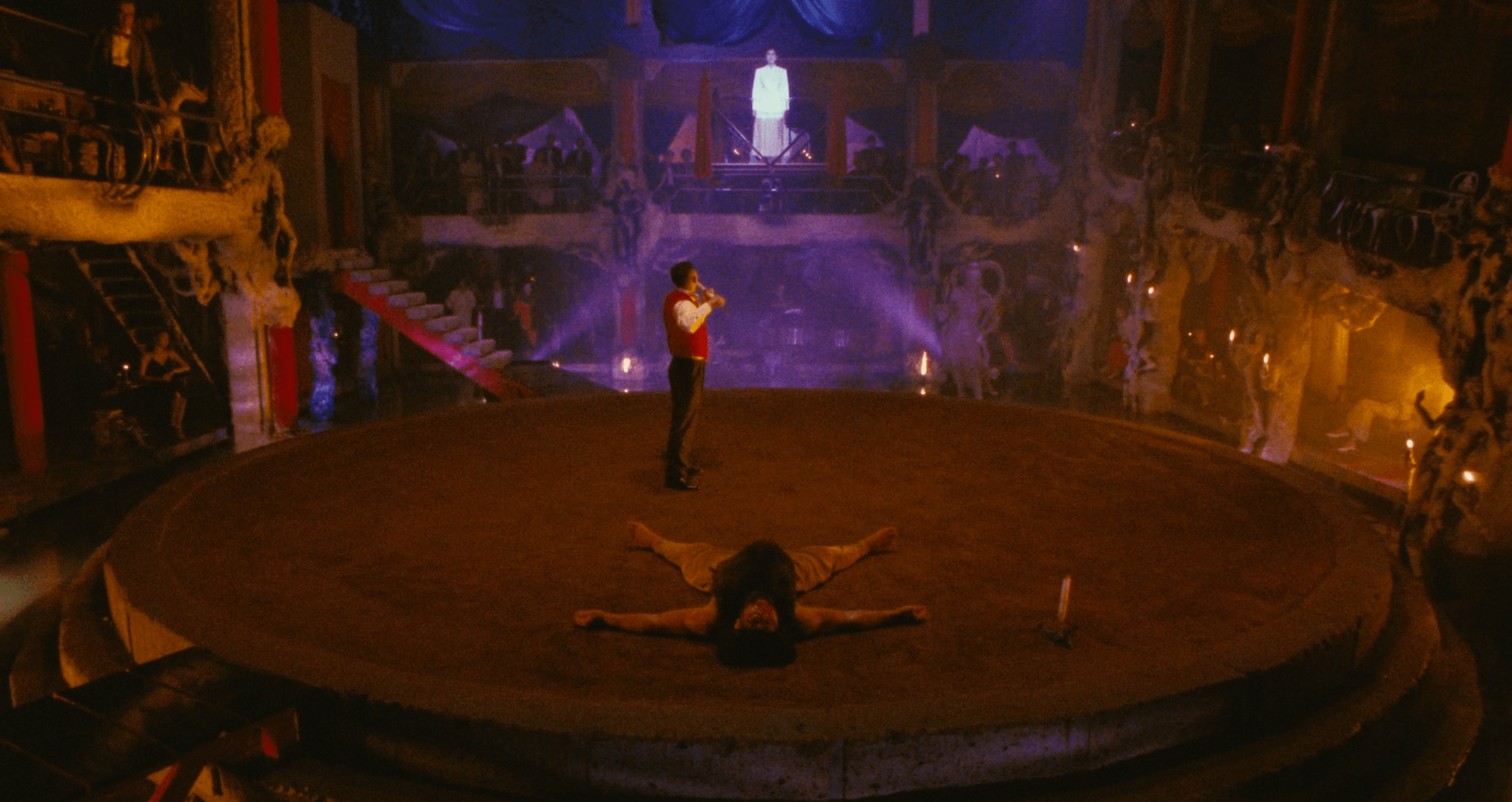
“I’ve come to the city and my heart has turned black” sings a monstrously corrupt former opera singer turned bizarre nightclub impresario in hellish Bubble-era Tokyo. A tale of urban “sophistication” versus pastoral innocence, Shinji Somai’s Luminous Woman (光る女, Hikaru Onna) sends a pure-hearted mountain man into the dark heart of the modern day city hoping to rescue the woman he loves who swore she would return to him but instead has been swallowed whole by the neon-lit landscapes of the contemporary capital. 

“Tokyo is lonely place” the hero immediately exclaims on witnessing it from the urban sprawl across the water in the company of an opera singer, Yoshino (Monday Michiru), whom he describes as like a doll without any blood coursing though its body. The incongruity of Sensaku’s (Keiji Muto) presence is immediately signalled by his appearance. Dressed in a bearskin jerkin and baggy trousers, walking with bare feet (all the way from Hokkaido!) and his face mostly beard, he looks every part the frontiersman as if he’d somehow stepped out of the 19th century straight into Bubble-era Japan. As he explains, he’s come looking for his woman, Kuriko (Narumi Yasuda), who travelled to Tokyo to study accounting to help the local farmers manage their businesses when she returned to run a farm with Sensaku. 

The first note of discord arrives when the man travelling with the opera singer, Shiriuchi (Kei Suma), tells him that he knows a woman by that name who also came from the same town in Hokkaido but she now works as a bar hostess. Shiriuchi only agrees to tell Sensaku the rest of what he knows if he makes an appearance at his club in its gladiatorial floor show. Sensaku is used to the primal struggle, he’s a mountain man after all and physically robust. He isn’t afraid of a fight only warning that there’s a chance he may kill his opponent to which Shiriuchi declares so much the better.

This a Tokyo populated by those who are in a sense already dead. Shiriuchi’s floor shows leverage mortal struggle as a means of existential validation, yet his concept of “sophistication” founded in European classicism is directly contrasted with the idealised pastoralism to which Sensaku eventually returns as he and the other villagers plant new crops surrounded by greenery and an incongruous mix of animals including a mischievous racoon. Yoshino, the “bloodless” opera singer has lost her ability to sing seemingly because of her oppression at the hands of Shiriuchi who describes as her as a “commodity”, “precious as a diamond”, but later treats her as a kind of broken toy complaining that if he cannot “enjoy” her body nor exploit her voice she has no further value to him. 

It soon becomes clear that Kuiriko too has fallen under his spell, working at an equally weird nightclub where the pale-faced hostesses wear kimono and sing children’s folksongs. She came to the city for education, but has become a drug user which leaves her vulnerable to Shiriuchi’s manipulation. Several times he is referred to as “master” and there is something Devil-like about him in the influence he seems to wield in these strange spaces of the prosperous city buried somewhere beneath the neon lights and sprawling office blocks. The pinkish tint of Somai’s colour grading along with his characteristically roving camera add to the sense that we already in hell and if Sensaku does not escape from it soon, he too will be consumed like Akanuma (Hide Demon) before him who came to look for a woman only to discover that she had already found happiness with someone else. 

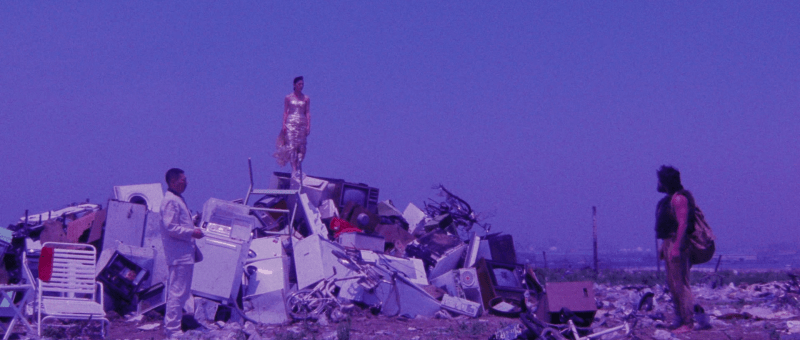
Mountain man Sensaku’s identification with fisherman Akunuma is only further deepened by the sensation that he too is “burning” in the literal flames which lend a hellish glow to the empty swimming pool where he consummates his relationship with Yoshino who subsequently regains the ability to sing. They are both in a sense pure-hearted men out of place in the emotional austerity of a modern capitalist society, a pair of Orpheuses descending into hell in search of lost love but finding only disappointment and ruination. Sensaku is finally able to escape in accepting that he cannot rescue Kuriko in part because she has no desire to be rescued, while Yoshino may still come with him if she too chooses to leave. Somai’s characteristically long takes add an edge of eerie oscillation to his often theatrical composition which culminates in the scene of two women connected via telephone call seemingly sharing the same space even as one is surrounded by a spiderweb of laser-like red string. Dreamlike and often surreal, Somai’s etherial fable casts the Bubble-era society as a hellish underworld of broken dreams and human cruelty but finally takes refuge in a scene of pastoral restoration neatly mirroring the trash-heap paradise of its opening.


Luminous Woman screens at Japan Society New York on May 5 & 13 as part of Rites of Passage: The Films of Shinji Somai

Teaser trailer (no subtitles)
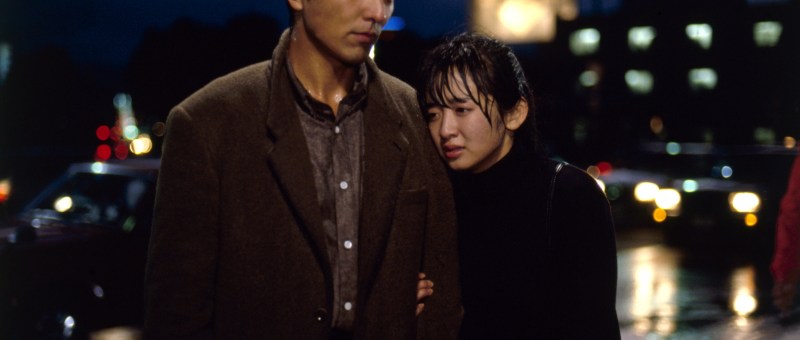
Lost Chapter of Snow: Passion (雪の断章 情熱, Shinji Somai, 1985)

Lost-Chapter-of-Snow-Passion dvd coverShinji Somai’s work is most closely identified with depictions of contemporary young people who meet their approaching adulthood with an almost nostalgic melancholy but in Lost Chapter of Snow: Passion (雪の断章 情熱, Yuki no Dansho: Jonetsu), he takes things one step further as his orphaned heroine moves through dependence to independence and finally assumes her own identity. Based on a novel by Marumi Sasaki, Lost Chapter also fits neatly into the idol movie subgenre, starring the then popular singer and actress Yuki Saito who sings frequently throughout the film and provides the end titles theme Jonetsu (Passion).

As the film opens, seven year old orphan Iori (Mami Nakazato) has been adopted by the wealthy but cruel Naba family who regard her as a slave, to be beaten, humiliated and pressed into service. One day, an employee of Naba’s, Yuichi (Takaaki Enoki), visits and witnesses Iori’s cruel treatment at the hands of oldest sister Sachiko (Kyoko Fujimoto), immediately taking her home to live with him. The situation is difficult, especially as Iori’s past has led her to be wary of new connections, and her sudden arrival has also placed a strain on Yuichi’s engagement to a girl still living in Tokyo far away from snowy Sapporo. Ten years pass and Iori (Yuki Saito) has become a happy, healthy high school girl but the resurfacing of the Naba sisters in her life is to have profound consequences when one of them is murdered and Iori finds herself regarded as a prime suspect.

Embracing its almost Dickensian roots, Lost Chapter’s most obvious theme is the place, or displacement, of the orphaned within Japanese society which places the family above all else. Iori’s origins are never mentioned beyond her early life in an orphanage, but even when Yuichi brings her home the first words the housekeeper offers are that a discarded child like Iori maybe trouble, assuming that she is the result of a “loose woman’s” weakness and irresponsibility. The Nabas, who are a thoroughly unpleasant bunch ruled over by older sister Sachiko, have adopted her despite being an already large family but raising a lonely child in love was not their aim so much as getting a kitchen maid they wouldn’t have to pay. Iori is sent out on pointless errands through the snow and freezing air only to fear she will be beaten for having drunk the juice she was sent to buy on Sachiko’s behalf. This fate is not unique to Iori as she discovers when Daisuke (Kiminori Sera), a friend of Yuichi’s who has become like a second father to her, reveals his orphan past as a poor relation sheltered by family members but not quite embraced by them.

Iori’s poor treatment at the Naba’s is offered as a possible motive for the murder of Hiroko (Mai Okamoto) – younger sister to Sachiko and a student in the same class as Iori. Hiroko is fairly depressed and a flighty girl, still cruel and eager to show off in front of her former step-sister with a lengthy dance sequence offered in front of the hottest boys at school. When she dies suddenly, all evidence points to a cup of coffee Iori tried to take her in kindness but even if it wasn’t Iori who plotted to kill her, Hiroko’s death is still firmly linked to her family’s cruel superiority.

The strain of the investigation plays on Iori’s mind, forcing her into a deeper consideration of her place within Yuichi’s household especially as she’ll soon be approaching the crossroads of adulthood and will need to decide whether to go on to university or leave Yuichi’s house to be independent. In the housekeeper’s mind, staying at “home” is not an option once she could, theoretically, support herself but Yuichi and Daisuke may feel quite differently about this damaged little girl they once took in and are still in the process to turning into a fine young woman. Yuichi’s housekeeper has a choice metaphor regarding Yuichi’s intentions in rescuing Iori – pointing to a withered flower, she suggests that Iori was a thirsty seed that Yuichi has been patiently watering in order to see the flowers bloom, but this way of viewing the situation places a further wedge between Iori and Yuichi who is still seeing his fiancée in Tokyo while Iori’s feelings about the father figure who raised her but is also still a handsome, kind, and youngish man have begun to become confused.

Falling into shojo romance territory, Lost Chapter does indeed become a slightly uncomfortable romantic tale in which a young woman falls in love with her “father” and he with her though, as they aren’t blood related, it can still be depicted as sweet and innocent rather than a tale of long term grooming and inappropriate power structures. Yuichi, though obviously a kind and socially minded young man, is nevertheless as “irresponsible” as he’s branded in his neglect of his longterm fiancée (who later makes an embarrassing first visit in nine years to Yuichi’s home to ask Iori to back off and finally declare herself grown up so she and Yuichi can marry), and later positing of Iori as some kind of pet project in his determination to have her graduate university – a feather in his cap rather than a stepping stone to a middle-class life for his precious daughter.

Known for his long, roaming, handheld takes Somai opens with a 14 minute seemingly unbroken, dreamlike sequence recounting Iori’s life with the Nabas and her eventual rescue. Somai’s camera pans around a series of snow trenches, placing a phone call from Tokyo right inside the icy space alongside a hidden violin player scoring the action. Shot with the random, etherial quality of memory mixed with dream, this first sequence gives way to a more conventional main body even if Somai maintains his preference for long takes filled with surprising pans and unexpected entrances into the frame. There are great moments of tenderness and warmth in Iori’s story, brought to life by Somai’s noticeably expressionist techniques, but there’s pain and darkness too as death and suicide lurk in the background, ready to strike at any moment. A beautifully surreal, theatrical exploration of a standard coming of age tale Lost Chapter is both shojo romance at its most controversial and a fine showcase for a popular idol shining in a leading role.


Originally released as a double header with Nobuhiko Obayashi’s Four Sisters.

14 minute long take intro (no subtitles)

Yuki Saito singing Jonetsu on a Japanese TV show presumably around the time of the film’s release.

https://www.youtube.com/watch?v=gbR79Yax8R0

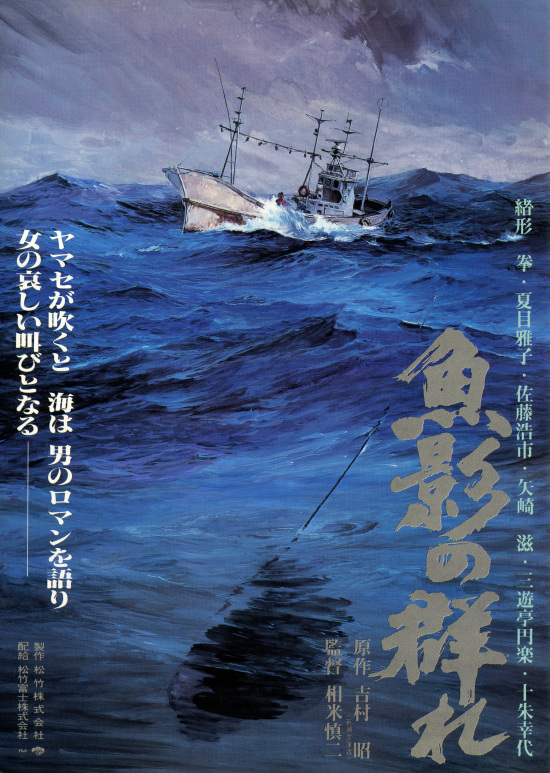
The Catch (魚影の群れ, Shinji Somai, 1983)

the-catch

Some men become their work, the quest for success consumes them to the extent that there is barely anything left other than the chase. The Catch (魚影の群れ, Gyoei no Mure), Shinji Somai’s 1983 opus of fishermen at home on the waves and at sea on land is a complex examination of masculinity but also of fatherhood in a rapidly declining world filled with arcane ritual and ancient thought.

Fusajiro (Ken Ogata) is a middle aged man who looks old for his years. Man and boy he’s spent his life at sea, hunting down the elusive tuna fish which can be sold for vast amounts of money in the rare event that one is actually caught. This “first summer” as the title card refers to it, marks a change in his life as the daughter he’s been raising alone since his wife left him many years ago, Tokiko (Masako Natsume), has found a man she wants to marry. Her boyfriend, Shunichi (Koichi Sato), owns a coffee shop in town and Fusajiro has his doubts about a city boy marrying into a fisherman’s family. However, Shunichi isn’t just interested in Tokiko, he wants to set sail too. Though originally reluctant, Fusajiro eventually agrees to take Shunichi as a kind of apprentice but is dismayed when he gets seasick and seems to have no hint of a fisherman’s instinct.

Fusajiro is a legend among his peers – a big man of the sea, a true sailor and top hunter. He’s the one people turn to whenever anything goes wrong on the waves. However, he’s also a gruff man who speaks little and seems to prefer his own company.  In the rare event that he is speaking, it’s generally about tuna. When Shunichi first meets Fusajiro he remarks that he knew it must be him because he “smells of the sea”.

A later scene sees Fusajiro catch sight of a woman caught in the rain who immediately starts running away from him. Chasing her  just like one of his ever elusive tuna he eventually pins the woman down and takes her back to his boat to complete his conquest. The woman turns out to be his ex-wife, who left him precisely because of this violent behaviour. After momentarily considering returning to him, she realises that he hasn’t changed and accuses him of being unable to distinguish people from fish – he hooks them, reels them in, and if they don’t come willingly he hits them until they do so he can keep them with him. This overriding obsession with domination also costs Fusajiro his daughter when Shunichi is gravely injured on the boat and Fusajiro delays returning to port until he’s secured the tuna he was chasing at the time. Shunichi’s blood and the fish’s mingle together on the deck, one indistinguishable from the other, both victims of Fusajiro’s need to reign supreme over man and fish alike.

Fusajiro tried to warn Tokiko not to marry a fisherman, it would only make her miserable. Shunichi is warned that a fisherman’s life is a difficult one and the seas in this area less forgiving than most, but his mind is made up. Finally acquiring his own boat after selling his cafe, Shunichi, just like Fusajiro, starts to fall under the fisherman’s curse – endlessly chasing, living only for the catch. Unlike Fusajiro, however, Shunichi has little instinct for life at sea and fails to bring home his prey. Little by little, the mounting failures eat away at his self esteem as he feels belittled and humiliated in front of the other sailors culminating in an attempt to reinforce his manhood by raping his own wife. These men are little better than animals, consumed by conquest, permanently chasing at sea and on land. To be defeated, is to be destroyed.

Somai never shies away from the grimness and brutality of the work at hand. Ogata catches and spears these magnificent fish for real and the unfortunate creatures are then carved up right on the dockside before our very eyes. As we’re constantly reminded, physical strength is what matters for a fisherman and Fusajiro is a strong man, duelling with the tuna fish and straining to hold the line with all his might. Yet he’s getting old, his body is failing and like an aged toreador in the ring, his victory is no longer assured. The Japanese title of the film which translates as crowds of shadows of solitary fish expresses his nature more clearly, his fate and the tuna’s are the same – a lonely battle to the death. Unable to forge real human connections on land Fusajiro and his ilk are doomed to live out their days alone upon the sea wreaking only misery for those left behind on the shore.


Original trailer (No subtitles, graphic scenes of animal cruelty)