
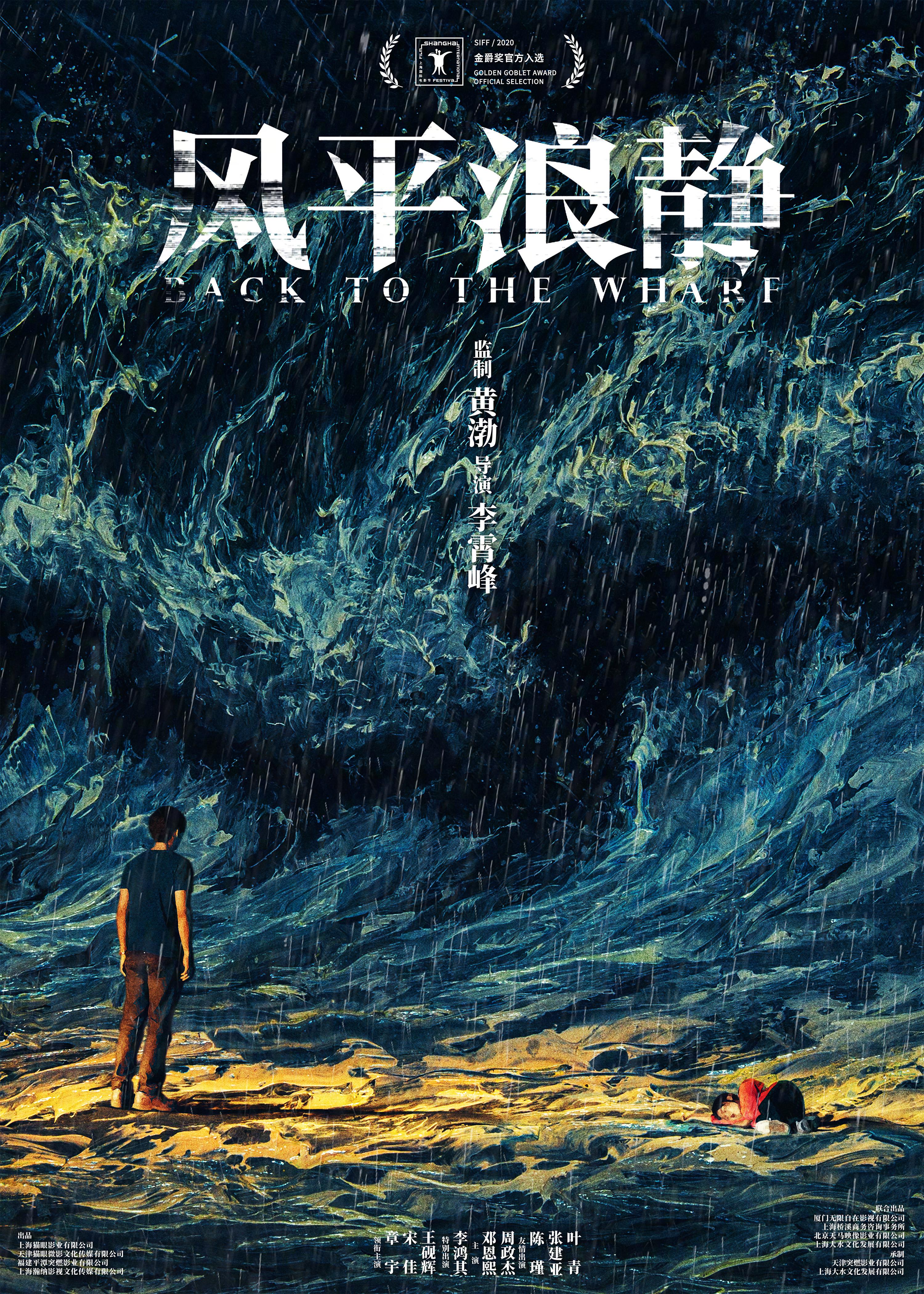
“How dare you want to live when your existence is pointless” a father admonishes his blameless son, deflecting his own willing complicity in the persistent decline of the modern China. Repeatedly abandoned and betrayed firstly by his society, then by his friend, and finally by his father, the hero of Li Xiaofeng’s moody neo-noir Back to the Wharf (风平浪静, Fēngpínglàngjìng) first chooses self-exile only to eventually return and wonder if his crime has been forgotten allowing him to live again before discovering that nothing really changes, there is no escape from the whims of the rich and powerful in an increasingly feudal society.
Quiet and studious, Song Hao (at 17: Zhou Zhengjie / at 32: Zhang Yu) first wakes up to life’s unfairness in 1992 when he’s called into school on a holiday by his headmaster who breaks the news that he’s losing his guaranteed university place supposedly because his grades are good enough to get there on his own and others need it more. “I like to prioritise the collective over the individual” he explains, reminding him that an extra person from the school going to a top uni can only be a good thing though it’s obviously a blow to Hao not to mention his ambitious father Jianfei (Wang Yanhui) who immediately rings up to complain and discovers that the place is going not to a needy student but Hao’s best friend Li Tang (Lee Hong-chi), son of the local mayor. Angry and confused, father and son set off on circular journeys to confront their respective counterparts, but there’s a storm raging and Hao accidentally wanders into the wrong house after noticing the door flapping in the wind. After walking past a baby sleeping upstairs he runs into an old man who mistakes him for someone else and soon lashes out, shoving fruit into his mouth and trying to suffocate him at which point Hao picks up a knife and stabs his attacker in the belly. Taking flight in terror Hao believes he has just killed a man and orphaned a little girl, never knowing that his father arrived a few minutes later and finished the old man off to stop him talking or that Li Tang was watching the whole thing from a window in the opposite building.
Returning 15 years later for his mother’s funeral, it’s Li Tang who is most pleased to see Hao when he runs into him by chance at the ruins of the scene of his crime now a future development site for the young real estate tycoon, that is if the now young woman (Den Enxi) the orphaned baby has become whom Hao had been following out of guilt-ridden curiosity would agree to vacate her family property. While Hao has been languishing as a lonely construction worker, Tang has prospered off the back of the 90s economic boom largely thanks to an entrenched network of local corruption that runs from his father the mayor through Hao’s father Jianfei who was handed a fat promotion presumably to placate him over the uni places scandal. Tang has, in a sense, stolen his future leaving him quite literally displaced wandering in the ruined landscape of a haunted past while his father, he discovers, had divorced his mother and remarried in order to have another son. “Your upbringing was a failure” he cooly explains, he needed another male heir to salvage the family reputation and restore his name. Jianfei has, however, done pretty well out of the arrangement now a wealthy man with a separate apartment Hao is not welcome to visit but planning to send his wife and child abroad and retire to Australia.
Intending to leave as soon as possible, Hao nevertheless starts to wonder if it hasn’t blown over and he might in a sense be allowed to seek happiness, bamboozled into a romance with an old school friend (Song Jia) apparently carrying a torch for him all this time. The past, however, will not let him go. The corruption runs deeper than he even suspected as does Li Tang’s insecure greed and duplicity, attempting to force friendship through blackmail. An embodiment of post-70s fuerdai Li Tang is an amoral capitalist willing to do anything it takes in pursuit of wealth, but at heart a coward ashamed that he owes everything to his father’s machinations and perhaps projecting all of his resentment onto his old friend Hao whose future he so casually stole.
Yet the message seems clear, men like Hao will always be at the mercy of men like Tang. Perhaps this is the bargain his father has made, but it’s one that Hao can no longer tolerate once Tang forces him to destroy the roots of his redemption. The only sane response to the madness of the modern China, he seems to say, is to go mad in one way or another. Even so, this being a Mainland movie, the nihilistic fatalism of the inevitable conclusion is somewhat undermined by the brief coda in which a policeman reassures a young woman that the crime has been investigated and the wrongdoers punished while the now familiar title card explains to us who went to prison and for how long for their many and various moral transgressions. Hao’s existence is rendered “pointless” because he is unable to live by the rules of a corrupt society, yet his self-destructive act of rebellion does perhaps bring about change if only in the names involved. Beautifully shot with brief flashes of expressionism amid the rain drenched streets of a decaying city to the melancholy strains of a noirish jazz score, Li’s fatalistic takedown of the inequalities of the post-90s society is an exercise in style but one which lets few off the hook as its nihilistic conclusion stabs right at the heart of patriarchal corruption.
Back to the Wharf streamed as part of the Glasgow Film Festival.
Original trailer (simplified Chinese subtitles only)


 Windows on Worlds