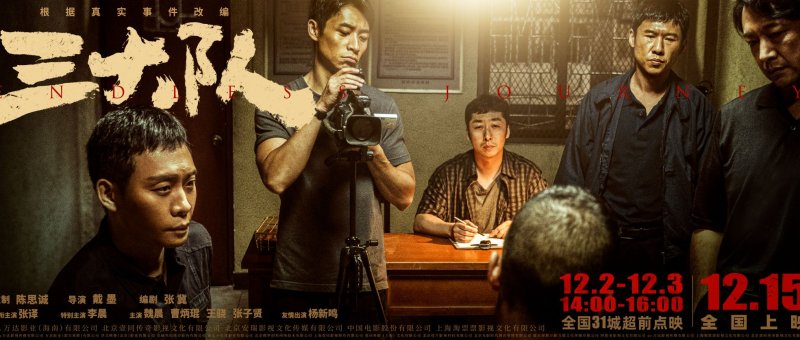
Endless Journey (三大队, Dai Mo, 2023)

The police officers at the centre of Dai Mo’s Endless Journey (三大队, Sān Dàduì) are soon stripped of their badges, accused of excessive force contravening laws existing since the medieval era to prevent vigilante justice. Yet in someways that’s essentially what they end up doing, extra-judicial investigators with a personal vendetta rather than a pure-hearted interest in justice even if the victim of the crime weighs heavily on their conscience. 

Though the film plays into the recent trend in Sino-noir and popularity of mystery thrillers at the Chinese box office, it is surprising that a film that is at least subtly critical of the justice system, featuring police who break the rules and are sent to prison, was approved by the censors board even if the central message is one of heroism as Captain Cheng (Zhang Yi) doggedly chases his suspect all over China for several years. Then again, the hero of this true life case turns out to be China itself as Cheng is reminded that his search is unnecessary given that the fugitive, Eryong (Zheng Benyu), is sure to be captured by the burgeoning surveillance network of CCTV cameras then being rolled out across the country. Years later, it’s the system that allows Cheng to identify Eryong as his DNA and fingerprints throw up positive matches within seconds of samples being taken thanks to the nation’s DNA database. 

Even so, as the veteran officer, Zhang (Yang Xinming), reminds the rookie behind every major case there’s a ruined family broken by their loss which is one reason why he doesn’t relish the prospect of investigating one so late in his career. This particular crime is so heinous that it’s become front page news which means that they’ve also got their boss breathing down their necks to get it solved as soon as possible with the existence of Division 3 itself on the line. Cheng pops home for a matter of minutes to check on his wife and daughter, shutting down his wife’s suggestion that they get a security system for their windows on the grounds that it would be an embarrassing thing for a detective’s home to have. The reason she wants one is that the victim in this case had been a little girl of around their daughter’s age unexpectedly home alone when thieves broke in by climbing over their aircon unit and smashing a window. Finding nothing of value they raped and killed the daughter. 

After a police officer dies as a result of the investigation, the squad take things too far questioning the first suspect leading to his death which is how they end up disgraced and sent to prison. After his release, Cheng has lost his family, his home, his job and identity as a protector of justice yet his determination to catch Eryong is born more of his desire to avenge a friend than it is to prevent further crime. His fellow officers join him in the beginning, but during the endless searching each make the decision to move on for easily understandable reasons such as their marriages, children, and illness but Cheng cannot let go even when prompted by an old friend from the force who tells him they have this in hand though there is perhaps a subtle implication that the police force isn’t really doing enough otherwise Cheng wouldn’t have to be chasing Eryong all over the country. 

But haunted by reflections of his own face, ageing, at times dishevelled and hopeless, Cheng is also searching for himself and a means to reclaim the self he once was by vindicating himself as a policeman along with Division 3 in finally completing their mission. The ominous score by Peng Fei with its stinging strings adds to the noirish feel as does the perpetual inevitability of Cheng’s forward motion in the dogged pursuit of his prey, unable to rest until Eryong has been brought to ground. His quest robs him of his life, but there is an undeniable poignancy to it in Cheng’s inability to find himself outside of the chase only to be left with a moment of uncertainty no longer sure who he is or where he goes now, left alone and with no sense of direction in the absence of his quarry.


Endless Journey is in UK cinemas now courtesy of CMC.

International trailer (English subtitles)

River of Salvation (一江春水, Gao Qisheng, 2020)

“But life’s supposed to be good, isn’t it?” the heroine of Gao Qisheng’s indie drama River of Salvation (一江春水, yī jiāng chūn shuǐ) asks an old lady who has just explained that she’s considered taking her own life because of its inescapable misery. The film’s title may in its way be ironic in that there’s no real sign of salvation for anyone in this quiet backwater of rural China where as we discover no one is quite who they say they are. 

The hopelessness of 32-year-old Rong’s (Li Yanxi) existence is emphasised in the opening scenes in which she gets dressed up and heads to the port to pick up her fiancé’s mother only to be told that she won’t consent to the marriage partly because her intended’s first wife was a refined, elegant woman of much higher status while her son, Sanqiang (Chen Chuankai), is rough and boorish. Rong walks home feeling humiliated but also as if a last shot at happiness has been taken away from her. Sanqiang is also her boss at the moribund massage parlour (seemingly legitimate and offering only foot massages) where she works which is itself in the midst of financial difficulty. Meanwhile, she’s also the sole carer for her 18-year-old younger brother, Dong (Zhu Kangli), who spends most of his time playing video games and hanging out with his delinquent girlfriend, Jing (Yang Peiqi). 

As dull as her life seems, we can also see that Rong has a degree of anxiety and may be attempting to hide something about her past. She seems unusually cagey when her friend and workplace colleague Jinhua (Liu Jun) tries to invite her to a recently opened dumpling shop while almost always wearing a face mask claiming to be allergic to UV light. When the police are called due to a workplace altercation, she finds herself hiding in the basement obviously not wishing to encounter them. Yet as she discovers pretty much everyone in this small backwater town is hiding something or as Jinhua puts it is different on the inside. The guy on the front desk (Xi Kang) has been embezzling money to cover a gambling problem while even the lovely old lady (Huang Daosheng) with whom Rong bonds has not been entirely honest with her even while selling dreams of a better life. 

The central crisis is itself motivated by dishonesty in Jing’s claim that she is pregnant, later (perhaps falsely) stating that she made the whole thing up in order to test Dong shortly after reciting her own tearful monologue about the kind of life she wants but fears she can never have. The relationship between Jing and Dong encourages Rong to reflect on her own adolescence which contains more than a few troubling elements the film never sufficiently explores even while it becomes clear that she is haunted by guilt over something which is later revealed to be a triviality. People ask her if she hasn’t thought of moving on, but she tells them that she doesn’t know how to do anything else essentially trapped in dead end small-town China where the only hope of escape seemingly lies in marrying a man with means. 

Making up her mind, Rong begins teaching Dong how to be independent in the light of her impending absence while he too steps into adulthood in finding his own direction and striking out in search of it. Having faced her past, Rong quite literally burns her mask perhaps hinting at a return to a more authentic self yet pushed into a strategic retreat released from the purgatorial limbo of her small-town life but left with no place to go. Shot in 4:3, Gao’s static camera lends an additional air of stagnation to Rong’s otherwise stultifying existence which is not itself unhappy except in its concurrent anxiety and pervasive sense of hopelessness. There may be no river of salvation, but Rong does at least begin to unpick the duplicities of the world around her in unmasking the various personas she encounters while digging out their hidden truths until finally deciding to face her own and gaining with it a kind of liberation if not perhaps one which engenders a great deal of hope for the future. 


River of Salvation screens in London at Picturehouse Finsbury Park, 17th May as part of Odyssey: a Chinese Cinema Season.

Original trailer (Simplified Chinese / English subtitles)