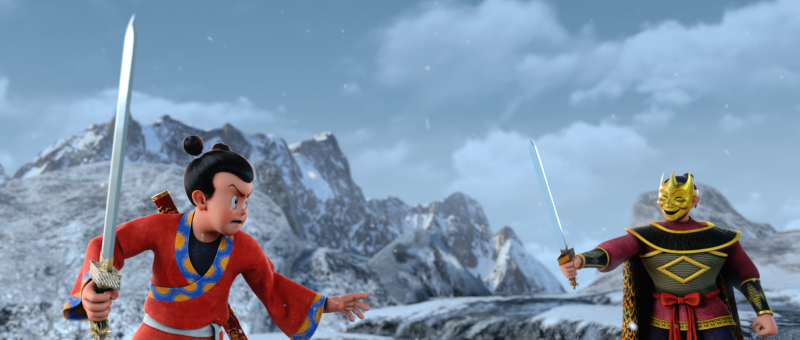
Shiro – Hero of Heroes (諸葛四郎 – 英雄的英雄, Lin Yu-chun & Chuang Yung-hsin & Liu Yu-shu, 2022)

An earnest young man, grieving son, and feisty princess team up to stop the evil Demon Society from becoming all-powerful rulers of their land in an adaptation of classic Taiwanese comic book Shiro – Hero of Heroes (諸葛四郎 – 英雄的英雄, Zhūgě Sìláng – yīngxióng de yīngxióng). Created by Yeh Hong-Chia in the late 1950s, the series has become a nostalgic touchstone for generations of children and is about to reach new ones with a feature-length 3D CGI animation following Zhuge Shiro (Wang Chen-hua) on another exciting adventure to reunite the magical Dragon and Phoenix swords and stop their awesome power from falling into the wrong hands. 

Unfortunately the Dragon Sword has already been lost, much to the king’s regret. When Demon Society raid the palace during a festival and place a mask over the princess’ face, the king puts the land on lockdown and summons the nation’s locksmiths to try and free her only to realise there’s no way to unpick Demon Society’s diabolical locks without giving in to their demands to surrender the Phoenix Sword. Luckily hero of heroes Zhuge Shiro just happens to be in town on the invitation of his locksmith uncle and pledges to help the king salvage his fracturing relationship with his daughter who resents his hesitation to exchange the sword for her wellbeing and make sure Demon Society doesn’t get its hands on the swords’ unleashed power. 

Though this is in many ways a tale aimed at younger audiences, the incredibly witty script moving to the rhythms of traditional opera includes a series of meta jokes for grownups from a silly reference to a limited edition dart and workplace exploitation to subtle digs at societal authoritarianism along with a small cameo from a wandering cartoonist whose work is censored by the powers that be. Having faced Demon Society several times before, Zhuge Shiro is a pure hearted young man wise beyond his years with a strong sense of justice. His first act of goodness is standing up to an officious guard, General Shan, who won’t let a worried father with a sick child enter the town to find a doctor, while he soon earns the respect of the king through his compassion and emotional intelligence in trying to explain the king’s dilemma to the princess. He does however engage in a little sexism which the princess herself is quick to push back against, pointng out that she’s a skilled fighter herself and does not need protecting but will be joining him on this mission whether he likes it or not. 

Similarly, Zhuge Shiro gains another comrade in Zhen Ping (Chiang Tieh-Cheng) who is originally under the misapprehension that Zhuge Shiro is responsible for his father’s death only to later realise it was all the fault of Demon Society. To reunite the swords and save the kingdom, the trio find themselves battling through the villain’s booby trapped lair and discovering that the swords’ power lies in a different place than they first might have assumed, one Demon Society is largely unable to appreciate and therefore to benefit from even if they had managed to hold both swords in tandem. In other words, it’s brotherhood and justice which eventually enable the trio to prosper while the bumbling masked demons only make fools of themselves in their intense greed and villainy. 

Staying close to the aesthetic of the comic book, the film’s highly stylised designs closely match those of the original characters from back in the late 1950s if perhaps a little cuter and rounder in keeping with contemporary CGI animation while it moves to a comic beat inspired by traditional opera interspersed with a few song and dance numbers and exciting martial arts fight scenes as the trio face off against the minions of Demon Society while standing up for justice. Just as the king learns the real meaning of treasure, the trio discover a brotherly bond and a new mission to rid the land of the evils of Demon Society while accepting that even villains can change their ways and should be allowed a chance to redeem themselves, and those who may seem obviously villainous might be alright on the inside. In any case, Zhuge Shiro embarks on what could be the first of many adventures in charming style taking down the bad guys with good humour and righteousness fuelled by the power of friendship.


Shiro – Hero of Heroes screens in Chicago on Oct. 23 as part of the 15th season of Asian Pop-Up Cinema.

Original trailer (English subtitles)

Last Letter (你好,之华, Shunji Iwai, 2018)

“Anything we need to change?” asks a young woman looking for feedback on a speech, “Nothing. It’s fine” her mentor replies in an exchange which takes on a peculiar poignancy, hinting at a gentle accommodation with the ordinary tragedies of life which is perhaps itself the hallmark of director Shunji Iwai’s career. Adapting his own novel and calling back to his 1995 masterpiece Love Letter, Iwai makes his first foray into Sinophone cinema with the Peter Chan-produced Last Letter (你好,之华, Nǐhǎo Zhīhuā) taking his key concerns with him as a collection of lovelorn souls ponder the what ifs of romantic misconnections and the “limitless possibilities” of youth. 

In the present day, the now middle-aged Zhihua (Zhou Xun) attends the funeral of her elder sister, mother of two Zhinan, who sadly took her own life though the family have been telling people she died of an illness which is in a sense not exactly untrue. Zhinan left behind her only two things, a letter to her children daughter Mumu (Deng Enxi) and son Chen Chen (Hu Changling), and an invitation to the 30-year reunion for her middle school class. Attending the reunion with the intention of letting everyone know that her sister has passed away, Zhihua is mistaken for Zhinan and ends up going along with it, even reconnecting with a teenage crush, Yin Chuan (Qin Hao) now an unsuccessful novelist, for whom she became an unfaithful go-between charged with delivering his love letters to the sister she feared was always prettier and cleverer than she was. After her husband, Zhou (Du Jiang), destroys her phone in a jealous rage, Zhihua finds herself ironically mirroring her teenage years in continuing a one-sided correspondence with her first love in the guise of her sister.  

As in Love Letter the older protagonists find themselves trapped in a nostalgic past, Yin Chuan complaining that he’s stuck with memories of Zhinan, the subject of his first novel, leaving him with perpetual writer’s block. Like misdirected letters the past is filled with missed opportunities and painful misunderstandings, but then again there are no guarantees that it would have been different if only the message had made it home. Little Zhihua (Zhang Zifeng in a double role), chastened to have been discovered frustrating Yin Chuan’s teenage attempts at romancing her sister (doubled by Deng Enxi) by not delivering the letters, plucks up the courage to write one of her own but finds it rejected while as her adult self is perhaps engaging in a little self delusion little realising that Yin Chuan may have already seen through her ruse but is as intent on attempting to communicate with the past in the form of her departed sister as she is. 

Perhaps slightly unfulfilled if not exactly unhappy (husband’s unexpected act of violence aside), Zhihua ponders lost love while attempting to come to terms with her sister’s death, denied an explanation for her apparently abrupt decision to run off with a rough man with no family who turned out to be a violent drunk exorcising his class resentment by beating up an educated, middle-class woman. Mumu, meanwhile, afraid to read her mother’s last letter, engages in a little epistolatory deception of her own, accidentally causing confusion in also replying to Yin Chuan’s letters posing as her mother when he tries writing to her old address with fond memories of their youth. “Life is not something you can write on a whim” he’s reminded, and it’s true enough that, as echoed in the poignant graduation speech, some will achieve their dreams and others won’t. Those limitless possibilities of youth don’t last forever, life doesn’t obey the rules of narrative destiny and you don’t always get a happy ending or in fact an ending at all. 

Yet unlike Love Letter, the man and the letter eventually arrive at the correct destination if much later than intended. The message reaches those it is intended to and a kind of closure comes with it. Mirroring her teenage self, Zhihua finds herself a go-between once again, passing letters between her lonely mother-in-law and her former professor whom she’s been secretly meeting in a local park, while reflecting on her own role as perpetual bystander not quite destined for the position of protagonist. As she had her daughter Saran (Zhang Zifeng) struggles with a nascent crush preferring to stay with grandma and keen to avoid going back to school in order not to have to face him, while Mumu attempts to deal both with the loss of her mother and with her legacy as a figure of romantic tragedy. Little Chen Chen is sadly forgotten, putting a brave face on grief and largely left to get on with it on his own until forced to face his sense of rootlessness as an orphaned child wondering if the world still has a place for him to call home. Shot with Iwai’s customarily lush, wandering camera filled with a sense of painful melancholy, the lasting message is nevertheless one of accommodation with life’s disappointments that even in moments of despair and hopelessness lack of resolution can also spark possibility and the memory of those “wonderful choices” of youth need not foreground their absence so much as sustain.


Last Letter streams in the US Feb. 12 to 18 as part of Asian Pop-Up Cinema’s “Happy Lunar New Year!”

Original trailer (English subtitles)