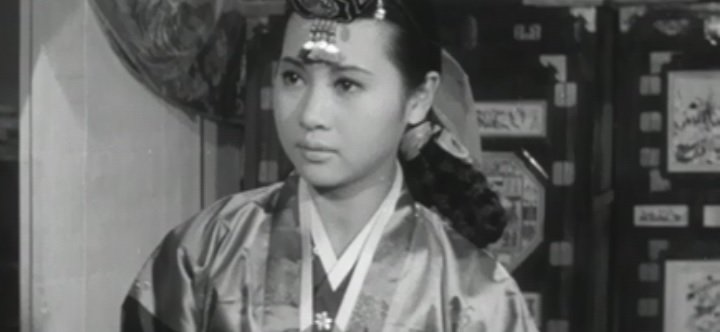
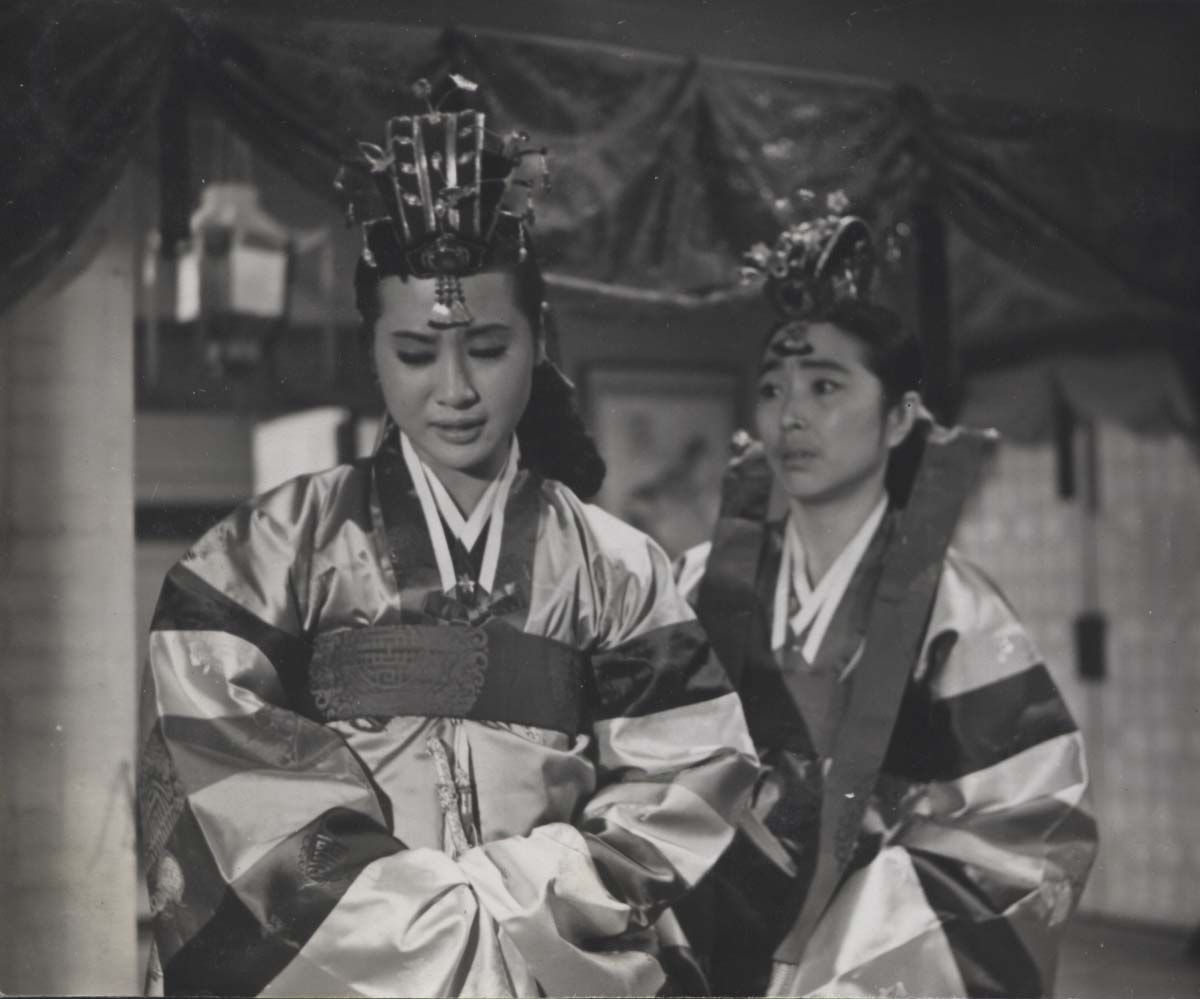
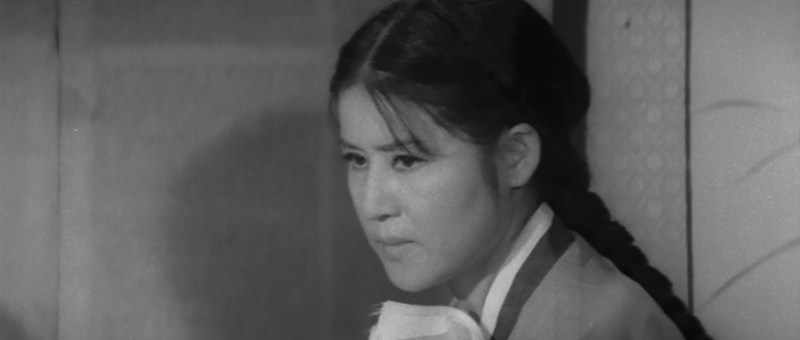
A Princess’ One-Sided Love (公主님의 짝사랑 / 공주님의 짝사랑, Choi Eun-hee, 1967)

“Those are the rules of the palace for a princess” the rebellious heroine of Choi Eun-hee’s second directorial feature A Princess’ One-Sided Love (公主님의 짝사랑 / 공주님의 짝사랑, Gongjunimui Jjaksarang) is told, though the “palace” is really the society and the “rules” those which all women are expected to “endure”. Quietly and perhaps subversively feminist, Choi’s humorous tale draws inspiration from Roman Holiday but unexpectedly engineers a happier ending for its lovelorn heroine who is permitted to transcend the constraints of her nobility if not quite of her womanhood. 

Tomboyish princess Suk-gyeong (Nam Jeong-im) is the youngest of six princesses and the last to remain at home in the palace yet to be married. Consequently, she is infinitely bored all the time and continually up to mischief in part because as a princess she is not permitted to leave the estate and has a natural curiosity about the outside world. That curiosity is further sparked when she lays eyes on handsome scholar Kim Seon-do (Kim Gwang-su) who picks up a shoe she had dropped while inappropriately running on the day of her mother’s birthday celebrations. Possibly the first young and handsome man she has even seen, Suk-gyeong cannot help but be captivated by him and manages to convince her sisters to help her escape the palace to venture in search of her probably impossible love under the pretext of visiting her grandparents whom she has apparently never visited before.  

Like Audrey Hepburn in Roman Holiday, what Suk-gyeong wants is a break from the “tedious and pathetic” life of a princess, but soon discovers herself to be entirely naive as to how the “real world” works. Her sisters agreed to help her in part because they acknowledge how difficult it was for them when they married and had to leave the palace with no understanding of how to live outside it. Having left in the clothes of a servant, the first thing that Suk-gyeong realises is that the outside world is governed by a different set of hierarchies and even if she’s a princess she is still a woman and therefore presumed to be “inferior” to men to whom she is expected to remain subservient. Her grandfather, who has never met her before, wastes no time exerting his patriarchal authority in his own, comparatively humble, home. “A woman, once married, must abide by the rules of her new family, the confucian ethics, and respect your father and husband and become a wise and obedient wife” he explains, striking her across the calves with a cane to teach her a lesson for her imperious tone in failing to pay him the proper respect. 

Failing to use appropriately polite language with those around her, forgetting that she should now be deferent both to men and to those who exceed her in age, gets her into constant trouble. Nevertheless, a trip to the marketplace gains her a further understanding of the extremes in her society firstly when she misunderstands a rice cake seller’s patter and assumes he intended to gift her some of his produce as he might to a princess, and secondly when she bumps into a woman with a baby on her back and breaks the pots she was hoping to sell to pay for her husband’s medical care. Introduced to such desperate poverty, the undercover princess knows not what to do but later gifts her a jade pin hoping perhaps to at least cure the husband’s malady, only to wander into another dangerous situation when she is mistaken for a sex worker by a trio of drunken noblemen who pull her into a drinking establishment which is in fact a brothel. Naively drinking with the men she mocks them for their attempts to play on their names each boasting of their famous fathers and personal connections to men she knows to be elderly cranks and obsequious fools. Shocked to discover what goes in establishments like these she tries to make her escape but is almost assaulted by one of the men, Shim, who is later posited as an ideal match by her unsuspecting mother laying bare another patriarchal double standard as Shim plays the part of the gentleman in order to effect his advancement. Luckily, she is saved by Seon-do who happens to be passing but mistakes her for a boy because of the disguise she is currently wearing. 

Selfish in her naivety, Suk-gyeong is warned that her impossible crush might end up harming Seon-do’s hopes of making it into the elite through success in the state exam while he, once made aware of the truth, immediately does the right thing by kindly rebuffing the princess’ inappropriate interest leaving her with a poetic love letter claiming he’s gone off to a temple for a spell of intensive study. Perhaps improbably it’s the love letter that eventually saves them, touching the king’s heart and convincing him to acquiesce to his sister’s wishes of escaping the gilded cage of nobility. Suk-gyeon’s pleas to renounce her royal title might also stand in for a desire to renounce womanhood in that it “stops us from doing anything we want. We are matched up with an unknown husband and we spend our youths in misery for our lives are tedious and pathetic”, reminding her brother that as a king but in truth as a man he cannot understand even while he reminds her that these are the “rules” endured by countless ancestors. The king is moved, he breaks with tradition and frees his sister yet he does so to allow her to become a wife even if he has also granted her the freedom to choose her husband and live in the outside world unconstrained by the strictures of nobility but nevertheless bound by oppressive patriarchal social codes. Nevertheless, it’s an unexpectedly progressive conclusion advocating for change and personal happiness over the primacy of duty and tradition. 


A Princess’ One-Sided Love streamed as part of the Korean Cultural Centre UK’s Korean Film NightsFilming Against the Odds 

Daughter-in-Law (민며느리, Choi Eun-hee, 1965)

Domestic power struggle meets oppressive patriarchal social codes and entrenched class prejudice in Choi Eun-hee’s lighthearted marital drama, Daughter-in-Law (민며느리, Minmyeoneuli, AKA The Girl Raised as a Future Daughter-In-Law). One of the biggest stars of Korean cinema’s golden age, Choi was only the third woman to direct a feature film and the first to direct herself as the leading lady, adapting a popular radio serial in which a pure hearted young girl finds herself suffering while patiently fulfilling the role of a dutiful daughter-in-law to a tyrannical middle-aged woman. Though the film may eventually reinforce traditional gender roles and the patriarchal norms of the conventional marriage it also subtly undercuts them in its final bid for female solidarity as well as in the surprisingly frank depiction of the sexually active relationship between the middle-aged in-laws. 

Perhaps surprisingly, the film opens with a montage sequence of a young woman doing laborious household tasks while the title song muses on the difficulties of married life. For young Jeomsun (Choi Eun-hee), the problems are compounded as we discover she was in effect sold into marriage because of her once wealthy family’s poverty and as her intended husband is still only a child is treated as an unpaid housekeeper by her harridan of a mother-in-law, Mrs Kim (Hwang Jung-seun). “Serve your parents and respect your husband, that’s this country’s way” Mrs Kim reminds her, continually dissatisfied with everything but mostly that she isn’t getting enough respect or attention as the head of the household (in the domestic sense at least). 

As thoughtlessly cruel as she often appears to be, Mrs Kim’s behaviour can perhaps be seen as merely an attempt to leverage the only power she will ever have as the matriarch in her own house, a power made all the greater by the fact her son is still a child and her future daughter-in-law only afforded a liminal space within the family hierarchy. She continually reminds her husband (Kim Hie-gab) and Jeomsun that she too had a mother-in-law who treated her badly, often making her work through the night, and so her treatment of Jeomsun is a way of paying down the system, a facet of the “custom passed down through the generations”. Having been badly treated herself, she relishes her new sense of power and treats her daughter-in-law badly as misdirected payback for her own youthful suffering. 

Jeomsun herself has internalised a sense of the system’s righteousness, fully believing that she must do her “duty” as a good daughter-in-law even when her own mother points out that her in-laws are hardly doing their duty when they wilfully mistreat her. Added to notions of patriarchal subjugation is a further class dimension that leaves Jeomsun at their mercy because she has become impoverished, her mother having consented to her marriage only reluctantly in an attempt to avoid having to sell the family house. Jeomsun had been in love with a local man, Sugil (Park No-sik), but felt their union was impossible while her father was alive because he was of a lower social class and continues to believe it improper even after his death with only her mother lamenting that she wishes she had found a way that her daughter could have had a happier life marrying a man she loved. For his part, Sugil attempts to buck the system by continuing to pursue her, hoping to “buy” her back off the Kims after raising money while the marriage remains unconsummated and therefore unofficial. 

Choi’s age, then in her late 30s though presumably playing the part of a young woman in her late teens or early 20s, further adds to the incongruous inappropriateness of her position in the household as the future wife of a boy who is still quite clearly a child. Yet the young master, Bokman, appears to dote on her, often taking her side against his mother but in the end unable to defend her, too afraid of Mrs Kim to tell the truth and risk having to take responsibility for his actions preferring to let Jeomsun pay for them instead. In an interesting role reversal, it’s Mr Kim who is the perpetual peacemaker, a kind and patient man who quite clearly loves his firecracker wife despite her harsh demeanour. The slightly comedic depiction of their cheerfully active sex life as a middle-aged couple is perhaps at odds with the often prudish times, but also softens Mrs Kim’s otherwise difficult character until such time as she’s tricked into a moment of self-realisation in the recognition that her resentment of Jeomsun is really a reflection of her maternal jealousy and therefore entirely unfair. 

It’s this momentary epiphany that brokers an opportunity for a new female solidarity not only between Jeomsun and her mother-in-law but also with her own mother who must then find the magnanimity to forgive Mrs Kim for treating her daughter so badly in the first place. What began as a tale of patriarchal cruelties, a young woman sold as a wife to a spoilt child at the expense of her own romantic fulfilment, ends with a wilful reversal of the “custom passed down through the generations” as Mrs Kim agrees to cede some of her power in treating her daughter-in-law as more of an equal while making space to welcome her mother, another mother-in-law, into her home. “We all have to live according to our duties” Jeomsun had sadly explained to her former love, yet what she discovers is that duty is a two way street and lies perhaps more in mutual compassion than in slavish devotion to outdated tradition. 


Daughter-in-Law is currently available to stream in the UK as part of the Korean Cultural Centre UK’s Korean Film Nights: Filming Against the Odds where it will be followed by Choi Eun-hee’s second film as a director A Princess’ One Sided Love on 27th May. Other films streaming in the season include Park Nam-ok’s The Widow (streaming throughout), Li Mi-rye’s My Daughter Rescued From The Swamp and Lee Seo-gun’s Rub Love (both 10th June).
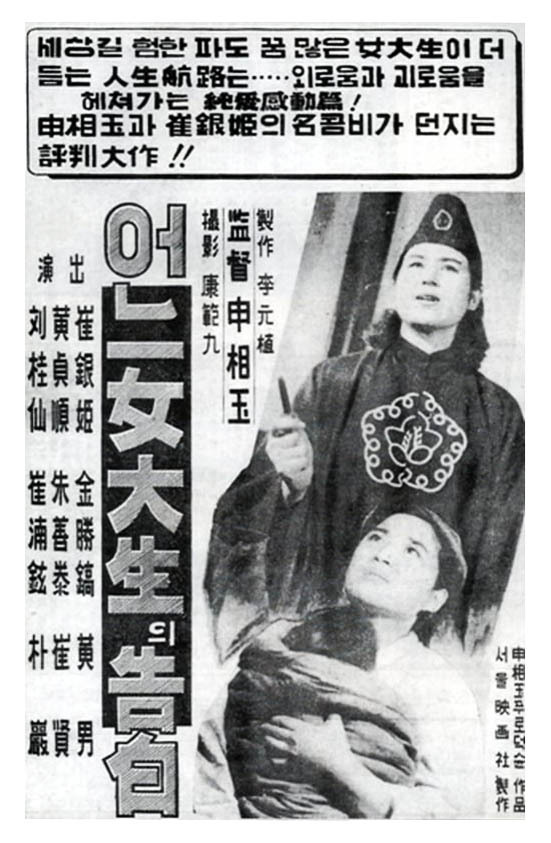
A College Woman’s Confession (어느 女大生의 告白 / 어느 여대생의 고백, Shin Sang-ok, 1958)

Five years after the end of the Korean War, South Korean society was both economically unstable and battling the increasingly authoritarian government of Rhee Syngman. Nevertheless, there was perhaps an aspiration for a brighter democratic future which many hoped would materialise after the protests which eventually brought down Rhee’s regime in 1960 but unfortunately led only to the even more repressive Park Chung-hee era. Released in the same year as Flower in Hell, Shin Sang-ok’s A College Woman’s Confession (어느 女大生의 告白 / 어느 여대생의 고백, Eoneu Yeodaesaengui Gobaek) is perhaps a reflection of that aspiration in its broadly humanist condemnation of an inherently unfair, rigidly patriarchal society which forces good people to act in ways which offend their sense of justice solely in order to survive. 

From a poor family, law student So-young (Choi Eun-hee) finds herself in dire straits after her grandmother who’d been supporting her and paying her tuition fees suddenly dies. She tries to find a part-time job that will let her carry on with her studies, but is either turned away or placed in difficult situations with men who abuse her trust. A sleazy boss interviewing her for a secretarial position pauses after hearing she’s a student after part-time work to suggest a “night job”, crudely leaning over as he offers her money to become his mistress. So-young slaps him across the face and leaves, but faces something much the same from the husband of her landlady who promises to stop pressuring her for the back rent in return for sexual favours. She turns him down too, but even though he backs off in fear she’ll tell his wife that he tried it on, his suddenly relaxed attitude only makes her landlady suspicious. 

At her wits end and about to quit school, So-young turns to her comparatively better off friend Hee-sook (Kim Sook-il) who dreams of becoming a novelist. Hee-sook brings up a diary she’s been reading that was found in some old furniture sold to her family’s store which recounts the sad life story of a girl who was seduced and betrayed by a man who left her to marry a wealthy woman. With too much time on her hands, Hee-sook has identified the man in the diary as prominent politician Choi Rim (Kim Seung-ho) and taken it upon herself to send him a letter telling him that he has a daughter named So-young from the love of his youth. Despite the fact that the diary says the woman’s baby died, Hee-sook suggests So-young pose as Choi’s long lost daughter so he’ll support her through the rest of uni. So-young is not convinced, but finds herself heading over to visit Choi after exhausting all her other options and being reluctant to go back to the boarding house without money. Choi absentmindedly turns her away, only to think better of it and send his secretary after her, but she ends up getting hit by a car trying to avoid yet another creepy old man who sees her in distress in the street and offers her money for sex. 

Creepy men are indeed everywhere. Even the wily Hee-sook finds herself bothered by an unpleasant man in a cafe who repeatedly pesters her even after she makes a point of ignoring him and pointedly switches seats. He doesn’t give up even after So-young arrives, abruptly offering to buy both women dinner, after which Hee-sook ushers So-young out declaring that this cafe is too “weird” to stay in any longer. Men are, it seems, content to exploit the desperation of vulnerable women for their own satisfaction. As So-young puts it in trying to defend another woman after she’s successfully become a lawyer, “vulgar men see women only as objects to satisfy their sexual desires”. 

This feeds back in to the sin the otherwise kindhearted Choi is trying to expiate. He made a choice in his youth, sometime in the colonial era, to abandon a woman he claimed to love to make a dynastic match. Though it’s not clear whether or not he knew there was a child, he seems to harbour a deep sense of guilt over his decision to essentially use two women in different ways. Faced with the “resurfacing” of So-young, he immediately explains everything to his wife (Yoo Gye-seon) but tries to pass it off as “all in the past” while earnestly asking her to help him make amends by accepting So-young into their home in place of the daughter they apparently lost. She fires back at him that it must be very convenient for men who can forget about things that are “all in the past” while women have to live the rest of their lives with the harm that they cause. Choi doesn’t argue with her, but nor does he ask for forgiveness, only understanding. Mrs. Choi answers that she ought to tell him no in revenge for the all the wrongs he’s done her (this appears not to be a terribly happy marriage), but agrees that it’s not So-young’s fault and so of course she can come because “it’s the right thing to do as a human being”. 

Mrs. Choi, however, remains suspicious, unconvinced by So-young’s story but also by her distance from her. That could of course be explained by embarrassment in being the child of the “other woman”, but Mrs. Choi is right to sense guilt in her reserve as she becomes ever more conflicted about the necessity of deceiving people who have been nothing but kind to her. It’s this sense of guilt which is intensified after she becomes a lawyer and achieves her dream of helping other disadvantaged women by defending a single-mother, much like the woman from the diary, who was seduced and betrayed by a man whom she later killed in a crime of passion. In her passionate defence of the extremely repentant Soon-hee (Hwang Jung-seun) is who is around the same age as she is, So-young reflects on the relative similarities between them and that the only reason they are standing in their respective positions is circumstance. 

“The purpose of the law is not only punishment but to awaken goodness in all our hearts” So-young reminds the judges, determined to offer “an earnest plea on behalf of desperate women”. Soon-hee admits her guilt and asks for no leniency, but is brought to tears as So-young outlines the social factors which explain why she found herself stabbing the man who had caused her so much suffering and then got on with his life without giving her a second thought. Her only transgression being sex before marriage, Soon-hee did everything else right but was condemned to a life of poverty and forced to consider sex work in order to buy medicine for her sickly baby. As a pure hearted woman, she can’t go through with it and considers robbery instead (apparently a “lesser” crime) only to bump into an old friend but be too ashamed to ask her for help. 

Earlier on, after her graduation ceremony, So-young had explained her ambitions to help women and children in poverty to Choi’s kindly secretary Sang-ho (Choi Hyeon) who has obviously taken a liking to her. He’s broadly supportive, but reminds her that if she wants to improve society perhaps she should think about fostering greater social change through political action (as he is perhaps doing), but she shakes her head and points out that he’s never known what it is to be hungry or desperate and that there are people who need the kind of help that only she can give them, such as women like Soon-hee. Yet in defending another woman she’s reminded only of her own “sin” in having wilfully deceived Choi and his wife, burdened by the need to keep her secret and convinced the only thing she can do is to confess all. 

Yet Mrs. Choi proves unexpectedly supportive, explaining that she’s known all along that So-young lied and has come to love her as a daughter anyway. She can see how happy she makes Choi who is proud and excited to have such an amazing young woman in his life, and finding out the truth would only break his heart. So-young’s confession would be for herself alone, to ease her own conscience, while the burden of carrying this secret is perhaps the price of her happiness. In an odd way, So-young has repaired their marriage, and with her success in the courts has perhaps completed the integration of their family with the implication that Sang-ho may later join it too. Fiercely condemning the evils of a patriarchal society, A College Woman’s Confession suggests that the literal truth might not be as important as the emotional, and that a rigid morality serves no one, while offering the vision of a brighter, more equal society founded on compassion and understanding rather than cold authoritarian paternalism. 


A College Woman’s Confession is the first of three films included in the Korean Film Archive’s Shin Sang-ok’s Melodramas from the 1950s box set. It is also available to stream via the Korean Film Archive’s YouTube Channel.