Ransomed (비공식작전, Kim Seong-hun, 2023)

A jaded diplomat finds himself caught between competing factions both at home and abroad while trying to rescue a kidnapped colleague in Kim Seong-hun’s action dramedy, Ransomed (비공식작전, Bigongsigjagjeon). Inspired by true events, the film ironically echoes the recent Chinese hit Home Coming which was itself at least incredibly indebted to Escape from Mogadishu in praising the efforts of a civil servant who braved a war zone to rescue a stranded colleague but received little support from his conflicted government.

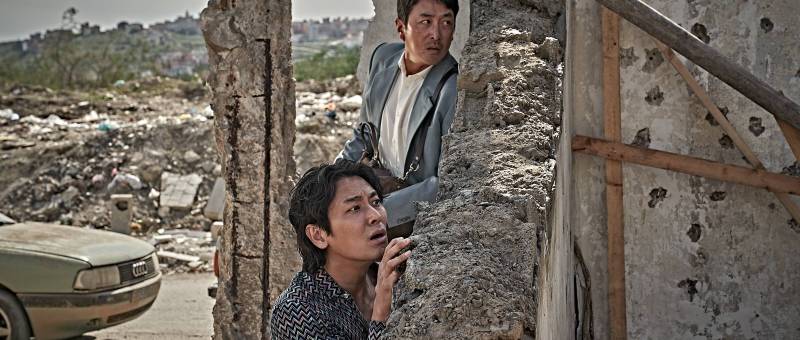
During the time the film takes place, Korea is caught in a moment of transition technically still under the military dictatorship of Chun Doo-hwan but with the first democratic elections already scheduled and the 1988 Olympics in the offing. Diplomat Oh Jae-seok (Lim Hyung-guk) is kidnapped in during the civil war in Beirut in 1986 and believed dead after efforts to retrieve him fail. Nearly two years later, jaded Foreign Office Middle East specialist Lee Min-jun (Ha Jung-woo) picks up a call and hears a message in morse code including a special diplomatic password and the claim the that it comes from Jae-seok who is alive and requesting rescue. The problem is that both the Foreign Office and the KCIA are on the fence about taking action, each wanting the glory of bringing Jae-seok home but fearful of being professionally embarrassed if it turns out that the call is a hoax and they pay a ransom for a man who’s already dead. 

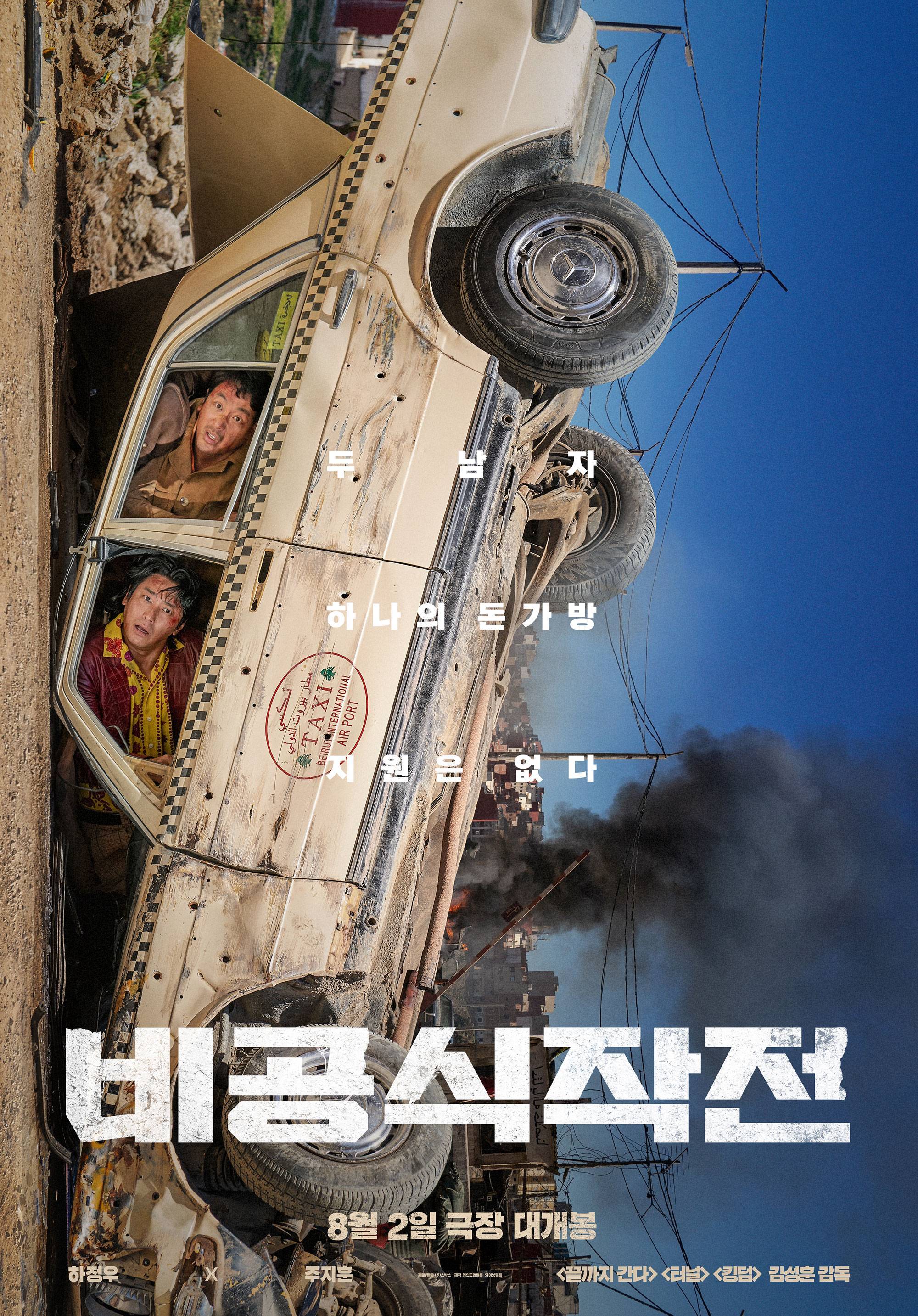
Min-jun finds himself caught between the two while essentially forced to set up a secret covert operation through former US CIA officer Carter (Burn Gorman) and a wealthy Swiss businessman with connections in Lebanon. The irony is that both he and Pan-su (Ju Ji-hoon), a Korean taxi driver he inexplicably runs into in Beirut, only want to go to the US, Min-jun desperate for a more prestigious positing to advance his diplomatic career while Pan-su, technically undocumented, seeks a better life in a more stable environment. As such, Min-jun’s motivations for rescuing Jae-seok are only partly a sense of responsibility as a fellow diplomat and the man who took the call that Jae-sook was alive, hoping to prove himself to his superiors only agreeing to the job on the promise of a transfer to a major US city resentful of having been passed over for a position in London in favour of an elite graduate of Seoul University. 

The irony is that once in Beirut he’s faced with a further series of kidnap threats, another random militia hot on Min-jun’s trail hoping to capture at least one Korean in the hope of a major payout though Min-jun’s problem is that the government only agrees to send more money after each step has been completed endangering the efficacy of the rescue mission while leaving him at the mercy of the militia leader the government has secretly and perhaps questionably agreed to pay to broker the negotiations to secure Jae-seok’s release and passage out of the country. Caught between competing militias in Beirut, Min-jun is also a victim of the push and pull between the waning influence of the KCIA and the Foreign Office with his fate decided largely by political infighting while in the end it’s his colleagues who eventually take a stand each chipping in three months’ salary to fund his rescue out of a sense of solidarity in the reflection that their job is only really possible given their government’s assurance of protection when they undertake dangerous work overseas for the national good. 

As expected, Min-jun soon rediscovers his sense of duty as does shady taxi driver Pan-su though more thanks to the shaming of his Lebanese girlfriend who points out that it’s not a good look to run off with millions of dollars intended to save to save a man’s life. Despite the constant precarity of the situation, what arises is an awkward brotherhood between the two men brokered by an uneasy trust and genuine fellow feeling as they try to rescue Jae-seok while evading the militia trying to kidnap them along with the wider civil war. Undercutting the seriousness of the situation with a healthy dose of irony and black humour, Kim lends his otherwise grim tale of citizenry held hostage by a bureaucracy in flux a degree of positivity if only in proving the power of the individual over a dysfunctional system. 


International trailer (English subtitles)
Stateless Things (줄탁동시, Kim Kyung-Mook, 2011)

“We looked everywhere for a place for us to stay, but we could not find it anywhere” one of the twin heroes of Kim Kyung-mook’s indie drama Stateless Things (줄탁동시, Jooltak Dongshi) confesses. As the title suggests, Kim’s eventually surrealist drama follows those who no longer have a home and are instead condemned to wander the margins of an unforgiving city. Finding only loneliness and exploitation they long for an escape and perhaps find one if only in a moment of eclipse. 

Shooting in a more naturalistic, documentary style, Kim first focusses on the figure of Jun (Paul Lee), a young North Korean refugee who lost his mother in the crossing and his father to another woman in Busan. He works in a petrol station but is treated with disdain by his boss who has his eye on his female colleague, Soon-hee (Kim Sae-Byuk), who is a member of the Korean minority in China where most of her family reside. Though originally hostile towards each other, each wary of their mutual isolation and concurrent vulnerability, the pair later bond in a shared resentment of their boss who exploits Jun physically for his labour and seeks to exploit Soon-hee sexually. After each saving the other from the nefarious boss, the pair have no choice but to go on the run taking in a series of tourist spots while looking for another place to settle. 

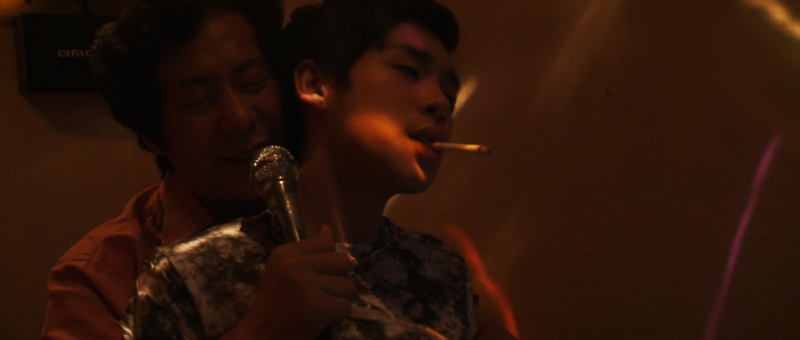
Meanwhile, across town, a young gay man, Hyun (Yeom Hyun-Joon), is a virtual prisoner in the home of his wealthy, married and closeted lover. He looks out across the midnight city and dances sadly alone in a luxury apartment in the sky while occasionally venturing out to meet other men, mostly older, who similarly only intend to exploit his body. “You have nowhere to go.” the exasperated Sung-woo/Sung-hoon (Lim Hyung-Guk) insists, thrown into jealous anxiety on visiting the flat and finding Hyun absent, yet he cannot really offer him a “home” and is all too aware of the transactional nature of their relationship. Though Hyun is also in a sense “stateless”, he has a power over Sung-woo and is able to wield his youth and beauty like a weapon if one he may not fully be able to control. In any case, he too is excluded from the mainstream society by virtue of his sexuality and socio-economic background. 

When Soon-hee and Jun visit a temple, he remarks on the incongruity of seeing a painting that features both a sun and a moon. She explains a folktale to him in which sun and moon are embodiments of siblings who climbed a rope into the sky to escape a hungry tiger. In his diary, Hyun also envisages a pair of twins one opening a door with his right hand as the other closes it with his left. In the surrealist sequence which closes the film, after a title card that appears 90 minutes in, the two men blur into one another as if they shared the same soul in an almost literal eclipse of the self. Kim nevertheless characterises them as sun and moon who cannot ordinarily share the same space. Jun occupies a world of street level sunniness until the light finally begins to dim leaving him alone in a dusky, rain-soaked city. Hyun meanwhile lives by night in his high rise apartment, a prisoner of luxury who flirts with danger for a sense of escape. 

Then again we might ask if Jun and Hyun are two sides of one whole, a sun and moon protecting the king who finds himself an exile. Kim shifts to scenes of emptiness, rooms without presence and streets without life as if the two men were ghosts of themselves hovering above a rootless Seoul, the sense of eeriness only deepened by Kim’s lengthy takes as he follows Jun walking a lonely path towards nowhere in particular because in the end he too has nowhere to go. Departing from the realism with which the film opened, the final sequence gives way to a kind of rebirth if only one of wandering that leaves its heroes at the mercy of a society continually unwilling to recognise their personhood. 


Stateless Things screened as part of this year’s Queer East .

Trailer (English subtitles)

Come, Together (컴, 투게더, Shin Dong-il, 2017)

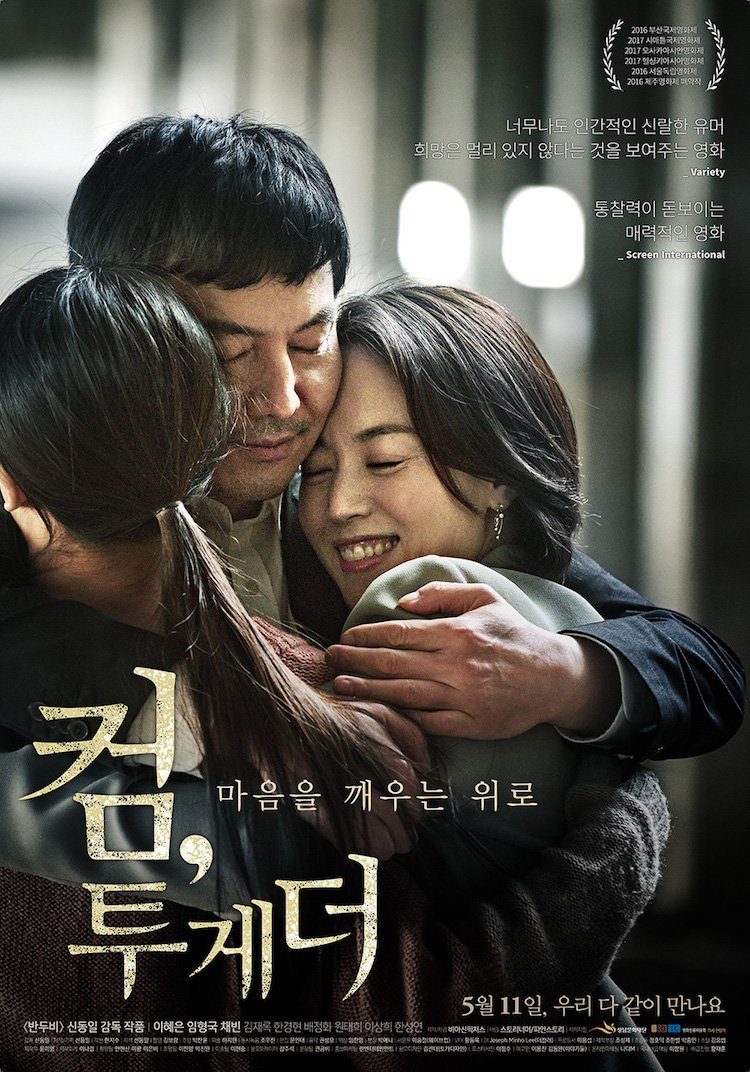
come, together posterToo fast, too loud, too bright. The pressure cooker society threatens to explode in Shin Dong-il’s sympathetic portrayal of one family’s period of crisis in Come, Together (컴, 투게더). When sorrows come they come not single spies but in battalions – redundancy (of several kinds), betrayal, anxieties academic and financial, the Parks have more than their fare share to deal with but the cumulative effect of their individual troubles quickly overwhelms their ordinary, middle-class existence, exposing the tiny fractures in its foundation hitherto papered over by chasing the dream of materialism.

From the outside the Parks are just like any typical middle-class family. They live in a nice apartment with a greenhouse balcony and plenty of space for three. Dad Beom-goo (Lim Hyung-guk) is a moderately successful salaryman, but his world collapses when he’s abruptly let go in the most insensitive of ways by his slimy boss. Mum Mi-yeong (Lee Hye-eun) is a credit card saleswoman who earns by commission and is well used to the hard sell. Teenage daughter Han-na (Chae Bin) has taken a year out to retake her university entrance exams but is now in limbo after not doing well enough to be accepted but having been ranked 18th on the waiting list, anxiously waiting to find out if enough people decide to decline the place she is so desperate to win.

Beom-goo losing his job of 18 years is not just humiliating and embarrassing, but as the family are already in huge debt it is also extremely worrying. As a middle-aged man, it’s unlikely Beom-goo is going to be able to find a comparable position in Korea’s competitive labour market where switching companies is still not the norm and most employees are hired right out of college. Having spent the last 18 years debasing himself to flatter his bosses, it’s galling in the least to realise he’s simply been replaced with a younger, cheaper employee he himself helped learn the ropes. Deprived of his breadwinner status, Beom-goo is supposed to be doing the housework but the boredom quickly gets to him and he spends most days lounging around in his pants lamenting his sorry state. That is until he meets the man from upstairs (Kim Jae-rok) who happens to be in a similar position and begins to lead Beom-goo astray before hinting at a much darker course for himself than the one he’s set Beom-goo on.

Mi-yeong is now the sole provider but her work is extremely stressful – not just the high pressure world of sales, but the bitchy, backstabbing atmosphere in the mostly female office. The job is to get people to sign up for credit cards they don’t really need and probably can’t afford, adding to the pressures of the consumerist society which have already landed the Parks in financial difficulty themselves. Mi-yeong is good at her job, she knows how to get people to sign on the dotted line but she’s also desperate enough to risk breaking the rules. When she’s undercut by a colleague whose situation she has misread, Mi-yeong takes it extremely personally, vowing revenge not just on the colleague but on the boss who refused to back her up and the client who betrayed her.

Mi-yeong’s rage and resentment are to have tragic, unforeseen consequences, threatening to deliver everything she’d dreamed of but at a terrible price. Han-na faces a similar dilemma as she finds herself staring at the list of 17 people in the queue in front of her and silently hoping some of them get hit by busses. The tense atmosphere at home only adds to Han-na’s stress levels as Beom-goo’s increasing impotence finds him playing father of the house like never before and deliberately undermining her sense of self esteem by repeatedly bringing up her failure to get into college. Unlike either of her parents, Han-na does at least have a positive influence in her life in the form of friend Yoo-gyeong (Lee Sang-hee), whom both her parents disapprove of because of her deliberate choice to live outside the mainstream.

Yoo-gyeong, though only in her early ‘20s, owns her own store selling leather bracelets and uses the proceeds to fund her free spirited lifestyle of taking off backpacking across whichever land takes her fancy. When Han-na says she wishes she could live like Yoo-gyeong, Yoo-gyeong bristles, insisting that she’d support whichever decision Han-na makes but that she ought to live her own life the way she wants rather than emulating someone else. Also, by way of an aside, she points out that people seem to assume she does exactly as she pleases but that’s not quite the case. In fact, it may be that Yoo-gyeong is, in a sense, forced to live a life outside of the mainstream simply by virtue of who she is and that her frequent flights to pastures new are a kind of escape or of running away from various social pressures at home.

Irrespective of whether or not they get what they thought it was they wanted, each is forced to reassess their way of living, realising that their relentless pursuit of material gain and the socially accepted definition of success has only made them miserable. Rather than continuing down the road to ruin, the Parks decide to choose happiness by simply dropping out, resetting their lives with the intention of doing what it is they want to do rather than what it is they think they’re supposed to. Waking up from a conformist delusion reawakens the freedom to embrace individual desires but it also restores the family to its previously happy state, released from the strain of modern life in favour of simpler, more essential pleasures.


Screened at the London Korean Film Festival 2017.

Original trailer (select English subtitles from captions menu)