The Phantom Lover (夜半歌聲, Ronny Yu, 1995)

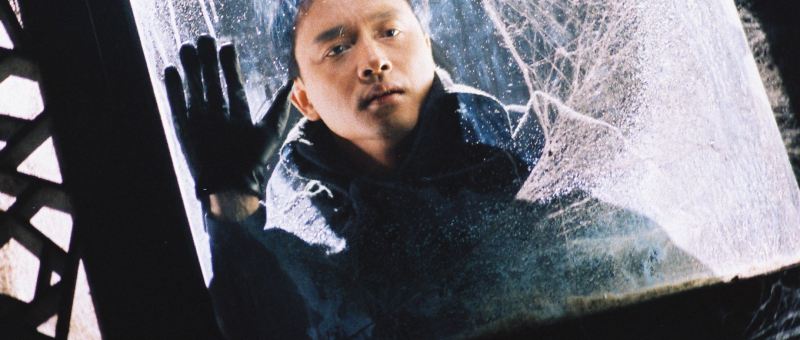
For his last film in Hong Kong before decamping to Hollywood, Ronny Yu looked back to a lost classic in loosely remaking 1937’s Song at Midnight, itself loosely based on Gaston Leroux’s The Phantom of the Opera. A Hong Kong/Singapore co-production, the film was, perhaps surprisingly, shot entirely in Beijing where Yu constructed an opulent set including a full-scale replica of the theatre which he then burnt down for real during the legendary climax of the classic story. 

Set in 1936 (one year before the release of A Song at Midnight and the intensification of the Sino-Japanese war), the film opens with a gothic scene of carriages racing through the fog. A troupe of left-wing actors has come to make use of a ruined theatre to put on their revolutionary play. On arrival, the troupe’s leading man Wei Qing (Lei Huang), who is in a relationship with leading lady Landie (Liu Lin) but claims he is too poor to marry so they will have to wait until he’s famous, is captivated by the auditorium, convinced he can hear strange sounds of a woman singing. The strangeness of the surroundings continues to bother him until he finally decides to ask creepy caretaker Uncle Ma (Cheung Ching-Yuen)to disclose what he knows of the fire which destroyed the theatre 10 years previously. 

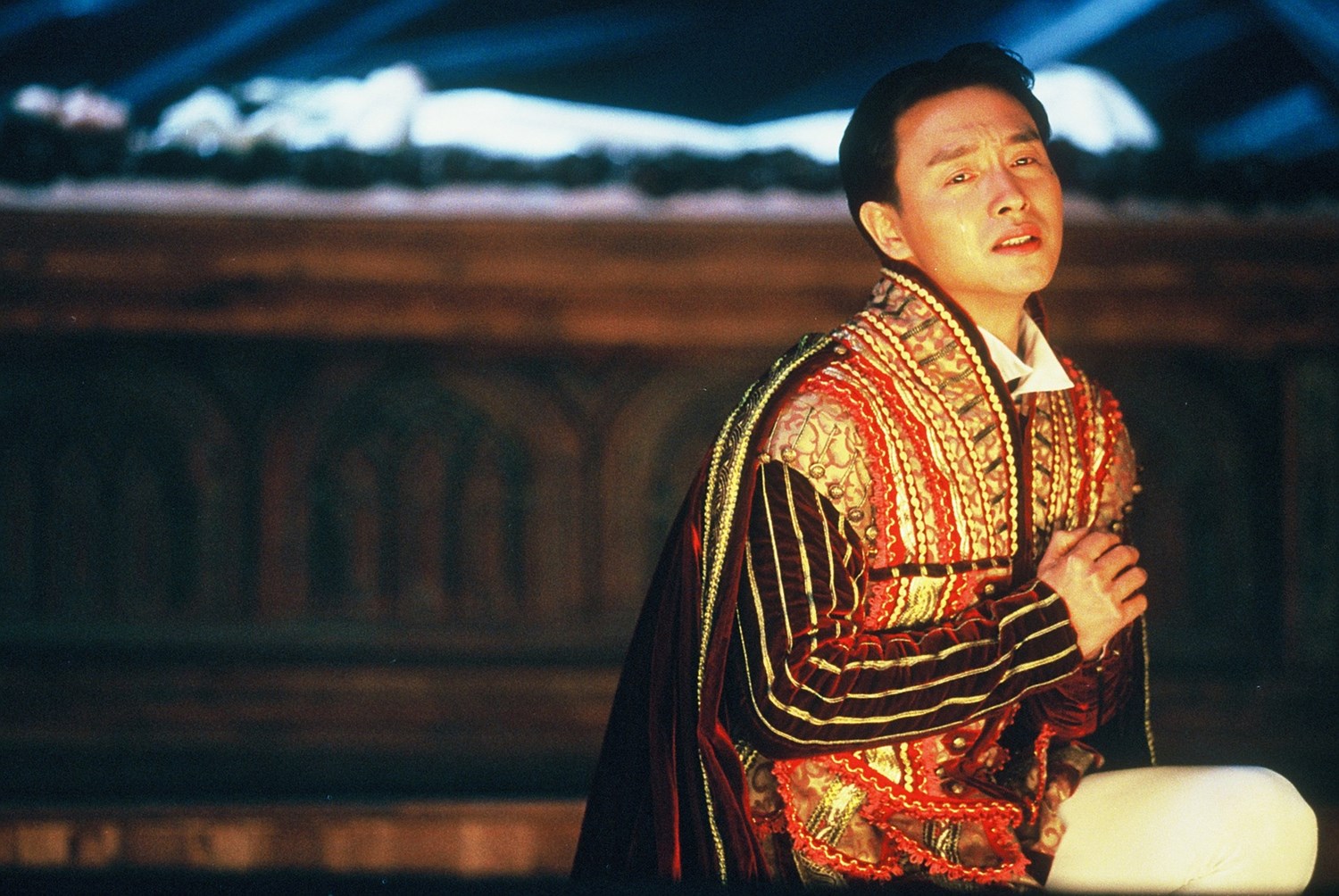
Counter-intuitively, Yu shoots the ‘30s sequence in a washed-out sepia with occasional flashes of colour almost like hand-tinted photographs. As Ma spins his story, we transition into a sumptuous world of reds and golds in the old opera house designed, as we’re told, by the famous actor Song Danping (Leslie Cheung Kwok-Wing) who is said to have perished along with it in the fire. Danping, to whom Wei Qing is constantly likened, was the greatest actor of the age famous for his performances in Western theatre, such as the Mandarin musical adaptation of Romeo and Juliet in which he was performing immediately before his death. In a case of life imitating art, Danping had fallen in love with the daughter of a wealthy family, Yuyan (Geng Xiao-Lin), and wished to marry her, but actors belong to an undesirable underclass and in any case, Yuyan’s father had already arranged her marriage to the idiot son of a powerful politician, Zhao (Bao Fang), in exchange for smoothing the path for his new factory enterprise. 

In a direct reversal of the 1937 film, it is Wei Qing who is the left-wing revolutionary proudly singing communist songs about the “national humiliation” which, it seems, partly accounts for their low audience numbers, while Danping is the reactionary libertine performing in “decadent” Western theatre which seemingly has no political import other than its capacity to cause annoyance to the conservative older generation extremely concerned about Danping’s effect on the local young women. With that in mind, it seems strange that Wei Qing is so quick to accept Danping’s offer once he finally reveals himself and drops the playbook for Romeo and Juliet into his hands. Nevertheless he is content to accept the older man’s tutelage, hoping that the increased revenue will save the troupe and, as implied earlier, he doesn’t actually seem to be very invested in the idea of revolution so much becoming famous. 

Nevertheless, it turns out that he does indeed have integrity. To gain additional funding, the troupe’s leaders end up schmoozing with none other than Zhao, the man who eventually married Yuyan after the fire but quickly discarded her on learning she was not a virgin. Now apparently having risen in politics in Shanghai, Zhao is a misogynistic bully carrying a grudge towards women because of his humiliation by Yuyan. In the scene in which we re-meet him, no longer quite so moronic but definitely nastier, he forces his dining companion to eat 60 meat buns because she had the temerity to declare herself full and try to leave the table. When Wei Qing snaps at him he takes a liking to Landie who is more or less pimped out by the impresario in the same way that Yuyan was sold by her father to the Zhaos in order to further his business interests. On discovering Yuyan, who has since descended into madness, wandering the streets, he stops his carriage to give her a public whipping, ranting about how he had her 10 years preciously but she turned out to be a “slut” who’d already slept with the famous actor Song Danping which seems like a curious thing to announce in the public square. 

Then again, these fascist stooges have an odd approach to public humiliation, stopping Danping’s play mid-performance to call out Yuyan which seems like a counter-intuitive and extremely embarrassing move when they could simply have dragged her out of her box. Danping strikes a minor victory for art when he get the goons ejected from the theatre by the irate audience who, he points out, have had their evening spoiled by officials misusing their authority for a spot of personal pettiness. The intervention is mirrored in the film’s conclusion with the “villains” effectively put on trial in the theatre, as theatre, with an appeal made to law enforcement which is eventually successful as the police commander affirms his intention to act for the public good (though in this case is also serving his own while ironically giving justification to mob rule). 

Despite all of that, however, the major stumbling block to the tragic romance turns out to narcissistic vanity on the part of former matinee idol Danping who has been hiding himself away even though he knows Yuyan has gone mad in love for him simply because his face was ruined when Zhao’s goons threw acid at it and then locked him in the burning theatre. He contents himself with singing on nights when the moon is full knowing that hearing his voice on such occasions is the only thing keeping her going. On learning of his mentor’s true purpose to make Yuyan think he, the handsome young actor, is the Danping of old, Wei Qing is extremely conflicted, unable to understand why the now ghoulish Danping would put Yuyan through so much grief when he could simply have revealed himself a decade ago. Nevertheless, realising the intensity of the romantic suffering all around him perhaps pushes him towards ”forgiving” Landie for having schmoozed with Zhao. 

Full on gothic melodrama, Yu’s adaptation of the classic story is all fog and cobwebs, situating itself in a world which is already falling apart. In photographing the 30s in washed-out greys, he perhaps suggests that something has already faded, or at least become numb, in comparison with the life and colour of mid-20s Shanghai in all its art deco glory. Yet even in giving us a superficially happy ending in which justice, moral and romantic, appears to have been served Yu denies us the resolution we may be seeking with a melancholy title card reminding us that happiness in the China of 1936 may be a short-lived prospect.


The Fallen Bridge (断.桥, Li Yu, 2022)

Li Yu’s mystery thriller The Fallen Bridge (断.桥. duàn.qiáo) finds itself at a series of contradictions in the modern China and its film industry. The film was an unexpected box office success, though largely because it falls into a new category of boy band film in starring TFBoys’ Karry Wang locking in an audience of ardent fans much as Jackson Yee’s presence in Better Days had though it also plays into ongoing anti-corruption theme in recent cinema while simultaneously adopting a mildly positive stance towards whistleblowers if specifically within the field of construction.

It is of course an unescapable fact that hypercapitalistic working practices and ingrained corruption have led to numerous public safety failures with bridge collapses unfortunately a fairly common occurrence. This one is particularly problematic as a skeleton is discovered encased in the concrete during the cleanup effort. From the way it’s posed, it appears the man may have been buried alive. A preserved piece of paper found in a bag accompanying the skeleton states his intention to take his concerns to the head of the construction project that the structure is unsafe and should be entirely rebuilt. Of course, that would be incredibly expensive, embarrassing, and disadvantageous to others who have used the bridge as a way of forging connections with important people.

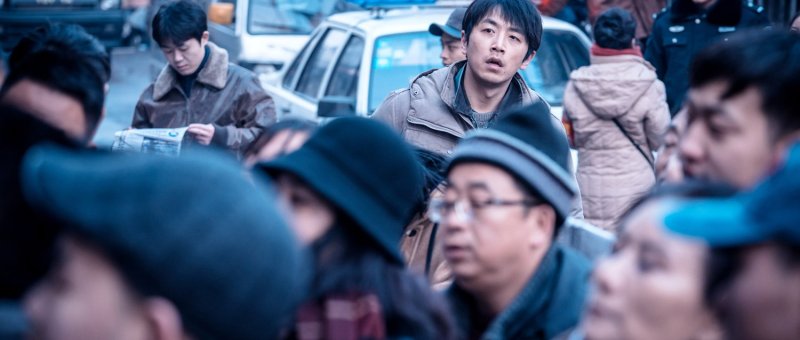
The bridge’s collapse is therefore also symbolic in pointing to the fracturing instability of these relationships along with that between college friends Zhu Fengzheng (Fan Wei), the project manager, and Wen Liang (Mo Chunlin), the would-be-whistleblower. Fengzheng has also been raising Liang’s daughter Xiaoyu (Ma Sichun) who was 12 at the time her father disappeared after seemingly being disowned by her mother who was under the impression he had runaway with his mistress. Now in her 20s and an architecture student, Xiaoyu becomes determined to learn the truth even as she begins to suspect Fengzheng who has otherwise become a second father to her and does at least seem to care for her as a daughter while his own son is apparently living in Australia. Teaming up with a fugitive, Meng Chao (Karry Wang), on the run for killing the man who raped his sister, she begins plotting her revenge while a police investigation into the bridge collapse and an additional suspicious death otherwise seems to flounder.

Though it may not mean to (as it seems unlikely to please the censors) the film gives tacit approval to vigilante violence in subtly suggesting that “official” justice is rendered impossible because of the complex networks of corruption that exist within the soceity. Meng Chao says the man who raped his sister was a judge which is why he had to kill him, while Xiaoyu seems to desire individual vengeance believing the police aren’t investigating properly but refusing to go to them with key evidence because she wants to kill her father’s killer herself. While carrying out their investigation, the pair end up adopting the wily daughter of another casualty of the villain’s greed and form an unlikely family unit marking them all out as good people who have been betrayed by the system which is itself corrupted by the nation’s headlong slide into irresponsible capitalism. 

Even so, revealing the villain so early weakens the suspense while their own motivations are left unexplored, assumed to be merely greed if perhaps also a wish to remain connected to influential people and be thought of as important at the cost of the lives of the general public (along with those of often exploited labourers) endangered by shoddy construction practices. It isn’t entirely clear how they intended to deal with the fallout of their machinations to cover up their past misdeeds, especially as the sub-standard work on the bridge has already been exposed though obviously could be blamed on others no longer around to defend themselves, but perhaps it all amounts to crazed self-preservation pitched against the righteousness of Xiaoyu and Meng Chao who are after all wronged parties in China’s deeply entrenched judicial inequality. Nevertheless, we get the inevitable title card (left untranslated in the overseas release) explaining that justice was served and a censor-pleasing ending that still in its way suggests the police are incapable of solving these crimes and that the petty corruptions of small-town life are otherwise impossible to prosecute. 


The Fallen Bridge streamed as part of the 18th Season of Asian Pop-Up Cinema.

Original trailer (English subtitles)

The Best is Yet to Come (不止不休, Wang Jing, 2020)

A man denied a fair chance in life because of his impoverished background comes to identify with the plight of those carrying the hepatitis B virus in Wang Jing’s true life drama, The Best is Yet to Come (不止不休, bùzhǐ bùxiū). Inspired by the story of Han Fudong, a journalist who exposed the societal prejudice against those with a previous diagnosis of the disease, the film’s Chinese title “no pause no rest” makes clear how tirelessly he strived to reveal the truth even at the potential cost of destroying his dream of becoming a professional reporter. 

Han Dong (Bai-Ke) came to Beijing in 2003 in the hope of landing a job at a paper, but just like everywhere else journalism is a largely closed profession almost impossible to break into without elite qualifications and connections. At a jobs fair, Han Dong tries to pass off his reluctance to hand over a CV as a recruitment tactic to get people to remember him, circulating copies of his portfolio instead though recruiters quickly lose interest on realising they are all self-published articles posted online. Once he admits that he only finished middle school, it’s game over no matter how talented a writer and investigator he may turn out to be. 

It’s this sense of unfairness, of being turned away on the grounds of a few words on a piece of paper that eventually leads him to sympathise with those carrying the hepatitis B virus after investigating a company that claims it buys blood, discovering that they provide a service helping people to forge health certificates for job and school applications. Vox pop-style interviews recreated in the manner of the time feature several people describing the various ways their lives have been ruined simply because they happen to carry the virus, many of them infected since birth or early childhood. One man has been trying to apply for jobs and graduate schools for several years but finds the offers are always withdrawn after the health screening, while another woman recounts that her fiancé cancelled their engagement because his family could not accept someone with hepatitis B. 

This is also in the immediate aftermath of the SARS epidemic which perhaps caused a preoccupation with infectious disease which may be largely unfounded in the relative difficulty of passing on the hepatitis B virus. After landing a golden opportunity of an unpaid internship compensated only with 50% article fees, Han Dong finds himself conflicted. He knows the forgery operation is illegal and a threat to public health, but also cannot blame the people who make use of it when their lives have been rendered so impossible that is difficult for them simply to live. An early assignment had seen him cover a mine collapse and witness a destraught mother bounced into accepting compensation for her son’s death while shouted at by the foreman (played by film director Jia Zhangke who also produced) for having the temerity to ask to see his body. Han Dong got a front-page byline as co-author with his mentor figure, Huang (Zhang Songwen), but wonders what the point is if nothing ever changes and the truth is not enough on its own. 

For obvious reasons, films about crusading journalists are rare in Chinese cinema given that whistleblowing is not regarded as a virtue and those who try to expose wrongdoing are often shouted down or hounded into silence as seen with the doctor who drew attention to the poor medical practices in rural blood clinics that caused an HIV epidemic in farming communities, and most recently with the physician who tried to raise awareness of the new respiratory illness that later developed into a global pandemic. Journalists who report problematic stories can also find themselves facing prosecution and imprisonment. Han Fudong’s writings did however lead to an eventual change in the law and the destigmatisation of hepatitis B while he himself overcame the educational elitism of the contemporary society to achieve his dreams of becoming a professional reporter. As such, Wang’s dramatisation of his life may be in a way subversive if subtly so in hinting at a greater role for a currently not so free press in the modern China while also embracing a central philosophy that one need not simply accept an unacceptable status quo but actively reject and challenge it and that by doing so something might actually change. 


The Best is Yet to Come screens in Chicago Sept. 30 as part of the 17th season of Asian Pop-Up Cinema 

International trailer (English subtitles)