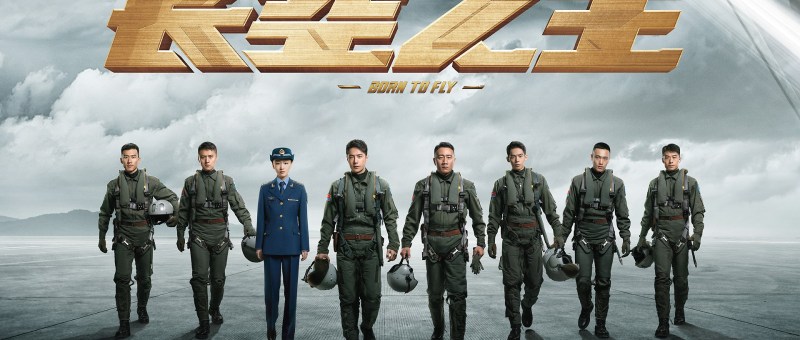
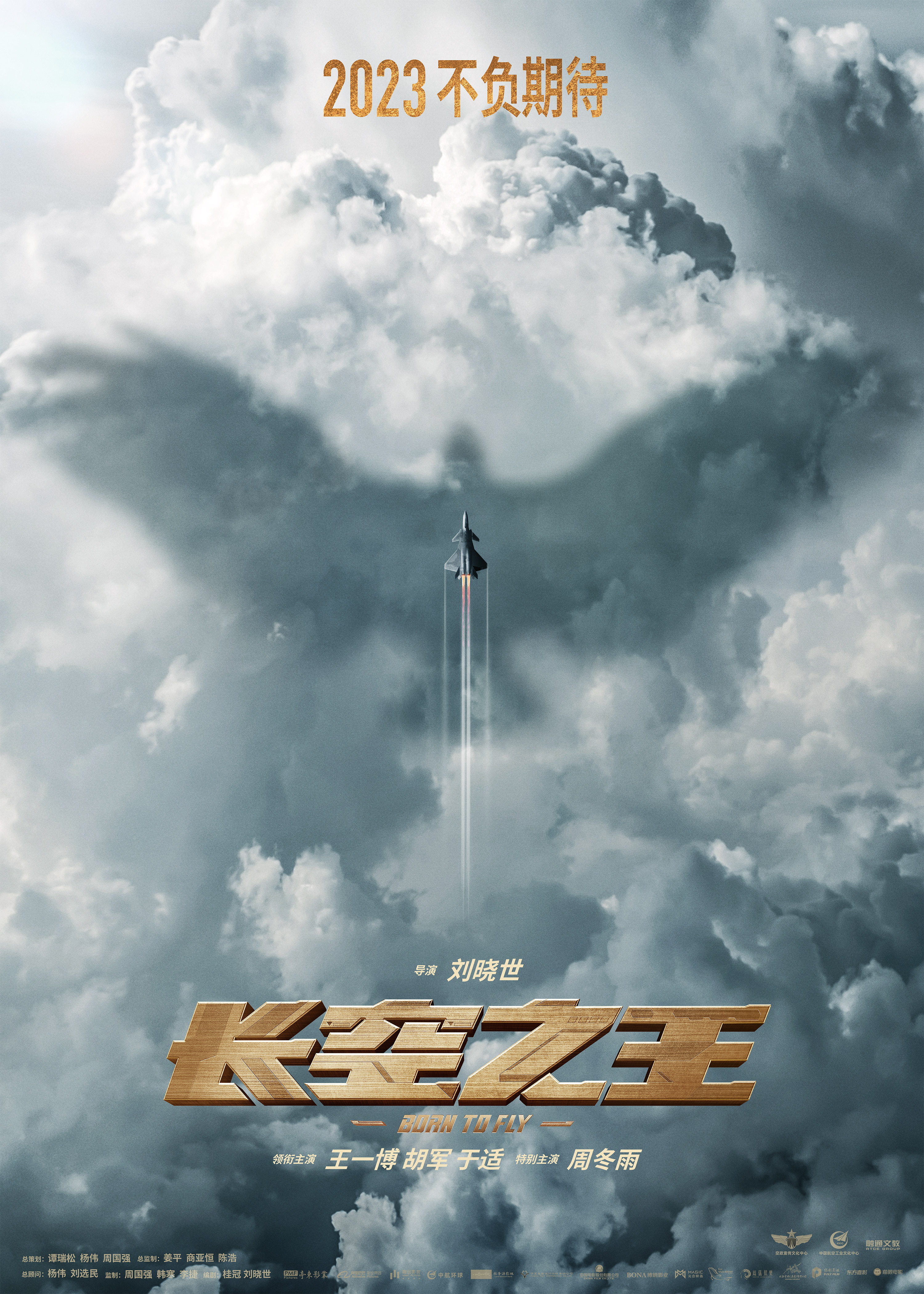
Elite test pilots set out to reclaim Chinese “dignity and security” through the development of a next generation stealth fighter in Liu Xiaoshi’s action drama, Born to Fly (长空之王, Chángkōng zhī Wáng). Clearly a riposte to Top Gun: Maverick (which was not approved for release in Mainland China), the film was originally scheduled as a National Day release and is another in a long line of “main melody” movies paying tribute to particular areas of military and civil service as evidenced by the use of actual voice recordings from downed pilots at the film’s conclusion and a lengthy pause on an aerial shot of the airmen’s cemetery praising those who gave their lives for the country.
The main thrust is however that China is ready to defend itself. The film ends with a show of force much like that at the end of Operation Red Sea, though curiously for a propaganda film the implication is very much that China is lagging behind in terms of military technology and as the film begins lacks the necessary capability to hold its own against foreign aggression. The planes that stray into its airspace buzzing an oil rig and causing havoc with a sonic boom are never directly named as American but their pilots speak US-accented English while sticking one finger up and declaring “we can come and go wherever we want”.
To that extent, the central battle is as much between Western individualism and the collective spirit as it is a race for hegemony over the skies. Hot shot pilot Lei Yu (Wang Yibo) originally turns down the opportunity to join the elite test pilot squad because he wants to fight on the frontline and get personal revenge against the enemy planes. He also has a grudge against arch rival Deng Fang (Yu Shi) because he did not salute him after he beat him to a coveted Golden Helmet award and then accused him of cheating. What they have to set aside is, in contrast to the American Top Gun, the notion of “being the best” or engaging in an egoistic individual struggle to be named a winner. Instead, they must learn to work together for the common good so that China may be declared the winner as the planes they’ve risked their lives to perfect are in the best shape to protect frontline pilots and allow them to safeguard the Chinese people.
Meanwhile, like other recent similarly themed main melody movies, the film is keen to sell the message that China stands alone and has been unfairly shunned by the international community. The leaders of the test pilot programme constantly complain that Western powers have refused to share technology with them or have attempted to limit their ability to innovate through embargoes and blackouts. They insist that China will have to create its own discoveries, but hint at an under-confidence in their ability to do so which is in some ways at odds with the usual propaganda messaging even if it spurs a sense of collective urgency that all hands are needed on deck to solve this particular problem before it’s too late.
Lei’s unsupportive father even tells him point blank that he does not believe China can develop a stealth fighter and he is risking his life for nothing. Tellingly, Lei’s father had wanted to send him abroad and resents his decision to join the military. In order to serve his country, Lei must break a taboo by defying his father, while it’s later revealed that Deng’s father was a fighter pilot who was killed on the frontlines after winning an award while training in Russia. In another moment of surprising messaging, Deng wonders if his father might have survived if he’d been given a better plane to fly which is why he’s committed to the test pilot programme and the reason he’s eventually able to give up his ego and agree to assist Lei in testing his bright new idea for the stealth fighter rather than chasing glory for himself as the lead pilot.
All of that aside, Lei is allowed the mild distraction of an extremely subtle romance with an airforce doctor played by Zhou Dongyu in a “special appearance” who decides to give up her transfer back to the south to commit herself to the test pilot programme after being touched by Lei’s grumpy heroism. In any case, the message is very much about pushing the limits as far as they will go while striving together for the common good. Jingoistic it may be but Liu manages to sell the aerial spectacle and sense of danger as his elite pilots risk all in the name of patriotism.
Trailer (Simplified Chinese / English subtitles)
 Windows on Worlds