
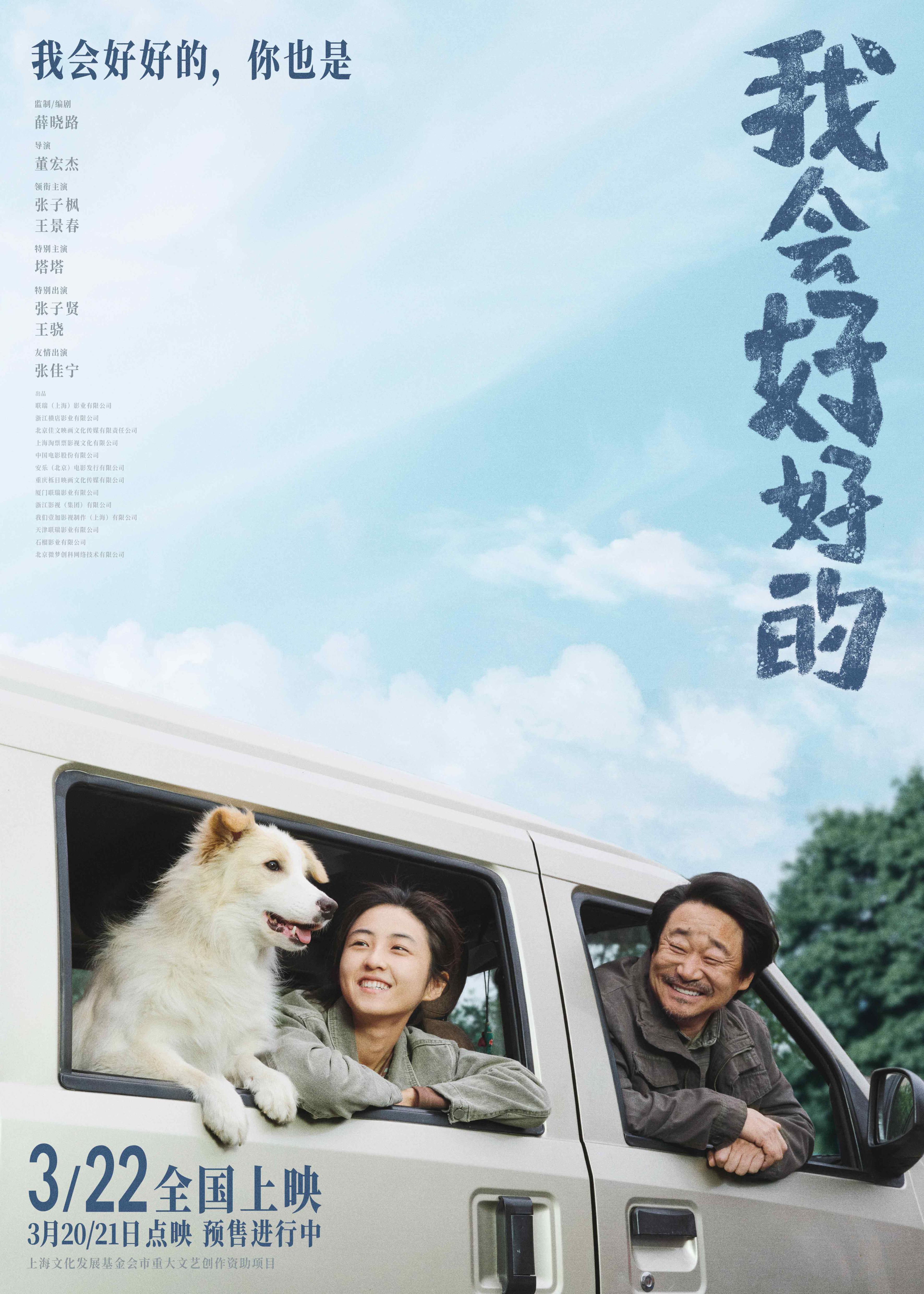
New Life (我会好好的, Dong Hongjie, 2025)

A lost young woman begins to find new purpose in life after taking in a stray dog in Dong Hongjie’s tearjerking drama, A New Life (我会好好的, wǒ, huì hǎohǎo de). A tribute to the healing power of a dog’s unconditional love, the film is partly about the grieving process and learning to let go, but also about what it’s like to feel abandoned and hopeless. Having something to look after gives Xiaoman (Zhang Zifeng) a reason to look after herself as well as her heartbroken father who’s turned to drunken rages in the wake of his wife’s death and subsequent loss of his business.

Ironically, Zhao Bujin’s (Wang Jingchun) old wood carving shop has been taken over by a vet, though Bujin can’t seem to let it go and is intent on causing trouble there. Having lost her mother due to an illness, Xiaoman is intent on not taking up her place at university and instead is earning money as a removals driver often helping to clear houses after the death of the owner. It’s during one particular job that she’s confronted by an angry dog who refuses to leave a cardboard box where, a neighbour explains, it stayed with its mother until she died. Ever since then, he’s been unable to get out, much like Xiaoman who also remains trapped within the box of her grief.

Identifying with the dog, she begins to worry about him during a rainstorm and decides to rescue him as a means of rescuing herself. But at the same time, she doesn’t really want to keep him and continues referring to the dog as “doggie” rather than naming him while he imprints on her as a new maternal figure. There’s a half an idea in the back of her mind that there might be money in it if she cleans the dog up a bit and sells him on with the help of the vet, Chuan (Zhang Zixian), who promises to help her find a good home for it. The first couple he suggests appear to be extremely wealthy and keen to adopt, but the film seems to be critiquing the idea that a life of material comfort is better than one spent struggling with family. The wealthy couple clearly have ideas about their ideal dog and how it would fit into their Instagram-worthy life including a name that skews feminine while Xiaoman’s dog is a boy. Predictably, the couple eventually send it back when it fails to bond with them and insists on returning to Xiaoman. 

Then again, Xiaoman and her father don’t necessarily seem to be struggling all that much. Though they don’t have much money, they’ve managed to keep their sizeable home and furniture even they’re economising on food and worrying about how to make ends meet with Bujin unable to find work. Xiaoman attributes this to his drinking, though it seems he actually sustained an injury he never got treatment for which has damaged his ability to carve. In any case, his industry has also changed. Though Xiaoman is led to believe he’s found a well-paying job at a factory producing wooden statues, she later learns that he’s being paid a pittance to do an apprentice’s job doing things like prepping wood. His friend explains that only elite master carvers make money these days because all the lower grade stuff is all mass-produced by machine so there aren’t any jobs for mid-grade craftsmen like Bujin. Bujin keeps on about finding an amazing log he’ll use for his masterpiece, but like so much in his life it seems like an impossible pipe dream.

Meanwhile, Xiaoman tries to keep it together with her only goal being to buy a proper grave for her mother overlooking ocean. Nevertheless, bonding with the dog, whom she later names Xiaoyi as if it were really her brother gives, her new reasons to look after herself and think about her future. Identifying with it closely, she also comes to realise how little people value the lives of cats and dogs and by extension other people too. That’s one reason why she begins holding proper funerals for pets to give them a little dignity in death when some owners just tell the vets to get rid of their remains and don’t even bother to collect the ashes. Adopting a quasi-maternal position in caring for Xiaoyi also helps her process her own mother’s death and begin letting her go so that both she and her father can start to move on. Truly tugging at the heartstrings, Dong’s film is a tribute to the unconditional love of a dog and the healing effects it can have on a life if only someone is willing to offer it the same in return.


Trailer (no subtitles)

Cloudy Mountain (峰爆, Li Jun, 2021)

In recent years, Chinese big budget disaster extravaganzas have dedicated themselves to celebrating the selfless heroism of the undersung branches of the emergency services, firemen for example in Tony Chan’s The Bravest or the coast guard in Dante Lam’s The Rescue. Li Jun’s Cloudy Mountain (峰爆, Fēng Bào) features its fair share of fearless rescue teams, but is nevertheless dedicated to the rather unlikely source of pride, the Rail Soldiers whose lives, at least according to the closing credits, were sacrificed in large numbers to complete the infrastructure necessary for the expansion of the Chinese state yet in 1984 they were renamed “China Railway Construction Corporation” a development the film at least seems to regard with a surprising degree of ambivalence. 

This becomes most obvious in the conflict between the two heroes, an estranged father and son burdened by personal trauma, one a former Rail Soldier and the other a high tech engineer working for a commercial enterprise on the building of a high speed railway network through terrain known to be geologically volatile. Grandpa Hong (Huang Zhizhong) is set to visit his son Yizhou (Zhu Yilong) for New Year, though he doesn’t really want to see him knowing that his father will only criticise his work on the tunnel leading to another intergenerational argument. Meanwhile, Yizhou also finds himself unpopular at work for requesting additional safety checks many seem to regard as a pointless waste of time, and oddly they might have a point seeing as Yizhou’s monitoring fails to detect a shift in the rock formation which causes water to flood the almost complete tunnel during routine blasting. 

The fact is Hong was a Rail Soldier and is also one of those old men who think they know best about everything. He kicks off at a bored young lady at service station because she doesn’t want to accept payment in cash and has no change to offer confused as to why Hong can’t just pay with Alipay or WeChat like everyone else. Despite his years of hands-on experience, he no longer understands the modern high tech engineering industry and thinks his son is somehow unmanly with his scientific data and use of drones, believing that if you want to solve a problem you just get in there and do it. This causes a minor problem when a manmade earthquake strikes just after his arrival as he pushes rescue crews out of the way to set about rescuing everyone trapped underground on his own only to end up trapped himself. 

The film is almost on his side, definitely ambivalent about the state of modern Chinese infrastructure. Mrs. Ding (Chen Shu), the female manager of the tunnel project, is initially positioned as a villain, insisting that the tunnel must be completed on schedule and they can’t be wasting money on things like safety checks, hinting at the nation’s notoriously lax approach to public safety and widespread corruption in the construction industry. One might even ask if it was a good idea to build this tunnel at all given the geological volatility of the local area, yet Mrs. Ding later becomes something of a hero in finally agreeing to sacrifice 10 years of her own work when it becomes clear a nearby town cannot be evacuated before disaster strikes. Stepping into propaganda mode she advances that while Westerners may pin their hopes on Noah’s Ark, Chinese men move mountains convincing the workmen to blow up the tunnel they’ve been spent the last decade working on by reminding them that they can simply build it again. 

Meanwhile, Yizhou and Hong begin to sort out their father/son problems underground most of which go back to the death of Yizhou’s mother for which he blames himself but also his father for failing to return home when his wife was ill because he had important nation building work to do. This minor barb might hint at a conflict between selfless dedication to the State and familial responsibility, which would seem to run against the secondary message that unchecked capitalism is doing the same thing while also endangering public safety. One reason the crews didn’t want to fall behind through “needless” safety checks was because they’d already agreed to sacrifice New Year with their families to get the tunnel done on time. Nevertheless the only way to save both the tunnel and the town depends on father and son working together, a mix of Yizhou’s high tech data analysis and Hong’s hands-on experience as they perilously climb up the slide of a sheer rock face in torrential rain to blow up an entirely different mountain to create a protective shield. 

The major villain, if there is one, is personal greed born of irresponsible capitalism, and its only cure is, paradoxically, a recommittal to the State as Mrs Ding offers inspirational messages about the legacy of the Rail Soldiers while self-sacrifice for the public good is held up as the only moral responsibility. In any case, Li piles on the tension with a series of possible negative outcomes from the tunnel disaster not only swamping the town and killing off the local population but also endangering an adjacent chemical plant, never quite making the case for why the tunnel is so necessary in the first place even as it swaps its literality for the metaphorical in allowing the reconnection of father and son overcoming a generational divide to find an ambivalent accommodation with the demands of the modern China. 


Cloudy Mountain screens at ChiTown Movies Drive-in Chicago on Nov. 13 courtesy of Asian Pop-Up Cinema.

Original trailer (English subtitles)