Autobiography (Makbul Mubarak, 2022)

“It’s 2017. Forget about hierarchies. We are friends” a former general disingenuously reassures from the other side of the bars in Makbul Mubarak’s pointed exploration of the mediation of power in contemporary Indonesia, Autobiography. A young man with few prospects for the future is drawn towards authoritarianism by a charismatic father figure but is soon confronted by the realities of his quasi-fascist posturing only to discover that there may be no real escape from the violent world of toxic masculinity that he has unwittingly entered. 

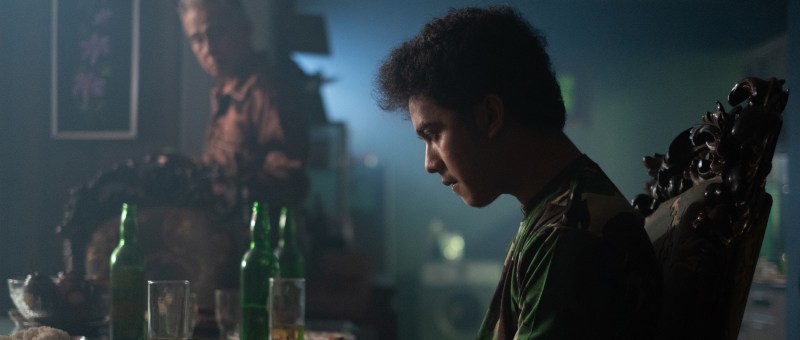
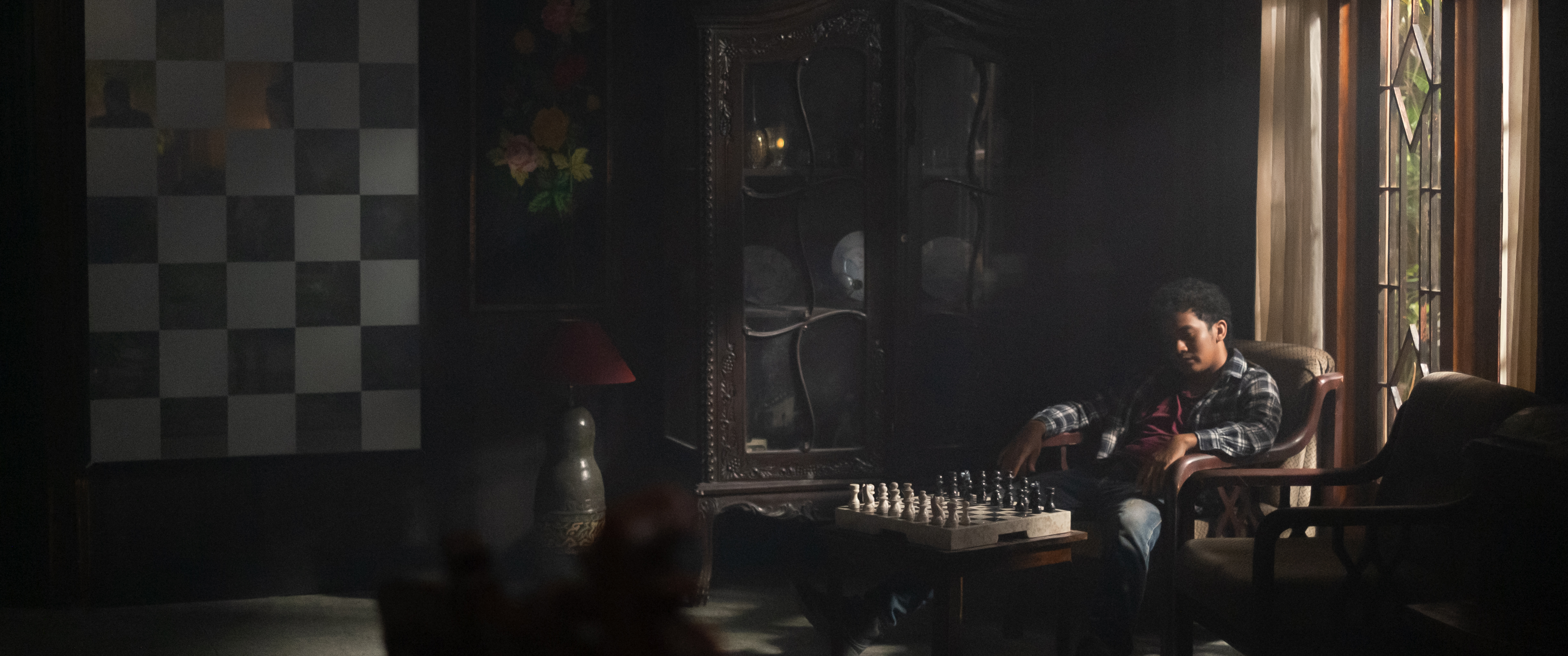
19-year-old Kib (Kevin Ardilova) lives alone in a vast mansion, the country home of a former general, Parna (Arswendy Bening Swara), who soon arrives unexpectedly with the intention of beginning his political career. Kib is quite obviously awestruck by the figure of the General, gazing at him like some long lost saviour drunk on the sense of power he exudes from every pore. On silently collecting the old man’s laundry, he stops to stare at a large portrait of him in uniform on the bedroom wall as if somehow thinking he too could one day be a fine general wielding such infinite power for himself. 

Such a thought might in a sense be transgressive. Kib is a servant in this house and as his father Amir, currently in prison for standing up to developers who were trying to steal his land, points out, their ancestors have always served the ancestors of Purna. Purna may tell him that no one cares about class anymore, but it obviously isn’t true or these two men wouldn’t be on opposite sides of the bars, or perhaps they would but their positions might be reversed. “Be careful who you trust” Amir tries to warn his son, but it’s already too late. Kib is ambitious. There’s something that bristles in him when Purna asks after his brother and wonders how well he can be doing as a migrant worker in Singapore with thinly concealed disdain in his voice. When Purna gives Kib an army shirt and says he looks just like him when he was young, a resemblance soon noticed by others, it flatters him to think he may be the General’s son rather than that of a mere servant turned convict. 

The more time he spends with Purna the more like him becomes, walking around with a swagger, exuding power and intimidation as if he really were a soldier not just a boy in a green shirt. Tragically he doesn’t even quite understand how this power mechanism works or what it’s implications are. When he accidentally bumps into a mosque while attempting a tight three point turn, local men surround the car demanding compensation. Purna gets out and puts on a show of authority. On realising what they’re dealing with the men instantly back down. Purna has a sheepish Kib apologise, and the men apologise to him, before explaining that sorry is a powerful word that can turn rage into blessing. What Kib fails to realise is that Purna is talking not about humility but intimidation, a mistake he learns to his cost in bringing a boy only a little younger than himself to Purna to “apologise” for disrespecting him expecting the General to pull the same trick again but shocked when events take a much darker turn than he’d anticipated. 

The boy he brought in, Argus, was the son of a woman whose coffee plantation would have to go if Purna got his hydroelectric plant approved. Purna sells the plant as a way of dealing with the problems caused by inefficient infrastructure but hides the corruption at its centre, forcing families off their land for the developers’ benefit through violence and intimidation. Argus is just as angry Kib, only he’s not falling for Purna’s sales patter. Kib watches the General shift the blame onto the developers, whom he backs and back him, while claiming to be a man of the people and giving a glib speech at the funeral of a boy he killed in nothing other than pettiness. 

Yet Purna is ageing and his grip on power may not be as firm as it once was while his seeming sentimentality in his attachment to Kib as a surrogate son is also a weakness. Kib may be deciding that being a migrant worker’s not as bad as becoming the heir of a man like Purna, but once you’re in it’s hard to get out as the ambivalent closing scene implies catching him dumbstruck once again only now like a general overseeing his troops and in one way or another a prisoner of his father’s house, a servant inheriting the mansion whether he wants it or not. In many ways a tale of seduction, Autobiography paints a fairly bleak picture of the contemporary society ruled by violent masculinity and fragile authority figures who quite literally visit their sins on their sons. 


Autobiography screens 15th/16th October as part of this year’s BFI London Film Festival.

Original trailer (English subtitles)

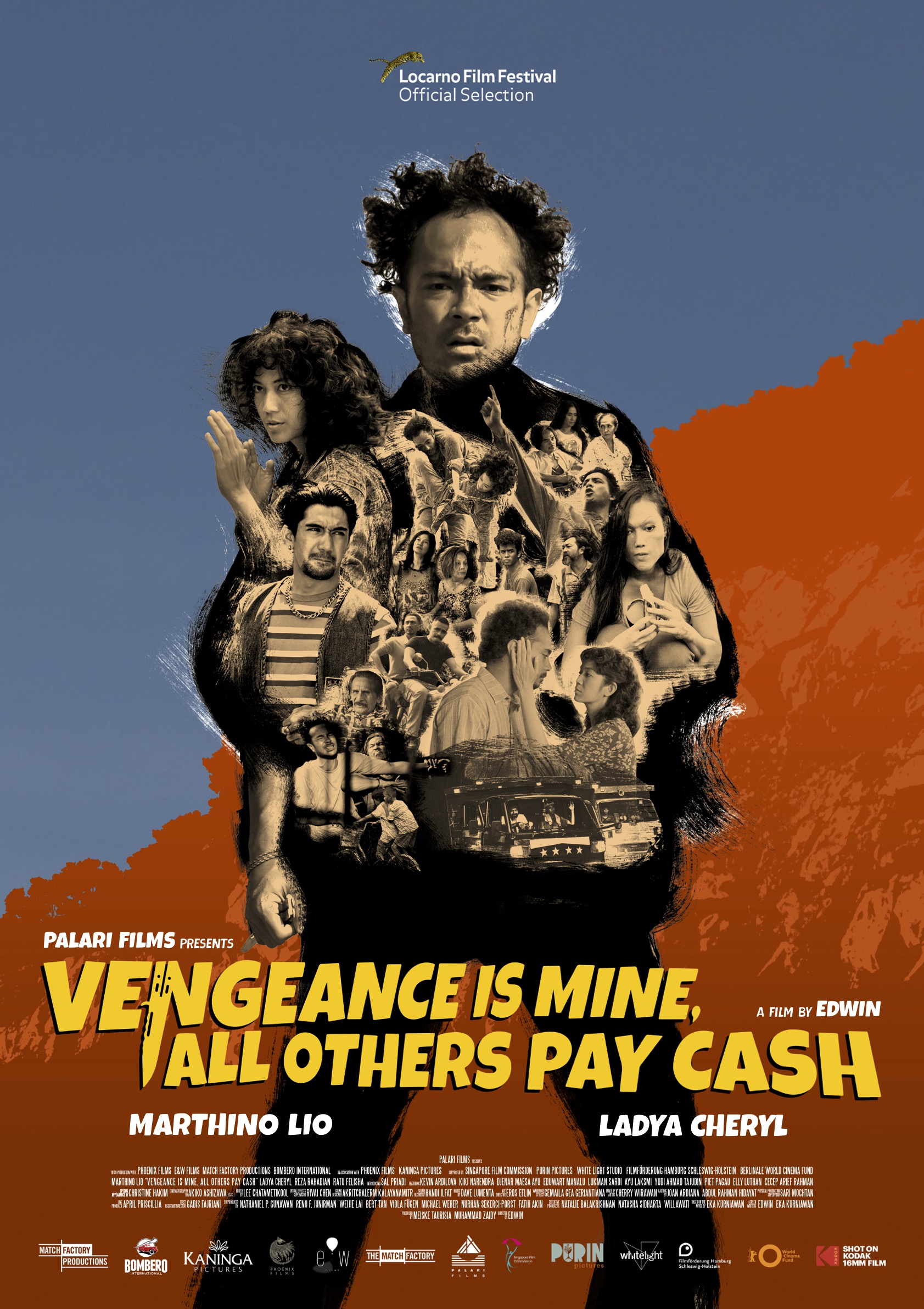
Vengeance Is Mine, All Others Pay Cash (Seperti Dendam, Rindu Harus Dibayar Tuntas, Edwin, 2021)

The innocent love of a pair of traumatised youngsters is crushed by the society in which they live in Edwin’s ‘80s-set pulp adventure, Vengeance is Mine, All Others Pay Cash (Seperti Dendam, Rindu Harus Dibayar Tuntas). An absurdist parable about the corrosive effects of toxic masculinity and its links to oppressive authoritarianism, Edwin’s outlandish drama sees a young man contend with literal and societal impotence through the medium of violence while falling in love with a woman equally in desire of revenge against her misuses at the hands of a misogynistic society. 

Rendered sexually impotent after childhood trauma, 20-something Ajo (Marthino Lio) gets his release through violence well known for always being up for a fight whether there’s money involved or not. Yet as we see he seems to enjoy being on the receiving end, almost giggling when he’s set upon by a small mob in a bar. During the course of one particular job with a social justice angle roughing up an overreaching local businessman who apparently pressed a man into debt in order to extract the payment from his wife, Ajo ends up running into Iteung (Ladya Cheryl), his target’s bodyguard and a lover of violence like himself. The pair fall in love, but Ajo is afraid to pursue a relationship because of his impotence eventually provoked into a rain-soaked confession only to realise that just like everyone else in town Iteung already knows and doesn’t care. She marries him anyway but is continually stalked by a resentful ex, Budi (Reza Rahadian), while Ajo is preoccupied with a job he unwisely took on to knock off a gangster rival of former general Uncle Gembul (Piet Pagau).

The pair are in a sense pursued by their pasts each of which stems back to an instance of sexual abuse, the young Ajo forced to participate in a rape after being kidnapped by a pair of corrupt soldiers and thereafter rendered impotent. In an ironic touch, the assault takes place on the day of an eclipse which president Suharto had issued advice not to look at owing to the possibility of damaging one’s sight though in essence Ajo gets in trouble for looking directly at something he should not have seen and is rendered impotent by corrupt state power. Years later, Iteung decides she wants revenge, that if she could track down and enact justice on these two former soldiers she might be able to lift Ajo’s curse and ironically enough restore his manhood so that they might have a full marriage. 

She meanwhile is also carrying her own trauma having been subject to male sexualised violence from a young age. Given Ajo’s condition, the pair consummate their relationship through pugilism, a fight scene standing in for sex but the disruptive presence of the brooding Budi continues to linger on the horizon Iteung coming to regret a bargain she made with him in the hope of tracking down the soldiers. Having quelled his lust for violence, discovering that Iteung has betrayed him sends Ajo into a murderous rage finally completing the job he had been afraid of doing in fear that it would pollute his otherwise blissful relationship with his new wife. In an ironic touch, Budi’s big business plan is selling a snake oil male virility tonic, his insecure yet superficially powerful vision of masculinity held up as an ideal while Ajo once again attempts to validate his manhood through violence. After a period of wandering and an encounter with a mysterious figure he begins to rediscover a sense of security in masculinity that is not linked with sexuality realising that all he wants is to be with Iteung and he no longer cares whether or not his impotence is ever cured. 

A retro homage to the action exploitation movies of the 1980s, Edwin’s absurdist world building is a direct attack on a macho culture that manifests itself in oppressive authoritarianism along with the concurrent misogyny that leaves women vulnerable to male violence. At heart a romance in which love ultimately triumphs over the corrosive effects of toxic masculinity and entrenched patriarchy, Edwin’s absurdist tale later takes a turn for the metaphysical in the form of the arrival of a ghostly avenger come to enact justice on those who presumed themselves above the law but nevertheless ends on a note of cosmic irony in which the wages of vengeance must indeed be paid in full.


Vengeance Is Mine, All Others Pay Cash screens in New York March 19 with lead actress Ladya Cheryl appearing in person as part of Museum of the Moving Image’s First Look 2022. Due to popular demand, a second screening without guest appearance has now been added on March 26.

International trailer (English subtitles)

Gundala (Joko Anwar, 2019)

“If we see injustice before our eyes and do nothing then we’re no longer humans” the idealistic father of a future superhero instructs his young son, trying to impart a sense of humanitarianism as a basic moral good. It’s a lesson the boy will find himself unlearning and resuming later, his innocence well and truly destroyed by an often cruel and cynical society only to be reawakened to the idea that it doesn’t need to stay that way. Among the most recognisable names of Indonesian cinema, Joko Anwar turns his hand to the creation of a local comic book cinematic universe, adapting the 1969 comic Gundala by Harya “Hasmi” Suraminata for the present day filtering contemporary Jakarta through classic Gotham. 

Operating as an origin story for the titular hero, Gundala opens with the young hero Sancaka (Muzakki Ramdhan) unable to prevent his father’s (Rio Dewanto) death due to his fear of electrical storms when he is first set up by a duplicitous factory boss and then assassinated while leading a protest for fair pay and conditions. Soon after, Sancaka loses his mother (Marissa Anita) too after she is forced to go to the city for work and never returns. Ending up a ragged street kid, he’s saved from an attack by a rival gang by an older boy (Faris Fadjar Munggaran) who teaches him how to protect himself physically and mentally by convincing him that the only way to survive on the street is keep his head down and walk on by even if it looks like others are in trouble. 20 years later the adult Sancaka (Abimana Aryasatya) is an aloof young man working as a security guard at a print house where his sympathetic mentor Agung (Pritt Timothy) begins to remind him of his father in his conviction that “living is no use if you stop caring and only think about yourself”, while he also finds himself defending the woman next-door, Wulan (Tara Basro), and her young brother Teddy (Bimasena Prisai Susilo), from hired thugs sent to intimidate them because of their involvement in a protest against the forced redevelopment of a local marketplace.  

Events seem echo around him. The major villain Pengkor (Bront Palarae) is also an orphan but on the opposing side as the son of a cruel plantation owner murdered by his not altogether ideologically pure workers whose desire for fair pay and conditions he had resolutely ignored. According to cynical politician Ridwan (Lukman Sardi), Pengkor became a union organiser of his own, leading an uprising at the abusive orphanage he was placed into by a cruel uncle hoping he’d die and free up the inheritance, thereafter becoming a kind of godfather to the fatherless with a thousands strong army of eternally grateful orphans he saved acting as sleeper agents for a coming revolution. 

Pengkor’s nefarious plan involves fostering a conspiracy surrounding contaminated rice said to make the unborn children of the women who eat it turn out “immoral”, a generation of psychopaths unable to tell right from wrong. Fairly unscientific, it has to be said, but playing directly into the central questions of the nature of “morality” in a “immoral” society. Can it really be “moral” for bosses to exploit their workers and get away with it, for politicians to cosy up to gangsters and remain complicit with corruption, and for a man like Pengkor to be the only hope for orphaned street kids otherwise abandoned and ignored by a wilfully indifferent society? Pengkor decries that hope is the opiate of the masses, but that’s exactly what Gundala eventually becomes for them in his “electric” ability to resist, eventually rediscovering his humanity as he designates himself as the embodiment of “the people” pushing back against the forces of oppression and seeming at least to win if only momentarily.  

Young Sancaka’s fear of lightning is, in essence, a fear of his power and his social responsibility something he is quite literally shocked into accepting. In a world of quite striking social inequality, he finds himself the lone defender of the oppressed whose very existence spurs others, including previously cynical politician Ridwan, into rediscovering their own humanity in the resurgent hope of a better future. As someone puts it, peace never lasts long but you keep fighting for it because every moment is precious. Not so much a battle of good versus evil as a battle for the meaning of good, Anwar’s Gundala recalibrates the anxieties of the late ‘60s for the modern era and creates an everyman hero not only to resist them but to foster a spirit of resistance and humanity in the face of heartless cynicism. 


Gundala streams in Poland until 6th December as part of the 14th Five Flavours Film Festival.

Original trailer (English subtitles)