Love After Love (第一炉香, Ann Hui, 2020)

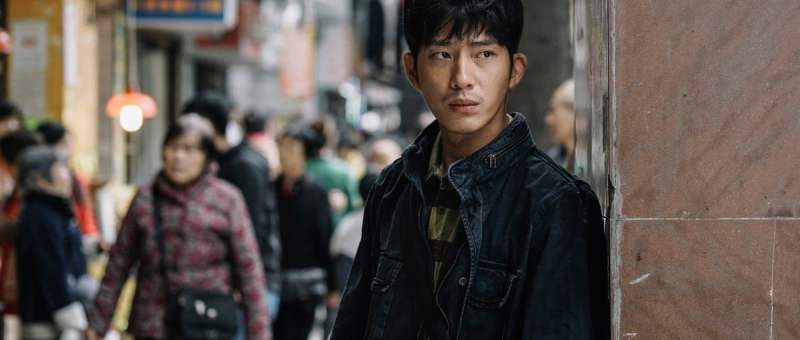
A naive young woman’s path from besotted teen to tortured yet masterful courtesan amid the colonial realities of pre-war Hong Kong is elegantly charted in Ann Hui’s stately adaptation of the novel by Eileen Chang, Love After Love (第一炉香, Dì yī lú xiāng). A slow-burn romantic tragedy, Hui’s floating drama at once reflects a sense of hopeless rootlessness and the ruinous intensity of a one-sided love but also the transgressive possibilities for freedom and independence in the rejection of traditional patriarchal social codes. 

Displaced from her native Shanghai by ongoing political tension, Weilong (Ma Sichun), the daughter of a once noble house, finds herself impoverished and left with the choice either of accompanying her family in returning to the Mainland where she will be set back a year in completing her studies or remaining behind alone in Hong Kong to graduate high school. Unable to support herself, she decides to turn to an estranged aunt she barely knows, throwing herself on her mercy and asking to be taken in even while knowing of the animosity which exists between her father and his sister. That would be because her aunt, Madame Liang (Faye Yu), turned down all the suitors her family found for her and chose instead to become the mistress of a wealthy man. He now having died, Madame Liang has inherited a sizeable fortune including a European-style mansion where she hosts society parties and enjoys a hedonistic lifestyle which has earned her a reputation as a seducer of young men. 

On her introduction to this world, one of the maids uncharitably describes Weilong’s entrance as like that of a new girl in a brothel and there is indeed something of that in her new role in the household, dangled like a bauble in front of Madame Liang’s collection of wealthy male associates, though Madame Liang apparently intends her only as decoration rather than gift. Tensions come to the fore as Weilong develops a fondness for a dashing young man, George (Edward Peng Yu-Yan), the mixed ethnicity son of coterie member Sir Cheng (Paul Chun), previously eyed by Madame Liang who understands much better than her naive niece that men like George are dangerous in their destabilising faithlessness. For Madame Liang, so perfectly in control, George may be manageable but as she later tells Weilong, unwisely goading her that her life of comfort is a failure because she will never find love, the only danger that exists to her is in unequal affection a prophecy that will in a sense come to pass in Weilong’s single-minded obsession to possess the heart of George. 

Weilong may describe Madame Liang’s lifestyle as ridiculous, yet as she points out her transgressive sexuality is also currency that permits the opulence and luxury in which she lives. Seduced by this world as much as by George, Weilong disapproves but admits that she is no longer the naive girl who arrived even if she also dislikes this new version of herself, considering a return to Shanghai and a possible reset to become someone else again presumably more in line with contemporary notions of social proprietary. She can’t deny that Madame Liang’s rejection of the patriarchal institution of marriage has granted her an unusual degree of independence otherwise unavailable in the contemporary society. She herself faces a choice in approaching the end of her high school days, either progressing to higher education, seeking work, or getting married naively insisting to Madame Liang that she will earn money in order to support George and his lavish lifestyle even as she advises her to enact a plot of romance as revenge. 

While Weilong’s discarded suitor benefits financially in becoming Madame Liang’s lover, she sponsoring his study abroad, Weilong again attempts to reverse traditional gender roles by trapping George as a kind of trophy husband. He had repeatedly told her he wasn’t the marrying kind, in part because of his insatiable sexual desire and perpetual loneliness in having lost his mother young, yet also because of his father’s perfectly acceptable yet socially destructive romantic history which includes several concubines and illegitimate children meaning there will be little in the way of inheritance. If he married, he’d need to marry well but Weilong’s family is impoverished and she has only her connection with Madame Liang to leverage. As she’d warned her it would be, the relationship between them will always be unhappy, Weilong winning a symbolic victory in coercing George towards marriage but unable to accept the limits of her control while he, paradoxically, is emotionally honest only with her but she can only see this as a slight as if he is so indifferent towards her that she is not worth lying to. 

As Weilong gradually morphs into her aunt, George’s sexually liberated sister Kitty lands on a different path later becoming a nun. The three women attempt to muster all of the advantages afforded to them under an oppressive patriarchal system but none perhaps find true happiness. It might be tempting to read a subversive comment on the nature of colonialism in the various frustrated love affairs and persistent sense of rootlessness, Hui’s drama is at heart a romantic tragedy in which two people become locked in a torturous relationship because they cannot understand each other. Their very idea of love is different. Doyle’s floating camera perfectly captures the fleeting opulence of this unreal society itself lingering on an abyss as the lovers continue to dance around each other looking perhaps for the love after love in immaterial comfort. 


Trailer (English subtitles)

The Fallen Bridge (断.桥, Li Yu, 2022)

Li Yu’s mystery thriller The Fallen Bridge (断.桥. duàn.qiáo) finds itself at a series of contradictions in the modern China and its film industry. The film was an unexpected box office success, though largely because it falls into a new category of boy band film in starring TFBoys’ Karry Wang locking in an audience of ardent fans much as Jackson Yee’s presence in Better Days had though it also plays into ongoing anti-corruption theme in recent cinema while simultaneously adopting a mildly positive stance towards whistleblowers if specifically within the field of construction.

It is of course an unescapable fact that hypercapitalistic working practices and ingrained corruption have led to numerous public safety failures with bridge collapses unfortunately a fairly common occurrence. This one is particularly problematic as a skeleton is discovered encased in the concrete during the cleanup effort. From the way it’s posed, it appears the man may have been buried alive. A preserved piece of paper found in a bag accompanying the skeleton states his intention to take his concerns to the head of the construction project that the structure is unsafe and should be entirely rebuilt. Of course, that would be incredibly expensive, embarrassing, and disadvantageous to others who have used the bridge as a way of forging connections with important people.

The bridge’s collapse is therefore also symbolic in pointing to the fracturing instability of these relationships along with that between college friends Zhu Fengzheng (Fan Wei), the project manager, and Wen Liang (Mo Chunlin), the would-be-whistleblower. Fengzheng has also been raising Liang’s daughter Xiaoyu (Ma Sichun) who was 12 at the time her father disappeared after seemingly being disowned by her mother who was under the impression he had runaway with his mistress. Now in her 20s and an architecture student, Xiaoyu becomes determined to learn the truth even as she begins to suspect Fengzheng who has otherwise become a second father to her and does at least seem to care for her as a daughter while his own son is apparently living in Australia. Teaming up with a fugitive, Meng Chao (Karry Wang), on the run for killing the man who raped his sister, she begins plotting her revenge while a police investigation into the bridge collapse and an additional suspicious death otherwise seems to flounder.

Though it may not mean to (as it seems unlikely to please the censors) the film gives tacit approval to vigilante violence in subtly suggesting that “official” justice is rendered impossible because of the complex networks of corruption that exist within the soceity. Meng Chao says the man who raped his sister was a judge which is why he had to kill him, while Xiaoyu seems to desire individual vengeance believing the police aren’t investigating properly but refusing to go to them with key evidence because she wants to kill her father’s killer herself. While carrying out their investigation, the pair end up adopting the wily daughter of another casualty of the villain’s greed and form an unlikely family unit marking them all out as good people who have been betrayed by the system which is itself corrupted by the nation’s headlong slide into irresponsible capitalism. 

Even so, revealing the villain so early weakens the suspense while their own motivations are left unexplored, assumed to be merely greed if perhaps also a wish to remain connected to influential people and be thought of as important at the cost of the lives of the general public (along with those of often exploited labourers) endangered by shoddy construction practices. It isn’t entirely clear how they intended to deal with the fallout of their machinations to cover up their past misdeeds, especially as the sub-standard work on the bridge has already been exposed though obviously could be blamed on others no longer around to defend themselves, but perhaps it all amounts to crazed self-preservation pitched against the righteousness of Xiaoyu and Meng Chao who are after all wronged parties in China’s deeply entrenched judicial inequality. Nevertheless, we get the inevitable title card (left untranslated in the overseas release) explaining that justice was served and a censor-pleasing ending that still in its way suggests the police are incapable of solving these crimes and that the petty corruptions of small-town life are otherwise impossible to prosecute. 


The Fallen Bridge streamed as part of the 18th Season of Asian Pop-Up Cinema.

Original trailer (English subtitles)

The Shadow Play (风中有朵雨做的云, Lou Ye, 2018)

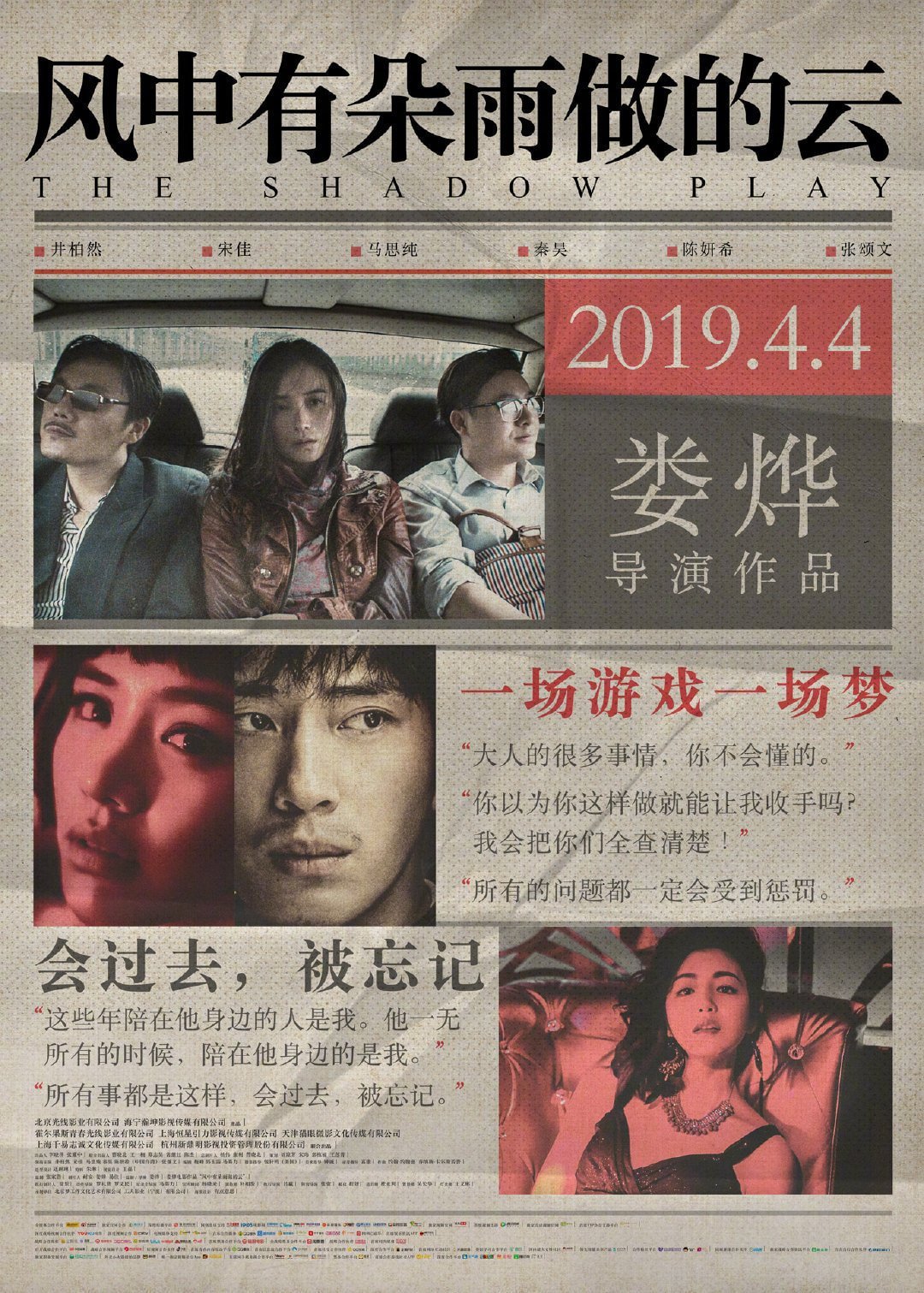
The forever rebellious Lou Ye has had his share of troubles with the Chinese censors board. Suzhou River was banned on its release, while he received a five-year filmmaking sanction for screening his provocative Tiananmen Square drama Summer Palace in Cannes without clearing official permission first. Stuck in censorship limbo for two years, the aptly named The Shadow Play (风中有朵雨做的云, fēng zhōng yǒu yù zuò de yún), taking its title from characteristically well-placed retro pop song, sees Lou steeping into the increasingly popular genre of Sino-Noir once again critiquing the the corrosive corruption of the Modern China through the prism of crime. 

Many of Lou’s films pivot narrative around a single implosion from which everything radiates like cracks in a pane of shattered glass. The Shadow Play is no different only there are perhaps three distinct, interlinked points of fracture each connected in a complex web of corruption and frustrated desires. He opens therefore with a moment which occurs in the mid-point of the narrative, the accidental discovery of decomposing body by a young couple venturing into the wilds of nature for a little privacy. The action then moves to the “contemporary” present of 2012 in which a small village is engulfed by “rioting” as residents attempt to protest the demolition of their community by the Violet Gold Real Estate Company. CEO Tang (Zhang Songwen) turns up to do some ineffectual damage control, slipping into Cantonese as he reminds them he’s a local boy too and only wants to bring about “the transformation of our community” insisting that the “beautiful future” is possible only by tearing down the old. As he’s speaking, however, protestors manage to knock down the neon sign bearing his company’s name from the building behind him and later that night Tang himself is found dead, impaled its framework after apparently “falling” from the rooftop. 

Young and idealistic policeman Yang (Jing Boran) was assigned to the detail that night and thereafter to the investigation into Tang’s death, quickly growing suspicious over his ties to shady property tycoon Jiang (Qin Hao). As a brief montage sequence explains, Tang and Jiang who met at university in 1989 each prospered from the capitalist explosion of China’s ‘90s reforms but their complicated relationship is founded on resentment and dependency partly connected to their mutual love for campus sweetheart Lin Hui (Song Jia) who first dated Jiang but as he was apparently already attached later married Tang. Many suspect that Jiang has something to do with Tang’s death even as others point out that he needed him to preserve his access to government bureaucracy, but the investigation is further complicated by witness sightings of a third person thought to be Jiang’s Taiwanese former lover/business partner Ah-yun whose mysterious disappearance in 2006 Yang is convinced is connected to the traffic accident which left his veteran policeman father in a catatonic state. 

The Shadow Play is in some respects unusual in its strong yet often implicit hints of police corruption perhaps mitigating its mild attack on the mechanisms of state through Yang’s idealistic, though flawed, goodness. Seduced by the lonely Lin Hui, he finds his name blackened but refuses to give in even when forced on the run after being framed for murder. Like Lin Hui’s daughter Ruo (Ma Sichun) however he is also representative of the post-90s generation who have grown up in the world created by men like Jiang and Tang. He is obviously uncomfortable in being introduced as his father’s son but also carries with him a desire for justice that lies adjacent to revenge. Ruo, meanwhile, though now an adult, longs for the restoration of her family despising her father Tang while obviously close to Jiang who has been supporting her financially by funding her education, using his wealth to game the system. “She’ll be happier than we are,” Jiang insists, ironically echoing Tang’s insistence that the village must be destroyed so they can give their children better futures. 

Tang meanwhile is a representative of China’s resentful petty bureaucrats forced into a middle-man existence unwilling to admit that he owes everything to Jiang, the man he knows to be sleeping with his wife. His toxic sense of male inferiority sees him take out his frustrations those with the least power, subjecting Lin Hui to years of domestic abuse before eventually having her locked up in a psychiatric institution claiming that she self-harms and is mentally unbalanced. The facade of the elegant, prosperous middle class family is well and truly imploded while it becomes difficult to tell if Tang is just a sleaze, exposing his misogyny in bringing up Ah-yun’s bar girl past, or his ill-advised pass at her is an attempt to get back at Jiang for his relationship with his wife while undercutting his rival’s manhood by sleeping with his woman. There is widespread impropriety in this incestuous world of corporate politics, but there’s also personal pettiness, hurt, and heartbreak that eventually blossoms into an ugly violence. 

In characteristic non-linear fashion Lou zips between the three points of fracture from the trio’s meeting in a 1989 through the disappearance of Ah-yun and the death of Tang, the layers of corruption deepening as the two men make themselves rich taking advantage of the unregulated capitalism of the modern China while slowly destroying themselves in their mutual unhappiness. It’s no surprise that the film found itself on the wrong side of the censors with its brutal footage of anti-redevelopment riots, hints of political corruption, and the depiction of the destruction of a body though we get the now customary title cards appearing at the end reminding us that the guilty parties have been caught and punished outlining exactly how long for everyone went to jail even if Lou subtly undercuts the sense of the State in action the card is intended to portray. Elliptical and somehow hard, ending like Summer Palace on the innocent image of the trio dancing back in 1989, The Shadow Play is cutting indictment of a morally bankrupt society and the corrosive effects of corruption but perhaps implying that the younger generation will in one way or another have its revenge for the ravages of their parents’ greed. 


Original trailer (no subtitles)