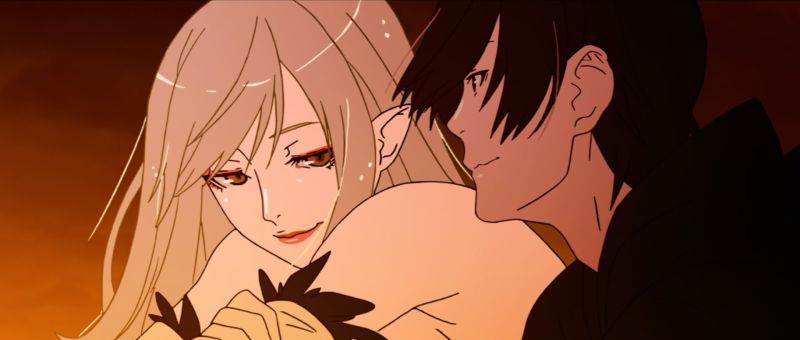
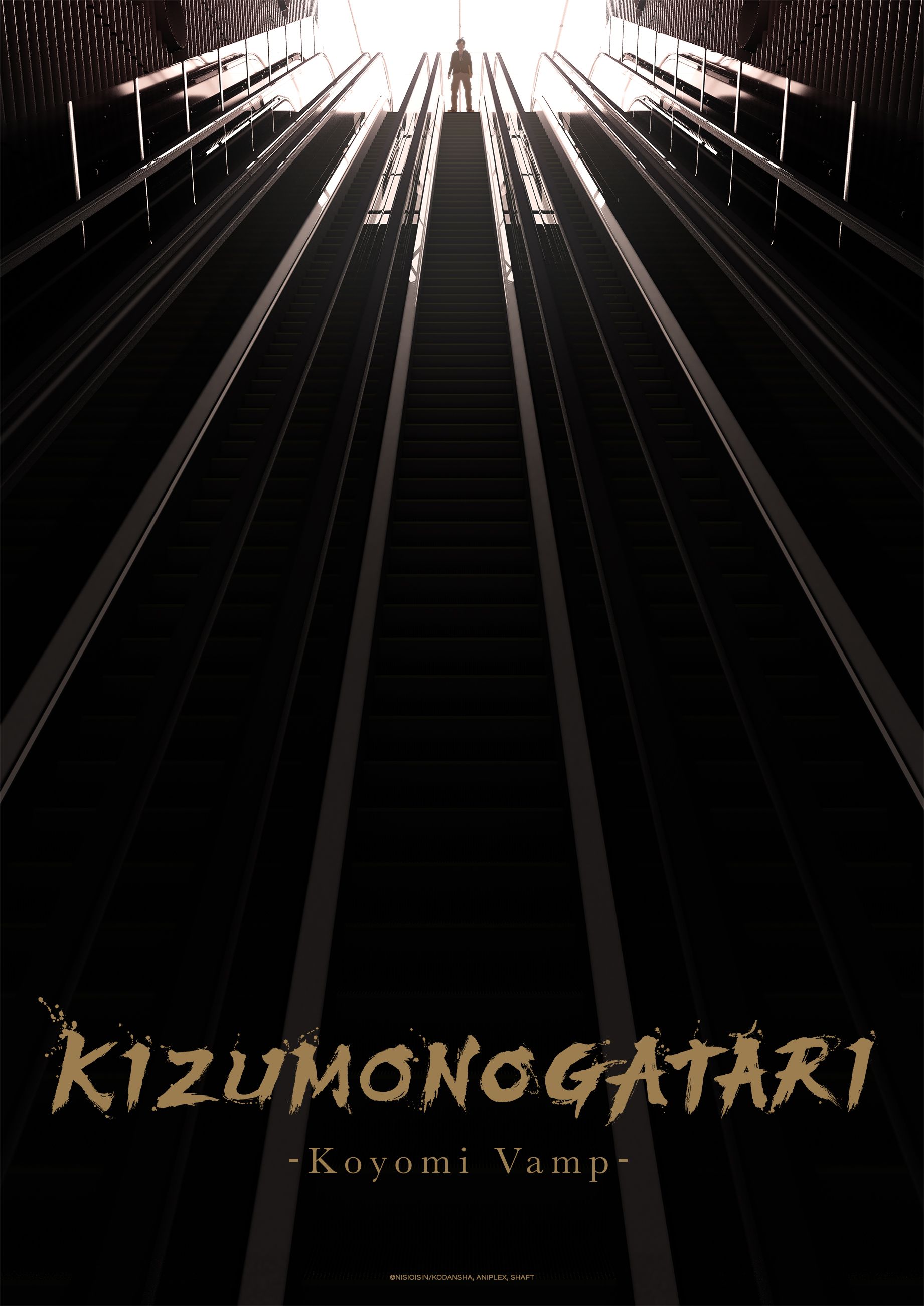
A young man walks into an empty subway station already ominously strewn with blood and finds there the corpse of a woman shorn of her limbs. The corpse rises and begs him to have her life by sacrificing his own in allowing her to suck his blood and surprisingly the young man agrees. He does not, however, die but is brought back as something else, not quite human and definitely subservient to the creature he has saved.
Running 2.5 hours, Tatsuya Oishi’s Kizumonogatari -Koyomi Vamp- (傷物語 -こよみヴァンプ-) is in fact a compilation of three films released in 2016 and a part of the long running Kizumonogatari series which originated with Nisio Isin’s light novels and has gone to spawn an expansive universe of interconnecting spin-offs. This is technically a prequel, and in that sense begins with a black slate but also deliberately drops us into confusion with breakneck pace through the hero’s quest to recover himself and his place in the world after this rude awakening to the supernatural.
Rude is in many ways a defining characteristic of Kiss-shot, the 500-year old vampire Araragi finds bleeding in the subway station at that point a blonde and alluring figure of forbidden desire. Araragi is drawn to her in an unconscious death wish linked with the sexual desire he struggles to understand, running into the subway minutes after buying a pornographic magazine from a convenience store after striking up a friendship with fellow student Hanekawa. But once he saves her life, Kiss-shot is transformed into a cheeky little girl who now tells him that he is her minion and he must recover her severed limbs from a trio of vampire in order to be restored to humanity even as the power dynamic between them becomes confused and distorted.
In his vampire state, Araragi becomes immortal, powerful and free of mortal jeopardy yet he remains uncertain and insecure while reliant on the support of Hanekawa who encourages him to reject his desire for death and remain alive. But this also presents a problem to Araragi who sees himself as self-sacrificing and is unwilling to accept the what he sees as a self-sacrifice from Hanekawa for whom he feels unworthy and inadequate. In some senses it’s a typically self-centred, adolescent male perspective that rejects any idea of her own agency and assumes Hanekawa performs these actions for him rather than considering that she performs them for herself and is simply doing what she wants to do which in the end is not really about him at all. He declares it a burden he’s too weak to carry, which might in some senses be fair but also again a mischaracterisation that is further evidence of his lack of self-worth.
It’s this sense of inadequacy that lies behind his desire to reclaim his humanity along with the concurrent disgust he feels in the degradations of vampirism. It genuinely comes as a surprise to him that Kiss-shot feeds on human beings and lost her own humanity so long ago that she no longer gives it a second thought. She is after all only being what she is, but like Araragi is drawn to death partly out of frustrated longing and lingering boredom with a relentless yet apparently uneventful 500 years behind her in which the only other highlight was her previous minion who rejected this life much more quickly than she ever expected.
Even so, Oishi lends their mutual dilemma a degree of absurdity in the expectedly comic sight of severed heads littering a sports filed or launching themselves in toothy attacks. Heavily inspired by the French New Wave, he breaks the action with sometimes barely legible title cards often reading a single world while his composition has a kind of jauntiness that is also bleak and melancholy. The world surrounding Araragi veers between the pristine entrance to the high school, and post apocalyptic devastation littered with crows emblematised by the depilated cram school in which Kiss-shot keeps him. Backgrounds often have a photo realistic quality that further sets the world at a kilter when matched with the more conventional character designs of the central players. The conclusion that Araragi is presented with amounts a sharing of the misery which is also akin the burden he didn’t want to carry but also perhaps symbolic of his path towards adulthood in acceptance of compromise and selflessness in being willing to carry a small part of others’ pain and despair and allowing them to carry a part of his own.
Kizumonogatari -Koyomi Vamp- screened as part of this year’s Fantasia International Film Festival.
Original trailer (English subtitles)
 Masamune Shirow’s cyberpunk manga Ghost in the Shell burst onto the scene in 1989 and instantly became a genre classic. Mamoru Oshii then adapted the manga into a much lauded anime movie in 1995 which almost came to define cyberpunk animation even if it emerged towards the end of the genre’s heyday. A sequel, Ghost in the Shell: Innocence followed in 2004 as well as a TV anime spin-off Ghost in the Shell: Stand Alone Complex. Now with the 20th anniversary of the original animated movie, the series has yet again been adapted into a series of entirely new anime OVAs under the name of Ghost in the Shell: Arise. Ghost in the Shell: The New Movie (攻殻機動隊 新劇場版, Kokaku Kidotai – Shin Gekijoban) is the big screen outing of this latest incarnation scripted by Tow Ubukata who also produced the very GITS influenced Mardock Scramble.
 Windows on Worlds