Tea Friends (茶飲友達, Bunji Sotoyama, 2023)

Japan’s rapidly ageing society has provoked an epidemic of loneliness but also perhaps new business opportunities in Bunji Sotoyama’s empathetic social drama Tea Friends (茶飲友達, Chanomi Tomodachi). The phrase may sound innocuous enough, but given some potentially outdated cultural connotations the men who spot the advert cunningly placed in a newspaper to catch the eyes of older readers may have reason to assume that it’s more than just tea and chat on offer. Though as it turns out, it’s not just the old who are lonely as a younger generation in turn often in conflict with their parents also attempt to seek security and comfort in found family.

That said, there’s something a little cult-like about the way that Mana (Rei Okamoto), a former sex worker, talks about her organisation which aims to cure late life loneliness through what others might describe as an elderly sex ring. Employing a collection of older women, she accompanies them to meet new clients where they silently slide viagra over the table. The gentleman caller subscribes to a plan to purchase “tea” and anything that happens inside the hotel room they subsequently go to is just “free love” rather than “prostitution”. Mana sees herself as running a “community safety net” and helping elderly people who might otherwise have become isolated and depressed keep active as part of one big happy family along with the other members of staff who have, like her, become estranged from their parents and relatives. 

For Yoshiki, one of the men who escorts the ladies around, it’s that he views his father as a failure for leaving a well-paid corporate job to open a bakery which subsequently went bankrupt and has led to him living in his car. He thinks that in the end it’s better not to try at all than be left with the humiliation of things not working out. But then for Mana herself it’s more a sense of parental rejection. After a difficult childhood, her now terminally ill mother continues to reject her on the grounds of her history of sex work while she continues to crave the unconditional love of a family. Like a mother hen, she nestles those around her into the Tea Friends organisation which operates out of her own home and strives to create a place where everyone can feel they belong. 

Which is all to say she’s the loneliest one of all, but as someone else later cautions her you can’t cure your own loneliness with the loneliness of others. What she sees as a social enterprise others may see as a deliberate attempt to take advantage of vulnerable people who have admittedly been let down by an indifferent society and are in need of the money even more so than comfort or validation. At the other end of the spectrum, a young woman working at Tea Friends discovers that she is pregnant but her boyfriend immediately rejects her, insisting that he refuses to take responsibility and revealing that he is already married. Chika wants to have her baby, but everyone seems to be telling her that she shouldn’t. The doctors seem to look down on her after realising she isn’t married and the father most likely not in the picture, while an attempt to inquire about benefits at the town hall leads only to judgement as the clerk pithily tells her that they’re there for when you need them but she shouldn’t “depend” on them too much virtually calling her a scrounger and implying she’s been irresponsible in becoming a single mother. 

As another of the older women admits, being used was better than being ignored and at least being part of Tea Friends gave her a sense of purpose and acceptance if only for a time. In any case, Mana’s attempt to find unconditional love from her new “family” largely flounders as even those she’d come to believe herself close to desert her when the threat of legal proceedings enters the picture leaving her to face the music alone while she continues to protect them insisting that they’ve done nothing wrong even if it it was technically against the law. An old man’s devastation on picking up the phone and getting no answer suggests that Mana might have had a point when she said it was a social service seeing as no one else seems keen to tackle the problem of late life loneliness even if she did go about it in a problematic way. As Mana often says, righteousness does not equal happiness and it is often outdated social brainwashing that keeps people unhappy and not least herself as she struggles to find the unconditional love lacking in her life that would enable her to cure her own loneliness even in the prime of her youth.


Tea Friends screened as part of this year’s Camera Japan.

Original trailer (English subtitles)
Going the Distance (かぞくへ, Yujiro Harumoto, 2016)

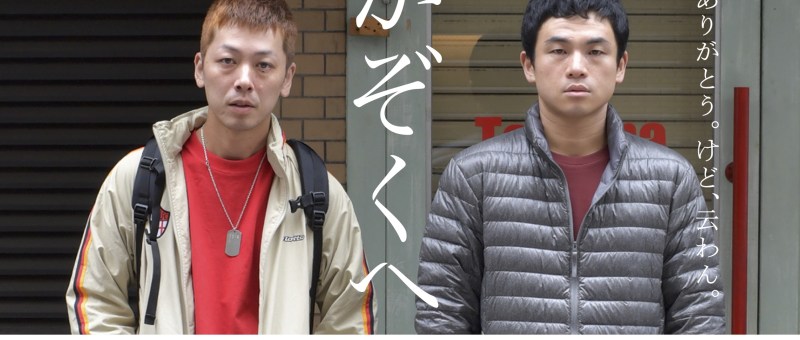
going the distance posterThe “family drama” is often regarded as Japanese cinema’s representative genre, but in the consumerist atmosphere of the late 20th century the family itself became an increasingly discredited concept. Nevertheless, it remains true that discriminating against those who have no family is the last acceptable prejudice with orphans in particular unfairly viewed as somehow untrustworthy, rejected by mainstream society, and denied both work and the possibility of starting a family of their own. The hero of Yujiro Harumoto’s debut feature Going the Distance (かぞくへ, Kazoku e) thinks he has everything finally back on track with a steady job and an engagement to a middle-class secretary, but his good heart coupled with his precarious social status seem set to ensure his new start is a non-starter.

Raised in an orphanage in the Goto Islands, Asahi (Shinichiro Matsuura) now lives in Tokyo with this fiancée Kaori (Yumi Endo) for whom he has given up his boxing career to work as a trainer in a gym. Though Kaori, superficially at least, does not care that Asahi is a man with no family, she is a little preoccupied about how it’s going to look that his “family table”  at the reception will be largely unoccupied because he’s only planning on inviting his “brother” from the orphanage, Hiroto (Masahiro Umeda), and his wife.

Hiroto still lives in Goto and works as a fisherman. Hoping to help him out, Asahi sets him up with a man from his gym, Kita (Nobu Morimoto), who is opening a restaurant specialising in super fresh fish. The meeting goes extremely well and earns Hiroto a hefty contract that convinces him he needs to take out a loan to get a bigger boat. Unfortunately, however, Kita turns out to be a crook and Hiroto ends up well out of pocket, not only for the loan but for all the fish he never gets paid for.

Feeling intensely guilty and somewhat responsible, Asahi wants to do everything he can to put things right for Hiroto, even suggesting to Kaori that they postpone the wedding so that he can give part of the money they’ve saved to help take care of his debts. As predicted, Kaori is not happy about the idea, not least because she’s repeatedly explained to Asahi that she needs to get married as soon as possible because she wants her grandmother, who is suffering with dementia, to be able to attend the wedding while she’s still well enough to know what’s going on.

Unbeknownst to Asahi, one of the reasons Kaori is so keen on her grandmother attending is that her mother almost certainly won’t. Despite telling Asahi that her mother is lukewarm on the idea but coming round, the truth is that she won’t even talk to her, rudely rejecting the invitation and vowing that she’s no interest in seeing her daughter throw her life away on a man with no family and no prospects. In fact, Kaori’s mother crassly makes a point of sending her omiai photos for potential arranged marriages to more “suitable” men – ones from “good families” matching her own class background. Kaori wastes no time in calling her a “bigot”, accusing her of indulging in an outdated and offensive prejudice against the orphaned that regards them as untrustworthy because they have no history and are not anchored to anyone who might be held responsible for their actions.

Yet, despite her anger towards her mother Kaori is not quite free of those same prejudices, snapping back at Asahi that he wouldn’t understand what she’s going through because he had no parents of his own. She keeps the drama a secret from him to avoid having to admit that her family oppose the marriage solely because he is an orphan, partly wanting to spare his feelings and partly aware that Asahi is a good and noble man who might choose to absent himself rather than force her to choose between the man she loves and her family.

Meanwhile, Asahi does something similar in refusing to confide in Kaori about everything that’s going on with Hiroto, partly out of guilt and embarrassment, and partly out of shame in knowing that he is on some level betraying her by choosing to save Hiroto rather than prioritise their marriage. He wants to make things right, put them back to the way they were before, but he has an impossible choice – either reject his responsibility to his brother who is also a good and kind man and would not want to cause him trouble in his relationship, or neglect his new responsibilities to his soon-to-be-wife.

Unfortunately, the couple elect to go on deceiving one another, intending to protect but causing only more harm. It may be the case that they’ve rushed into marriage because of Kaori’s grandmother’s precarious health and Asahi’s hopes for a solid family foundation, but their previously happy relationship is eventually eroded by a gradual disillusionment born of refusing to rely on each other, continuing to fight separate battles rather than combine their efforts to fight them together. Faced with the realisation that he may have ruined his relationship by his own foolishness in trying to help a friend with a problem that was really none of his responsibility, Asahi begins to reject Hiroto, giving up on the idea of “family” in its entirety in mistaken resentment towards his brother for a series of decisions that were entirely his own. Nevertheless, what he discovers is that true family isn’t always about blood ties but about people who will always be there for you no matter what you do. Asahi wasn’t quite as alone as he thought he was, but only by admitting his mistakes, accepting his responsibilities, and finally allowing himself to confide in and rely on others can he truly begin to build a family anchored by something deeper than blood.


Going the Distance was screened as part of the 2019 Five Flavours Film Festival.

Original trailer (English subtitles)