Flames of a Flower (火の華, Oudai Kojima, 2024)

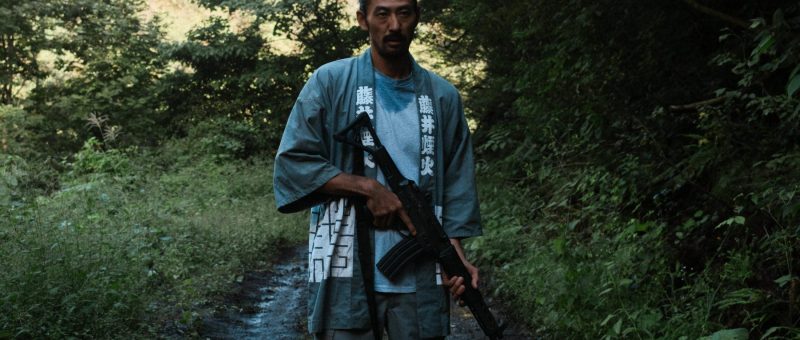
A former soldier finds it difficult to adjust to civilian life after becoming involved in a fire fight in which a close friend died while on a peace-keeping mission in South Sudan in Oudai Kojima’s politically-inflected drama, Flames of a Flower (火の華, Hi no Hana). The film takes its title from the literal meaning of the Japanese word for fireworks, but its hero is also in some senses closely aligned with a flower, both as a kind of sacrificial object burned after outliving its usefulness, and in also slowly growing in the nurturing environment of a family-run fireworks factory until finally coming into bloom.

Shimada’s (Ikken Yamamoto) growth is only, however, one side of the story as the film draws inspiration from a real-life incident of a Japanese soldier dying in a combat situation in Sudan which was covered up by the authorities as, under the pacifist constitution, Self Defence Force troops are not supposed to be deployed in combat areas while on peace-keeping missions. While serving in South Sudan, Shimada’s troop is ambushed and he is forced to shoot a child soldier when his comrade and close friend is killed after having put his gun down in an attempt to defuse the situation. While he and fellow soldier Tanaka (Ippei Tanaka) attempt to get Furukawa to a hospital, Captain Ito (Yohei Matsukado) is left behind and thereafter presumed to have been killed. On his return, Shimada is forced to sign confidentiality documents that prevent him from talking about what really happened on the grounds of national security, while the authorities report that Furukawa and Ito died as a result of a traffic accident.

It’s this inability to speak the truth that informs Shimada’s trauma as much as it is the physical stressors of the battlefield or his guilt over having to kill the child soldier. Two years after the incident, he’s working as a welder in a small factory but experiences a flashback which causes him to assault a colleague. Though his boss is sympathetic, he has no other option than to let Shimada go, but introduces him to a friend, Fujii (Masato Ibu), who runs a fireworks factory and seems to have a track record with rehabilitating those with difficult backgrounds. Working in a fireworks factory might not seem the best option given Shimada’s condition, but at the same time it gives him the opportunity to do something more constructive with the same material that caused so much destruction while he was a soldier. The film plays on this dichotomy, Shimada later visiting Sudan again to teach the children about fireworks as a means of explaining to them that they have a choice between using gunpowder for fear and killing or making something beautiful, but at the same time it ignores the third option which is obviously just not to have anything to do with gunpowder in the first place. 

Showing the children the fireworks plays into the idea that children are cruelly robbed of their dreams by egotistical adults, hinting both at the children who are forced to become soldiers, and Fujii’s own regret that he would not let his daughter Akiko (Yurina Yanagi) become a fireworks technician. She has since become a florist working with a literal kind of flowers and also helping Shimada with his recovery. His former comrades, however, have largely become consumed with anger and rage against the government for its lack of transparency. Ito, having survived, has formed a militia after meeting a former member of the Japanese Red Army and is planning some kind of revolutionary action to change the society.

Exactly how they mean to change it isn’t altogether clear aside from a clear desire for transparency and also an end to Japan’s dependence on the US for defence which they argue drags them into situations they don’t belong in because of American foreign policy they might not necessarily agree with. They don’t quite state if that means having a standing army that could go to war if necessary, or if they still believe in pacfism but want the Americans out. In any case, they plan to expose the fact that the government prioritises its diplomatic arrangements over the lives of ordinary citizens while keeping from them that this puts Japanese troops in danger overseas. 

A subsequent plot by a government official working with a Chinese gangster (Kim Chang-bak) who Shimada meets after ironically becoming involved with trading illegal weapons, further muddies the waters, though the film is at its best in exploring the ways in which Shimada is able to come to accommodation with himself while being supported by those at the fireworks factory who become a kind of surrogate family. This sense of community is, the film suggests, what prevents him from jumping off the deep end like his former comrades who have become dangerously fixated on revenge. Though at times its politics may seem muddled or obscure, the film is at least at pains to stress that war and violence are choices that are often made by those who won’t have to suffer the consequences, when it is much easier to channel those same resources into something beautiful that can bring hope and enrich lives rather than destroying them.


Flames of a Flower screened as part of this year’s Camera Japan.

Trailer (no subtitles)

Going the Distance (かぞくへ, Yujiro Harumoto, 2016)

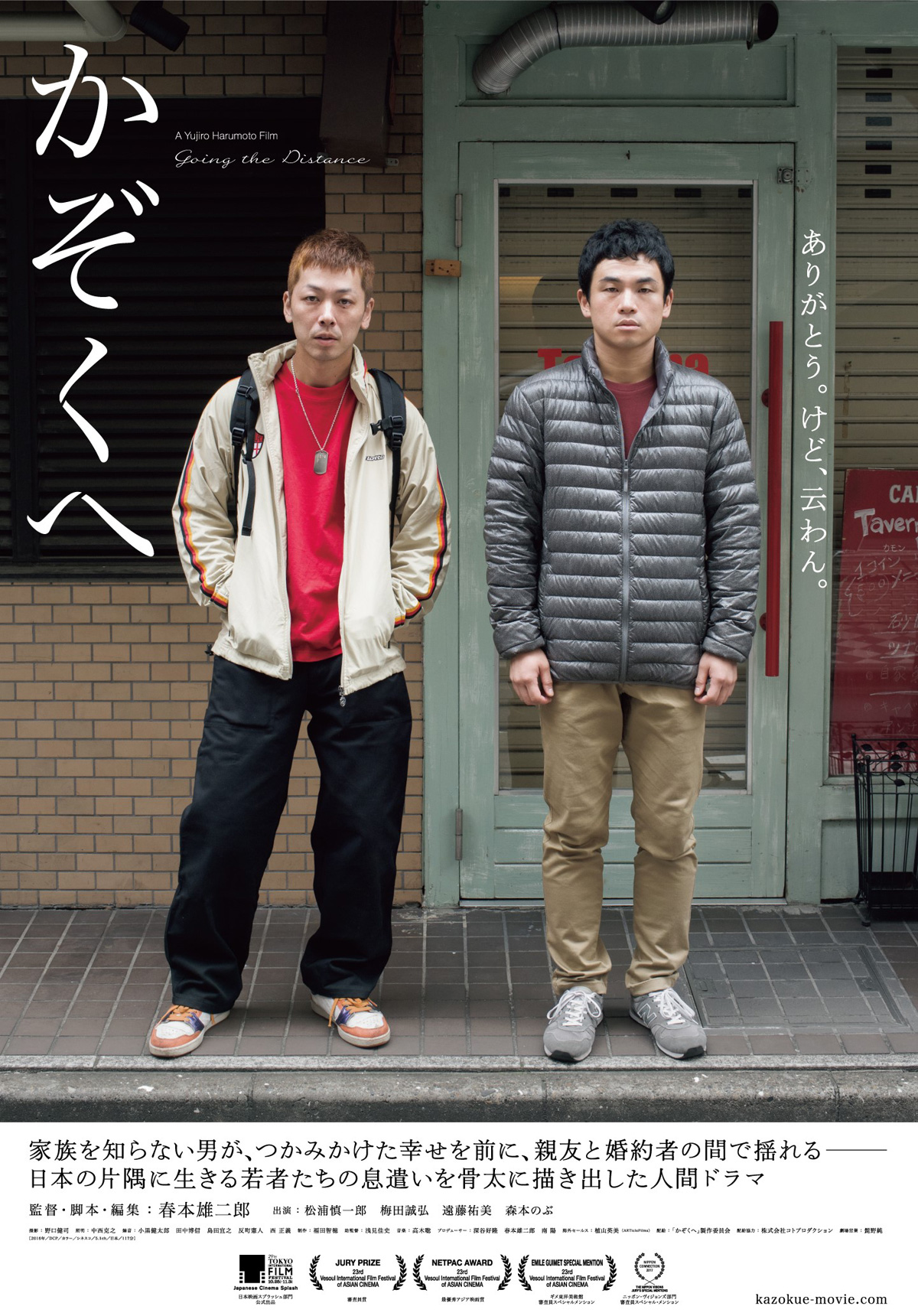
going the distance posterThe “family drama” is often regarded as Japanese cinema’s representative genre, but in the consumerist atmosphere of the late 20th century the family itself became an increasingly discredited concept. Nevertheless, it remains true that discriminating against those who have no family is the last acceptable prejudice with orphans in particular unfairly viewed as somehow untrustworthy, rejected by mainstream society, and denied both work and the possibility of starting a family of their own. The hero of Yujiro Harumoto’s debut feature Going the Distance (かぞくへ, Kazoku e) thinks he has everything finally back on track with a steady job and an engagement to a middle-class secretary, but his good heart coupled with his precarious social status seem set to ensure his new start is a non-starter.

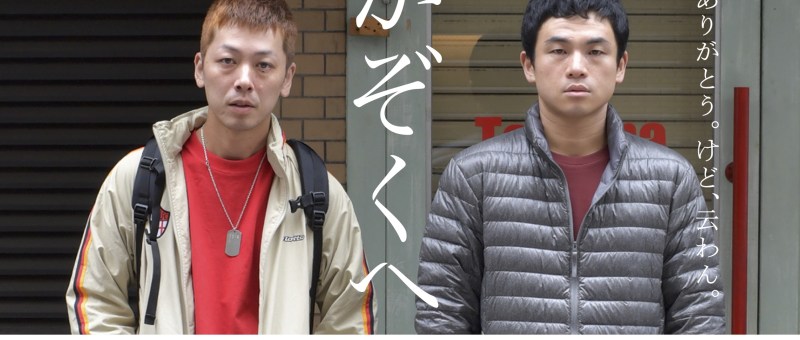
Raised in an orphanage in the Goto Islands, Asahi (Shinichiro Matsuura) now lives in Tokyo with this fiancée Kaori (Yumi Endo) for whom he has given up his boxing career to work as a trainer in a gym. Though Kaori, superficially at least, does not care that Asahi is a man with no family, she is a little preoccupied about how it’s going to look that his “family table”  at the reception will be largely unoccupied because he’s only planning on inviting his “brother” from the orphanage, Hiroto (Masahiro Umeda), and his wife.

Hiroto still lives in Goto and works as a fisherman. Hoping to help him out, Asahi sets him up with a man from his gym, Kita (Nobu Morimoto), who is opening a restaurant specialising in super fresh fish. The meeting goes extremely well and earns Hiroto a hefty contract that convinces him he needs to take out a loan to get a bigger boat. Unfortunately, however, Kita turns out to be a crook and Hiroto ends up well out of pocket, not only for the loan but for all the fish he never gets paid for.

Feeling intensely guilty and somewhat responsible, Asahi wants to do everything he can to put things right for Hiroto, even suggesting to Kaori that they postpone the wedding so that he can give part of the money they’ve saved to help take care of his debts. As predicted, Kaori is not happy about the idea, not least because she’s repeatedly explained to Asahi that she needs to get married as soon as possible because she wants her grandmother, who is suffering with dementia, to be able to attend the wedding while she’s still well enough to know what’s going on.

Unbeknownst to Asahi, one of the reasons Kaori is so keen on her grandmother attending is that her mother almost certainly won’t. Despite telling Asahi that her mother is lukewarm on the idea but coming round, the truth is that she won’t even talk to her, rudely rejecting the invitation and vowing that she’s no interest in seeing her daughter throw her life away on a man with no family and no prospects. In fact, Kaori’s mother crassly makes a point of sending her omiai photos for potential arranged marriages to more “suitable” men – ones from “good families” matching her own class background. Kaori wastes no time in calling her a “bigot”, accusing her of indulging in an outdated and offensive prejudice against the orphaned that regards them as untrustworthy because they have no history and are not anchored to anyone who might be held responsible for their actions.

Yet, despite her anger towards her mother Kaori is not quite free of those same prejudices, snapping back at Asahi that he wouldn’t understand what she’s going through because he had no parents of his own. She keeps the drama a secret from him to avoid having to admit that her family oppose the marriage solely because he is an orphan, partly wanting to spare his feelings and partly aware that Asahi is a good and noble man who might choose to absent himself rather than force her to choose between the man she loves and her family.

Meanwhile, Asahi does something similar in refusing to confide in Kaori about everything that’s going on with Hiroto, partly out of guilt and embarrassment, and partly out of shame in knowing that he is on some level betraying her by choosing to save Hiroto rather than prioritise their marriage. He wants to make things right, put them back to the way they were before, but he has an impossible choice – either reject his responsibility to his brother who is also a good and kind man and would not want to cause him trouble in his relationship, or neglect his new responsibilities to his soon-to-be-wife.

Unfortunately, the couple elect to go on deceiving one another, intending to protect but causing only more harm. It may be the case that they’ve rushed into marriage because of Kaori’s grandmother’s precarious health and Asahi’s hopes for a solid family foundation, but their previously happy relationship is eventually eroded by a gradual disillusionment born of refusing to rely on each other, continuing to fight separate battles rather than combine their efforts to fight them together. Faced with the realisation that he may have ruined his relationship by his own foolishness in trying to help a friend with a problem that was really none of his responsibility, Asahi begins to reject Hiroto, giving up on the idea of “family” in its entirety in mistaken resentment towards his brother for a series of decisions that were entirely his own. Nevertheless, what he discovers is that true family isn’t always about blood ties but about people who will always be there for you no matter what you do. Asahi wasn’t quite as alone as he thought he was, but only by admitting his mistakes, accepting his responsibilities, and finally allowing himself to confide in and rely on others can he truly begin to build a family anchored by something deeper than blood.


Going the Distance was screened as part of the 2019 Five Flavours Film Festival.

Original trailer (English subtitles)

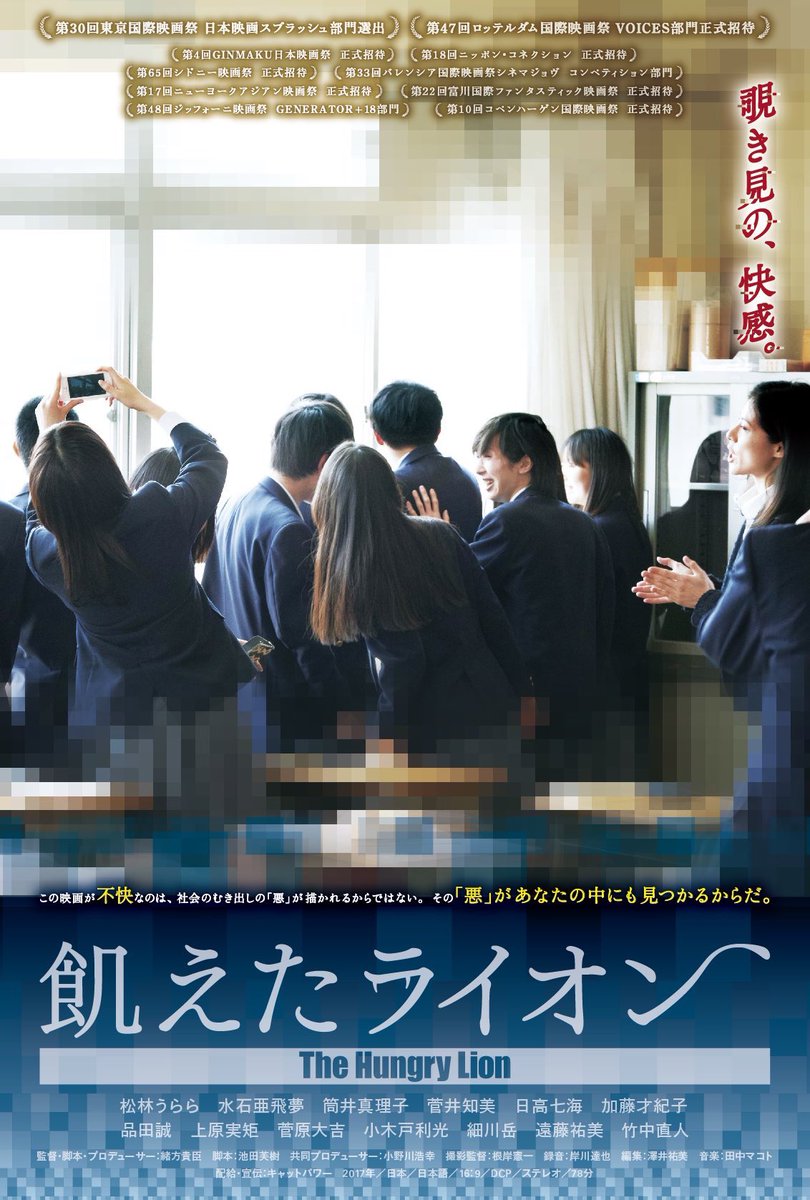
The Hungry Lion (飢えたライオン, Takaomi Ogata, 2017)

Hungry lion posterRumour has a strange power. A baseless lie, no matter how innocuous, can quickly derail a life but the power of lie with a tiny grain of, if not truth exactly but circumstantial evidence, can prove ruinous when there are vested interests at play which make belief an attractive prospect. The heroine of Takaomi Ogata’s The Hungry Lion (飢えたライオン, Ueta Lion) finds herself at the centre of such a storm through no fault of her own, becoming a victim not only of her country’s restrictive social codes, tendency towards victim blaming, and reluctance to deal openly with “unpleasant” topics, but also more directly of the latent jealousy lurking in her closest friends which finds a convenient home in someone else’s scandal. Nobody will come to her rescue, her “disgrace” has exiled her from the group and she finds herself abandoned as a lonely a sacrifice to the hungry lion that feeds on social shame.

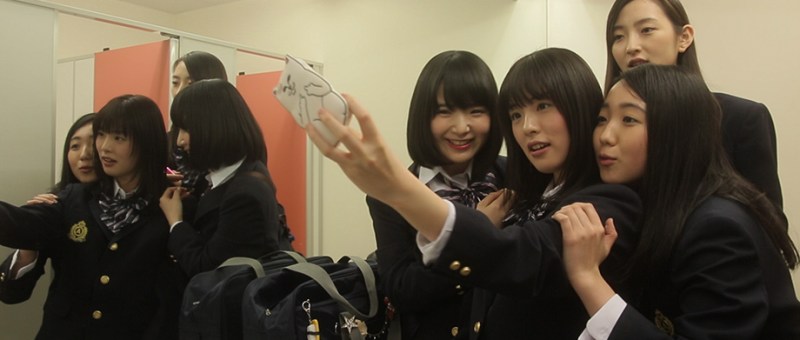
High school teacher Mr. Hosono is not exactly popular with his students. He is strict with the boys but less so with the girls, as he proves greeting one tardy student who blames a train accident for his late arrival by berating him about his regulation busting necklace while allowing a female student, Hitomi (Urara Matsubayashi), who arrives a couple of minutes later to take her seat unharrassed. Midway through the register, Mr. Hosono is called away and eventually arrested in connection with the viral video all the kids were looking at before he arrived which appears to show him in a compromising position with a student. For one reason or another, a rumour spreads that Hitomi is the girl in the video. She isn’t, but few believe her strenuous denials and her life becomes one of constant strife not only because of the bullying itself, or the injustice of being falsely accused and then disbelieved by those closest to her, but by the way she is made to feel embarrassed and shamed for causing trouble to others even though she herself has done nothing wrong.

A “relationship” between a teacher and a student is never appropriate, and Mr. Hosono has at least been removed from his position at the school, but no one seems very interested in identifying the girl in the video in order to help her, only to spread ruin and rumour. Hitomi is not the girl in the video, but even if she had been there is no support on offer to her as a person who has been abused by someone in a position of power she should have been able to trust, nor are there any measures in place to ensure her academic life will not be unduly damaged by becoming involved in such a traumatic incident. Aware of the rumours, the school accepts Hitomi’s assertion that she is not the girl but still suspends her to avoid “awkwardness” and protect their own reputation. Likewise, her own mother and sister are far from supportive, berating her for bringing shame on the family and creating problems for them in making the family a target rather than standing by her in her ordeal whether she had been the girl or not.

The rumour itself seems to spring from persistent shaming and stigmatisation of atypical families. Hitomi is 18 and she has a boyfriend who is a little older. He has some shady friends and likes to push buttons as he does by causing mild embarrassment to Hitomi by taking her into the curtained off “adult” section of the local video store in an attempt to shock her. Nevertheless the pair eventually make their way to a love hotel (where they are not age checked) and he films her in a compromising position. Girls talk and Hitomi’s friends all know about her relationship which is also plastered all over her social media on which she is something of a star. Some of her friends are jealous but also harbour a degree of disapproval and the mere fact that she is already sexually active ties her to the girl in the video and casts her in an “impure” light in the cute and innocent world of high school girls. Similarly, her boyfriend’s estimation of her drops after she consents to sleep with him while his leering friends make lewd comments and regard her as an “easy” girl who has lost the right to refuse their advances.

Ostracised for essentially becoming a “fallen woman”, Hitomi is left entirely alone with no one to turn to for support. Later, authorities are keen to stress that it’s important to speak out if you’re suffering because adults will always help children but like everything else they are just empty words. The school give out a pamphlet on the importance of prudence when using social media, but refuse to accept their responsibility in failing to protect their students. The news meanwhile becomes obsessed with tearing apart Hitomi’s family, laying the blame at their feet, insisting that Hitomi’s downfall is in someway a result of her parents’ divorce even blaming her mother for having the audacity to find a “boyfriend” before her children were fully grown. The image we had of Hitomi is suddenly reversed. No longer is she a “slutty schoolgirl” involved in an illicit relationship with her teacher, but a neglected child damaged beyond repair by “liberal modern society”.

Reputation is what matters, but reputation is easily manipulated and rewritten, muddy even when objective truth is revealed. Ogata shoots in brief vignettes, each severed from the next by a stark black screen which forces us to examine the objectivity of each scene as distinct from the others, assembling our own versions of “objective” truth which are in fact guided by Ogata’s carefully crafted editing. Fake news has an agenda, truth does not, but it’s often much easier to believe the lie especially if the lie benefits us much more than the truth or enables us to feel superior to someone we secretly think needs taking down a peg or two. Society is a hungry lion which feeds on shame, externalised and internalised, as those who find themselves on the wrong sides of a series of social taboos become unwilling sacrifices to its unkind, unforgiving, and unrelenting hunger for suffering.


Screening at New York Asian Film Festival 2018 on 30th June, 2.45pm.

Original trailer (English subtitles)