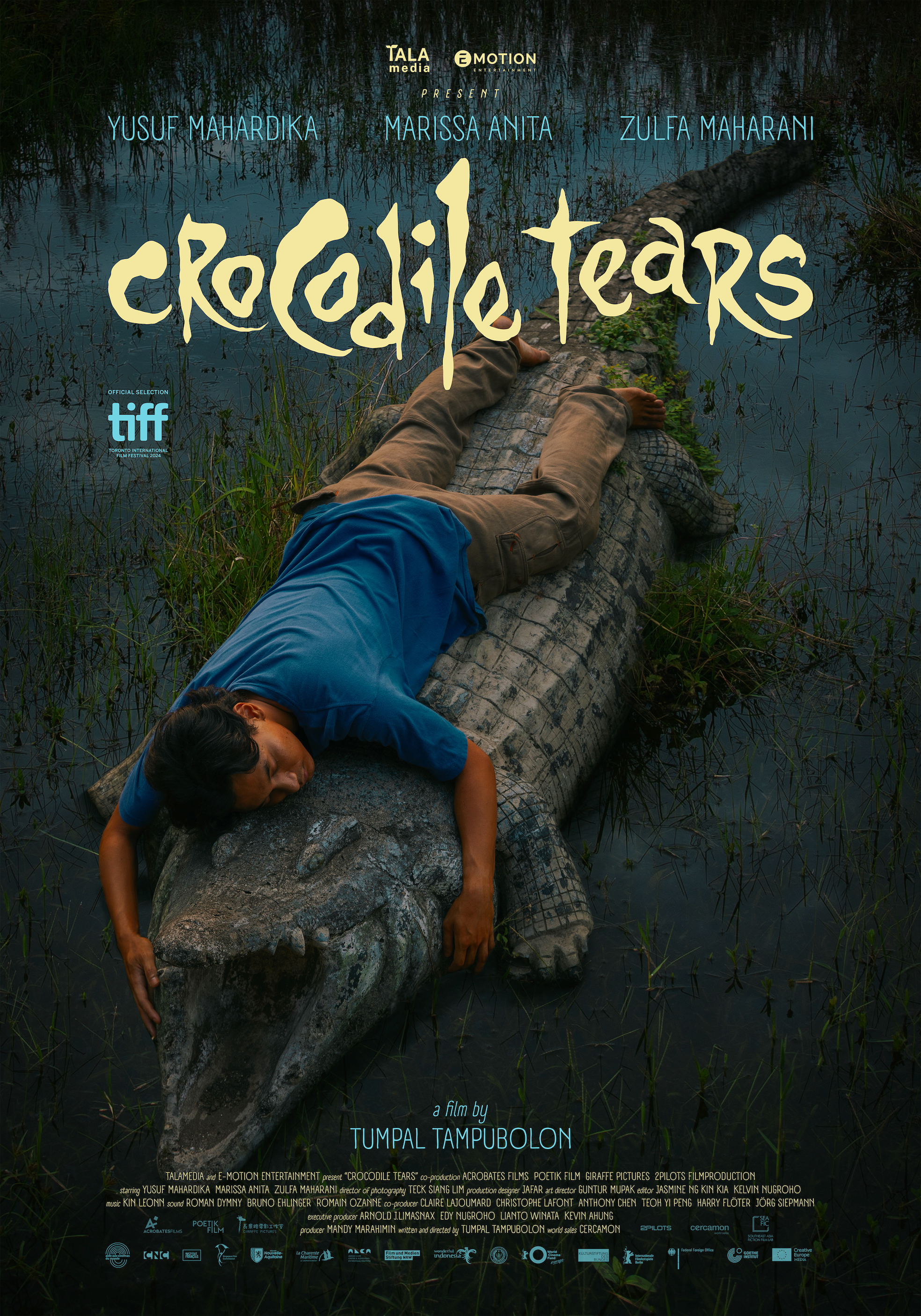
Crocodile Tears (Air Mata Buaya, Tumpal Tampubolon, 2024)

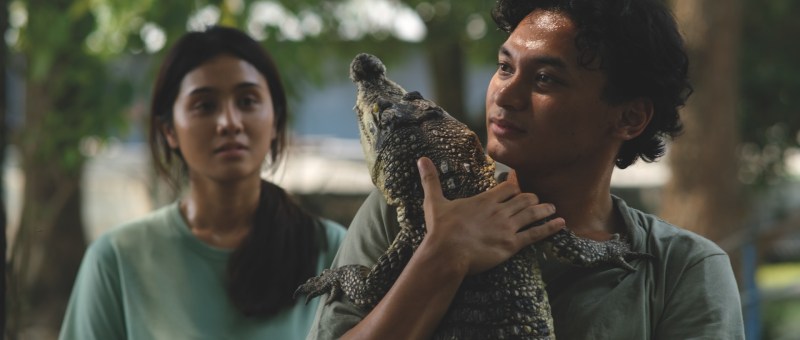
What happens when the baby wants to break out of the egg? The hero of Tumpal Tampubolon’s Crocodile Tears (Air Mata Buaya) isn’t a baby, he’s a 20-year-old man, but the crocodile zoo where he lives with his mother is also a kind of extended womb in which she keeps him constrained. The film’s title is apparently inspired by the fact that crocodiles protect their young by holding them in their jaws, the same jaws they use to snap at the live chickens Johan (Yusuf Mahardika) and his mother (Marissa Anita) throw over the fences. 

Mama is evidently aware her little boy’s growing up. In the first shot of the film he’s furtively masturbating until he’s interrupted by her screaming for him outside. She scrubs his pants and seems to notice that they’re soiled, taking care to remind him that he should keep himself clean now he’s a grown man, but Johan doesn’t seem to understand telling her that he showers every day. Perhaps he’s smarting a little at her comments having overheard two women complaining about a bad smell while sitting next to him at a restaurant and wondering if he carries the stench of the crocodile park even when in the outside world. Later he takes to wearing some of the perfume he picked up for his mother’s birthday and had also given to his girlfriend Arumi (Zulfa Maharani).

Arumi is a direct threat to Mama who knows that another woman will inevitably replace her. She and Johan still sleep in the same bed. The irony is that her loneliness becomes that of Johan who is terrified of ending up all alone in the crocodile park prevented from having anything like a normal life by his mother’s possessive neediness. He loses his virginity to Arumi, a more worldly woman working in the local karaoke box and on the fringes of the sex trade, and she becomes pregnant though unsure whether or not Johan is the father. He realises he likely isn’t, but like his mother is so lonely that he doesn’t care only begging Arumi not to leave him because he can’t bear the idea of being on his own. 

But despite the obvious conflict and rivalry between them, the past is essentially repeating with each woman oppressed by Indonesia’s oppressively conservative and patriarchal social norms. Mama had Johan at 19 and seemingly unmarried. Though she resented the baby in her womb, when he was born she gave all of herself to him and he became her entire world. There are rumours that Mama may have murdered her husband and fed him to the crocodiles though Johan says he never knew his father. He was told both that he had died before he was born and that his father is the zoo’s white crocodile whom his mother refers to as “Papa” and claims to have a special connection to “mentally”. Now Arumi looks her in the eye and says she will do for her child as she did for Johan, but she too has been railroaded into a marriage through lack of other options. Aside from the stigma attached to unwed motherhood, she is fired from the karaoke bar for shoving a customer who was harassing her with the boss apparently thinking it’s all part of her job and she should have known better than to upset a paying client. 

The two women become almost like crocodiles in a cage snapping in defence of their territory as if knowing only one of them can stay. Plagued by strange visions, as is Arumi later, it seems the choice is really Johan’s of whether to bust out of his shell and symbolically break free of his mother’s womb or abandon the idea of starting his own family with Arumi to stay in there forever. Tumpal Tampubolon cracks up the sense of dread and eeriness  beginning merely with discomfort in this quasi-incestuous relationship and heading into the realms of folk horror with its strange and surreal hallucinations that confront Johan with his Oedipal dilemma as he tries to crawl free only waiting to see if Mama’s jaw will finally snap.


Crocodile Tears screened as part of this year’s BFI London Film Festival

Original trailer (English subtitles)
Yuni (Kamila Andini, 2021)

“Marriage is a blessing”, according to a wise old grandma, “we shouldn’t refuse a blessing, no?” expressing a commonly held belief in the traditional small town where the titular Yuni (Arawinda Kirana) resides in Kamila Andini’s melancholy social drama. Yuni meanwhile isn’t so sure, if marriage is a blessing then why does it feel like a trap and how can you call something a blessing if as it seems to have been for some of her friends it only results in violence and misery? 

At 17 Yuni is a talented student, her progressive female teacher urging her to consider going to college while offering various pamphlets about applying for scholarships which Yuni feels might make it easier for her parents to accept. Yet in addition to the academic criteria, the rules are clear that married women are not eligible which is a problem because Yuni has just received her first marriage proposal from a man recently relocated to the village who is handsome enough and thought a catch because he has a good job in a local factory. 

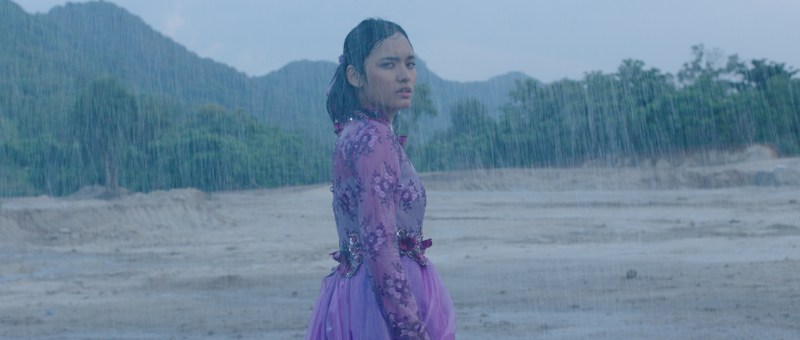
While everything in Yuni screams no, she finds it difficult to articulate her resistance constantly second guessing herself wondering if she’s doing the right thing or if as some of the other girls suggest she is lucky to have received such a generous offer and ought to accept it. Her obsession with the colour purple, the colour both of a wedding dress and according to another girl widow’s weeds, which causes her to steal any purple item she sees is an expression of her alienation yearning for colour and vibrancy in a culture which seems to deny her both. Dressing in purple under her green school uniform, she rejects the idea of marriage and wants to continue her education, spending time with an older woman who takes her to clubs to dance enjoying the illicit freedom of a modern society which has otherwise been kept from her. 

Even at school, her freedom begins to shrink. The Islamic Club seems to dominate everything, planning to introduce virginity tests for the female students to prevent the inconvenience and shame of teenage pregnancy though it does not seem as if the boys are given the same talk. The girls are all convinced that one of their classmates is pregnant because she wears a baggy jacket and has become withdrawn, but later wonder if she may have been raped no one seemingly very interested in helping her. Later after embarking on an escapist romance with diffident and sensitive classmate Yoga (Kevin Ardillova), Yuni is also asked if was raped when confessing that she is no longer a virgin in order to escape a second marriage proposal to become the second wife of a wealthy old man who not so subtly tries to buy her from her grandmother while implying that she might be considered damaged goods as a woman who’s already rejected a suitor. 

Yuni is warned that turning down a second proposal is bad luck and struggles with herself in her decision, her internal confusion ironically interfering with her studying making it harder for her to escape through education. Meanwhile she hears of a woman who married young but experienced domestic violence after her husband blamed her for a series of miscarriages only to be disowned by her family following a divorce they again telling her she ought to have counted herself lucky that her husband still put up with her despite her “condition”. Another friend’s husband has abandoned her with a young son and she isn’t sure if she should divorce him and look for someone else, while one of Yuni’s classmates ends up having to marry a teenage boyfriend when a gang of blackmailers threatens to ruin their reputations after discovering them taking photos at a well known hookup spot. 

With most of the other women largely complicit, Yuni feels she has no one to talk to or turn to for advice eventually pouring her heart out to the sensitive Yoga who offers to run away with her knowing that nothing will change as long as she stays in the conservative environment of their hometown. Even the teacher whom she’d once admired, Mr. Damar (Dimas Aditya), proves no ally attempting to use her to escape his own sense of impossibility after she catches him trying on women’s clothes at a local department store. Mr. Damar’s own desperation causes him to act in the most insidious of ways, in effect barring Yuni’s path out of her repressive life in inappropriately wielding his power as a teacher against her. Having lost all confidence, Yuni no longer knows what she wants out of life and is growing weary of fighting the same battles in attempting to struggle free of the constraints of traditional patriarchy but is left with little choice once all her dreams are shattered. A tragedy of modern day Indonesia, Yuni sees its heroine’s spirit gradually crushed by the world in which she lives in which she has only the choice of lonely exile or resigned misery. 


Yuni screened as part of this year’s Glasgow Film Festival and is available to stream in the UK until 8th March.

International trailer (English subtitles)

Gundala (Joko Anwar, 2019)

“If we see injustice before our eyes and do nothing then we’re no longer humans” the idealistic father of a future superhero instructs his young son, trying to impart a sense of humanitarianism as a basic moral good. It’s a lesson the boy will find himself unlearning and resuming later, his innocence well and truly destroyed by an often cruel and cynical society only to be reawakened to the idea that it doesn’t need to stay that way. Among the most recognisable names of Indonesian cinema, Joko Anwar turns his hand to the creation of a local comic book cinematic universe, adapting the 1969 comic Gundala by Harya “Hasmi” Suraminata for the present day filtering contemporary Jakarta through classic Gotham. 

Operating as an origin story for the titular hero, Gundala opens with the young hero Sancaka (Muzakki Ramdhan) unable to prevent his father’s (Rio Dewanto) death due to his fear of electrical storms when he is first set up by a duplicitous factory boss and then assassinated while leading a protest for fair pay and conditions. Soon after, Sancaka loses his mother (Marissa Anita) too after she is forced to go to the city for work and never returns. Ending up a ragged street kid, he’s saved from an attack by a rival gang by an older boy (Faris Fadjar Munggaran) who teaches him how to protect himself physically and mentally by convincing him that the only way to survive on the street is keep his head down and walk on by even if it looks like others are in trouble. 20 years later the adult Sancaka (Abimana Aryasatya) is an aloof young man working as a security guard at a print house where his sympathetic mentor Agung (Pritt Timothy) begins to remind him of his father in his conviction that “living is no use if you stop caring and only think about yourself”, while he also finds himself defending the woman next-door, Wulan (Tara Basro), and her young brother Teddy (Bimasena Prisai Susilo), from hired thugs sent to intimidate them because of their involvement in a protest against the forced redevelopment of a local marketplace.  

Events seem echo around him. The major villain Pengkor (Bront Palarae) is also an orphan but on the opposing side as the son of a cruel plantation owner murdered by his not altogether ideologically pure workers whose desire for fair pay and conditions he had resolutely ignored. According to cynical politician Ridwan (Lukman Sardi), Pengkor became a union organiser of his own, leading an uprising at the abusive orphanage he was placed into by a cruel uncle hoping he’d die and free up the inheritance, thereafter becoming a kind of godfather to the fatherless with a thousands strong army of eternally grateful orphans he saved acting as sleeper agents for a coming revolution. 

Pengkor’s nefarious plan involves fostering a conspiracy surrounding contaminated rice said to make the unborn children of the women who eat it turn out “immoral”, a generation of psychopaths unable to tell right from wrong. Fairly unscientific, it has to be said, but playing directly into the central questions of the nature of “morality” in a “immoral” society. Can it really be “moral” for bosses to exploit their workers and get away with it, for politicians to cosy up to gangsters and remain complicit with corruption, and for a man like Pengkor to be the only hope for orphaned street kids otherwise abandoned and ignored by a wilfully indifferent society? Pengkor decries that hope is the opiate of the masses, but that’s exactly what Gundala eventually becomes for them in his “electric” ability to resist, eventually rediscovering his humanity as he designates himself as the embodiment of “the people” pushing back against the forces of oppression and seeming at least to win if only momentarily.  

Young Sancaka’s fear of lightning is, in essence, a fear of his power and his social responsibility something he is quite literally shocked into accepting. In a world of quite striking social inequality, he finds himself the lone defender of the oppressed whose very existence spurs others, including previously cynical politician Ridwan, into rediscovering their own humanity in the resurgent hope of a better future. As someone puts it, peace never lasts long but you keep fighting for it because every moment is precious. Not so much a battle of good versus evil as a battle for the meaning of good, Anwar’s Gundala recalibrates the anxieties of the late ‘60s for the modern era and creates an everyman hero not only to resist them but to foster a spirit of resistance and humanity in the face of heartless cynicism. 


Gundala streams in Poland until 6th December as part of the 14th Five Flavours Film Festival.

Original trailer (English subtitles)