Being Two Isn’t Easy (私は二歳, Kon Ichikawa, 1962)

With the Olympics still two years away, the Japanese economy had begun to improve by 1962 and the salaryman dream was on the horizon for all. But for young couples trying to make it in the post-war society things were perhaps far from easy and having more to want coupled with the anxieties of a newly consumerist society only left them with additional burdens. A surprisingly moving evocation of the cycle of life, Kon Ichikawa’s Being Two Isn’t Easy (私は二歳, Watashi wa Nisai) is as much about the trials and tribulations of its toddler hero’s parents as they try to navigate their new roles in a world which now seems fraught with potential dangers. 

This difference in perspective is brought home in the opening sequence in which soon-to-be two Taro (Hiro Suzuki) recalls his own birth in a slightly creepy voiceover, lamenting his mother cooing over him excited that he is smiling for her though he is not yet able to focus and has no idea the vague shadow above him is his mother or even what a mother is. His smiling is simply involuntary muscle contraction as he learns how to manipulate his body. Nevertheless, little Taro is a definite handful taxing his poor mother Chiyo (Fujiko Yamamoto) with frequent attempts to escape, managing to get out of the apartment and start climbing the stairs the instant she’s turned her back. “Always finding fault, that’s why grown-ups are unhappy” Taro complains, irritated that even though he’s quite proud of himself for figuring out not only how to undo the screws on his playpen but the string his parents had tied around it for extra protection, he’s not received any praise or congratulation and it feels like they’re annoyed with him. 

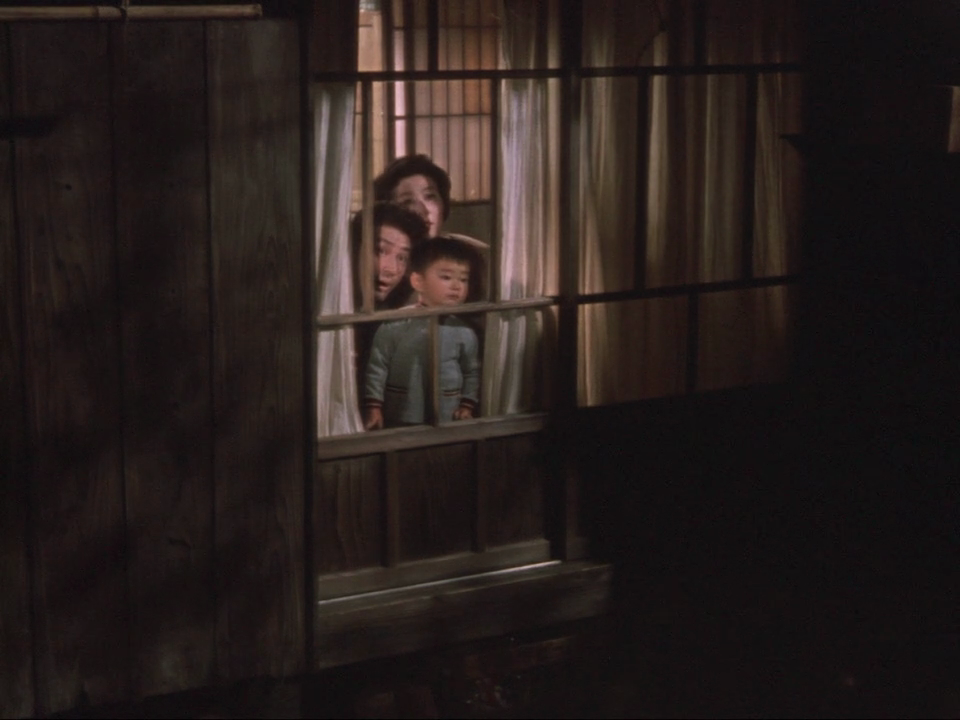
The landlord alerted by the commotion somewhat ironically remarks that “Japanese houses are best for Japanese babies” (being at least usually all on one level even if they also sometimes have their share of dangerously precipitous staircases), implicitly criticising the new high rise society. There do indeed seem to be dangers everywhere. Another baby playing on the balcony eventually falls because the screws are rusty on the railings only to be caught by a passing milkman in what seems to be an ironic nod to the film’s strange fascination with the new craze in cow’s milk to which Taro’s father Goro (Eiji Funakoshi) attributes Westerners’ ability to grow up big and strong. Taro does seem to get sick a lot, the doctor more or less implying that his sickliness is in part transferred anxiety from an overabundance of parental love. Visited by her older sister who lives on a farm in the country and has eight children, Chiyo becomes broody for a second baby (though not another six!) but Goro isn’t so sure, not just because of the additional expense or the fact that their danchi apartment is already cramped with the two of them and a toddler, but reflecting that he already lives in a world of constant fear why would you want to double it worrying about two kids instead of one?

Nevertheless, Goro is certainly a very “modern” man. He helps out with the housework and is an active father, taking on his share of the childcare responsibilities and very invested in his son. He accepts that his wife also “works” even if he also insists it’s not the same because she doesn’t have to bow to Taro and is not subject to the petty humiliations of the salaryman life. Tellingly, this changes slightly when the couple end up leaving the danchi for a traditional Japanese home to move in with Goro’s mother after his brother gets a job transfer. Grandma (Kumeko Urabe) is actively opposed to him helping out around the house, viewing it as distasteful and unmanly not to say a black mark against Chiyo for supposedly not proving up to her wifely duties. Living with Grandma also introduces a maternal power struggle under the older woman’s my house my rules policy which extends to criticising Chiyo’s parenting philosophy not to mention refusing to trust “modern technology” by insisting on rewashing everything that’s been through the washing machine by hand.

Yet when Taro becomes sick again it’s perhaps Grandma who has a surprisingly consumerist view of medical care. Exasperated by the couple’s failure to get Taro to take his medicine she offends the doctor by insisting on him having an injection as if you haven’t really been treated without one. Eventually she takes him to another clinic where they get on a conveyor belt of doctoring, rushed through from a disinterested receptionist to a physician who yells “bronchitis” to a nurse who violently sticks the baby in the arm. After that Taro vows never to trust grown-ups, though Grandma only gives in when she realises injections are not an instacure and didn’t do any good. 

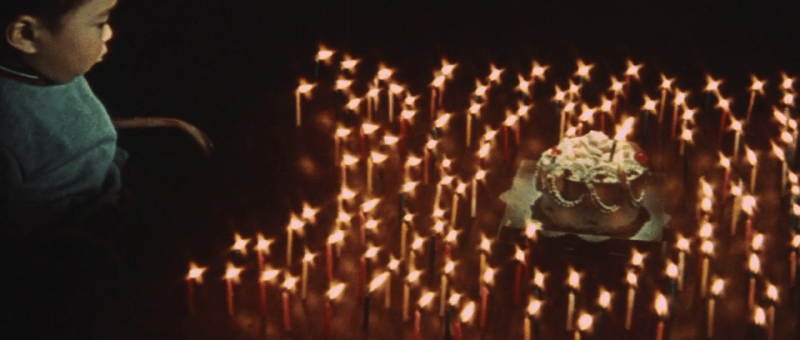
For all that however there’s a poignancy in Taro’s reflecting on his birthday cake with its two candles that Grandma’s must have many more and in fact be brighter than the moon with which he has a strange fascination. He’s just turning two. He used to be a baby but now he’s a big boy and soon he’ll be a man. Goro reflects on time passing, for the moment he’s a father but might be a grandad soon enough. The wheel keeps turning which perhaps puts the hire purchase fees on the TV he bought to keep Grandma occupied and out of the way into perspective. From the experimental opening to the occasional flashes of animation and that banana moon, Ichikawa paints a whimsical picture of the post-war world as seen through the eyes of a wise child but ironically finds a wealth of warmth and comfort even in an age of anxiety.
Sing, Young People (歌え若人達, Keisuke Kinoshita, 1963)

Keisuke Kinoshita has sometimes been dismissed by Western critics for his supposed sentimentality, but his mid-career comedies can be surprisingly cynical. Scripted not by Kinoshita but Taichi Yamada, 1963’s Sing, Young People (歌え若人達, Utae Wakodotachi) is in someways an exception to the rule, a breezy take on the student comedy updated for the present day, but underneath all the absurdist humour and jibs about youthful ennui is a real sense of adolescent hopelessness as these aimless young men ponder their “pitch-black” futures in a rapidly changing Japan where the best they can hope for is fulfilling the salaryman dream.  

Shooting in glorious colour, Kinoshita opens with a lengthly pan over contemporary Tokyo which the jaunty voice over describes as “the number-one city in the world” before homing in on the incongruous figure of a strangely dressed man holding a sign advertising “sensual massage beauties”. A relic of an earlier advertising age, the wandering sign man nevertheless catches sight of someone even “weirder” than he is, a student wearing a student’s cap! Kinoshita then takes us on a brief detour through Japan’s major universities demonstrating that no one is so uncool as to wear a student’s cap in the age of protest, drawing a direct contrast to the student comedies of old while showing us a series of scenes of students “playing” hard with part-time jobs in bands or as models, training hard in preparation for the upcoming Olympics, fomenting the revolution, or fighting in the streets. In the first of many meta touches, our hero, Mori, is eventually woken by the narrator after falling asleep in class, his eyes “gleaming with hopes for the future”. 

Or, perhaps not, he’s just tired. Mori (Tsutomu Matsukawa) is as he describes himself a man without hopes or dreams who believes that the road ahead of him is “pitch black”. Dropping a brush from the window washers’ platform at one of his part-time jobs, he asks himself if there shouldn’t be more to life than this. The only son of his widowed mother, he’s pinned everything on graduating from a top university but feels powerless and empty, adrift in the post-war landscape. Where his calculating friend Miyamoto (Yusuke Kawazu) fills the void with romance and a determination to “get lots of As” and then land a top job, his roommate Okada (Shinichiro Mikami) earnestly studies hard afraid to disappoint his austere family but also quietly resentful in his lack of autonomy, and the dopey Hirao (Kei Yamamoto) simply goes about being nice to people more or less forcing them to eat the traditional treats his loving mother is forever sending. 

Yet for all the bleakness Mori seems to see in his future, he only ever falls up. Luck follows him and he’s presented with ever more fantastic opportunities at every turn. In fact, it’s his slightly grumpy expression as he cleans the windows of an office building that leads to them snapping a picture and making him a cover star without ever bothering to ask his permission though they do eventually pay. Still Mori remains indifferent, telling a reporter who tries to interview him that he had nothing to do with the cover, he has no dreams or aspirations for the future but lives his life day by day. He describes himself only as “nervous”. His words run ironically over the magazine literally becoming tomorrow’s chip paper, used by a stall owner to wrap her croquettes, as a stand for a hot pot, and otherwise bundled up to be pulped. Nevertheless, the cover leads to great opportunities from a TV network looking for a fresh face to front their new youth-orientated drama serial. 

Despite all the promise, Mori remains indifferent, later irritating a new colleague and potential love interest (Shima Iwashita) when he idly suggests he might just give up acting and fall back on the salaryman dream. As she points out, she had to fight all the way to achieve her dreams of becoming an actress so hearing someone say they’re going to throw away a tremendous opportunity that came to them entirely by chance is mildly offensive. Miyamoto meanwhile is growing lowkey resentful, realising that maybe nothing matters after all it’s all just dumb luck. Mori deliberately didn’t do anything because he thought his life was pointless but everything has landed right at his feet while Miyamoto’s life is crumbling. He’s lost all his girlfriends and endured a lonely New Year alone in the dorm, coming to the conclusion that his future really is “pitch black”.

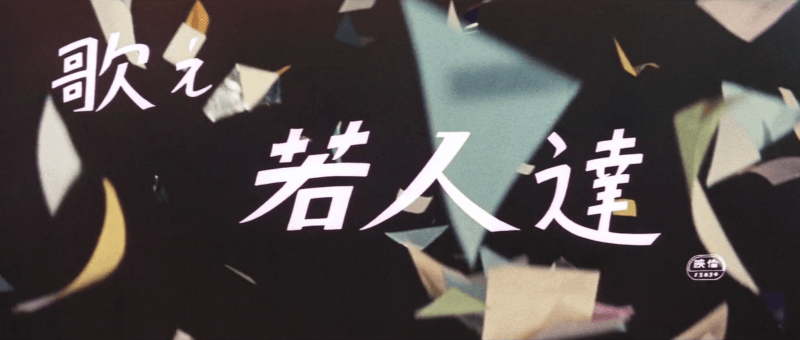
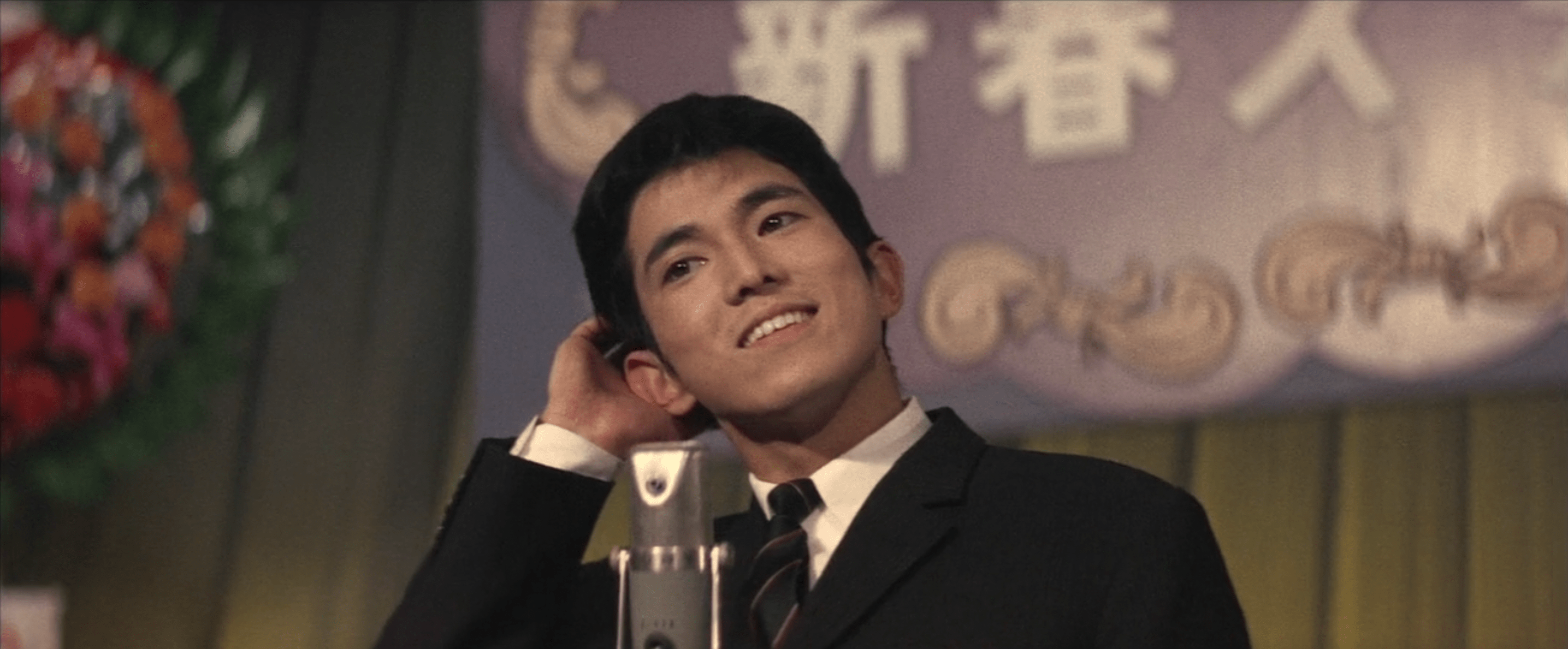
Nevertheless, it’s difficult to remain resentful about a friend’s accidental success and so each of the men eventually finds direction in even in directionlessness. Mori realises that he might as well ride his wave of fame for as long as it lasts, accepting in part at least his sense of powerlessness, while Okada does the reverse in deciding to rebel against his authoritarian family by marrying in secret. Miyamoto resolves to make a success of himself in his own way, and Hirao seemingly accepts the hand fate has dealt him with good humour. Kinoshita ramps up the meta comedy with Mori joining Shochiku, encouraged to try and work for that “excellent” director Keisuke Kinoshita, later referencing Garden of Women, while Mariko Okada and Keiji Sada turn up as onstage guests at an event launching him as a young actor. Playfully using outdated, quirky screen wipes and opening with an artsy title sequence featuring colourful confetti falling up, Kinoshita perhaps adopts a slightly ironic tone in satirising the all pervasive sense of confusion and hopelessness among the younger generation but does so with only sympathy for those coming of age in uncertain times.