The Mosquito on the Tenth Floor (十階のモスキート, Yoichi Sai, 1983)

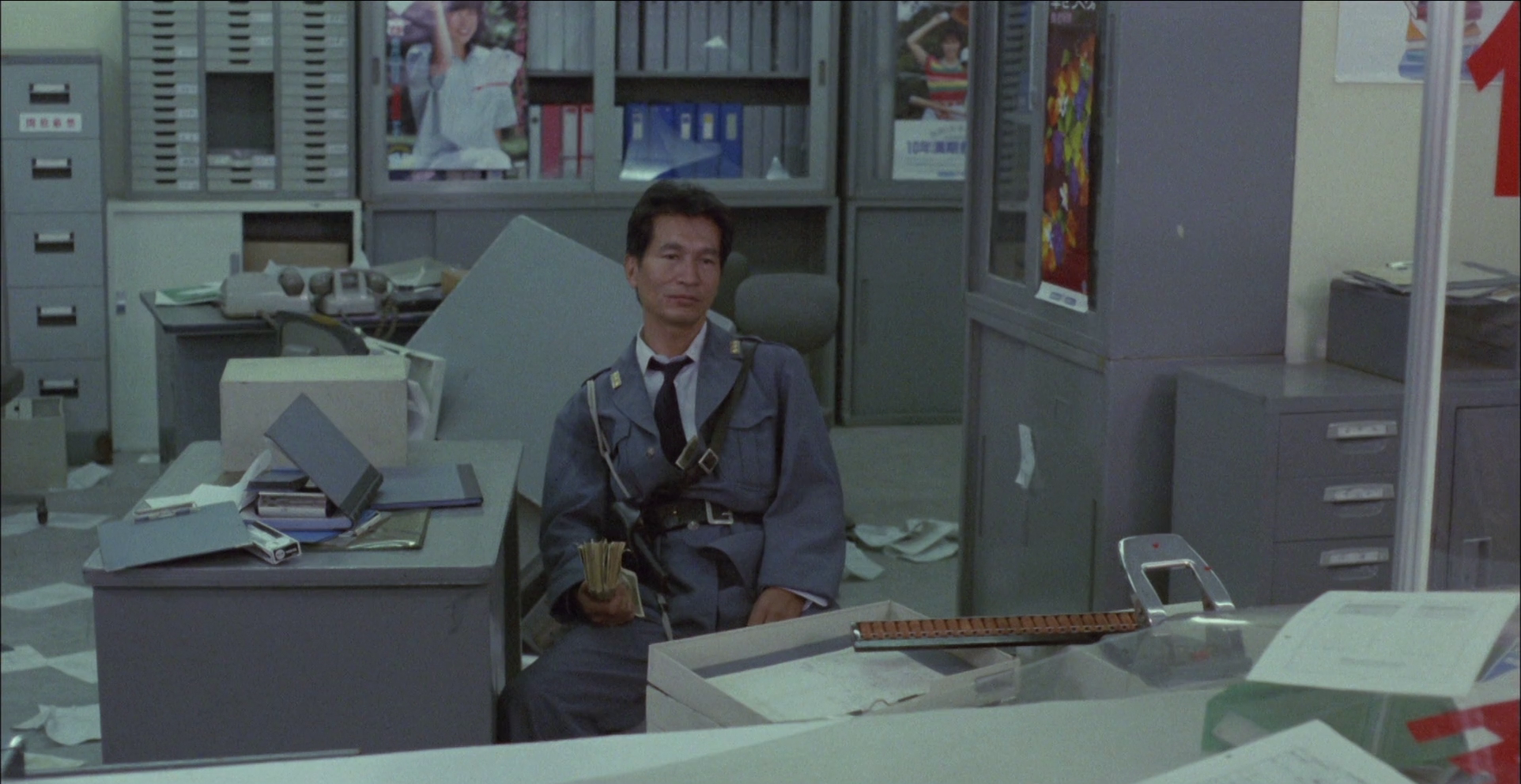
A beaten-down beat cop’s existential crisis progressively deepens after he throws himself into financial ruin to buy a computer in Yoichi Sai’s debut The Mosquito on the Tenth Floor (十階のモスキート, Jikkai no Mosquito). Like Pool Without Water, star Yuya Uchida conceived and co-scripted the film as a vehicle for himself and was apparently inspired by the sight of some blood, his own, on a wall where he’d squashed a mosquito though he also claimed the the 10 in the title is intended to reference the 10 commandments in addition to simply where the unnamed protagonist lives.

The fact that he lives on the 10th and top floor in a building with no lift is symbolic of his dismal circumstances. On the one hand he can rise no higher but on the other is stuck with an inconvenient living situation precisely because of his inability to rise socially. As it transpires the hero, a policeman, joined the force right out of high school with aspirations of rising to the rank of captain but has spent the entirety of his 20-year career manning a police box. He’s repeatedly failed the exam for promotion to lieutenant and realistically speaking is now simply too old to make much further progress. A man of few words, he listens as the other officers who took the exam with him outline the hierarchal structure of the police force while meditating that as a man on the wrong side of 40 his possibilities have decreased and it’s more than likely he’ll be stuck in the police box until he retires. 

His boss later says as much, sympathising with him but also pointing out that a policeman is also a public servant with a role to serve within the community. He is supposed to make people feel safe and contribute to the progress towards a crime-free society, but it’s clear that his life has spiralled out of control precisely because he cannot ally his career goals with the kind of life he wished to lead. His wife divorced him two years ago seemingly because she wanted a greater degree of material comfort and became resentful that he failed to progress in his career and could not move on from the low-salaried position of an ordinary street cop. She now makes a living selling golf club memberships, looking ahead to the oncoming Bubble-era and a society of affluent salarymen which is very much what her new boyfriend seems to be. Meanwhile, she lives in a very nice townhouse with their teenage daughter and constantly hassles the policeman for falling behind with his child support and alimony payments. He’s also racked up a healthy tab at a karaoke bar where he regularly hangs out and has a serious gambling problem with betting on boat races seemingly his only other form of social outlet.

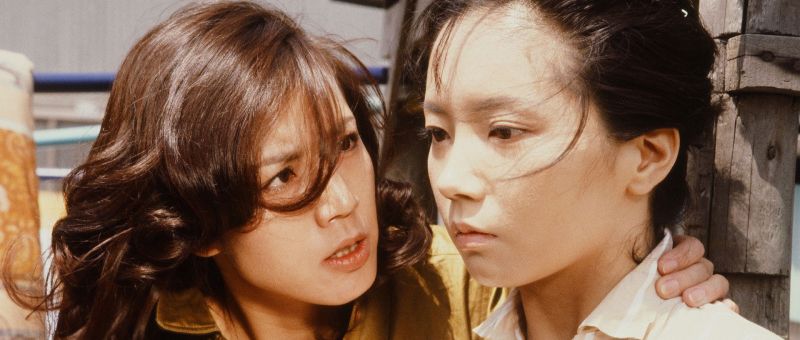
As his daughter and others keep reminding him, the world is changing and his decision to buy a computer after unwisely taking out a payday loan is in part a symbol of his desire to progress into the modern society even if, somewhat ironically, others chastise him for spending what is then a huge amount of money on something they think of a child’s toy. Otherwise an upstanding policeman who irritatedly deflects a colleague’s joke about bribing someone to pass the exam, the policeman finds himself taking out one payday loan to pay another with loansharks constantly ringing him at the police box to remind him he’s behind on his payments. To overcome his sense of powerlessness, he begins by abusing his authority in catching a punk woman shoplifting and arresting her but then taking her back to his flat to play computer bowling and take advantage of her sexually. He later does something similar with a bar hostess, Keiko (Reiko Nakamura), who took him home when he was drunk. Though the encounter begins as rape, Keiko soon gives in and even comes back for more claiming that she’d never done it with a policeman before and it exceeded her expectations which is in many ways reflective social attitudes at the time. Emboldened, he invites danger by raping a female traffic cop, tearing her clothes as she fights back, screams, and cries though she presumably does not report him given the professional and social consequences that may adversely affect her life and career if she chose to. 

His ex-wife Toshie (Kazuko Yoshiyuki) says she’s not even sure if he’s human anymore, and his failed attempt to rape her after his boss reminds him that he advised against getting a divorce in the first place because it would negatively affect his chance of promotion may be a perverse way to prove he is though it obviously backfires. Having failed in every area of his life and with no prospect of ever getting back on track or starting again, he begins to go quietly insane typing rude words into his computer while the constant calls from loansharks take on a mosquito-like buzzing as does his own final wail of despair and powerlessness as he’s brought down by same authority he once served. His aloneness and confusion are palpable when he ventures into the city and discovers his teenage daughter Rie (Kyoko Koizumi) dancing in Harajuku staring at her intently but then walking away having invaded this space reserved for the young. “Police yourself!” one of the Rockabilly guys ironically instructs him on noticing that he’s dropped his ice cream cone, explaining that the police might shut them down if they’re discovered to be using the space irresponsibly by littering. Rie and her friends tell him to get a life, explaining that the world is changing while tapping him for cash he doesn’t have but is too embarrassed to refuse, laying bare the extent to which he and those like him have been left behind by the economic miracle, buzzing around maddeningly in mid-air with safe nowhere safe to land. 


Original trailer (no subtitles)

Case of the Disjointed Murder (不連続殺人事件, Chusei Sone, 1977)

Case of the disjointed murders posterJapanese cinema of the 1970s fell hard for the prestige murder mystery. Following the success of The Inugami Family, an early and unexpected hit thanks to Kadokawa’s “innovative” marketing strategy, multi-cast detective dramas dominated the box office for the rest of the decade. Meanwhile, ATG had been known for serious and high-minded avant-garde cinema throughout the 1960s but its brand of left-leaning, politically conscious, arthouse-fare was tantamount to box office poison in the increasingly consumerist post-Asama-Sanso world. ATG’s Kindaichi-centric Death at an Old Mansion, updated to the present day, pre-dated Ichikawa’s series for Toho by a whole year and perhaps signalled their resignation to shifting into the mainstream. By 1977, that transition was perhaps complete with former Nikkatsu Roman Porno director Chusei Sone’s adaptation of a classic serial penned by Ango Sakaguchi, an author of the “Buraiha“ school well known for chronicling post-war aimlessness.

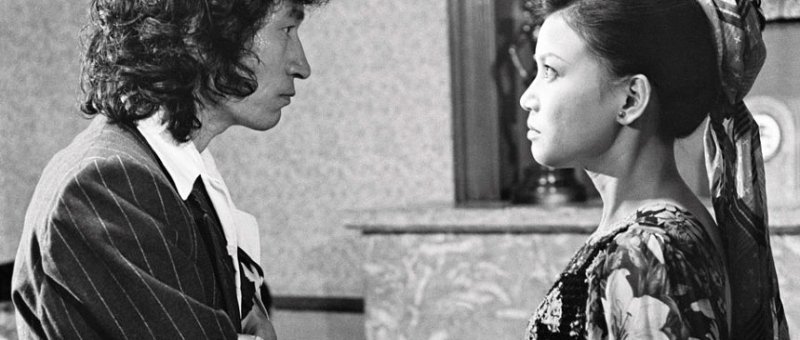
Set in the summer of 1947, Case of the Disjointed Murder (不連続殺人事件, Furenzoku Satsujin Jiken, AKA Unrelated Murder Cases) is a classic country house mystery in which a series of high profile writers are invited to a mansion owned by a wealthy family, the Utagawas. Only, as it turns out, many of the letters of invitation are forgeries or have been doctored so that several unexpected guests have arrived including dissolute artist Doi (Yuya Uchida) whose presence is particularly awkward because he is the former husband of the host Kazuma’s (Tetsuro Sagawa) new wife Ayaka (Junko Natsu). Soon enough, one of the guests is murdered, and then another, and still more, seemingly for no real reason. Amateur detective Kose (Kazuya Kosaka), one of the “unexpected” guests, tries to piece the crime together to prevent its expansion but finds himself outflanked by a lack of material evidence.

Sakaguchi’s original tale ran as a newspaper serial which promised a cash prize for anyone clever enough to identify the murderer(s) before the truth was revealed as it eventually is in true country house mystery fashion with the detective explaining everything in a lengthy monologue while all the interested parties sit around a dinner table. The gamified nature of the serial is perhaps the reason for the large cast of characters comprising of Utagawa family members, the literary house guests, and staff all of whom become mixed up in the ongoing crime drama which Kose comes increasingly to believe is engineered rather than random as it might originally seem.

The “supposed” random chaos of the the “unconnected” murders is a key part of Sakaguchi’s interrogation of post-war anxiety. For a time it seems as if these mostly quite unpleasant people have taken the opportunity of being trapped within a claustrophobic environment to air out their own grievances with each other in an atmosphere already tainted with violence and resentment. Meanwhile, the moral corruption of the Utagawa household continues to come back to haunt them in the sexual transgressions of the late grandfather who apparently fathered several illegitimate children in addition to those from multiple marriages. The half-siblings bring additional strife into the Utagawa home in Kazuma’s incestuous desire for his half-sister Kayoko (Hitomi Fukuhara) who returns his affections and even hopes to marry her brother, while he has also transgressed by “buying” Ayaka from her venal first husband Doi.

As in most Japanese mysteries, however, the motives for murder turn out to be banal – simply monetary greed and seemingly nothing more even if backed up by a peculiar kind of romanticism. Such unbound desire for riches is perhaps another symptom of the precariousness of the post-war world in which individual survival is all in a chaotic environment where financial security is more or less impossible for those not already born into wealth. Kose begins to solve the crimes through the “psychological traces” the killer(s) leave behind, the various ways in which “scenes” are calculated and contrived but fail to entirely mask the truth which lies behind them.

Which is to say that the mechanics behind the killings ultimately become secondary to their psychological import in which Kose analyses superficial relationships to uncover the depths which underpin them and their implications for a conspiracy of crime. This persistent amorality in which human relationships and connections are subverted for personal gain is yet another example of post-war inhumanity in which the corruption of the war has destroyed the “innocence” of pre-modern Japan and provoked nothing more than a moral decline born of a confused anxiety and a generation struggling to adjust itself to a new reality.

Death at an Old Mansion aside, the ‘70s mystery boom had a peculiar obsession with post-war crime in the comparative comfort of the economic miracle. 30 years on, society was perhaps ready to ask more questions about an intensely traumatic moment in time but equally keen to ask what they might say about another anxious moment of social change only opposite in nature. No longer quite so burdened by post-war regret or confusion, some began to wonder if consumerism was as dangerous as poverty for the health of the national soul, but nevertheless seem content to bask in the essential cosiness of a country house mystery in which the detective will always return at the end to offer a full and frank explanation to a roomful of compromised suspects. If only real life were so easy to explain.


Original trailer (no subtitles)