Blue Imagine (ブルーイマジン, Urara Matsubayashi, 2024)

Over the past few years, there have been a series of scandals exposing a culture rampant sexual harassment and abuse which has long been an inextricable part of the Japanese film industry. Just recently, a director very like the one in Urara Matsubayashi’s indie drama Blue Imagine (ブルーイマジン) was arrested following several accusations of sexual assault though like his film counterpart insists that he has done nothing wrong and all his relationships were consensual. 

This is the battle that the women face. When Noeru (Mayu Yamaguchi), an aspiring actress, tries to take her case to the press she’s first met by a scruffy reporter who puts it to her that she willingly participated in a game and her problem is she didn’t get her half of the bargain rather than having been victimised by a predatory man. The reporter claims that they have women like that in the office who are keen to accompany older men for drinks or dinner in the hopes of getting ahead. In retrospect, one could see Tagawa’s treatment of her as a kind of grooming. He love bombs her with praise for her talent and then half promises her a leading role in his upcoming film before attempting to take advantage her. He insists he’s done nothing wrong, and perhaps on some level believes he simply seduced the women he assaulted unable to see how the power he wields over them prevents them from refusing or resisting him. Then again, he and his producer routinely engage in misogynistic banter and wilfully give false hope to the actors who take part in his workshops hoping to bolster their chances of landing professional gigs. 

Eventually it’s this wilful crushing of dreams that begins to get to Noeru along with the knowledge that Tagawa is still out there probably doing the same thing to other women aided and abetted by a misogyinistc culture that prevents the women from speaking out through shame and social stigma. When Noeru tells her brother, a lawyer, what happened to her he snaps back that this is why he didn’t want her to become an actress as if she’s somehow brought it on herself. A female reporter who treats their case with sympathy encounters something similar when her editor is relcutant to publish because to him it’s just how things work in the entertainment industry so there’s not really a story in it. 

Yet the waters are muddied a little by a sub plot revolving around the concept of compensated dating or as it’s now called “sugar dating” in which young women “date” wealthy older men who provide them with material goods rather than money. One of Noeru’s friends encounters the dangerous side of the arrangement when her Daddy becomes violent and possessive, threatening to leak nude photos of her if she chooses to break up with him. Her friend Yurina (Yui Kitamura) disapproves of what she’s doing which is in effect what the actresses were accused of in engaging in, a solely transactional relationship. A young man Noeru meets who lives in the floors above the refuge she later begins helping out at sees some of their fliers but immediately says they aren’t really for him, which seems like an ironic comment though it’s also of course true that men also suffer sexual harassment from both men and women while facing a similar but different level of social stigma to the women who are just beginning to find the strength to speak out thanks to their newfound solidarity.

Much of this is due to the efforts of Michiyo who runs Blue Imagine to support women who’ve suffered sexual assault or violence. Her Filipina barmaid Jessica also suffered domestic abuse at the hands of her Japanese husband which was compounded by her vulnerability as foreign national knowing her husband could use her immigration status as a further tool to control her while she had little access to help or support.Yet it’s she who tells Noeru that silence is also complicity and she should speak out to the extent that she is able in order to improve the situation for women in the film industry or at least put a stop to Tagawa’s abuse of power.

Confronted at a press conference for his film that is still shockingly going ahead, Tagawa denies everything while the leading actress is forced to say that he was a perfect gentleman only later asking why he and the producer bullied her into a nude scene that wasn’t in her contract or why it was so important for her to take off all her clothes. Pressed by the women for a explantation for his assaults he offers only that his sexual desire was too powerful. The female reporter and her colleague bemoan the lack of progress over lunch, but also refer to another scandal about a minister and his secretary though it turns out not even to be the one the female reporter thought they were talking about. 

In the end, however, it’s less about changing the film industry or in indeed society at large as it is about solidarity between women as symbolised by the closing scenes in which everyone at Blue Imagine sits down to dinner together to enjoy traditional Filipino food prepared by Jessica and another woman who arrives at the refuge after suffering domestic violence. Through bonding with other women in similar positions and making the decision to fight back, Noeru comes to make peace with herself and begins moving past her trauma determined to support other women in the hope that something will finally change. Shot with a down to earth naturalism, the film may at times feel bleak and filled with a sense of despair yet displays its own resilience and eventual serenity born of female solidarity and long-awaited self acceptance,


Blue Imagine screened as part of this year’s Osaka Asian Film Festival.

Original trailer (English subtitles)
The Midnight Maiden War (真夜中乙女戦争, Ken Ninomiya, 2022)

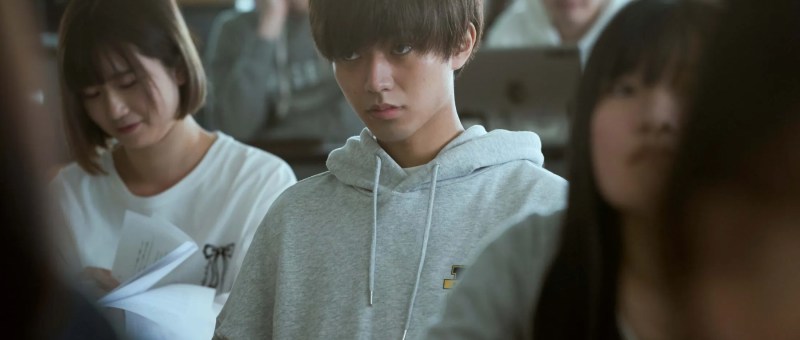
An apathetic college student is pulled between nihilistic destruction and the desire for life in Ken Ninomiya’s adaptation of the novel by F, Midnight Maiden War (真夜中乙女戦争, Mayonaka Otome Senso). “Do those who struggle for life deserve to be defeated as evil?” is a question that is put to him while he asks himself if there’s something wrong in his yearning for a “boring”, conventional existence with a good job, house in the suburbs and people to share it. Then again as the forces of darkness point out, those who long for normality usually cannot attain it which only fuels their sense of resentment towards a “rotten” society. 

The unnamed protagonist (Ren Nagase) has come to Tokyo from Kobe to attend university and as his family are not wealthy is supposed to be studying for a scholarship exam while supporting himself with part-time jobs. Only as he’s abruptly let go from his side gig, he finds himself unfulfilled by his studies and wondering what the point is in wasting his youth just to lead a dull life of drudgery. In an intense act of self-sabotage which later goes viral, he tells his English professor (Makiko Watanabe) to her face that her classes are pointless while calculating exactly how much they cost per hour which turns out to be the equivalent to three hours of labour for his mother, the price of a new text book, or three months’ Netflix subscription which oddly becomes a kind of currency benchmark. He can’t see that anything he’s learning will be of much use to him in the further course of his life when the only prize is conventionality even if that conventionality might also provide basic comfort. 

After joining a mysterious “hide and seek” club and becoming distracted by a series of minor bombings of public bins on campus, the hero is pulled between a woman only known as “Sempai” (Elaiza Ikeda), and a man only known as “The Man in the Black Suit” (Tasuku Emoto) who sell him conflicting visions of hope and darkness. While Sempai thinks it’s wrong to belittle those who want to live their lives and are genuinely content with the conventional, The Man in the Black Suit quite literally wants to burn it all to the ground. What begins as an awkward friendship between two awkward men, soon develops into a cult-like organisation of, as the hero puts it, “social outcasts”, drawn to the Man in the Black Suit’s desire to destroy the rotten society which has rejected them through blowing up Tokyo on Christmas Day. 

Positing Tokyo Tower as the “root of unhappiness”, the hero claims he wants only to destroy, and most particularly himself along with everything else. Experiencing extreme ennui, he struggles to find meaning in his life yet is also conflicted in the breadth of the The Man in Black’s goals being fairly indifferent to the existence of others and unconvinced that those merely complicit in the system should also be targets of his social revenge. If not quite dragged towards the light, he realises that he must kill the nihilist within himself and in a sense be reborn, as the Man in Black puts it, as the god of a new world. “You’re alive, that’s good enough for me” Sempai echoes as the hero does at least in a sense embrace life even amid so much destruction. 

Ken Ninomiya has become closely identified with a singular style heavily inspired by music video and often taking place in Tokyo clubland. Midnight Maiden War is in many ways a much more conventional film mimicking the aesthetic of other similarly themed manga and light novel adaptations featuring only one real party scene and no extended musical sequences while routing itself in a more recognisably ordinary reality albeit one secretly ruled by a lonely tech genius. It does however feature his characteristic neon-leaning colour palate, focus pulls, and striking composition such as the revolving upside down shot which opens the film and hints at the unnamed protagonist’s sense of dislocation. Quite literally a tale of darkness and light, the film finds its dejected hero struggling to find meaning in a stultifying existence but perhaps finally discovering what it is to live if only at the end of the world. 


The Midnight Maiden War screened as part of this year’s Camera Japan.

Original trailer (English subtitles)

Family Bond (太陽の家, Hajime Gonno, 2020)

“All I ever wanted was to make everyone happy” claims the father at the centre of Hajime Gonno’s Family Bond (太陽の家, Taiyo no Ie). Once again placing the modern family under the microscope, Gonno’s take is perhaps more traditional than most taking a largely uncritical stance against its extremely patriarchal patriarch whose heart might be in the right place even if his extremely outdated vision of idealised masculinity continues to undermine the idea of family that he is endeavouring to build. 

A manly man, Shingo (Tsuyoshi Nagabuchi) proudly introduces himself as a “Master Builder”, tearing up some revised blueprints from his excited newlywed clients who admittedly unreasonably have proposed major changes to the design at the groundbreaking ceremony on their new home. Such fits of artistic temperament are apparently not uncommon, Shingo’s understanding wife Misaki (Naoko Iijima) profusely apologising and later talking him down while reminding him that he might be a master craftsman but he also runs a business and his family need to eat. Shingo prides himself on being a paterfamilias, subscribing to a traditional ideal of masculinity in which a man must be strong to protect his family, and most particularly his women, but that protection extends in the main to the physical. As Misaki later complains, he largely does what he likes because family means no consequences, rarely bothering to consider the feelings of others in his impulsive drive to live in a thoroughly manly way. 

That’s perhaps one reason why he walks off the site of the traditional woodframe house he’s being paid to build to have coffee with a pretty young woman, Mei (Ryoko Hirosue), who as it turns out has an ulterior motive in that she wants to sell him an insurance policy. Despite all his life claiming that insurance is for cowards, Shingo signs as gesture of patriarchal solidarity helping out a struggling single mother while perhaps harbouring sightly less altruistic intensions. Nevertheless, it’s her son Ryusei that he’s eventually taken by, struck by the loneliness in his eyes as a boy without a father and taking it upon himself to fulfil that role. For her part, Mei is disturbingly unconcerned by this strange, over friendly, middle-aged man with a strong interest in her young son, encouraging Ryusei to hang out with him expressly because Shingo signed a policy with her as if she were in a sense loaning him out in exchange. In any case, it’s difficult to believe a modern woman would be entirely happy about Shingo’s well-meaning fathering, transmitting this extremely problematic, toxic masculinity to a new generation in instructing Ryusei that he needs to get strong because it’s a man’s responsibility to “protect womenfolk” and Ryusei’s to protect his mother as the man of the house. 

These outdated chauvinistic ideas also undermine his relationships with his wife and children, teenage daughter Kanna (Mayu Yamaguchi) resentful at his bond with a random little boy whom he seems to be grooming as a replacement son and potential heir having already alienated his adopted son and apprentice Takashi (Eita Nagayama). Kanna, studying to become an architect, resents her father for his sexism, largely ignoring her because she is a girl and therefore in his eyes unable to assume the family business. Takashi meanwhile resents him because he sent him off to apprentice as a plasterer rather than training him in carpentry as if suggesting he didn’t have what it takes to become a master builder himself. Both of them are hurt by his desire to simply get a new son in its implication that they were never good enough, a feeling compounded by the fact that they are both adopted. Shingo later signals something similar himself when Ryusei’s estranged birth father resurfaces, immediately backing off believing that he couldn’t win against blood as if that really is everything. 

“It’s all a big lie” Kanna and Takashi yell on different occasions trying to get through to their irritatingly distant father whose manly code means he doesn’t engage with emotion or feel the need to respond to their distress, eventually striking Kanna for her disrespect and kicking her out of the house. Of course, he doesn’t really mean it but it’s just another example of the ways his problematic manliness continues to destroy his relationships, Takashi also apparently harbouring resentment towards him for his unreconstructed chauvinism in his many affairs believing his desire to help Mei is just him getting up to his old tricks again. What Shingo discovers however is that he’ll have to literally repair his family through building it anew by helping Mei and Ryusei do the same as her estranged husband reassumes his male responsibility to protect his family. In essence, he’s forced to accept the family he has rather than chasing a better one, drawing a clear divide in building a house for Ryusei and his parents which is separate from his own while entreating his children to return to him through getting them to help build it. Shingo might not have changed, still defiantly patriarchal, but he has perhaps begun to accept that family is a mutual construct that requires strong support. In the end you have to build it together or the structure won’t hold.


Family Bond streams in the US via the Smart Cinema app Aug. 28 to Sept. 12 as part of this year’s New York Asian Film festival.

Original trailer (no subtitles)