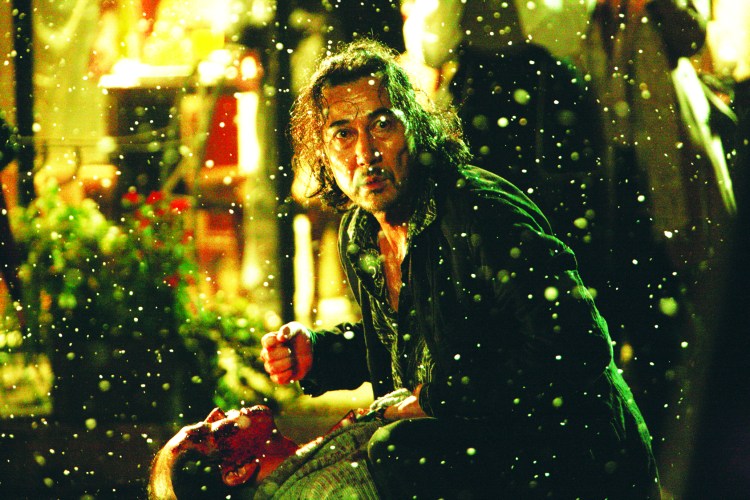
 Another LFF review up at UK Anime Network – The World of Kanako. I was also lucky enough to interview the director, Tatsuya Nakashima, who was actually very nice and quite chatty in contrast to some of the other interviews I’d read with him! (The consequence being I had way too many questions so it’s sort of a front loaded interview, oh well.) Interview’s already transcribed and in the system so hopefully live soon.
Tetsuya Nakashima is probably best known for his 2010 film, Confessions, which saw a school teacher’s extremely convoluted bid to avenge the death of her daughter at the hands of her students spill out to reveal a whole host of other ‘confessions’ of varying natures from its out of control teenage cast. Though Confessions had its fair share of violence and blood, this is nothing compared to the hellish darkness which fills The World of Kanako. Corrupt cops, teenage femme fatales, wife beaters, child traffickers, pimps and drug dealers make up the cast of this grim exposé of just how wrong you can be about the people most close to you. Those of you with a weak disposition had better step off here – this journey is not for the faint of heart.
Disgraced former policeman Fujishima has a whole host of problems in his life, alcoholism and possible schizophrenia being but two of them. Suddenly he gets a call from his estranged wife who’s out of her mind with worry because their teenage daughter, Kanako, has not been home in a few days. On searching her room in true detective style, he finds a stash of illegal drugs hidden in her school pencil case. This alarming discovery sends Fujishima down an increasingly dark alley way that leads only to the heartbreaking realisation that the kind and beautiful straight A student he believed his daughter to be was no more than a figment of his own imagination.
Fujishima is not a nice guy. There’s not really any other way to put it – he’s an arsehole. A self aggrandising drunk who lives inside a dream where he’s a hero fighting for justice with a loving wife and adorable little daughter waiting for him in their beautiful home. Except that his wife wants nothing to do with him, he hasn’t seen his daughter in a very long time and he’s been kicked off the force and currently works in security. Often drunk and on medication he’s never quite in the moment and therefore neither are we – thrown between flashbacks and unreliable mental images, we begin to float just as freely as Fujishima. It’s testimony to the abilities of the great Koji Yakusho that somehow we still feel a degree of sympathy and a desire to understand Fujishima’s complex psychology despite his deep seated rage which is directed both at himself and others. Deluded beyond belief, his quest to find his daughter is really a thinly veiled attempt to save himself by resurrecting the idealised image he had of her as the one decent thing he’d been able to build in his life.
His daughter turns out to be daddy’s little girl after all, just not in the way Fujishima originally thought. She may be beautiful and clever, but never kind and her attentions are always part of some grander plan. Like the femme fatales of old and despite her young age, Kanako knows how to get what she wants but what she wants is to cause other people pain. She too lives in a dream, or perhaps a nightmare, as she says at one point falling like Alice in Wonderland through a seemingly endless black hole. There aren’t any ‘decent’ people in this world, everyone is fighting to maintain some kind of delusional self image that will allow them to believe in their own goodness – often through projected images of an idealised family.
Coupled with this intensely dark world, the film wears its influences on its sleeve including ‘60s quirky cool action films, as evidenced by its psychedelic title sequence, and 50s Noir B-movies with their down at heel antiheroes who are often lost in worlds far darker than their imaginings. It’s also true the film is extraordinarily violent in way you don’t generally see in modern times but that doesn’t mean that Nakashima’s gift for intensely beautiful set pieces is entirely absent. The teenager’s world is full of extreme bubblegum pop and purikura garishness coupled with introspective retro tunes and animated sequences which contrast heavily with the adults’ universe of bespoke kitchens and ordered realities.
Ironically, Fujishima turns out to be quite a good detective, though the clues don’t lead him to the answers he really wanted to find. Where they do lead him is ever onward down a dark and dingy rabbit hole with no end in sight. It’s a gloriously bleak tale, but told with an ironic, detached eye that seems to be finding all of this cosmic lack of clarity ever so slightly amusing. The World of Kanako almost redefines the word ‘extreme’ but it does it with so much style that even the most jaded of viewers couldn’t help raising a wry, if slightly depressed, smile.

 Windows on Worlds