I Love You, to the Moon, and Back (穿过月亮的旅行, Li Weiran, 2024)

The economic realities of a changing mid-90s China conspire against a young couple who find themselves stranded in different cities and only able to meet up once a month for a night of passion in a hotel in Li Weiran’s wholesome romantic dramedy, I Love You, to the Moon, and Back (穿过月亮的旅行, chuānguò yuèliang de lǚxíng). Based on a novel by Chi Zijian and themed around the Mid-Autumn Festival, the film has a quirky, nostalgic quality but also a degree of poignancy amid the absurd journeys the lovers make in pursuit of their love.

Gradual flashbacks reveal that Wang Rui (Hu Xianshu) and Lin Xiushan (Zhang Zifeng) married in their home village but like many youngsters of the day left soon after for the city in search of work. Forced to leave school by his farmer father who saw no point in education, Wang Rui quickly finds works in construction but Xiushan, who was also forced to leave school early, is unable to find anything in Shenzhen and eventually takes a job in a dumpling factory in Guangzhou where she lives in workers dorms. Their plight reflects the economic reforms which were taking place throughout the 1990s giving rise to a new, much more capitalistic society as embodied by the employers who give Wang Rui an extra day off for lying on TV that they’re not exploiting him, and an obnoxious businessman Xiushan has the misfortune to sit opposite on the train who talks loudly on his mobile phone about an important deal and even drips cigarette ash all over the old lady next to him justifying himself that he doesn’t want to damage his expensive suit. 

By contrast, Xiushan and Wang Rui are incredibly frugal shopping mainly at markets with Wang Rui padding a fancy pair of shoes that are too big for him but available at a large discount. They save all their money for their monthly meetups which, as they’re both living in communal dorms, take place in cheap motels. Xiushan tries to ameliorate their grimness by covering the stained mattresses with her own sheets featuring a pattern of large sunflowers and blue skies that help her feel as if they’re back in the village lying down together in a pretty garden. To this extent it’s clear that living in the city in addition to so far apart has corrupted the innocence of their romantic connection. Xiushan was warned by her brother that if she wanted to hear Wang Rui’s harmonica playing she should put off going out with him because the romance will die once he’s won her, and it’s true enough that Wang Rui never plays the harmonica for her anymore in part because they’re now quite expensive and he’d rather save up his money for another cross-country visit. 

Xiushan’s decision to buy one for him with some money from an unexpected windfall is then an attempt to rescue their romantic connection which is now under threat because of their geographical displacement and economic oppression. On the train, however, she runs into another man who plays harmonica and has apparently been arrested for an undisclosed crime. Out of compassion she asks the policeman escorting him to allow the condemned man to play a song which he does and reduces the entire carriage to tears hinting at other sad stories of separated lovers in modern China. Wang Rui encounters something similar in a one armed man caring for a wife from whom he was separated who has since become ill and is apparently in love with someone else. His cynicism causes Wang Rui to doubt Xiushan, so paranoid that another man may take a liking to her that he puts back the pretty dress he’d intended to buy as a present and gets the much more temporary gift of a bunch of roses instead.

These respective choices of items might signal where they are in their relationship, but there’s still a pureness to their love that can’t be destroyed completely. Both unexpectedly given an extra day off for the Mid-Autumn Festival they decide to make surprise visits to other’s cities only to perpetually miss each other, stuck travelling back and forth by train and only able to make contact via “their” set of payphones for as long as their phonecards would allow before fate finally, if briefly, smiles on them under the light of the autumn moon. Charmingly quirky and hopelessly innocent, the film nevertheless captures something of the chaotic undulations of the mid-90s society in which youth is on the move but love it seems is standing still.


Original trailer (Simplified Chinese & English subtitles)
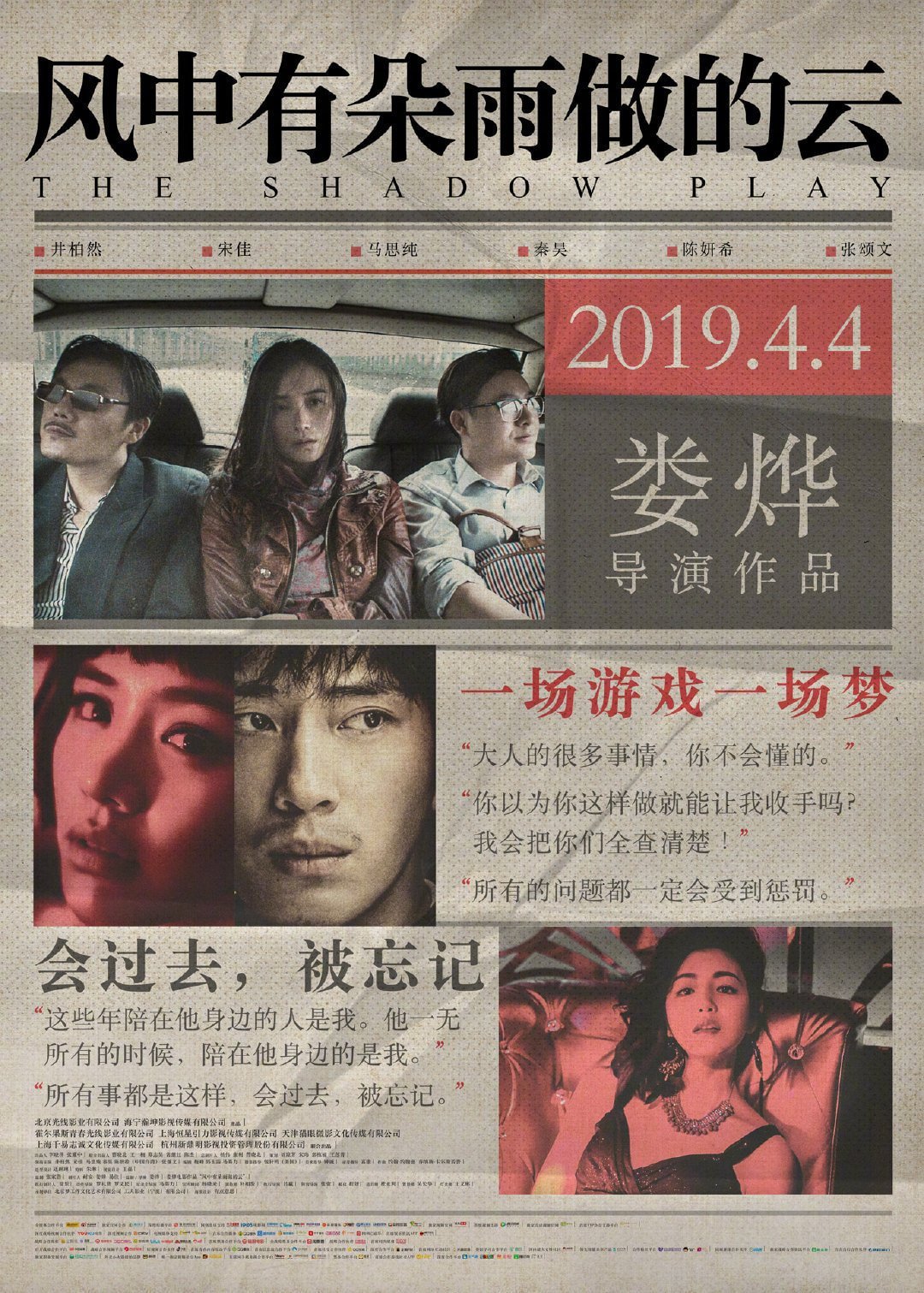
The Shadow Play (风中有朵雨做的云, Lou Ye, 2018)

The forever rebellious Lou Ye has had his share of troubles with the Chinese censors board. Suzhou River was banned on its release, while he received a five-year filmmaking sanction for screening his provocative Tiananmen Square drama Summer Palace in Cannes without clearing official permission first. Stuck in censorship limbo for two years, the aptly named The Shadow Play (风中有朵雨做的云, fēng zhōng yǒu yù zuò de yún), taking its title from characteristically well-placed retro pop song, sees Lou steeping into the increasingly popular genre of Sino-Noir once again critiquing the the corrosive corruption of the Modern China through the prism of crime. 

Many of Lou’s films pivot narrative around a single implosion from which everything radiates like cracks in a pane of shattered glass. The Shadow Play is no different only there are perhaps three distinct, interlinked points of fracture each connected in a complex web of corruption and frustrated desires. He opens therefore with a moment which occurs in the mid-point of the narrative, the accidental discovery of decomposing body by a young couple venturing into the wilds of nature for a little privacy. The action then moves to the “contemporary” present of 2012 in which a small village is engulfed by “rioting” as residents attempt to protest the demolition of their community by the Violet Gold Real Estate Company. CEO Tang (Zhang Songwen) turns up to do some ineffectual damage control, slipping into Cantonese as he reminds them he’s a local boy too and only wants to bring about “the transformation of our community” insisting that the “beautiful future” is possible only by tearing down the old. As he’s speaking, however, protestors manage to knock down the neon sign bearing his company’s name from the building behind him and later that night Tang himself is found dead, impaled its framework after apparently “falling” from the rooftop. 

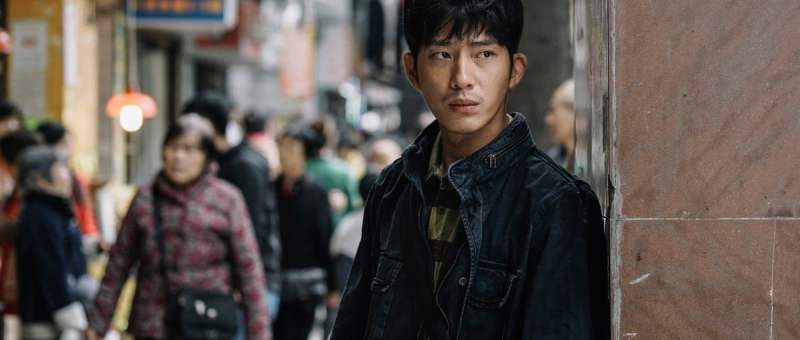
Young and idealistic policeman Yang (Jing Boran) was assigned to the detail that night and thereafter to the investigation into Tang’s death, quickly growing suspicious over his ties to shady property tycoon Jiang (Qin Hao). As a brief montage sequence explains, Tang and Jiang who met at university in 1989 each prospered from the capitalist explosion of China’s ‘90s reforms but their complicated relationship is founded on resentment and dependency partly connected to their mutual love for campus sweetheart Lin Hui (Song Jia) who first dated Jiang but as he was apparently already attached later married Tang. Many suspect that Jiang has something to do with Tang’s death even as others point out that he needed him to preserve his access to government bureaucracy, but the investigation is further complicated by witness sightings of a third person thought to be Jiang’s Taiwanese former lover/business partner Ah-yun whose mysterious disappearance in 2006 Yang is convinced is connected to the traffic accident which left his veteran policeman father in a catatonic state. 

The Shadow Play is in some respects unusual in its strong yet often implicit hints of police corruption perhaps mitigating its mild attack on the mechanisms of state through Yang’s idealistic, though flawed, goodness. Seduced by the lonely Lin Hui, he finds his name blackened but refuses to give in even when forced on the run after being framed for murder. Like Lin Hui’s daughter Ruo (Ma Sichun) however he is also representative of the post-90s generation who have grown up in the world created by men like Jiang and Tang. He is obviously uncomfortable in being introduced as his father’s son but also carries with him a desire for justice that lies adjacent to revenge. Ruo, meanwhile, though now an adult, longs for the restoration of her family despising her father Tang while obviously close to Jiang who has been supporting her financially by funding her education, using his wealth to game the system. “She’ll be happier than we are,” Jiang insists, ironically echoing Tang’s insistence that the village must be destroyed so they can give their children better futures. 

Tang meanwhile is a representative of China’s resentful petty bureaucrats forced into a middle-man existence unwilling to admit that he owes everything to Jiang, the man he knows to be sleeping with his wife. His toxic sense of male inferiority sees him take out his frustrations those with the least power, subjecting Lin Hui to years of domestic abuse before eventually having her locked up in a psychiatric institution claiming that she self-harms and is mentally unbalanced. The facade of the elegant, prosperous middle class family is well and truly imploded while it becomes difficult to tell if Tang is just a sleaze, exposing his misogyny in bringing up Ah-yun’s bar girl past, or his ill-advised pass at her is an attempt to get back at Jiang for his relationship with his wife while undercutting his rival’s manhood by sleeping with his woman. There is widespread impropriety in this incestuous world of corporate politics, but there’s also personal pettiness, hurt, and heartbreak that eventually blossoms into an ugly violence. 

In characteristic non-linear fashion Lou zips between the three points of fracture from the trio’s meeting in a 1989 through the disappearance of Ah-yun and the death of Tang, the layers of corruption deepening as the two men make themselves rich taking advantage of the unregulated capitalism of the modern China while slowly destroying themselves in their mutual unhappiness. It’s no surprise that the film found itself on the wrong side of the censors with its brutal footage of anti-redevelopment riots, hints of political corruption, and the depiction of the destruction of a body though we get the now customary title cards appearing at the end reminding us that the guilty parties have been caught and punished outlining exactly how long for everyone went to jail even if Lou subtly undercuts the sense of the State in action the card is intended to portray. Elliptical and somehow hard, ending like Summer Palace on the innocent image of the trio dancing back in 1989, The Shadow Play is cutting indictment of a morally bankrupt society and the corrosive effects of corruption but perhaps implying that the younger generation will in one way or another have its revenge for the ravages of their parents’ greed. 


Original trailer (no subtitles)