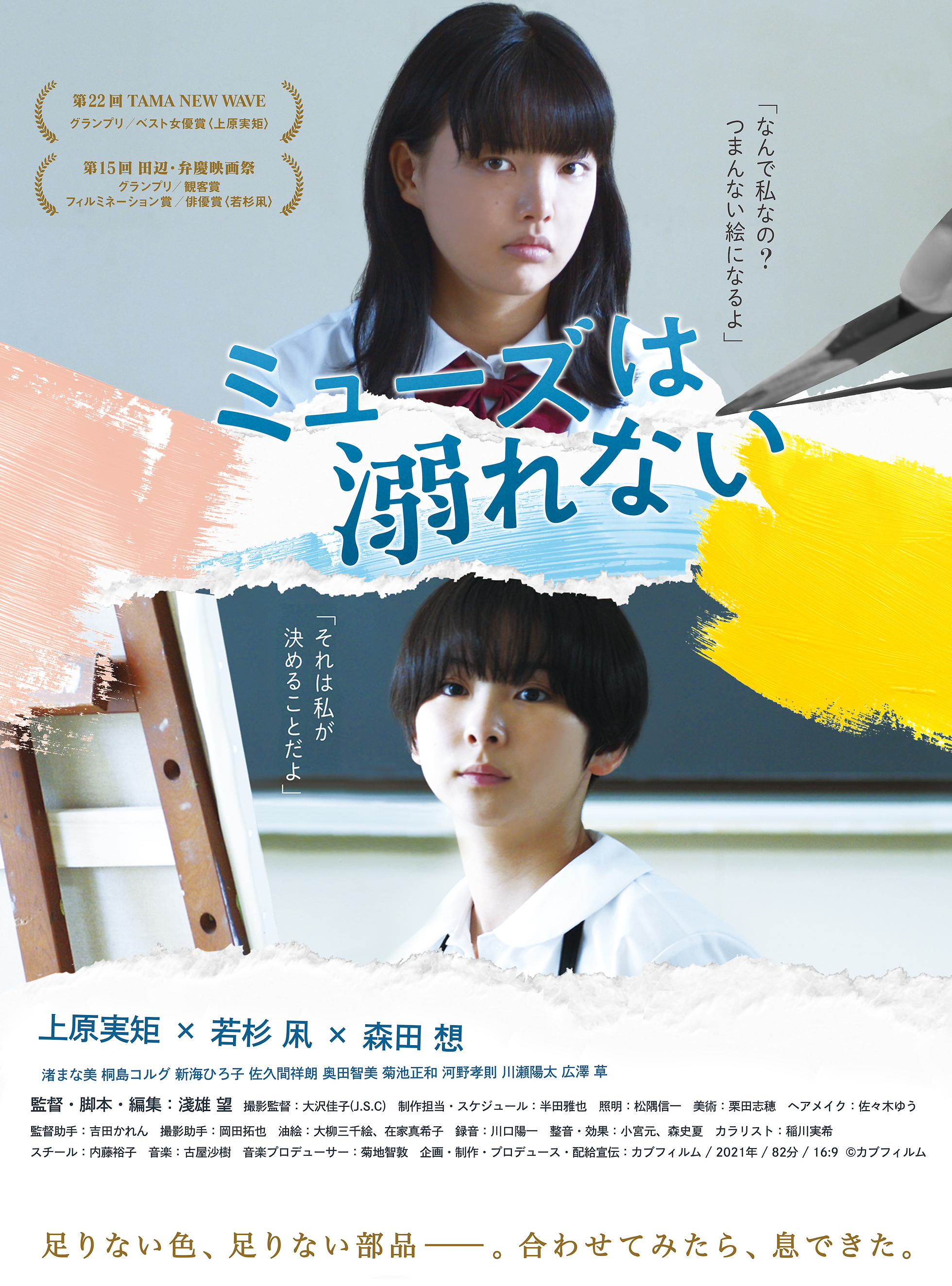
A Muse Never Drowns (ミューズは溺れない, Nozomi Asao, 2022)

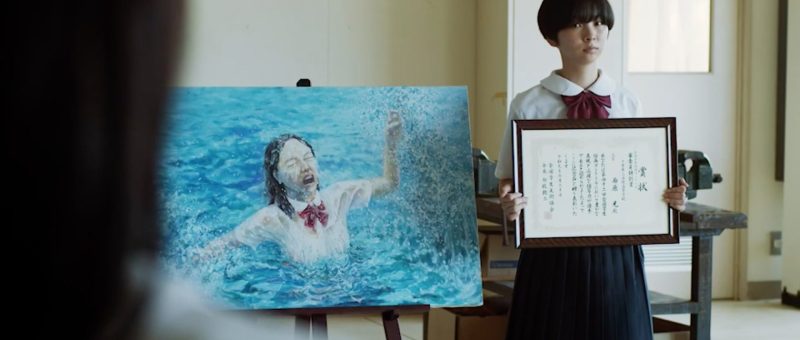
A teenage girl flounders amid a series of changes in her life while questioning her future and identity in Nozomi Asao’s empathetic coming-of-age film, A Muse Never Drowns (ミューズは溺れない, Muse wa Oborenai). Saku (Miku Uehara) is however drowning, a fact brought home to her by the relentlessly aloof Saibara (Mimori Wakasugi) who captures a sense of her panic and despair in a painting of her falling into the local harbour. Yet through their rather tumultuous friendship the pair eventually discover that they aren’t so different after all.

Saibara’s perfectly executed painting destabilises Saku on more than only level, firstly in her discomfort in having been seen and secondly in the insecurity it causes her in her own talent as an artist. Saku had wanted to go to art college, but a teacher harshly corrects her drawing style as if trying to push her towards a more authentic form of expression that’s less worried about getting it right than capturing a sense of what she sees and feels. Lacking confidence that she’ll get in, Saku is thinking about quitting the club in embarrassment but is persuaded to try making something else for the cultural festival while simultaneously receiving an unexpected entreaty from Saibara who wants her to pose for her next painting.

Most of the other students seem to resent Saibara for what they see as her superiority complex, believing she is aloof because she thinks she’s better than them. Because of her blunt manner, Saku too had thought her to be ultra confident and is surprised to realise that Saibara too is filled with doubts and anxieties even if she makes a point of pushing through them. Echoing her teacher’s words, Saibara admits that the lines don’t always come out the way she wants them either but all she can do is try to connect the dots. The reason for her aloofness is a vicious circle of deep-seated loneliness that convinces her she will ultimately be rejected, mirroring Saku’s conviction that she is a “boring” person, and therefore it is easier to remain alone from the start. 

Part of Saibara’s self-rejection is borne of internalised homophobia uncertain if others will accept her sexuality while harbouring a crush on Saku she doesn’t know how to articulate other than through her art while Saku too struggles with her feelings and is confused by the attention she receives from Saibara. Saku’s feelings of insecurity are informed by a sense of embarrassment that she has never experienced a romantic crush like her friend Emi (Kokoro Morita) who likes baseball player Endo despite knowing that likes he Saku, though Emi has also picked up on the way she looks at Saibara and is drawing conclusions about her lack interest in boys. Emi tells her that she accepts her whatever her sexuality is, but is hurt and confused when Saku remains silent and declines the opportunity to open up to her though perhaps partly because she does not really know the answer herself. 

Other than Saibara, Saku is the only one who hasn’t yet returned her careers survey still uncertain of the future direction of her life. Her father has recently remarried and he and her step mother Satomi (So Hirosawa) are expecting a baby all of which has Saku feeling somewhat adrift, displaced within her family and soon to lose her home which has been bought out for a new development project meaning they’ll soon be moving to a new house shorn of the memories of her birth mother and primed for her father’s new start. 

Yet through all her experiences, slowly bonding with Saibara and repairing her friendship with Emi, Saku begins to discover a path towards a more authentic art born of the desire to take things apart and put them back together again while quite literally feeling her way forward with her hands. Coming to terms with her new family circumstances, she builds herself a boat and is no longer drowning but drawing strength from her new found friendships with a renowned sense of possibility for the future while her friends do much the same in the knowledge that they are all scared and uncertain but doing their best to join the dots towards a happier future. 


Trailer (English subtitles)
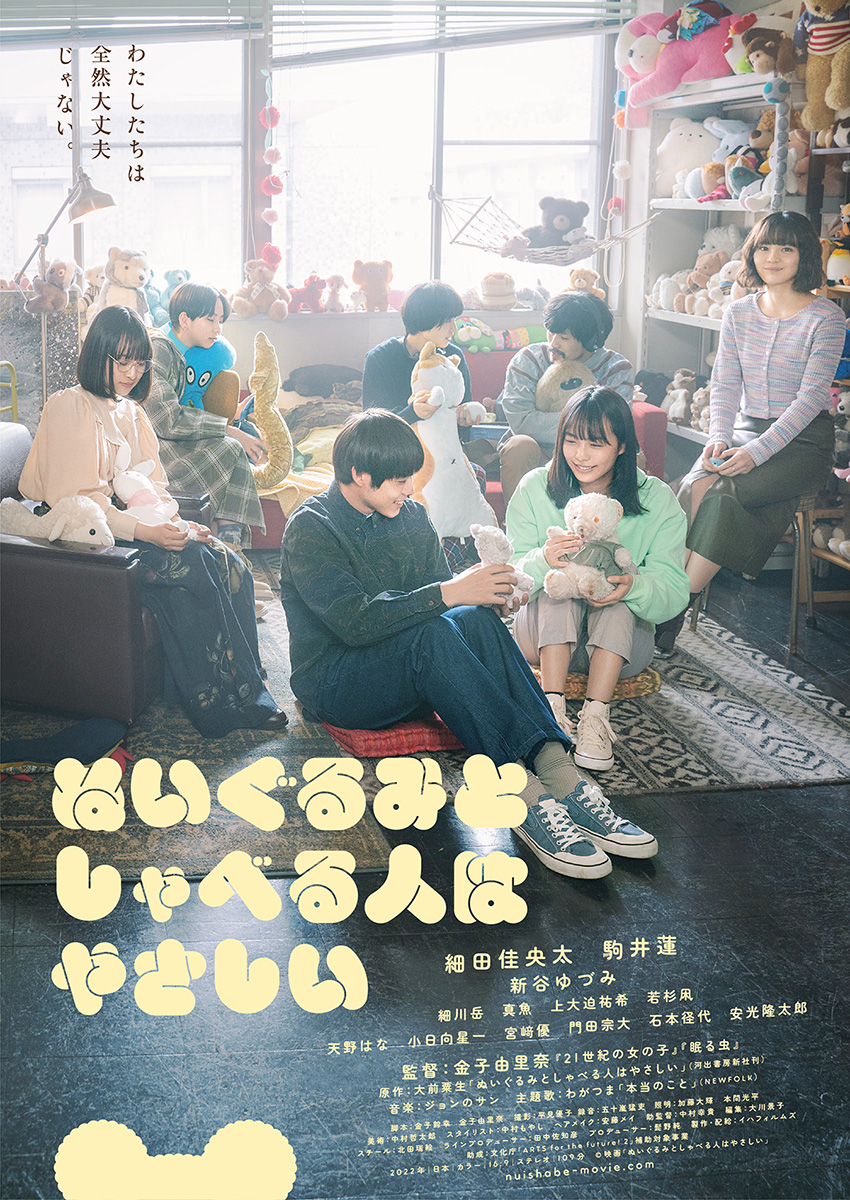
People Who Talk to Plushies Are Kind (ぬいぐるみとしゃべる人はやさしい, Yurina Kaneko, 2023)

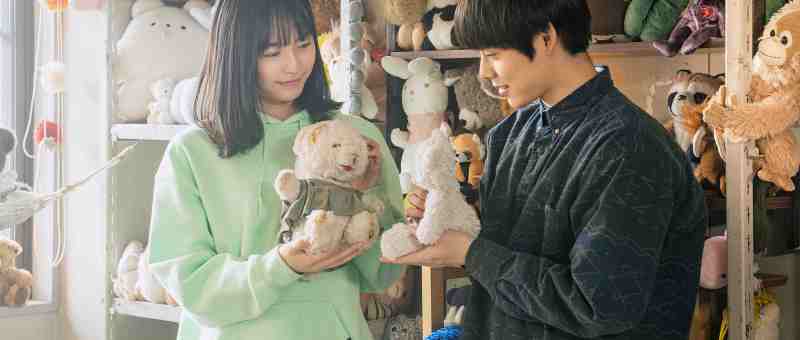
How is it possible to go on living in a society which is often unkind and at times hostile? A collection of sensitive university students find themselves struggling to accept the world around them in Yurina Kaneko’s charmingly empathetic adaptation of the novel by Ao Omae, People who Talk to Plushies are Kind (ぬいぐるみとしゃべる人はやさしい), but discover a kind of solidarity in softness after joining a club where they don headphones and unburden themselves to cuddly toys. 

As they point out, it’s good to talk. But talking to someone else about your worries can end up making them worried too and that’s the last thing any of the members of the Plushie Club want which is why they’ve decided to talk to plushies instead. Yet what’s worrying them isn’t just their worries, but a sense of their powerlessness and complicity in having behaved as if they believed the problems of others were nothing to do with them until they were shown otherwise. The hero, Nanamori (Kanata Hosoda) regrets that he “laughed things away with everyone else” rather than speaking up when he saw something that seemed wrong to him and should change while acknowledging that simply by existing as a man he may make someone feel afraid or uncomfortable without meaning to. 

Nanamori is careful not to hurt others by his own actions, trying to turn down a confession of love from a classmate in high school as kindly as he can but perhaps failing in his awkwardness even as he straightforwardly tells her that he doesn’t understand the concept of romantic desire. He simply doesn’t know what it means to “like” someone, and feels that there must be something wrong with him that he can’t grasp this simple facet of human behaviour. On a trip home uniting with some boys from school, he is immediately put off by their stereotypically masculine banter in which they ask him about girls and crushes and mock him for being a virgin until he finally leaves and tells them not to laugh at him just because he is different. 

Everyone at the Plushie Club is “different” in their own way, but has come to find a place to belong where they are simply allowed to be without needing to offer anything else. As another of the members, Nishimura (Mimori Wakasugi), puts it there’s something between kindness and indifference that is simply gentle, a quiet yet powerful quality of acceptance. When she casually revealed one day that she had a girlfriend, most of her friends were supportive but perhaps superficially. Her revelation had made them uncomfortable and regardless of how they felt about it, their perception of her had changed and she was no longer the person she had been to them before. They began to treat her differently, but at the Plushie Club there was no real difference and everyone carried on reacting to her the same way they always had. 

The Plushie Club is a place where it’s permitted to be soft in a hard world, where the members can allow themselves to feel drained by the process of living and find relief from their sense of powerlessness in acknowledging that they have made a choice to continue being kind rather than become what the world wants them to be. In an effort to understand romantic desire, Nanamori begins dating a fellow member, Shiraki (Yuzumi Shintani), but discovers that she has chosen the opposite path laughing at women who complain about societal misogyny and insisting that it’s pointless to resist because nothing will ever change. She joined the Plushie Club because she was sick of being sexually harassed at other uni gatherings but later decides to deliberately join another club filled with sexist guys because the real world isn’t so nice and the only way to survive it is to become hard yourself. 

Shiraki claims that she finds Nanamori’s “righteousness” “exhausting” and wishes she could free him and a similarly minded classmate, Mugito (Ren Komai), from their “tormenting kindness” which has in its way hurt her though unavoidably so even as she continues to be kind despite herself if rebelling by refusing to talk to plushies. Kaneko sometimes shifts to a blurry plushie vision with shimmering pastel-coloured edges and a kind of glitter snow effect that makes it seem as if the stuffed toys really are watching over their human friends as they silently, or not, agree to shoulder some of the burden of living. “They’re the ones talking to us,” Nanamori points out though in a way perhaps it’s more that the plushies reflect a part of themselves allowing them to exteriorise their internal dialogue and reach an accommodation with their fear and loneliness amid a world which consistently proves immovable and disappointing.


People Who Talk to Plushies Are Kind had its World Premiere as part of this year’s Osaka Asian Film Festival.

Original trailer (no subtitles)

Images: (C) 映画「ぬいぐるみとしゃべる人はやさしい」

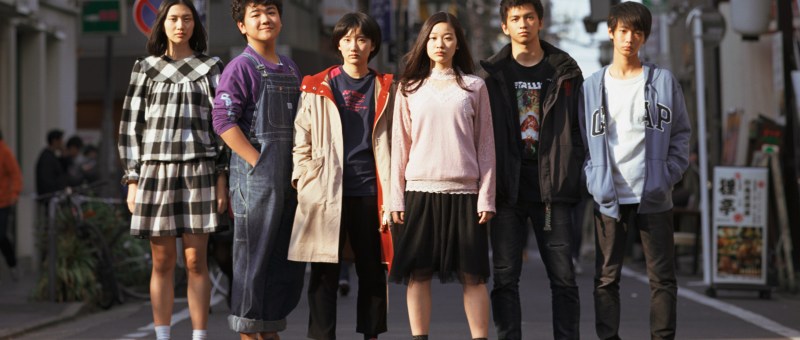
Ice Cream and the Sound of Raindrops (アイスと雨音, Daigo Matsui, 2017)

プリントThe youth movie has long held a special place in Japanese cinema but it would be fair to say that the fire has gone out of late, modern youth dramas are generally sad rather than angry. Daigo Matsui was in an enraged mood when he brought us Japanese Girls Never Die – a chronicle of female elision in an intensely misogynistic society. Now he brings his camera down a little to take a look at the incendiary play by boundary pushing British playwright Simon Stephens, Morning, through the eyes of real teenagers as their own hopes and dreams are suddenly pulled away from them by an act of “unfairness” which is perfectly typical of the treacherous adult world obsessed with rationality and not at all interested in their feelings.

Shot entirely in one take, Ice Cream and the Sound of Raindrops (アイスと雨音, Ice to Amaoto) masterfully condenses the one month rehearsal period of the play into a mere 70 minutes through dreamlike time segues, neatly swapping aspect ratios as the “play” takes over from “real life”. Stephens’ play, set at the end of summer – the same time as the play is being rehearsed and was scheduled to be performed, is a coming of age tale in which its small town heroine attempts to deal with the impending departure of her best friend for university by embracing the “freedoms” of youth only to discover that not all transgressions are cost free.

In a bid for “realism” the play’s director, played by Matsui himself, has cast real local teens by means of an open audition, but times are tough for the arts. With no “names” in the cast, ticket sales are slow. The producers have decided to pull the production and cut their losses ahead of time. The youngsters are obviously upset. This was, after all, their big chance and they’ve worked hard only to be told that all their efforts are worthless because they just don’t have “it”. No one cares about their feelings, no one cares about their wasted time, no one cares about them.

The actors and actresses play characters with their real names, slipping into and out of the theatrical world with little warning until the two begin to blend almost seamlessly and it becomes impossible to tell which level of theatricality best represents the teens’ inner lives. The “play” is also scored by a kind of Greek chorus in the form of a slightly older rapper/performance poet who offers a more direct commentary on the general feelings of hopelessness which have begun to plague the young cast who know they will be emerging into a world with few possibilities in which they will be expected to abandon their youthful dreams for an idea of conventional success which is destined to remain far out of their reach.

The cutesy title, Ice Cream and the Sound of Raindrops, hints at another kind of youth story – the melancholy journey into nostalgia as an older protagonist looks back on a beautiful summer many years ago spent with friends who perhaps are no longer around. Matsui’s film has some of that too, though his protagonists are younger. The teens almost eulogise themselves, telling their story as if it’s already over, walking like ghosts through halls of memory. They’re sad, but they’re angry too and they don’t understand why their platform has been so arbitrarily removed just as they were preparing their voices to be heard.

If youth wants the stage it will have to take it by force. Sick of being blamed, of being told that their failures are all lack of talent rather than luck, the kids make themselves heard even if they do so through a veil. Daigo Matsui gives them back their stage, enriching it with his own artifice in the thrillingly complex choreography of his oscillating one take conceit. Anchored by a standout performance from leading lady Kokoro Morita on whom many of the transitions depend, Ice Cream and the Sound of Raindrops returns the youth film to its previous intensity with a rebel yell from the disenfranchised next generation who once again find themselves at odds with the society their parents’ have created and see no place for themselves within it which accords with their own sense of personal integrity. 


Screened at Nippon Connection 2018.

Original trailer (no subtitles)