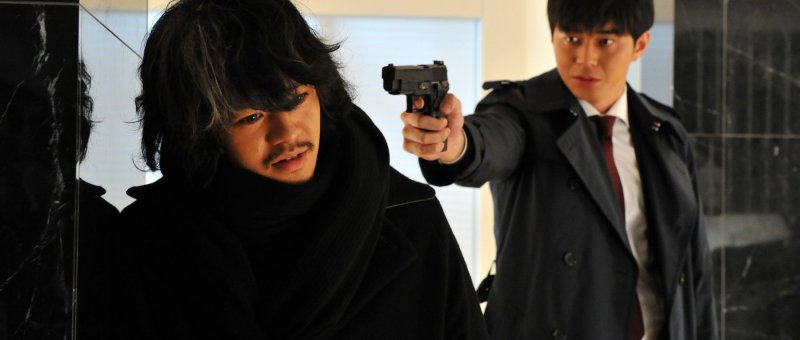
Black Night Parade (ブラックナイトパレード, Yuichi Fukuda, 2022)

According to the opening voiceover of Yuichi Fukuda’s seasonal comedy Black Night Parade (ブラックナイトパレード), we’ve all got Christmas wrong. It’s not completely true that Santa only gives presents to the nice kids for there are in fact two Santas, the other one, the anti-Santa, making sure that bad children have a very unhappy Christmas receiving gifts ranging from the traditional lump of coal to offal. The Santa dressed in black is described as being a little more egalitarian, but does indeed pedal in disappointment and the opposite of the holiday spirit though in another way perhaps he’s just an embodiment of a sense of resentment towards to the unfairness of the contemporary society. 

Miharu (Ryo Yoshizawa) is very definitely grown up and a good example of someone who regards themselves as earnest but is becoming fed up with seeing those he regards as acting inconsiderately prosper. Still working part-time at a convenience store having repeatedly failed to get into university or find a full-time job, he’s irritated by his loudmouth slacker colleague Kaiser (Taishi Nakagawa) who just seems to constantly fall up in life while Miharu ends up being the responsible one doing most of his work for him. When Kaiser asks him to cover his shift Christmas Eve so he can go on a date with his pretty girlfriend seconds after telling him he’s actually had a full-time job offer, it obviously stings more than a little. But when Miharu takes a leaf out of his book and tries to take home one of the expired Christmas cakes, he’s immediately caught and threatened by his boss not to mention being deemed a bad boy by the Santa in black. 

Though in his case, it results in an ironic job officer to become one of Santa’s helpers at a gloomy Santa centre where they run a virtual surveillance state to figure out whether the kids that send in letters to Santa have really been as good as they claim to have been. Surveillance queen Shino (Kanna Hashimoto) decides one little lad hasn’t on catching him cheating on a test despite having emphasised how hard he’d been studying in his letter. Cheating on a test is obviously not “good”, but perhaps it’s not innards in your stocking bad either and Miharu’s moral compass is going haywire trying to understand the strange world he finds himself in while participating in a contest to join the elite Reindeer division of Christmas shock troops. Meanwhile, he’s also confronted by a conspiracy in which the red Santa has already been murdered by rats controlled by a mysterious group who hate Christmas and are trying to eradicate it. If they don’t find a new red Santa soon, the magic will be broken forever.

Despite the zaniness of the concept, the humour is a little less grating than the broad variety style generally employed by Fukuda in his other films even if several of the performances are on the larger side. Rather than rediscovering the true meaning of Christmas or coming to an accommodation with the unfairness of the contemporary society, Miharu is guided towards dealing with his own unresolved childhood trauma which repurposes the empty consumerism of a contrived holiday tradition as a means of signalling of a lack of something or the roots of unhappiness. Even if most most kids are asking for the latest toys it may be because they want others to play with with them, while some just want company because their parents have to work long hours and they’re lonely at home. 

Despite making the astute observation that the best way to disappoint a naughty child is to get them what they asked for but not quite right, Miharu eventually discovers a calling in making sure no child is left empty-handed on Christmas Day spreading the spirit of the season wherever he goes even while being chased by packs of evil rats out to destroy the joy of Christmas forever. Then again, there is some mildly satirical humour in the likening of Santa Claus House to a “black company” ruthlessly exploiting its employees while engaging in some very dubious corporate shenanigans in its use of customer data and clear invasion of privacy in its all-seeing surveillance network. In any case, it does appear that Christmas is safe from the rat race for the moment and children good or bad will wake up to a surprise equally so on Christmas morning for years to come.


Original trailer (no subtitles)

The Nighthawk’s First Love (よだかの片想い, Yuka Yasukawa, 2021)

A young woman begins to regain a sense of self-confidence in the face of social prejudice when invited to consult on a film in Yuka Yasukawa’s adaptation of the Rio Shimamoto novel, The Nighthawk’s First Love (よだかの片想い, Yodaka no Kataomoi). Drawing inspiration from a Kenji Miyazawa story about an ostracised nighthawk bullied by a hawk who cannot accept that they are the same because he finds the nighthawk’s difference offensive, Yasukawa’s gentle drama is less about the transformational quality of love than it is about learning to accept oneself as distinct from the self that others see. 

A shy young woman, Aiko (Rena Matsui) keeps a distance with others because of a longterm sense of rejection owing to a prominent birthmark on her face. After agreeing to be interviewed for a book about people living with facial difference and disfigurement, Aiko is approached by filmmaker Tobisaka (Ayumu Nakajima) who just happened to chance on their photoshoot and was struck by what he describes as a quiet sense of strength in her reserve. Though Aiko is not originally keen on the idea of having someone turn her life into a film, she soon begins to bond with Tobisaka who does not appear to react to her birthmark and eventually embarks on a romance only to find herself insecure in his continuing attachment to a former muse and dedication to his craft. 

While visiting her publisher, Marie (Lisa Oda), Aiko encounters a curious little girl who touches her own face and bluntly asks Aiko if the bruise-like mark on her cheek hurts. Aiko answers patiently that it doesn’t and isn’t offended by the little girl’s question, but perhaps is by the mother’s reaction as she stares and wonders what to say before apologising for her daughter’s rudeness but not for her own. Aiko recounts something similar in recalling her childhood bullying in which the kids in her class nicknamed her “Lake Biwa” because the mark on her face resembled the famous landmark which they were learning about in school. Though they were being cruel to her, Aiko remembers that a part of her enjoyed the attention while the teacher’s attempt to shut her classmates down was in a way more painful as if it were the birthmark itself which was “horrible” rather than the kids’ comments. After that the other children began to avoid her, unsure what to say and perhaps blaming her for having gotten into trouble with the teacher. She explains that she worries people often drift away from her in part because of the birthmark itself and in part because of the way it influences her behaviour generating a vicious cycle of doubt, rejection, and loneliness. Tobisaka’s muse, Miwa (Miyuu Teshima), looks very much like her only without the birthmark and Aiko worries if she can keep him while fearing in her insecurity that their relationship is nothing but a long con designed to get her to agree to participating in the film. 

Yasukawa often frames Aiko looking into mirrors, at one point a reflection of her face appearing next to that of Miwa in her makeup on a poster for the film. Tobisaka gives her a compact mirror as a gift that he possibly intends to help her see herself though perhaps as he sees her, while she remains internally conflicted insistent that there’s nothing wrong with having a birthmark but carrying a degree of internalised shame and wondering if her life would be different without it. It’s another compact given to her by a similarly troubled friend that later grants her agency in realising that she does have a choice in displaying her birthmark or not even if deciding that she might not want to have it removed after discovering that it may be medically possible. Her supervisor advises her that attempting to become a different person in the pursuit of growth is nothing but a fantasy while she gradually comes to the realisation that change is not quite not quite what she’s looking for, quite literally freeing herself from her self-imposed imprisonment to embrace her authentic self. Her growth lies not simply in being loved by a man who may in a way be exploiting her, but in truly seeing herself and others for the first time. An elegantly lensed tale of self-acceptance, Yaskukawa’s gentle drama allows its diffident heroine the space to grow while becoming more rather than less of herself in defiance of a social prejudice that is all to often routed in the same insecurity she has now escaped.


The Nighthawk’s First Love screens at Japan Society New York on Nov. 13 as part of The Female Gaze: Women Filmmakers from JAPAN CUTS and Beyond.

Original trailer (no subtitles)

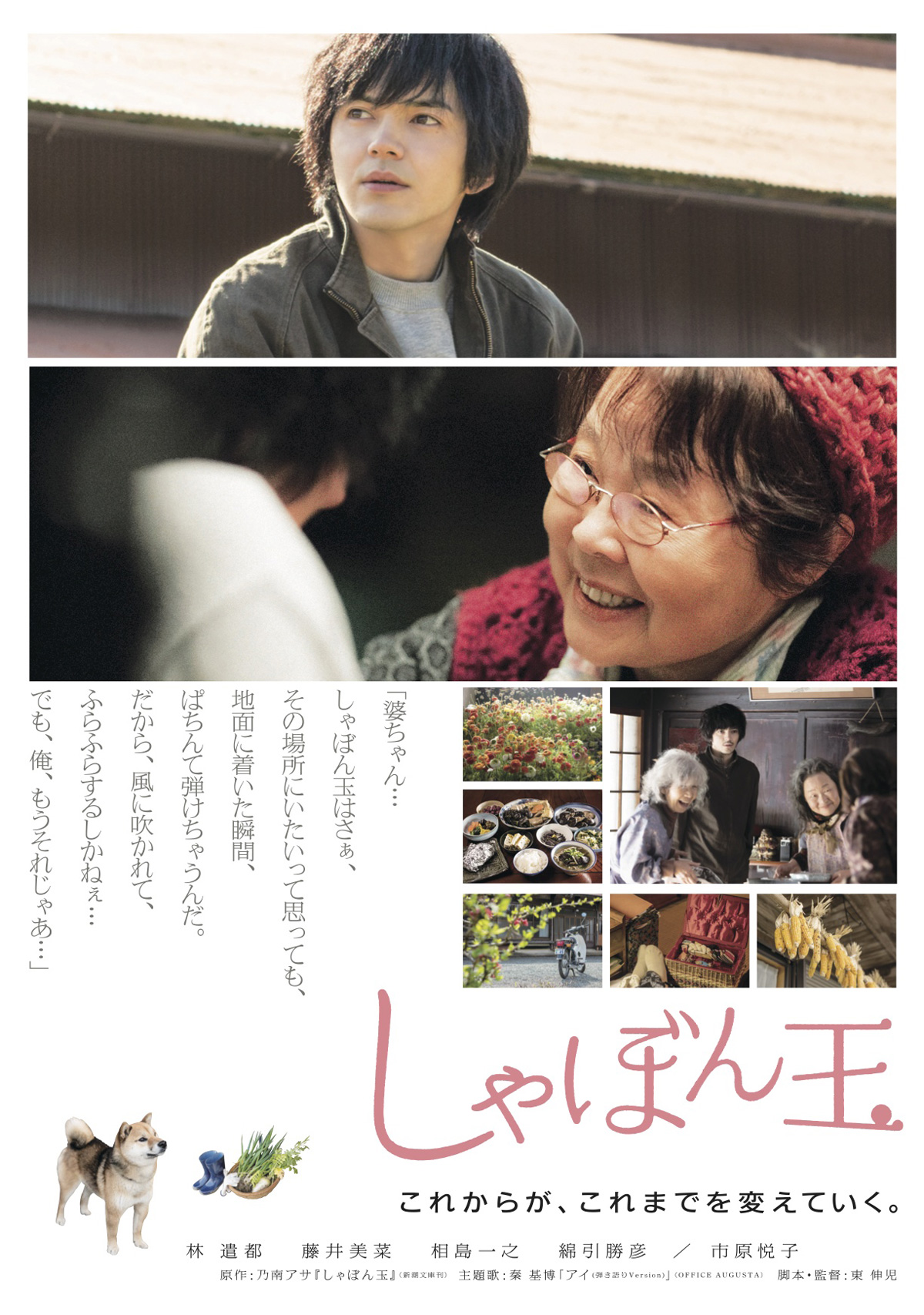
Where I Belong (しゃぼん玉, Shinji Azuma, 2017)

Where I Belong PosterTo the rest of the world Japan often seems as if it exists in the future, all gleaming city scapes and high-tech living, but Japanese cinema has a noticeable ambivalence about urbanisation. Where I Belong (しゃぼん玉, Shabondama) is the latest in a long series of films to lament the coldness and disconnection brokered by the anonymity of life in a metropolis and long for a return to a simpler time in which small communities supported each other in good times and bad, taking care to reinforce positive social values through mutual responsibility. Of course, such pictures of rural life tend towards the optimistic – these communities are accepting rather than judgemental and usually free from extreme hardships, but there is something universally comforting in the solidarity of community providing a home for those otherwise cast out.

Izumi (Kento Hayashi), a young man of indefinite age, was abandoned by his mother after his parents divorced and has lived the majority of his life on the streets. He gets by by bag snatching – mostly targeting the vulnerable, elderly and lone women. To make the job faster he carries a knife to cut the handles, never meaning to hurt anyone with it, but one night an attempted mugging in a rainy underpass ends in tragedy when his target is injured during the struggle. Getting out of town, Izumi finds himself kicked out of a truck in the middle of the mountains where he later finds an apparently abandoned scooter. Just as he’s about to continue his escape, an old woman cries out from the grassy verge. Izumi can’t quite bring himself to just ride off and helps the woman, Suma (Etsuko Ichihara), back to her home, after which he is rewarded by a hearty meal prepared by the warmhearted old ladies of the village and finds himself beginning to fight the urge to run in favour of hiding out in this strange little place where the people are unexpectedly warm.

Izumi’s not a bad guy, but he’s had a lot of bad luck. Let down so badly by family, his life has led him to believe all connections are necessarily suspect and it’s everyman for himself when it comes to surviving on the streets. He wanted to steal Suma’s scooter, but his better nature wouldn’t let him leave a little old lady bleeding on the side of the road where no one else might see her for days. The film’s central message is that kindness repays kindness, but kindness requires mutual trust – something of which the city robs its citizens though its persistent quality of anonymity and abnegation of one’s responsibility for others.

Describing himself as the soap bubble of the Japanese title, Izumi’s sense of loss and restlessness at having no particular place to return to is the root cause of his despair and lack of belief in a credible future. Through meeting Suma who repeatedly tells him that he is “good”, trusts him implicitly, and instils in him a belief in himself that had long been absent, Izumi is at last able to begin moving forward and imagine a future for himself with a place to call home. Taking to the woods with harsh but wise forager Shige (Katsuhiko Watabiki) and then helping the village prepare for a festival, Izumi begins to feel as if he can finally become a part of something bigger but equally that in order to do so he will have to make peace with his life in the city by submitting himself to its justice and paying his debt to society so that he can return and make a fresh start as a man who has finally found his place.

The first feature from TV director Shinji Azuma, Where I Belong is not solely a tale of the importance of community, but also of Japan’s changing social structure as small mountain towns find themselves devoid of youngsters leaving the elderly to fend for themselves. Izumi’s restored hopes are not so much to do with the goodness of country people, benefits of hard work, or the crisp mountain air, but simple human kindness and a consequence of the gradual awakening of his sense of self worth thanks to the often blind faith placed in him by others for nothing other than his kind heart.


Screened as part of the Japan Foundation Touring Film Programme 2018.

Screening again:

  • HOME – 19 February 2018
  • Phoenix Leicester – 7 March 2018
  • Storyhouse – 11 March 2018
  • Depot – 13 March 2018
  • Midlands Arts Centre – 17 March 2018

Original trailer (no subtitles)

Death Note: Light Up The NEW World (デスノート Light up the NEW World, Shinsuke Sato, 2016)

Death Note- Light up the NEW WorldTsugumi Ohba and Takashi Obata’s Death Note manga has already spawned three live action films, an acclaimed TV anime, live action TV drama, musical, and various other forms of media becoming a worldwide phenomenon in the process. A return to cinema screens was therefore inevitable – Death Note: Light up the NEW World (デスノート Light up the NEW World) positions itself as the first in a possible new strand of the ongoing franchise, casting its net wider to embrace a new, global world. Directed by Shinsuke Sato – one of the foremost blockbuster directors in Japan responsible for Gantz, Library Wars, and the zombie comedy I am a Hero, Light up the NEW World is a new kind of Death Note movie which moves away from the adversarial nature of the series for a more traditional kind of existential procedural which takes its cues from noir rather the eccentric detectives the franchise is known for.

Ten years after Kira, the Shinigami are bored out of their minds and hoping to find themselves a new puppet to play with and so they drop six notebooks at different places across the world and wait to see who picks them up. The first is a Russian doctor who uses it out of curiosity and compassion when faced with the desperate pleas of a suffering, terminally ill man. Others are not so altruistic, as a young girl with reaper eyes goes on a mass random killing spree in the busy Shibuya streets while the police attempt to cover their faces so they can’t fall victim to her relentless writing. Mishima (Masahiro Higashide) of the special Death Note task force hesitates, uncertain whether he should disobey orders and shoot the girl to end her killing spree, but his dilemma is solved when a strangely dressed masked man appears and shoots her for him. He is special detective Ryuzaki (Sosuke Ikematsu) – L’s successor, and a crucial ally in discovering the Shinigami’s intentions as well as the counter plan to obtain the six books and lock them away to permanently disable the Death Note threat.

As in the original series, Kira has his devotees including the cybercriminal Shien (Masaki Suda) who is intent on frustrating the police’s plan by getting his hands on the books and using them to complete Kira’s grand design. This time around, there’s less questioning of the nature of justice or of the police but at least that means there’s little respect given to Kira’s cryptofascist ideas about crime and punishment. At one point a very wealthy woman begins to voice her support of Kira because something needs to be done about “the poor” and all their “crimes” but she is quickly cut down herself as her well dressed friends attempt to rally around her.

The focus is the police, or more specifically their internal political disputes and divisions. Mishima, described as a Kira geek, heads a special squad dedicated to Death Note related crimes, where he is asssited by the flamboyant private detective Ryuzaki who is apparently the last remaining inheritor of L’s DNA. Mishima remains distrustful of his colleague but the bond between the rest of the team is a tight one. In order to frustrate possible Death Note users, none of the squad is using their real names which places a barrier between comrades in arms when it comes to building trust and solidarity in addition to leaving a backdoor open for unexpected secrets.

Sato’s focus, as it has been in the majority of his career, is genre rather than character or exploring the wider themes of the Death Note franchise from the corrupting influence of absolute power to vigilante justice and the failings of the judicial system. The new Death Note world is a more conventional one loyal to the police procedural in which dogged detectives chase mad killers through whatever means necessary whether on foot or online.

The action, however, is generally exciting as the police engage in a cat and mouse game with Shien even if not as complex as that between Kira and L. The Death Notes are an unstoppable force, corrupting otherwise fair-minded people and turning them into vengeful killing machines acting like gods in deciding who should live and who die. Moving away from the series trademark, Light up the NEW World is, essentially, the generic thriller spin-off to the main franchise but is no less fun for it even if it necessarily loses a little of itself in the process.


Death Note: Light up the NEW World was screened at the 17th Nippon Connection Japanese Film Festival.

Original trailer (English subtitles)

Abacus and Sword (武士の家計簿, Yoshimitsu Morita, 2010)

•Žm‚̉ƌv•ë•The stories of samurai whose soul is placed not in the sword but in another tool are quickly becoming a genre all of their own. Coming from the same screen writer as A Tale of Samurai Cooking: A True Love Story, Abacus and Sword is a similarly structured tale of penny pinching samurai accountants and a pean to the undersung heroes of the admin department without whom everything would fall apart.

Abacus and Sword (武士の家計簿, Bushi no Kakeibo) could almost be titled “a story of my father” as it begins with a voice over by the youngest adult generation seen in the film, Nariyuki Inoyama, who is at the time of speaking a naval accountant in the new post restoration world. As good an account as he is (and he must be, given his position), he feels he pales in comparison to his father, Naoyuki, whose skills with the abacus were somewhat legendary even if his people skills were often not on the same level.

Dubbed an abacus fanatic by his colleagues, Naoyuki’s top maths abilities get him into trouble right away when he notices an extreme discrepancy in the accounts details for the imperial rice dole. Around this time there are riots from farmers who are being squeezed to deliver more grain to the authorities during a time of famine but not seeing enough returned to them as well as starving people petitioning for food in the streets, so when Naoyuki asks why around a third of the rice is disappearing from the accounts or listed as “reserved” his superiors start getting nervous. As a mini underling, Naoyuki is not in a position to stop his bosses from exploiting their authority in the most devious of ways – creating a food panic and then profiting on the side through black market trading, and is simply instructed to “ensure the final accounts balance”. Unwilling to falsify his precious calculations, Naoyuki finds himself facing the possibility of exile from the imperial centre but eventually finds his persistence rewarded when the scam is finally uncovered by a higher level.

Accountants are often not respected in this era of samurai warriors who place an almost religious faith in the power of the sword. Their pay is low, hours long and taxing, and they have little prospects of advancement. After hearing the story of Naoyuki’s career Nariyuki returns to the subject of himself a little more as the conflict between austere father and wayward son takes centre stage. Naoyuki is a pragmatic man, he sees their family debts are unsustainable and embarks of prolonged plan of austerity in which he forces the entire extended family to sell all their non essential possessions and live as cheaply as possible until the debts reach a more manageable level so they can at least keep the social position their larger family home affords them rather than being moved to something less prestigious. This is an unusual move in status driven samurai circles and proves embarrassing for the rest of the family such as in one episode where Naoyuki can’t afford to buy fish for his son’s coming of age ceremony so simply puts a painting of a fish at each place setting. Creative accounting at its finest!

Nariyuki, however, can’t quite give up on the idea of the sword and goes off to fight in the various civil wars which erupt during the Meiji Restoration causing great worry to his parents, wife and children. He too becomes an accountant and is at first disappointed that it’s his skills with an abacus that can best serve the country rather than those needed on the frontlines but later comes to understand the tactical importance of maintaining the smooth financial functioning of an army.

A late career effort from the prolific Yoshimitsu Morita, Abacus and Sword is an uneven experience which is more or less devoid of the director’s usual attempts at experimentation pushing for a more general, sometimes even televisual approach to storytelling. At heart the film praises the virtues of living a thrifty, honest, and balanced life in which hard work is always fairly rewarded in the end and even when not provides its own set of rewards. However, virtuous as it is to live honestly and simply in tune with the clack of an abacus, it can prove fairly dull which is unfortunately also true of Abacus and Sword which despite brief episodes of light humour never quite engages with its twin dynamics of father son conflict which echoes that of the changing world as it emerges into the new Meiji era, and of shining a light on the forgotten admin workers who keep the world turning when everything else is falling apart. Morita’s anti-consumerist, transparency in government sympathies come to the fore and are once again timely, but like Naoyuki he fails to make his complaints sufficiently engaging to ensure his messages are received by those with the ability to take action.


English subtitled trailer: