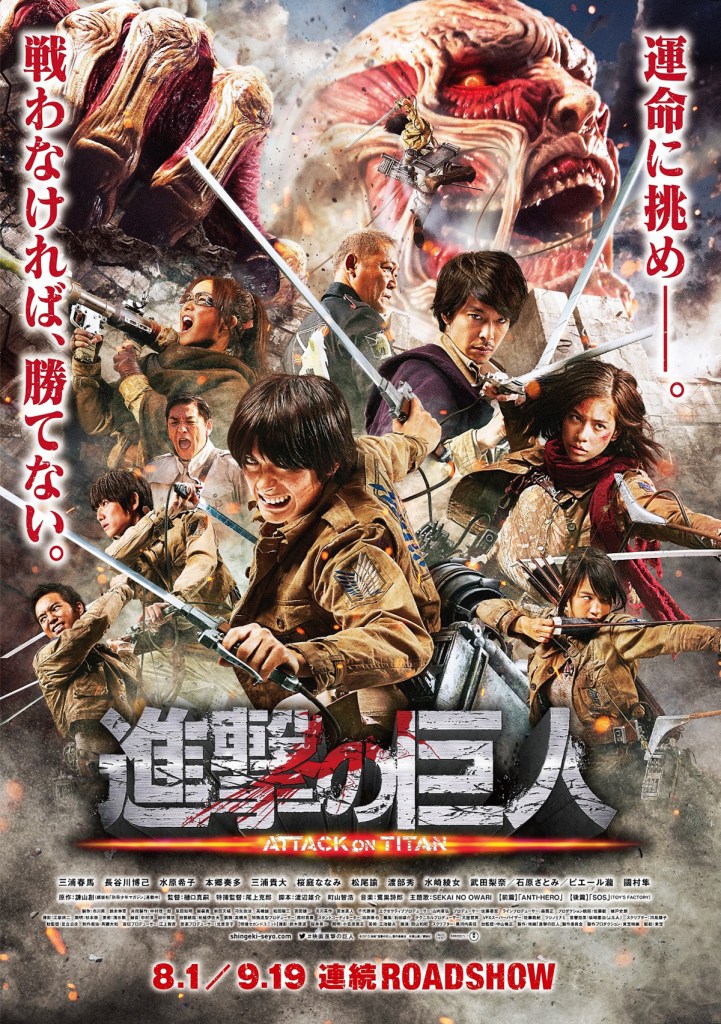
Attack on Titan: The Movie – Part 1 (進撃の巨人 ATTACK ON TITAN, Shinji Higuchi, 2015)

Attack on Titan p1Review of the first of the two part live action Attack on Titan (進撃の巨人 ATTACK ON TITAN, Shingeki no Kyojin) extravaganza first published by UK Anime Network.


It is a law universally acknowledged that a successful manga must be in want of an anime adaptation. Once this simple aim has been achieved, that same franchise sets its sights on the even loftier goals of the live action movie. This phenomenon is not a new one and has frequently had extremely varied results but fans of the current cross over phenomenon that is Attack on Titan may find themselves wondering if perhaps more time should have been allowed before this much loved series tried its luck in the non animated world.

Throwing in a few changes from the source material, the film begins with the peaceful and prosperous walled city where childhood friends Eren, Armin, and Mikasa are young adults just about to start out on the next phase of their lives. Eren, however, is something of a rebellious lost soul who finds himself gazing at the land beyond the walls rather than on a successful future in the mini city state. However, little does he know that the Titans – a race of man eating giants responsible for the destruction which saw humanity retreat behind the walls in the first place, are about to resurface and wreak havoc again. His dreams of a more exciting life may have been granted but humanity pays a heavy price.

Fans of the manga and anime may well be alarmed by certain elements of the above paragraph. Yes, the film makes slight but significant changes to its source material which may leave fans feeling confused and annoyed as the film continues to grow away from the franchise they know and love so well. For a newcomer, things aren’t much better as characterisation often relies of stereotypes and blunt exposition to get its point across. Attack on Titan actually has a comparatively starry cast with actors who’ve each impressed in other high profile projects including Haruma Miura (Eternal Zero), and Kiko Mizuhara (Norwegian Wood, Helter Skelter) as well as Kanata Hongo (Gantz) but even they can’t bring life to the stilted, melodramatic script. Things take a turn for the worse when Satomi Ishihara turns up having presumably been given the instruction to play Hans as comic relief only with a TV style, huge and bumbling performance.

That said, there are some more interesting ideas raised – notably that even a paradise becomes a prison as soon as you put a wall around it. Indeed, everything seems to have been going pretty well inside the walls until Eren suddenly decides he finds them constraining. Once the Titans break through, the very mechanism which was put in place for humanity’s protection, the walls themselves, become the thing which damns them as they’re trapped like rats unable to escape the Titan onslaught.

Machines are now outlawed following past apocalyptic events – humanity apparently can’t be trusted not to destroy itself and this cheerful, feudal way of life is contrasted with the chaos and pollution which accompanied the technologically advanced era. Unfortunately, a reversion to distinctly old fashioned values also seems to have occurred as we’re told you need permission to get married (as sensible as this may be from a practical standpoint in a military society) and the single mother gets munched just as she’s making the moves on a potential new father for her child. The Titans themselves have also been read as a metaphor for xenophobia which isn’t helped by the almost fascist connotations of the post attack society.

Much of this is really overthinking what appears to be an intentionally silly B-movie about man eating giants running amok in a steampunk influenced post-apocalyptic society but then it does leave you with altogether too much time to do your thinking while you’re waiting for things to happen. The original advent of the Titans is a little overplayed with the deliberately gory chomping continuing far too long. Action scenes fare a little better but suffer from the poor CGI which plagues the rest of the film. This isn’t the Attack on Titan movie you were expecting. This is a monster movie which carries some extremely troubling messages, if you stop to think about them. The best advice would be to refuse to think at all and simply settle back for some kaiju style action but fans of either campy monster movies or any other Attack on Titan incarnation are likely to come away equally disappointed. It only remains to see if Part 2 of this bifurcated tale can finally heal some of the many holes in this particularly weak wall.


US release trailer:
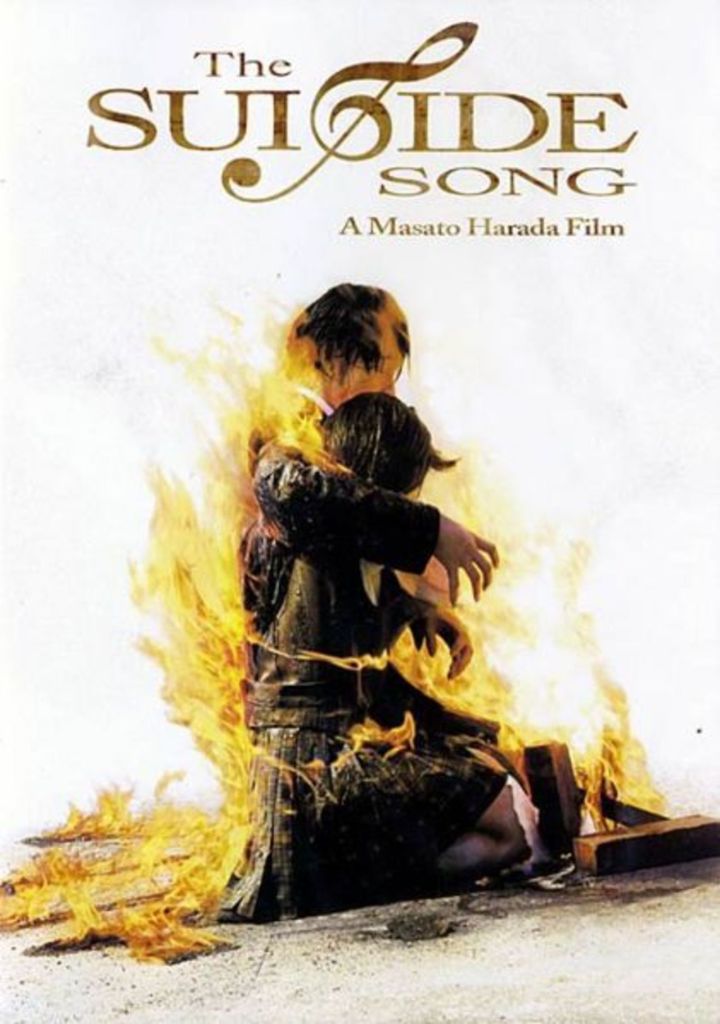
The Suicide Song (伝染歌, Masato Harada, 2007)

Suicide Song US Tokyo Shock DVD Cover
US Tokyo Shock DVD cover

There comes a time in every director’s life when fate leads them down the strangely tempting path of the idol movie. In recent years, sweet and innocent is no longer quite enough to cut it and when your film stars a bunch of kids from AKB48, you’re going to need 48x the kawaii factor so even though the DVD cover is suitably macabre and The Suicide Song (伝染歌, Densen Uta) is marketed as a J-Horror movie, there’s quite a lot more singing and dancing than might be reasonably expected.

In true idol star horror movie fashion, the film begins with some cutesy high school scenes before one student, Kana (Atsuko Maeda), starts in on her teacher who basically wants to skip a whole bit of the text book because it’s not on the exam. The potentially irrelevant teaching matter concerns famous Japanese playwright Chikamatsu whose big thing was, you guessed it, double suicides. Shortly after this, Kana is heard singing a weird song and then cuts her own throat with a kitchen knife right in front of her friend and classmate, Anzu (Yuko Oshima). It seems there has been a spate of these spontaneous suicides of teenage girls which occur after singing this particular song so skeevy newspaper guys Macasa, led by occult obsessed Riku (Ryuhei Matsuda ) and his ex-military buddy Taichi (Yusuke Iseya), decide to do some “investigative journalism”. Anzu and some of the other kids wind up helping out too, eventually coming under threat of that very same curse….

The idea of a “suicide song” isn’t a new one. Gloomy Sunday – a 1930s Hungarian folk song which achieved widespread acclaim thanks to an English language cover version recorded by Billie Holiday in 1941 became an urban legend after numerous suicides were linked to the doleful track and its extremely bleak lyrics. This time around, it’s AKB48’s inoffensive Boku no Hana which apparently drives anyone who tries to sing it to their deaths. Like Gloomy Sunday, the song features extremely nihilistic lyrics which echo the existential confusion and romantic disillusionment that many of its young listeners are undoubtedly experiencing. A perfectly rational explanation for why so many young women might be taking their lives with this particular song on their lips, yet Suicide Song is not particularly interested in exploring the various real world pressures which might push high school students towards death when their lives ought to be just beginning.

It’s not long before the curse makes the leap to supposedly solid adult males. Later, one character tries to weaken the importance of the song by suggesting that it just opened a door for the suppressed feelings that were already there. That each of the victims already wanted to die and and simply allowed themselves to make use of this real world meme to give themselves permission to end it all. This is an interesting idea in some ways, though comes close to victim blaming and conveniently lets the central characters off the hook for failing to save their friends who have already fallen for what is either a curse or mass hysteria. In any case, like most Japanese horror movies and mysteries, the real villain is a circle of buried secrets. The traumatic past must be faced, brought out into the light and then given a proper burial to end the ongoing chaos.

Harada is playing a very strange game. He adds in generic J-horrorisms such as odd jump cuts, stuttering, power outages and possessed video footage as well as a good deal of shadiness in the form of the low rent newspaper guys and the investigation turning up something as dark as a teenage gang competing to see how many kids they can get to kill themselves using the song as a marker. Yet, he generally keeps things cute and light just like your average teen idol romance movie. We’re even treated to a very special AKB48 performance at their club in Akihabara (“Japan’s Most Sophisticated Show” !) where they sing Aitakatta for a room full of devoted middle aged guys who are their biggest fans. There are also frequent cinematic quotations from such Hollywood classics as Vertigo and The Lady From Shanghai (not to mention a completely shoehorned in paintball sequence using Ride of the Valkyries a la Apocalypse Now) which seem to hint at some kind of greater plan, but whatever it is never quite materialises.

Whatever Harada’s intentions may have been, Suicide Song is a strange beast which veers widely in tone from wacky comedy to supposed horror film. In actuality there are very few real scares despite the J-horror aesthetic and the comedy never amps itself up to the level of parody. If the intention was to create some kind of weird, subversive genre hybrid, the punches have been well and truly pulled. Watched as a horror movie Suicide Song is prone to disappoint, though its moments of absurd comedy and cute schoolgirl drama prove enjoyable enough for those able to adjust their expectations on the turn of a dime.


The Suicide Song is available with English subtitles on R1 US DVD from Tokyo Shock.

English subtitled trailer (aspect ratio is slightly stretched):

https://www.youtube.com/watch?v=PT2vVgmwb10