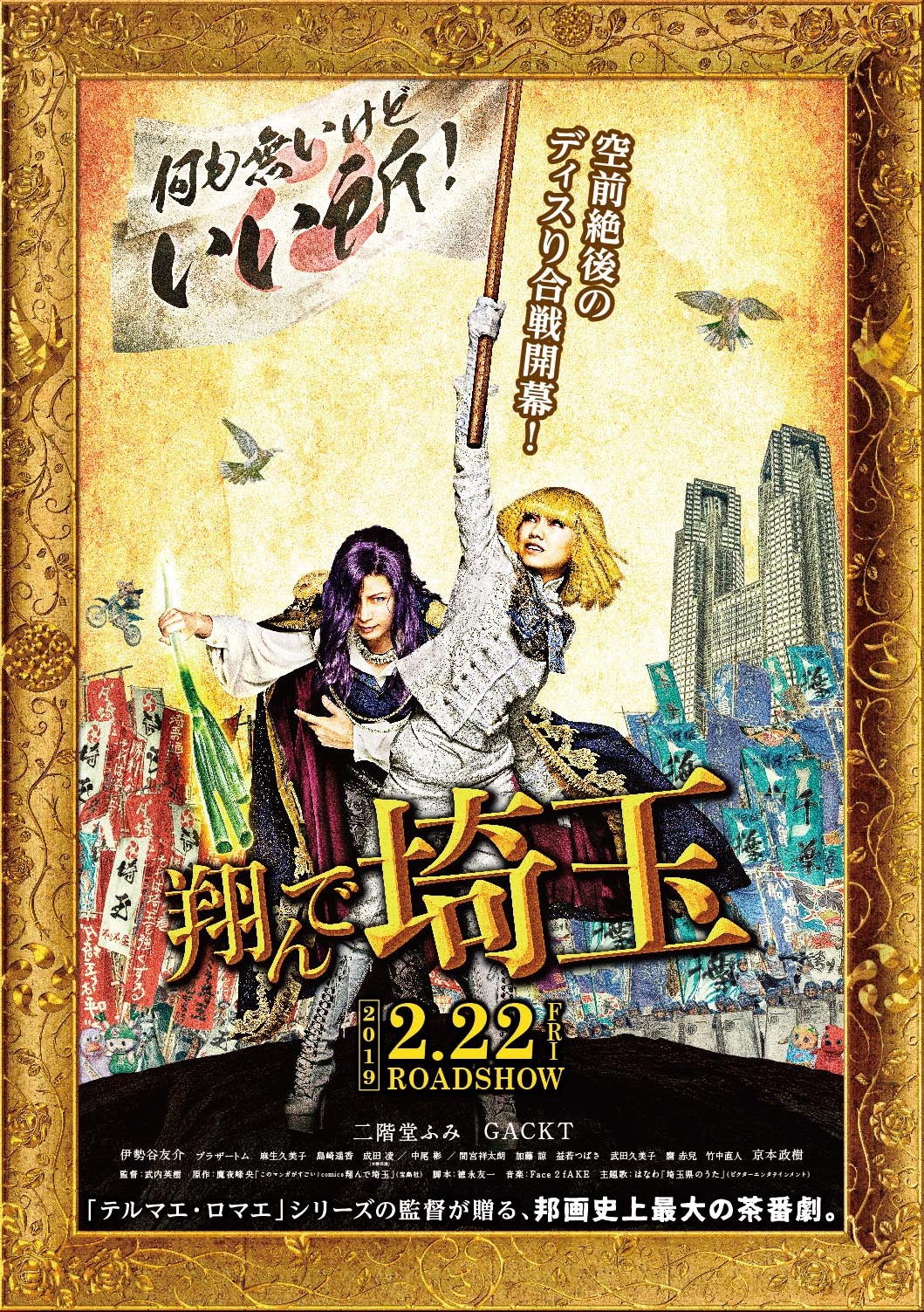
Fly Me To The Saitama -FROM BIWA LAKE WITH LOVE- (翔んで埼玉 ~琵琶湖より愛をこめて~, Hideki Takeuchi, 2023)

The Saitamafication of Japan continues in the long-awaited sequel to the hit 2019 comedy Fly Me to the Saitama. Though the visa system has been abolished and the citizens of Saitama are new free to enter the capital, that does not mean to say everyone is on the same page and the prefecture still faces internal divisions and increasing factionalism. Revolutionary Rei (Gackt) proposes a solution which involves connecting the series of train lines to make it easier to get around and building a beach resort to lesson their sense of inferiority over having no access to the sea.

Once again it has to be said that humour is very local and largely built around regional stereotypes, though it is perhaps curious that the ordinary citizens are often seen in clothing reminiscent of the 1930s something which is also echoed in scenes of trains arriving at stations greeted by crowds of well-wishers seeing soldiers off to war. This may in a sense echo the film’s central theme in the encroachment of Osaka imperialism in which Japan’s second city has launched a not so secret campaign to Osakify the rest of the nation, if not the world, using white powder manifesting as sand from Koshien Baseball Stadium which is a holy place to many as it is where the high school baseball championship takes place. 

They have a visa system in Osaka too, or more strictly the Kansai area, with Kyoto and Kobe apparently in on the plot and intent on looking down on suburban areas such as Wakayama and Shiga which is where Rei was planning on getting his sand. Shiga is set up as a the Saitama of the south west, a pleasant if dull sort of place with a lake its only claim to fame. Like Saitama it has a liberation front, led by Kikyo (Anne Watanabe) who known as the Oscar of Shiga because she went to France to study revolutions and is is dressed like Oscar from the Rose of Versailles. 

The citizens of Kyoto come in for a bit of a kicking for their stereotypically snobbish attitude, the natural politeness of the local dialect undone by a social gadget that reveals what they’re “really” thinking which is that their definition of Kyoite is very narrow. The stereotypical view of Osaka, as voiced towards the end of the film, is that the people are cheerful and warmhearted. The city is associated with comedy and particularly manzai double acts like the one which appears during the opening credits, which perhaps adds to the sense of despair and confusion that the normally nice Osakans could suddenly be hellbent on world domination aided by the already strong love for takoyaki throughout the nation.

As before, we also have a “real world” subplot in which members of a family listen to the radio broadcast outing the urban legend of Rei and his BL love story with Momomi, the Tokyo-raised governor of Saitama. These regional rivalries are tearing up the real world too with a tug of war match that threats to go incredibly wrong if the two areas with an existing beef are allowed to face each other in the final. In contrast, the fantasy world is a riot of zany 18th-century influenced design that sees Rei set off on a pirate ship to get his sand for the fake beach though the mayor of Kobe turns up dressed like Audrey Hepburn in Breakfast at Tiffany’s, and the Kyoto-ite has Taisho-esque straw hat. When the gang are caught by the fascisitic Osakans they’re relegated to a dungeon under Koshien Stadium and enslaved because of Saitama’s low ranking amid the other prefectures of Japan.

It’s all very silly, and somewhat impenetrable to non-Japanese speakers who can’t pick up on the dialect switching or zany wordplay while a certain degree of familiarity with regional stereotypes is certainly helpful. In any case, while the Osakafication of Japan undoubtedly sounded quite bad, the same cannot be said for its Saitamaification and Rei’s desire to create a land without discrimination free of the oppression and inequality born of pointless regional snobbery where everyone is free to go wherever they please without let or hinderance. 


Fly Me To The Saitama -FROM BIWA LAKE WITH LOVE- screened as part of this year’s Nippon Connection

Original trailer (English subtitles)
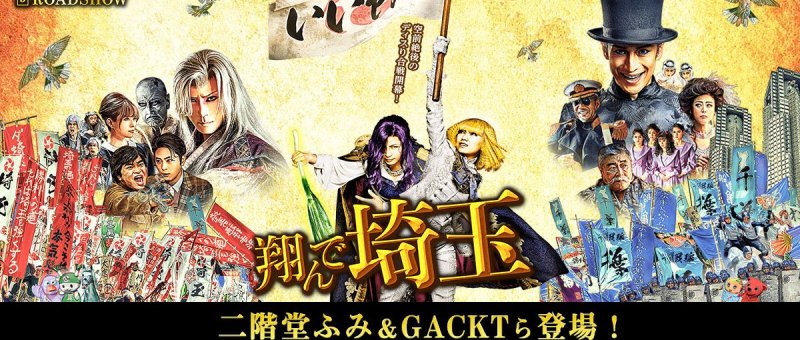
Fly Me to the Saitama (翔んで埼玉, Hideki Takeuchi, 2019)

Fly Me to the Saitama posterThe suburbia vs metropolis divide can be a difficult one to parse though there’s rarely a culture that hasn’t indulged in it. In England, for example, suburbia is to some a byword for quiet respectability, an aspirational sort of village green utopianism built on middle-class success as opposed to frivolous urban sophistication. Then again, city dwellers often look down on those from the surrounding towns as “provincial” or even dare we say it “common”. Saitama, a suburban area close enough to Tokyo to operate as a part of the commuter belt, has long been the butt of many a joke thanks to a quip from an ‘80s comedian which labeled it “Dasaitama” in an amusing bit of wordplay which forever linked it with the word “dasai” which means “naff”.

“Dasaitama” is a label which seems to haunt the protagonists of Hideki Takeuchi’s adaptation of the popular ’80s manga by Mineo Maya. Fly Me to the Saitama (翔んで埼玉, Tonde Saitama) opens in the present day with an ordinary family who are accompanying social climber daughter Aimi (Haruka Shimazaki) to Tokyo for her engagement party. While dad is quietly seething over this perceived slight to his beloved homeland, someone turns on the local radio station which is currently running an item on an “urban legend” about a long ago (well, in the ‘80s) period of oppression in which residents of Saitama (and other neighbouring “uncool” towns) had to get a visa to travel to Tokyo where they were treated as second-class citizens fit only for the jobs regular Tokyoites didn’t want to do and forced to live in hovels (which the snobbish city dwellers somehow thought made them feel more at home). The legend recounts the tale of a brave revolutionary who convinced the Saitamans to rise up, shake off their internalised feelings of inferiority, and reclaim their Saitama pride!

Shifting into an imagined fantasy of 20th century Japan which is in part inspired by warring states factionalism, Fly Me to the Saitama is, in the words of Aimi, a kind of “boys love” pastiche which riffs off everything from The Rose of Versailles to Star Wars while indulging in the (happily) never really forbidden love of mayor’s son Momomi (Fumi Nikaido) who has a girl’s name and feminine appearance but is actually a guy, and the dashing would-be-revolutionary Rei (Gackt) who has just returned from studying abroad in America and inevitably brought back some original ideas about individual freedom and a classless society. Having been born and raised in Tokyo, Momomi has a fully integrated superiority complex which encourages him to look down on Saitamans as lesser humans, almost untouchables, whose very existence is somewhat embarrassing. Only after being humbled, and then kissed, by Rei are his eyes opened to the evils of inequality and the ongoing corruption within his own household.

It goes without saying that much of Fly Me to the Saitama’s humour is extremely local and likely to prove mystifying to those with only rudimentary knowledge of daily life in Japan at least as far as it extends to regional stereotypes and ambivalent feelings towards hometown pride in a nation in which many still find themselves taking care not to let their accent slip after having moved to the capital lest they out themselves as an unsophisticated bumpkin. Yet there is perhaps something universal in its fierce opposition towards ingrained snobberies and petty class hierarchies which pokes fun both at the social climbing small-towners like Aimi desperate to escape the “dasai” countryside for the bright lights of Tokyo, and her proudly “dasai” dad, while asking the hoity-toity Tokyoites to get over themselves, and making a quiet plea for a little peace, love, and understanding along the way.

Then again, the Saitamans may have had a little more than freedom on their minds. If the “Saitamafication” of the world resulted in an expansion of mid-range shopping malls and chain restaurants filled with peaceful, happy people would that really be such a bad thing? Saitama might not be as “exciting” or as “cool” as Tokyo but it’s a nice enough place to live when all’s said and done. Perhaps that’s a frightening thought, but if the Saitama revolution ushers in a brave new world of freedom and equality then who really could argue with that?


Fly Me to the Saitama is screening as the opening night movie of the eighth season of Chicago’s Asian Pop-Up Cinema on March 12 at AMC River East 21, 7pm where director Hideki Takeuchi will be present in person for an introduction and Q&A.

Original trailer (English subtitles)

Nazeka Saitama – a novelty record released in 1981 and somewhat appropriately recorded in a style popular 15 years earlier.