
Kalanchoe (カランコエの花, Shun Nakagawa, 2017)

The truth is, most people genuinely mean well but they often make mistakes. They make them because they don’t think things through, fail to consider perspectives outside of their own, or act on assumptions that they later realise were incorrect (or tragically do not). Most people will come to understand where they went wrong and resolve to do better in future, but you don’t always get a second chance and a momentary lapse in judgement can do untold and sometimes irreparable harm.

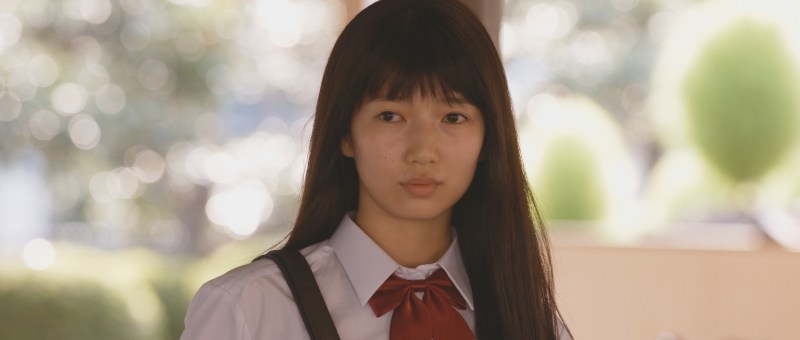
Perhaps that’s just a lesson you learn as a part of growing up, but it doesn’t make it any less painful or indeed shocking at least for the heroine of Shun Nakagawa’s 40-minute mid-length film Kalanchoe (カランコエの花, Kalanchoe no Hana). The film’s title refers to a bright red plant that in the language of flowers means “I will protect you.” But protection can be a double-edged sword, and Tsuki’s (Mio Imada) later attempt to do just that for her friend seriously backfires well meaning though it may have been. The same is true of an ill thought out decision by the school nurse to give a mini lecture on LGBTQ+ issues to Tsuki’s class when their English teacher’s off sick. Because it was only their class that received this talk, some of the students assume it must mean that one of them is gay and begin a kind of witch-hunt trying to figure out who it might be which is completely the opposite of the reaction the talk was supposed to provoke.

Of course, the nurse meant well but it probably should have occurred to her to make sure the class wasn’t singled out and support was available for any students who might be experiencing anxiety surrounding their sexuality or gender identity rather than doing something essentially superficial to make herself feel better. Though most of the students are indifferent to the talk, the class clown bears out the latent homophobia of the current society in badgering the nurse to find out if there are any gay people “or other creeps” in their class while vowing to root them out and making it a kind of game to catch one. The girls, meanwhile, engage in some aggressive heteronormativity talking about boys and pretty much making it impossible for any of them to declare themselves for whatever reason uninterested. 

As it turns out, one student overheard the conversation in the nurse’s office that provoked the talk and knows that one of the students is indeed gay, perhaps inappropriately telling Tsuki who it is in an effort to relieve the burden on herself of carrying this explosive information. When Sakura (Arisa), the student in question, begins to tell Tsuki that she’s gay, Tsuki firstly reacts well patiently waiting rather than admit she already knows though in the end Sakura cannot go through with it despite having said that Tsuki was the person she most wanted to understand. Sakura had admired Tsuki’s red scrunchie that she herself had worried was too bold, prompting her to turn over in her hands and consider it as if thinking over how she intends to react to this information and how she herself may or may not feel.

But on her second opportunity she missteps. Fearing Sakura has been outed, she loudly and clearly says it isn’t true even though she knows it is in a mistaken attempt at “protection” as if she were clearing her name which is also an expression of her own latent belief that it being true is in someway bad. In its way, it echoes the fateful moment in William Wyler’s The Children’s Hour in which Shirley MacLaine tells Audrey Hepburn there’s some truth in the rumour, but Audrey Hepburn tells her she’s lost her mind and though the outcome may not be quite as devastating it’s still a crushing blow with the brutal conclusion implying nothing more than Tsuki will have to live with her bad decision and the pain it caused for the rest of her life. Nakagawa skips between idyllic scenes of the girls on a bike, head gently resting on a shoulder, and scenes of regular high school life but ends on a note of quiet tragedy that feels somehow casually cruel.


Kalanchoe is available to stream via SAKKA from 20th September.
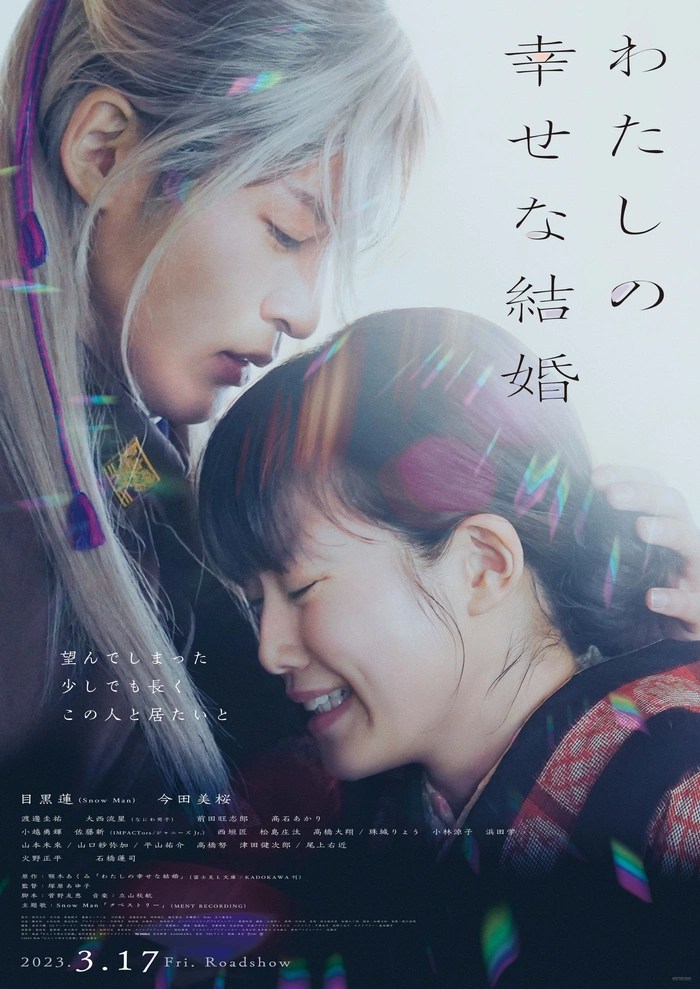
As Long As We Both Shall Live (わたしの幸せな結婚, Ayuko Tsukahara, 2023) [Fantasia 2023]

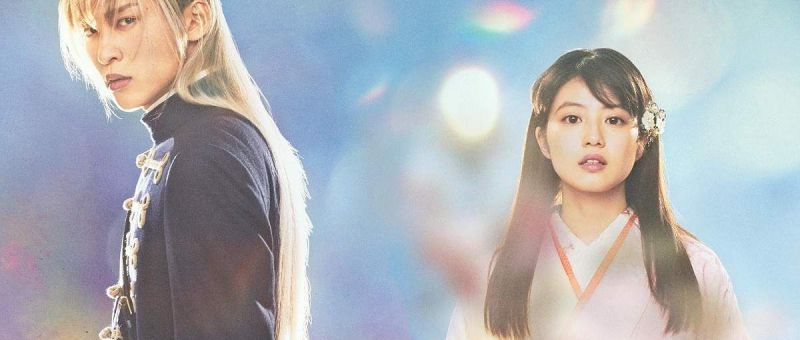
A young woman with chronically low self-esteem learns to love herself after bonding with a taciturn nobleman in Ayuko Tsukahara’s adaptation of the fantasy romance light novel series by Akumi Agitogi, As Long As We Both Shall Live (わたしの幸せな結婚, Watashi no Shiawasena Kekkon). Set in an alternate version of the late 19th/early 20th century in which the nation is ruled by an emperor who has the ability to foresee the future and leads a series of prominent clans of superpowered soldiers against “aberrations” who wreak havoc in the lives ordinary people, the film is effectively a kind of Cinderella story only the fairy godmothers are a kindly housekeeper a shady underground sect with the power to manipulate people’s minds. 

In any case, Miyo (Mio Imada) was born into a noble house the members of which have the ability to manipulate the wind though sadly she appears to have been born “powerless” and is bullied by her step-mother and step-sister who treat her as a servant. At 19, she learns she’s to be married off and is excited about finally escaping her abusive family home but also wary that it might not make much difference because her potential husband, Kiyoka Kudo (Ren Meguro), is said to be cruel and violent. All three of his matches have fled the house in under three days though being so used to mistreatment Miyo is sure that it will just be a matter of adjusting to her new circumstances. 

What she discovers is that Kiyoka doesn’t seem all that bad just a bit aloof and direct in his manner of speech. Nevertheless, she continues to believe that she isn’t good enough to marry him because she doesn’t have any magical powers and is convinced he will call off the engagement when he finds out. Meanwhile, she bonds with housekeeper Yurie (Mirai Yamamoto) after breaking protocol by helping out around the house for something to do though it is perhaps a bit odd that someone from such an apparently wealthy family has only one servant and seems to lead an incredibly simple life devoted to his role as a soldier helping to keep the aberrations in check especially now that the emperor is dying and someone has apparently released the pent up souls of fellow aberration fighters who died horribly and are filled with dangerous resentment.

Many of Miyo’s self-esteem issues are down to the way she was treated by her family and having lost her mother at two years old though there is obviously parallel in her literal “powerlessness” and the lack of agency that is afforded to her in having been kept a prisoner in the family estate only to be traded off in marriage by a father apparently out for whatever he can get for such a “mistake” of a daughter. It’s perhaps a slight failing in the narrative that she turns out to have powers after all rather than simply beginning to accept herself in the comparatively warmer environment of Kiyoka’s home even if it might also be a little awkward that her self-love is born of feeling loved by Kiyoka and to a lesser extent Yurie and immediately has her pledging to give her life for him if only he should ask it. 

For his part, Kiyoka is also undergoing something of a transformation in that it turns out he also felt estranged from his mother and is actually kind at heart just incredibly awkward and taciturn. The reason he didn’t bond with any of his previous suitors seems to be that he objected to their insincerity and the nonsense that goes along with being a member of the aristocracy like the concept of arranged marriage in itself, later taking Miyo’s family to task for their treatment of her claiming that he doesn’t really care about her social status or whether or not she has any powers. In any case, it’s love that helps her overcome her “powerlessness” even if she uses her newfound inner strength for someone else rather than herself, taking control over and her life regaining self-confidence as someone worthy of love, respect, and basic human decency not to mention happiness. A post-credits trail hints at a potential sequel or even series expanding on the franchise’s rich world building but for now at least it seems as if Miyo has found her happy ending, finally able to embrace life on her own terms rather than feeling as if she needs to make a mends for her existence.


As Long As We Both Shall Live screened as part of this year’s Fantasia International Film Festival.

Original trailer (no subtitles)

Tokyo Revengers (東京リベンジャーズ, Tsutomu Hanabusa, 2021) [Fantasia 2021]

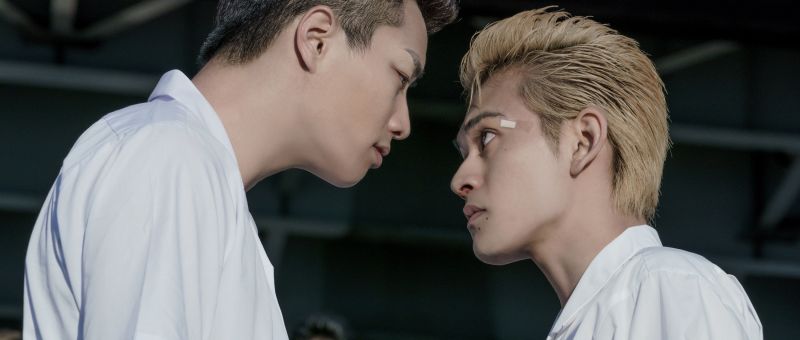
“You don’t deserve to change my life” the hero of Tsutomu Hanabusa’s adaptation of Ken Wakui’s manga Tokyo Revengers (東京リベンジャーズ) eventually affirms in finally facing his fears while trying to change destiny not least his own. In contrast to its original meaning in English, the wasei eigo “Revenge” usually means not payback but “rematch” or at least a second chance to prove oneself or make up for a past mistake. Through his time travel shenanigans, this is perhaps what young Takemichi (Takumi Kitamura) is attempting to do in revisiting the events which he feels ruined his life and left him a useless coward too cowed to offer much resistance to his continual degradation. 

Now 27, Takemichi lives in a rundown, untidy apartment and works part-time in a bookstore where his boss inappropriately mocks for him for still being a virgin, the kind of guy who peaked in high school and can’t move on from adolescent bravado. He might have a point in a sense in that Takemichi is indeed arrested but hearing on the news one day that his first love Hinata (Mio Imada) has been killed in a car accident supposedly caused by the Tokyo Manji gang alongside her brother Naoto (Yosuke Sugino), he finds himself thinking back to his school days. It’s at this point that someone shoves him off a train platform and, facing certain death, he suddenly finds himself in the body of his 17-year-old, bleach blond delinquent self. Takemichi assumes it’s a near death flashback, but later wakes up back in the present and realises that his actions in the past have consequences in the future. 

Quite clearly taking its cues from classic high school delinquent manga in which moody high school boys vie for the top spot through relentless violence, Tokyo Revengers nevertheless undercuts the genre’s macho posturing in firstly having Takemichi broken by his first defeat and then allowing him to reclaim his space as a hero through his determination to care for and protect others even if his final victory is in facing the man he held responsible for shattering his sense of self. Sent back into the past to prevent the Tokyo Manji Gang from ever forming, Takemichi refuses the obvious early solution but remains conflicted in realising that at its inception “Toman” saw itself as a compassionate force for good, a far cry from the nihilistic violence it now brings to the city. Rather than more violence, he finds a solution in its reverse, safeguarding relationships and preventing heartbreak in order to ensure no one else’s soul is corrupted by grief or loneliness. 

Takemichi feels himself powerless but is valued by his friends for his determination to protect others no matter the cost to himself, as he unwittingly proves through his time travel adventures attempting to save himself as much as Hinata by restoring his sense of self apparently shattered by his subjugation at the hands of a rival gang back back in high school. At 27 he’s a meek and broken man, forever apologising for his existence and living an unfulfilling life always running away from challenge or difficulty. Given an improbable second chance, he begins to find the courage to do it all differently with the benefit of hindsight and the stability of age, finally facing his teenage trauma as a fully adult man.  

Like any good delinquent movie, Hanabusa makes space for more than a few mass brawls along with intensely personal one-on-one battles drawing a direct line between high school violence and street war thuggery. “Thugs aren’t cool anymore” Toman leader Mikey (Ryo Yoshizawa) had explained, his compassionate second in command Kenchin (Yuki Yamada) reminding him to “have a heart” in keeping gang violence within the confines of their society and refraining from injuring innocent people. Toman aren’t yakuza, but they are perhaps the inheritors of jingi, or at least would be if left untouched by trauma and betrayal. In beating his own trauma, Takemichi undoes his destiny saving his friends and himself by learning to embrace his inner strength and refusing to back down in the face of intimidation. Part high school delinquent manga, part time travel adventure, Hanabusa’s sci-fi-inflected drama swaps macho posturing for a more contemplative take on the weight of past mistakes while giving its hero a second chance to be the kind of man he always thought himself to be.


Tokyo Revengers screened as part of this year’s Fantasia International Film Festival.

Original trailer (English subtitles)