The Pit of Death (怪談おとし穴, Koji Shima, 1968)

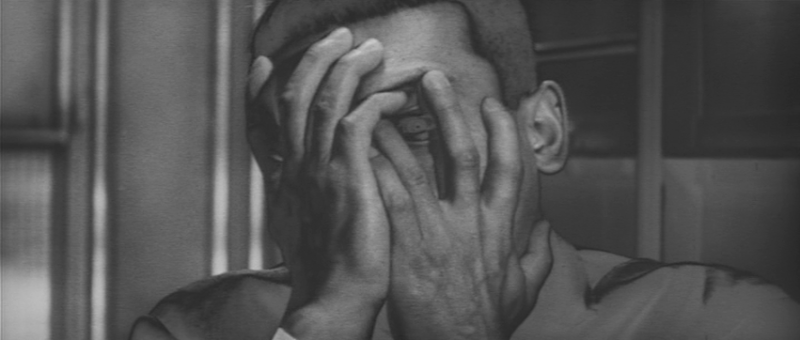
The building at the centre of Koji Shima’s dread-fuelled horror noir Pit of Death (怪談おとし穴, Kaidan Otoshi Ana) is said to be haunted by the spirits of the many people who died during its construction. In his opening voiceover, anti-hero Kuramoto (Mikio Narita) likens the city to a hornet’s nest, the salaryman drones mindlessly buzzing around the business district as if driven by some supernatural force. In that sense, the office building itself becomes an eerie place, the nexus of the salaryman dream which in the end drags all to hell. 

Largely a retelling of Yotsuya Kaidan for the mid-20th century with a little A Place in the Sun thrown in, the film finds Kuramoto an ambitious man deluded by consumerism and resentful of the classism and snobbishness which limit his prospects as a man who has otherwise been able to pull himself out of poverty. His boss pointedly speaks of his talents which include the ability to speak several languages despite only having attended night school rather than university while it’s unusual for a man of his background to hold this kind of position even if he’s only a secretary and not yet an executive. Nevertheless, his boss clearly sees him as a potential successor and plans to marry him to his daughter (Mako Sanjo) who has in some ways inexplicably developed a crush on him.

But Kuramoto is already in a relationship with typist Etsuko (Mayumi Nagisa). In fact, the reason the boss is so pleased with him is largely down to her in that he asked Etsuko to sleep with their foreign client, Mr Hancock, to seal the deal which she duly did. Kuramoto plans to throw her over in order to pursue his dream of taking over the company so he can look down on those who once looked down on him. He tells Etsuko that the marriage will be in name only, that he isn’t attracted to the boss’ daughter Midori, and their relationship will continue as before only to be confused when Etsuko is not totally on board with the plan. She tells him she’s pregnant with his child though he callously points out it could be Hancock’s and insists on an abortion thereafter determining he must kill her so that he can fulfil his destiny by joining the executive class. 

His desires are obvious when he steps into Midori’s home and gazes at a painting crassly asking how much it’s worth, admitting that he’s the kind of poor person who has a fascination with luxury. His forward propulsion is driven by a fear of poverty, the trauma of the hard life he’s had and the futility he felt in his inability to escape it. Yet it’s also a kind of class rebellion motivated by resentment for the prejudice held against him as a man without means in a highly stratified society. Paradoxically, he will do anything and everything to be accepted as a member of the elite class including murdering Etsuko, the symbol of the working class past he fears will drag him down.

Etsuko does indeed drag him down eventually in her own revenge against his callousness and the double standards of a patriarchal society. Her relationship with Kuramoto seems to be a secret in the office while he uses and discards her when no longer useful to him. She too is trapped within this building of a newly corporatised society but can rise no further alone and is in a fairly bleak position without Kuramoto for she has already thrown away her only bargaining chip by entering a sexual relationship with him. Should she attempt to raise his child alone as a never married single mother, her life would be very difficult indeed if not actually impossible. Nevertheless, she does have real power over Kuramoto in her ability to expose the affair and ruin his chances of career advancement through dynastic marriage destroying any possibility of his future success. 

In Kuramoto’s mind, Etsuko cackles like a witch or evil spirit. Her hair billows out into the wind like a vengeful ghost, though the first few times Kuramoto only imagines her death. He sees himself push her off a roof, only to be surprised to see her still standing over him. Etsuko haunts Kuramoto while alive as an image of his destruction all while he silently plots hers. He plans to use the building against her, hiding her body inside it where he assumes no one will see. In the end, it’s as if this building, an edifice of soulless corporatising capitalism, consumes them both, drawing them in with their unfulfilled desires until they fall into the bottomless pit of post-war ambition. Shima makes frequent use of solarisation and film noir lighting to destabilise Kuramoto’s world as his mental state starts to fracture along with innovative use of split screens to lend the space a sense of eerie continuity but ultimately posits the salaryman society as a kind of death trap beckoning greedy souls towards their demise with an inexorable fatalism.
Being Two Isn’t Easy (私は二歳, Kon Ichikawa, 1962)

With the Olympics still two years away, the Japanese economy had begun to improve by 1962 and the salaryman dream was on the horizon for all. But for young couples trying to make it in the post-war society things were perhaps far from easy and having more to want coupled with the anxieties of a newly consumerist society only left them with additional burdens. A surprisingly moving evocation of the cycle of life, Kon Ichikawa’s Being Two Isn’t Easy (私は二歳, Watashi wa Nisai) is as much about the trials and tribulations of its toddler hero’s parents as they try to navigate their new roles in a world which now seems fraught with potential dangers. 

This difference in perspective is brought home in the opening sequence in which soon-to-be two Taro (Hiro Suzuki) recalls his own birth in a slightly creepy voiceover, lamenting his mother cooing over him excited that he is smiling for her though he is not yet able to focus and has no idea the vague shadow above him is his mother or even what a mother is. His smiling is simply involuntary muscle contraction as he learns how to manipulate his body. Nevertheless, little Taro is a definite handful taxing his poor mother Chiyo (Fujiko Yamamoto) with frequent attempts to escape, managing to get out of the apartment and start climbing the stairs the instant she’s turned her back. “Always finding fault, that’s why grown-ups are unhappy” Taro complains, irritated that even though he’s quite proud of himself for figuring out not only how to undo the screws on his playpen but the string his parents had tied around it for extra protection, he’s not received any praise or congratulation and it feels like they’re annoyed with him. 

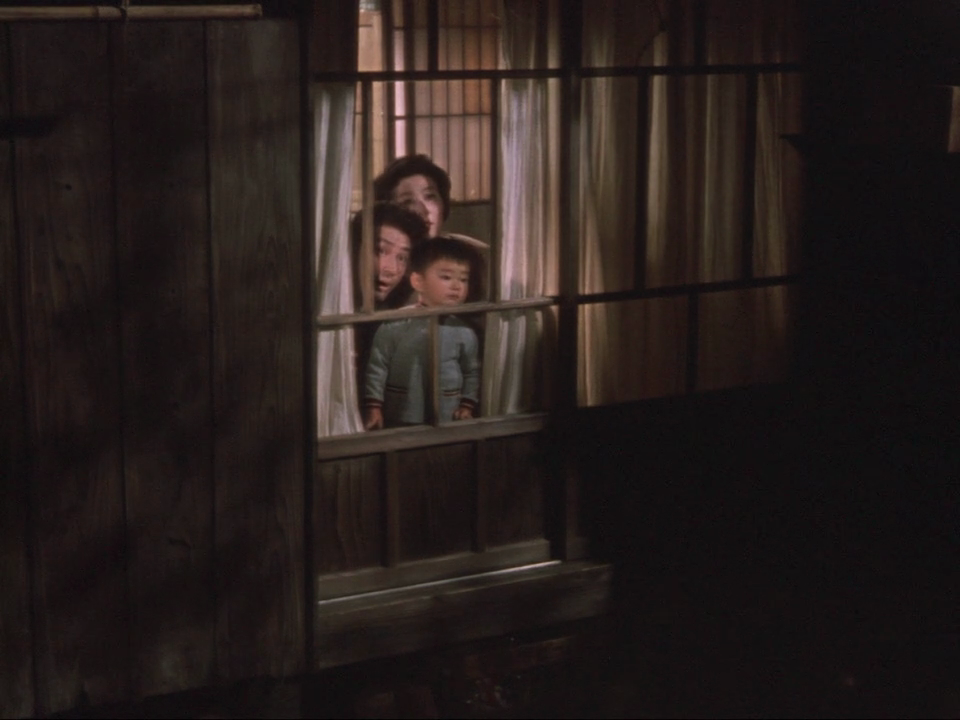
The landlord alerted by the commotion somewhat ironically remarks that “Japanese houses are best for Japanese babies” (being at least usually all on one level even if they also sometimes have their share of dangerously precipitous staircases), implicitly criticising the new high rise society. There do indeed seem to be dangers everywhere. Another baby playing on the balcony eventually falls because the screws are rusty on the railings only to be caught by a passing milkman in what seems to be an ironic nod to the film’s strange fascination with the new craze in cow’s milk to which Taro’s father Goro (Eiji Funakoshi) attributes Westerners’ ability to grow up big and strong. Taro does seem to get sick a lot, the doctor more or less implying that his sickliness is in part transferred anxiety from an overabundance of parental love. Visited by her older sister who lives on a farm in the country and has eight children, Chiyo becomes broody for a second baby (though not another six!) but Goro isn’t so sure, not just because of the additional expense or the fact that their danchi apartment is already cramped with the two of them and a toddler, but reflecting that he already lives in a world of constant fear why would you want to double it worrying about two kids instead of one?

Nevertheless, Goro is certainly a very “modern” man. He helps out with the housework and is an active father, taking on his share of the childcare responsibilities and very invested in his son. He accepts that his wife also “works” even if he also insists it’s not the same because she doesn’t have to bow to Taro and is not subject to the petty humiliations of the salaryman life. Tellingly, this changes slightly when the couple end up leaving the danchi for a traditional Japanese home to move in with Goro’s mother after his brother gets a job transfer. Grandma (Kumeko Urabe) is actively opposed to him helping out around the house, viewing it as distasteful and unmanly not to say a black mark against Chiyo for supposedly not proving up to her wifely duties. Living with Grandma also introduces a maternal power struggle under the older woman’s my house my rules policy which extends to criticising Chiyo’s parenting philosophy not to mention refusing to trust “modern technology” by insisting on rewashing everything that’s been through the washing machine by hand.

Yet when Taro becomes sick again it’s perhaps Grandma who has a surprisingly consumerist view of medical care. Exasperated by the couple’s failure to get Taro to take his medicine she offends the doctor by insisting on him having an injection as if you haven’t really been treated without one. Eventually she takes him to another clinic where they get on a conveyor belt of doctoring, rushed through from a disinterested receptionist to a physician who yells “bronchitis” to a nurse who violently sticks the baby in the arm. After that Taro vows never to trust grown-ups, though Grandma only gives in when she realises injections are not an instacure and didn’t do any good. 

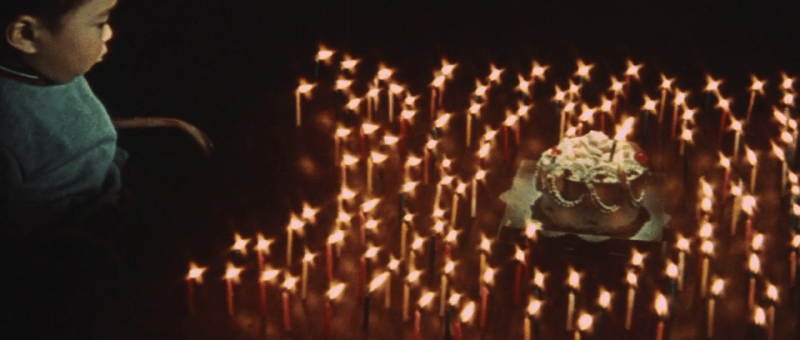
For all that however there’s a poignancy in Taro’s reflecting on his birthday cake with its two candles that Grandma’s must have many more and in fact be brighter than the moon with which he has a strange fascination. He’s just turning two. He used to be a baby but now he’s a big boy and soon he’ll be a man. Goro reflects on time passing, for the moment he’s a father but might be a grandad soon enough. The wheel keeps turning which perhaps puts the hire purchase fees on the TV he bought to keep Grandma occupied and out of the way into perspective. From the experimental opening to the occasional flashes of animation and that banana moon, Ichikawa paints a whimsical picture of the post-war world as seen through the eyes of a wise child but ironically finds a wealth of warmth and comfort even in an age of anxiety.


Her Brother (おとうと, Kon Ichikawa, 1960)

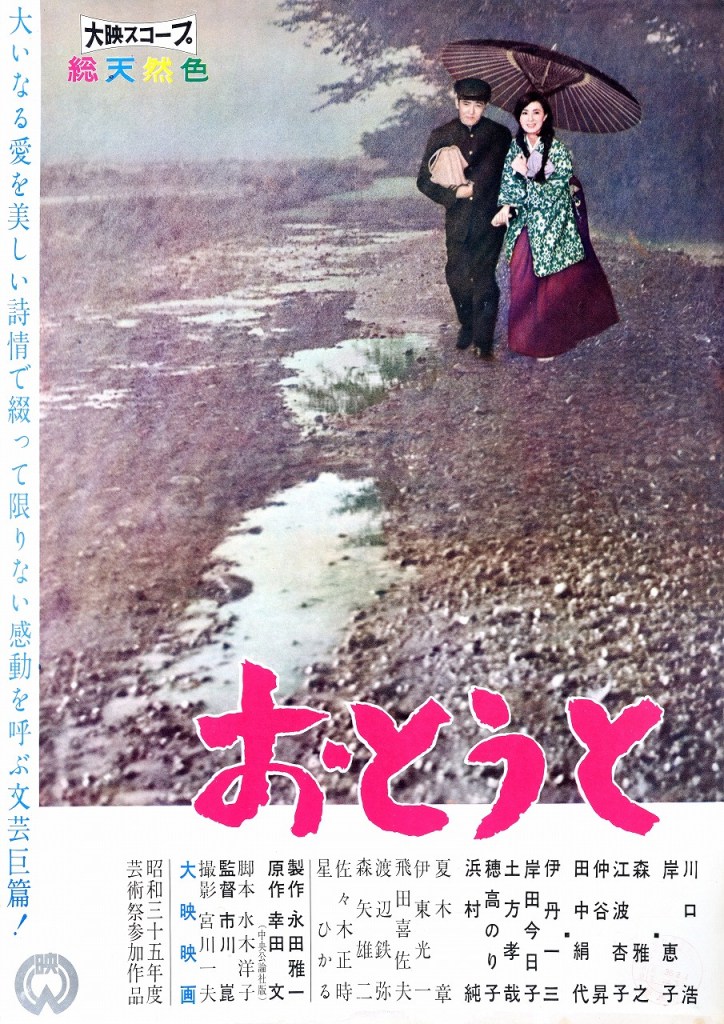
ototoPerhaps oddly for a director of his generation, Kon Ichikawa is not particularly known for family drama yet his 1960 effort, Her Brother (おとうと, Ototo), draws strongly on this genre albeit with Ichikawa’s trademark irony. A Taisho era tale based on an autobiographically inspired novel by Aya Koda, Her Brother is the story of a sister’s unconditional love but also of a woman who is, in some ways, forced to sacrifice herself for her family precisely because of their ongoing emotional neglect.

Oldest daughter Gen (Keiko Kishi) is still in school though she’s more or less running the household seeing as her invalid step-mother (Kinuyo Tanaka) spends most of her time bedridden with rheumatism and the rest of it pontificating about religion and listening to her poisonous friend (Kyoko Kishida) who likes to stir up trouble in this already difficult family environment. Gen’s father (Masayuki Mori) is a well known writer who needs a lot of quiet time for his work. As fathers go he’s very laid back and content to think his kids will be OK because they’re his kids, which isn’t to say he doesn’t care but he’s not exactly present most of the time. It’s no surprise then that care of the family’s youngest, Hekiro (Hiroshi Kawaguchi), has largely fallen to his sister. Where Gen is naturally responsible and practically minded, Hekiro is reckless and always in search of adventure. Eventually this lands him in trouble when he gets involved with a bad crowd but whatever his family might have been feeling towards him, everything changes once they discover that he’s facing a serious illness.

Because of the family’s odd arrangement, Gen has become almost a maternal figure towards Hekiro despite only being a couple of years older than he is. In fact, the pair have an almost comically childish physical fight at one point which is quite undignified considering their ages, especially when it involves staining their tatami mat floor with a puddle of bright red ink. Gen does her best but like her father she more often than not lets Hekiro off the hook by bailing him out, much of the time with her own rather than her father’s money. Not having the kind of authority a parent, uncle, or aunt might have all she can really do is ask him to think about behaving better, but Hekiro constantly pushes the boundaries to get a more concrete form of attention than his sister’s well meaning attempts to help are able to provide.

Hekiro’s stunts  eventually threaten to pull his sister into his darkening world, especially when a man claiming to be a detective starts more or less stalking Gen before pulling her into a shrine on the pretext of talking about her brother’s case before trying to have his wicked way with her. Luckily Gen is saved by a flock of geese cunningly released by some of her brother’s friends which gives her enough time to escape and finally get rid of the odious little man.

Similarly, Hekiro deliberately introduces his sister to the local pool hall. Though Gen seems to enjoy the game and is even good at it, she quickly realises she’s been brought as a sort of guarantor for her brother’s mounting debts. Add in other expensive and dangerous hobbies like his boat habit (he can’t swim) and it’s not surprising everyone’s had enough of Hekiro before he’s even left school. When he has an accident which results in the death of a horse (again, very expensive), it does at least lead him to reflect on the negative effect his actions can have on those around him, even if all he wanted and continues to want is an escape from his boring and miserable family life.

Even Hekiro’s illness fails to arouse very much in the way of concern from his well meaning father and grumpy step-mother who is hellbent on marrying Gen off against her wishes. Gen is, again, the only one to nurse Hekiro in hospital, managing the household as well as looking after her brother on his sickbed. When the illness becomes more serious it provides a last opportunity for the family members to bond and make amends for the various ways they’ve failed each other. The step-mother’s visit is not as altruistic as it seems when it transpires she’s only really come to “convert” Hekiro to her religion, but she begins to feel something more for him on believing that Jesus has already saved him thanks to his outwardly calm and polite manner. The final irony is that the idealised family is only born as it is destroyed, Gen puts her pinny back on and takes the reins from her stepmother who is presumably headed straight back to bed.

Gen’s devotion can’t save her brother either from himself or his fate and it may even be the end of her too. Vowing never to marry and rising from her own sickbed stopping only to instruct her stepmother to rest, she’s very clearly chosen her path even if Ichikawa’s camera and musical cues seem to find the ironic comedy of the situation rather than the sadness of her possibly tragic plight. Ichikawa and his cinematographer invented a whole new technique for this picture – the bleach bypass, which appropriately robs the environment of its vibrancy, dulling even bright colours with a sort of heavy leaded effect perfectly reflecting Hekiro’s increasingly depressed mindset as he reflects on being someone who has no firm anchor or place to feel at home. A strange, comically melancholic piece, Her Brother is a characteristically sideways swipe at the family drama from the master of irony though one which does not altogether escape his taste for the sentimental.


Original trailer (not subtitles)