Straying (猫は逃げた, Rikiya Imaizumi, 2021)

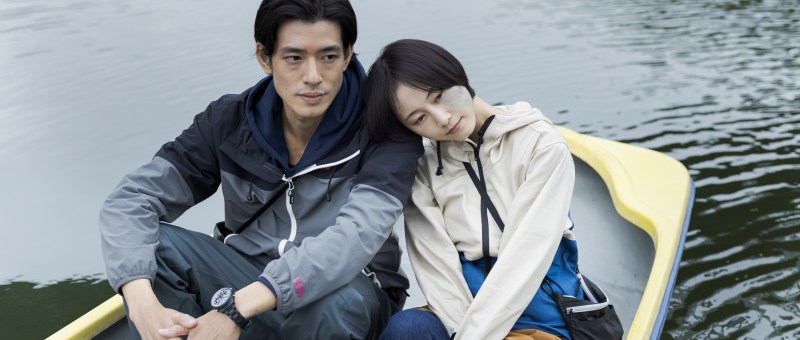
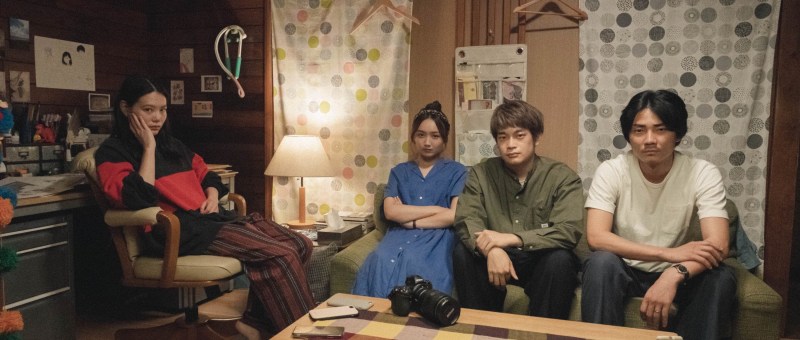
Part way through Rikiya Imaizumi’s Straying (猫は逃げた, Neko wa Nigeta), a tabloid reporter and the photographer with whom he’s been having an affair attend a screening of a pretentious film made by a hypocritical director exploring why a once loving relationship between husband and wife broke down. His reasoning may not be all that sound in the end, but does perhaps hint at something of the malaise which has invaded the relationship between Hiro (Katsuya Maiguma) and his wife of five years Ako (Nairu Yamamoto). Now on the brink of divorce, the couple have hit a stumbling block in the inability to agree who gets custody of their beloved cat, Kenta. 

Kenta may not be all that happy about the separation either, peeing all over the divorce papers which only Ako has so far stamped. Hiro suggests that they’re going about it in the wrong order, that the papers should have been the final step once they’d sorted out dividing their property and finding alternative living spaces but he is perhaps a little reluctant as his determination to hang on to Kanta implies. A kitten they found together in the street in the midst of a pregnancy scare, Kanta is a symbol of their love and the hopes they had for it in the beginning. When he suddenly disappears, it sends each of the couple into a tailspin trying to find him which is also an attempt to recapture their lost love. 

Yet we can see that the marriage has failed in part because of dissatisfaction in either on side. As he later admits, Hiro was always insecure in the relationship and had been planning to run out on Ako after hearing about the possible pregnancy while overcome with paternal anxiety. He once dreamed of being a novelist and hates himself for his morally dubious job as a tabloid journalist exposing the sordid secrets of the rich and famous, yet he does the job in part because he feels emasculated by Ako’s success as a manga artist and cannot bear the idea of being supported by his wife. For her part, Ako declares that she’s bored with eroticism while working on an erotic manga for a publishing company specialising in sexually explicit series aimed at a female audience. When she says she’s thinking of writing a cat manga, like the much loved Gugu the Cat, it suggests that what she wants is love rather than sex but she’s also begun a revenge affair with her besotted editor Matsuyama (Kai Inowaki) little realising that she’s toying with his feelings. 

Like Matsuyama, Hiro’s girlfriend Mamiko (Miyuu Teshima) is more emotionally involved in the relationship than Hiro is though he sadly tells her he loves her and has superficially committed to leaving his wife. Mamiko also has a habit of eating Haribo at every opportunity which hints at her childish nature, though as is later revealed she’s surprisingly conservative for her age coldly telling Ako in a final confrontation that wives are responsible for their husband’s affairs while insisting Ako let Hiro go because she wants to become a traditional homemaker cooking and cleaning for him. She was also offended by the film because of its anti-marriage stance all which fuels her desire to unmask the “devoted familyman” director as just another industry sleazeball. Yet evidently the last thing Hiro wants is marriage because if that’s what he wanted he wouldn’t be getting a divorce. It’s no surprise that he put his foot down over getting Kanta neutered, insisting he be free to sow wild oats wherever he sees fit which is apparently with next-door’s cat Mimi who becomes an accidental victim of his sudden disappearance. 

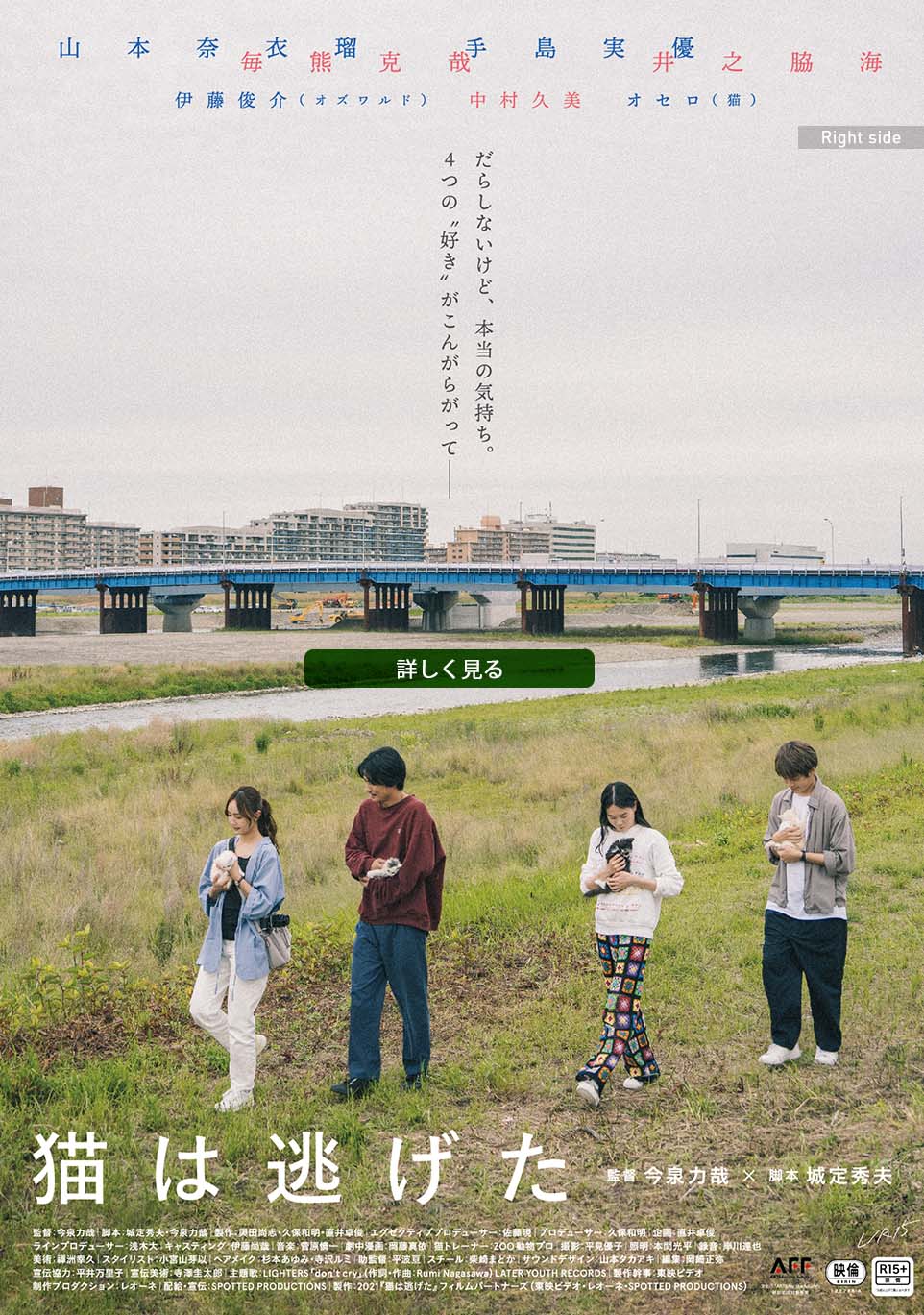
Yet sometimes straying only shows you the way home as the central couple awkwardly discover, brought closer together by the search for Kanta while forced to face the realities of their frustrated desires each emerging on a more authentic note and resolving to chase their individual dreams. The second film in the L/R15 project of contemporary sex comedies, Straying is scripted by Hideo Jojo who directed Imaizumi’s script for Love Nonetheless and in its ironic conclusion is perhaps less cynical than it might seem in hinting at new beginnings founded less on forgiveness than acceptance of life’s imperfections. 


Straying screened as part of this year’s Camera Japan

Original trailer (no subtitles)

The Nighthawk’s First Love (よだかの片想い, Yuka Yasukawa, 2021)

A young woman begins to regain a sense of self-confidence in the face of social prejudice when invited to consult on a film in Yuka Yasukawa’s adaptation of the Rio Shimamoto novel, The Nighthawk’s First Love (よだかの片想い, Yodaka no Kataomoi). Drawing inspiration from a Kenji Miyazawa story about an ostracised nighthawk bullied by a hawk who cannot accept that they are the same because he finds the nighthawk’s difference offensive, Yasukawa’s gentle drama is less about the transformational quality of love than it is about learning to accept oneself as distinct from the self that others see. 

A shy young woman, Aiko (Rena Matsui) keeps a distance with others because of a longterm sense of rejection owing to a prominent birthmark on her face. After agreeing to be interviewed for a book about people living with facial difference and disfigurement, Aiko is approached by filmmaker Tobisaka (Ayumu Nakajima) who just happened to chance on their photoshoot and was struck by what he describes as a quiet sense of strength in her reserve. Though Aiko is not originally keen on the idea of having someone turn her life into a film, she soon begins to bond with Tobisaka who does not appear to react to her birthmark and eventually embarks on a romance only to find herself insecure in his continuing attachment to a former muse and dedication to his craft. 

While visiting her publisher, Marie (Lisa Oda), Aiko encounters a curious little girl who touches her own face and bluntly asks Aiko if the bruise-like mark on her cheek hurts. Aiko answers patiently that it doesn’t and isn’t offended by the little girl’s question, but perhaps is by the mother’s reaction as she stares and wonders what to say before apologising for her daughter’s rudeness but not for her own. Aiko recounts something similar in recalling her childhood bullying in which the kids in her class nicknamed her “Lake Biwa” because the mark on her face resembled the famous landmark which they were learning about in school. Though they were being cruel to her, Aiko remembers that a part of her enjoyed the attention while the teacher’s attempt to shut her classmates down was in a way more painful as if it were the birthmark itself which was “horrible” rather than the kids’ comments. After that the other children began to avoid her, unsure what to say and perhaps blaming her for having gotten into trouble with the teacher. She explains that she worries people often drift away from her in part because of the birthmark itself and in part because of the way it influences her behaviour generating a vicious cycle of doubt, rejection, and loneliness. Tobisaka’s muse, Miwa (Miyuu Teshima), looks very much like her only without the birthmark and Aiko worries if she can keep him while fearing in her insecurity that their relationship is nothing but a long con designed to get her to agree to participating in the film. 

Yasukawa often frames Aiko looking into mirrors, at one point a reflection of her face appearing next to that of Miwa in her makeup on a poster for the film. Tobisaka gives her a compact mirror as a gift that he possibly intends to help her see herself though perhaps as he sees her, while she remains internally conflicted insistent that there’s nothing wrong with having a birthmark but carrying a degree of internalised shame and wondering if her life would be different without it. It’s another compact given to her by a similarly troubled friend that later grants her agency in realising that she does have a choice in displaying her birthmark or not even if deciding that she might not want to have it removed after discovering that it may be medically possible. Her supervisor advises her that attempting to become a different person in the pursuit of growth is nothing but a fantasy while she gradually comes to the realisation that change is not quite not quite what she’s looking for, quite literally freeing herself from her self-imposed imprisonment to embrace her authentic self. Her growth lies not simply in being loved by a man who may in a way be exploiting her, but in truly seeing herself and others for the first time. An elegantly lensed tale of self-acceptance, Yaskukawa’s gentle drama allows its diffident heroine the space to grow while becoming more rather than less of herself in defiance of a social prejudice that is all to often routed in the same insecurity she has now escaped.


The Nighthawk’s First Love screens at Japan Society New York on Nov. 13 as part of The Female Gaze: Women Filmmakers from JAPAN CUTS and Beyond.

Original trailer (no subtitles)

My Sorry Life (愛のくだらない, Kozue Nomoto, 2020)

A dejected, self-involved TV producer is forced into a moment of introspection when dealing with relationship breakdown and career setback in Kozue Nomoto’s ironic character study My Sorry Life (愛のくだらない, Ai no Kudaranai). Examining a number of social issues from women in the workplace to attitudes to LGBTQ+ people in contemporary Japan, Nomoto’s unflinching drama never lets its abrasive heroine off the hook even as she begins to realise that her own less than admirable behaviour has contributed to her present sense of despair and impossibility. 

Kei (Maki Fujiwara) has been in a relationship with former comedian Yoshi (Akiyoshi Okayasu) for the last five years, but it’s clear that she is beginning to tire of him. The couple are supposedly trying for a baby, but Kei has been taking contraceptive medicine behind Yoshi’s back while complaining that she doesn’t understand why he insists on getting pregnant before getting married when he hasn’t even met her parents. At work meanwhile she’s beginning to feel left behind, secretly jealous when a slightly younger female colleague reveals she’s been promoted to become the lead producer on a variety show and a little resentful when her idea for a programme focusing on the lives of ordinary people as opposed to celebrities is turned down by her bosses. The idea does however bring her to the attention of indie exec Kinjo (Takuma Nagao) who wants to bring her on board to produce a web series he’s about to launch along the same lines. And then, Yoshi drops the bombshell that he thinks he’s pregnant which is, to say the least, unexpected. 

Yoshi’s surprise announcement signals in a sense a reversal of traditional gender roles within their relationship with the man the nester and woman reluctant commitmentphobe. Kei is also the main financial provider, but on some level both resents and looks down on Yoshi for his lack of conventional masculinity having given up his comedy career to work part-time in a supermarket, obsessing over discount produce like the pettiest of housewives but often indulging in false economies such as reduced price yet still extravagant sake. Strangely, Kei goes along with Yoshi’s delusion taking him to a fertility clinic where she assumes they’ll set him straight but thereafter begins staying with a friend who ironically has an infant child and may be experiencing some difficulties in her marriage to which Kei remains entirely oblivious. 

Despite her journalistic desire to witness everyday stories, Kei is often blind to those around her never stopping to wonder if Yoshi is trying to tell her something through his bizarre pregnancy delusion or if her friend might need someone to talk to. She does something similar on spotting the office courier (Yukino Murakami) whom many of the ladies have a crush on using the ladies’ bathroom. Assuming the delivery guy is a lesbian she asks him about coming on the webshow, becoming even more excited when he explains that he’s a transman after inviting Kei to an LGBTQ+ friendly bar where he works part-time. Kei doesn’t realise that her throwaway comment that “that sort of thing is popular now” hurts Shiori’s feelings and leaves him feeling exploited as much as he would like to appear on the programme to raise awareness about LGBTQ+ issues. 

For her part, Kei is obviously not homophobic but does undoubtedly treat Shiori and his friends with a degree of exoticism, declaring that she’s never met anyone like them before while staring wide eyed in wonder as if these concepts are entirely new to her. Kinjo, the producer of the web series, is squeamish when Kei raises the idea, introducing her to a male scriptwriter who obviously already has his own concepts in mind, rudely ignoring Kei’s input while dismissively allowing his drink to drip on her proposal. The studio turn the idea down on the grounds that LGBTQ+ topics are “inappropriate” because there may be children watching and parents won’t want to explain words like “gay” or “lesbian” to their kids. Kei is rightly outraged, but she’s also a hypocrite because her intentions were essentially exploitative and self-interested. She wasn’t interested in furthering LGBTQ+ rights, she just wanted to chase ratings. 

Kinjo dresses up his personal distaste as a dictate from above but it’s clear that he doesn’t really value Kei’s input and continues to treat her poorly for the entirety of the project, blaming her for everything that goes wrong and expecting her to fix it on her own. There’s even an awful moment when Kei’s friend Tsubaki (Sayaka Hashimoto) shows up with her baby and one suspects they may be about to rope her in as a replacement guest, but the result is even worse as Kinjo stares into the pushchair and then throws the pair out while embarrassing Kei in the process. 

“Being busy’s no excuse for being unreliable” Tsubaki sympathetically tells her though it takes a few more setbacks before Kei begins to realise that she’s been unfair and to be honest generally unpleasant to those those around her. Feeling inferior, she makes a point of bumping into an elderly male janitor, treating him with contempt even when he stops to try and help her after she collapses in the office. Only through an ironic moment of emotional honesty which allows her to come to an understanding of her relationships does Kei begin to piece things together, reflect on her own mistakes and anxieties, and realise what it is she really wants. A contemplative reconsideration of accepted gender norms, Nomoto’s gently humorous drama never lets its heroine off the hook but does allow her to find new direction if only through confronting herself and the world in which she lives. 


My Sorry Life streams in the US until Sept. 2 as part of this year’s Japan Cuts.

Original trailer (English subtitles)