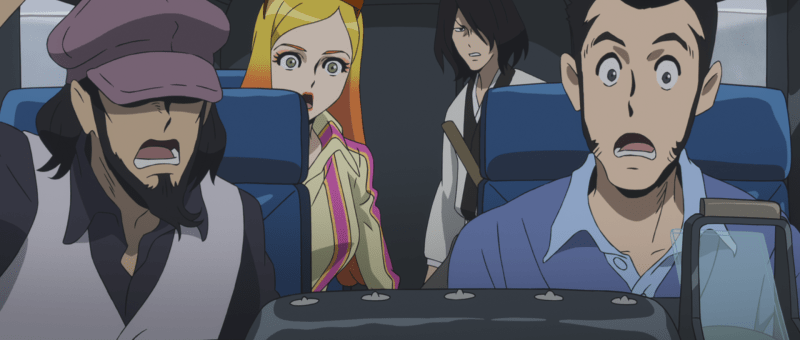
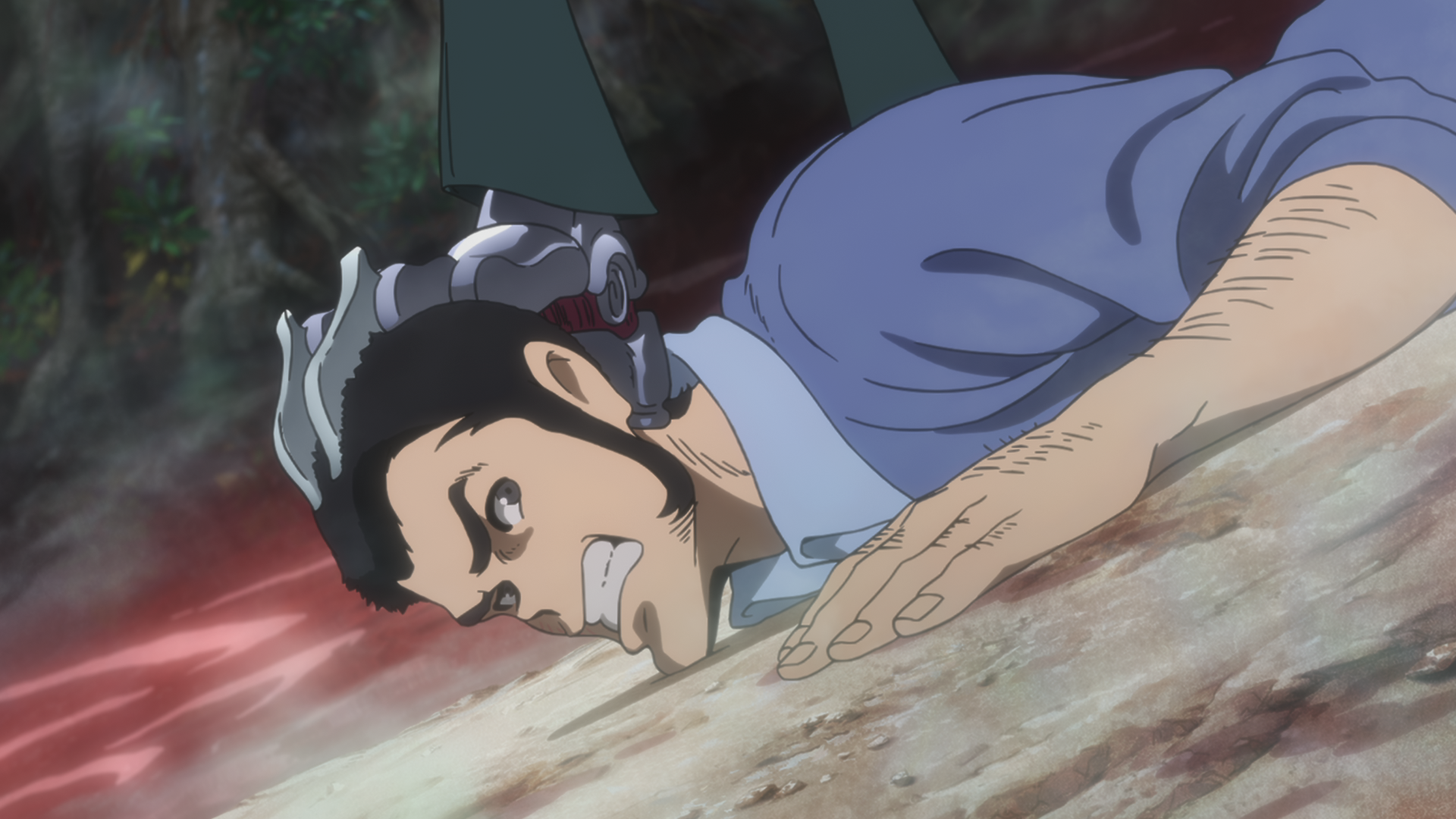
LUPIN THE IIIRD: The Movie – The Immortal Bloodline (LUPIN THE IIIRD THE MOVIE 不死身の血族, Takeshi Koike, 2025)

Lupin and the gang find themselves in a race against time after being lured to a mysterious private island in Takeshi Koike’s latest instalment in the classic franchise, LUPIN THE IIIRD: The Movie – The Immortal Bloodline (LUPIN THE IIIRD THE MOVIE 不死身の血族, Fujimi no Ketsuzoku). A sequel to a series of specials, the film opens with a lengthy recap explaining that each member of Lupin’s team has been targeted for assassination and seen off their adversaries using their own particular skills. Now Lupin’s home has been destroyed taking most of his loot with it, so he too is in hot pursuit looking for answers about who might be trying to kill them and why, along with some treasure, of course.

What he discovers, however, is that the island is a kind of graveyard for the unwanted. The place is full of mindless men in masks, the hitmen who didn’t make it reduced to animalistic predation. Disused military equipment scatters the landscape as if in reminder of mankind’s folly. But Lupin (voiced by Kanichi Kurita) is here because according to apparent mastermind Muom (Kataoka Ainosuke VI), he’s trash too and doesn’t belong in the new world Muom is trying to create by making the earth immortal. The air on the island is toxic to people like Lupin and unless he and his friends find a way off it within the next 24 hours, they’re destined to become zombie-like masked men too or else fade away into oblivion leaving not even a legacy behind them. 

The war is then against a notion of obsolescence or the idea that a person can become somehow unnecessary. The gang were followed to the island by Zenigata (Koichi Yamadera) who is still trying to catch Lupin but ends up becoming trapped too. Lupin is obviously very necessary to Zenigata as without him he doesn’t really have a reason to exist. That’s one reason he ends up ironically teaming up with him, protecting Fujiko Mine (Miyuki Sawashiro) and breaking his own code to shoot some bad guys in an attempt to keep Lupin alive to face justice. 

But as it turns out, Interpol might not be the best place to turn for back up as there’s some sort of blackout code on all things related to the island which is marked on no maps. Zenigata’s contact describes it as “sacred” and rather than sending the helicopter he asked for, explains everyone who sets foot on it will have to die because they know too much. As weird as Muom’s plans to make the earth immortal sound, it appears it’s locked into something bigger. All of which is quite good for Lupin who starts to realise there might not be much treasure here after all, but he’s found something more precious in a lead on even greater riches just waiting to be plundered.

This might be his way out of the purgatorial space of the island, the “hell for those burdened by karma” as Goemon (Daisuke Namikawa) describes it, in kicking back against Muom’s plans by identifying his nature and, quite literally, heading straight to the heart of the matter while reclaiming his identity as the gentleman thief from those who think he’s an unwelcome presence. Returning to the lair, he burns the history of himself and declares that life is a fiction to be enjoyed while immortality is a worthless gift that robs existence of its meaning. Separated on the island, the team must face their personal traumas alone before reuniting to try and figure out how to defeat their seemingly immortal captor and fight their way off the island before being consumed by its toxic gases.

The last in Koike’s Lupin cycle, the film is, in some ways, intended as a prequel to Mystery of Mamo, the very first Lupin anime released in 1978. As such it continues the style Koike has established in the series so far complete with kinetic action sequences and retro jazz score. Though this may seem like the end of the line for the gentleman thief, it is really just another beginning in returning the franchise to its point of origin. Lupin is, in a sense, reborn to steal back everything that was taken from him, with Zenigata hot on his heels and the world set to rights again, saved by his very particular brand of chaos.


LUPIN THE IIIRD: The Movie – The Immortal Bloodline opens in UK cinemas 21st February courtesy of Anime Limited.

International trailer (English subtitles)

Images: © MP / T

The Man Who Failed to Die (死に損なった男, Seiji Tanaka, 2025)

Feeling hopeless in his professional life and surrounded by a city of frustrated, angry people, comedy writer Ippei (Mizukawa Katamari) decides to end it all by throwing himself under the evening train, but as fate would have it, services are interrupted because of an incident at the previous station. Reconsidering his decision, he refunds his ticket and goes back to his life, but he soon finds himself haunted, in literal and figural senses, by the other person who died and, in some ways, ended up saving his life.

Like his earlier film Melancholic, Seiji Tanaka’s The Man Who Failed to Die (死に損なった男, Shini sokonatta otoko) is partly about the things we don’t see which in this case is that many people are struggling and have fallen into despair believing they have no one and nowhere to turn. Before he decides to die, Ippei is knocked over by a cyclist who curses at him for being in his way before riding on, while a woman out running has no option but to jump over him and then carries on her way. Later, he bumps into a man at the station who becomes angry and aggressive, ironically telling him that he should “fuck off and die”. The implication is that in this city everyone is so busy rushing about and overworked that it’s left them frazzled and impatient, overly focussed on the demands placed on them and unable to notice or reach out to others. 

It’s another minor irony that Ippei works in comedy which is supposed to entertain people, cheer them up, and relieve their stress, but it’s actually very hard work and incredibly competitive. When he returns after his failed attempt to die, he’s cornered by his manager and a comedian who is annoyed that she hasn’t been given as many lines as the men and feels she’s being discriminated against on the grounds of her gender. Ippei tries to explain that she’s got the punchlines and there are fewer of them because of the comedic rhythm, but it’s something that’s difficult to explain without performing the piece in front of an audience. He’s also been dumped by one of the groups he works with because they’ve chosen to go with a bigger producer who has better TV connections. The duo he’s working with now are struggling with some material that’s not really hitting home while preparing for a competition that’s only a couple of weeks away. Ippei suggests completely reworking the routine, but is obviously difficult for everyone and not least himself who’s going to have to come up with a killer idea in record time. 

Which is all to say he’s under a lot of stress, and if he did just hallucinate the ghost of the man who died in place of him, Tomohiro (Bokuzo Masana), that would be understandable. Tomohiro has unfinished business, and thinks that Ippei should take care of it for him seeing as he technically saved his life, but what he wants him to do is kill the abusive ex who’s started stalking his daughter again now the restraining order’s expired. The film sort of suggests that Wakamatsu (Yutaka Kyan) became violent because of these same stresses after losing his businesses during the pandemic, but nevertheless he’s a frightening and controlling presence while Aya (Erika Karata) is quite clearly terrified of him. Once again, when Ippei interrupts Wakamatsu in the street trying to force his way into Tomohiro’s house, another passerby picks up his dog and walks on without stopping to check if everything’s alright. Perhaps it’s fair enough that they didn’t want to get involved in a dangerous situation, but to speaks to the ongoing indifference of society in which few are willing step in and help women like Aya and men like Wakamatsu are allowed to go on bullying and tormenting those around them.

Getting involved in Tomohiro’s quest does however help Ippei to get a handle on his life and an acceptance that having failed to die he’s still here and has a chance to start again. He begins to realise that the reason he wanted to die was that although he had achieved his dreams of working in comedy, it all seemed quite meaningless and he’d lost sight of what took him there in the first place. Rather than contribute to the angry society around him, he resolves to be happy for other people’s successes and understand that even if someone appears to be successful it doesn’t necessarily mean they aren’t struggling or in need of help too. Filled with a gentle absurdity and good humour, the film is despite its darker themes an argument for a little more compassion and solidarity in the face of the constant pressure of a fast-paced society.


The Man Who Failed to Die screened as part of this year’s Camera Japan.

Trailer (no subtitles)