
Ya Boy Kongming! The Movie (パリピ孔明 THE MOVIE, Shuhei Shibue, 2025) [Fantasia 2025]

Why in this world does war never cease? Reincarnated in modern-day Shibuya, third-century military strategist Zhuge Liang, known by his courtesy name Kongming, finds himself fighting a different battle in becoming the manager of an aspiring singer whose music he feels could unite the world in peace. Adapted from the manga by Yuto Yotsuba and illustrated by Ryo Ogawa, Ya Boy Kongming! (パリピ孔明 THE MOVIE, Paripi Koumei the Movie) is both a surreal advocation for the power of music and satirical take on the cutthroat entertainment industry.

Having decided to become Eiko’s (Moka Kamishiraishi) strategist, Kongming (Osamu Mukai) has already advanced her career with an appearance at a major festival. He’s also turned himself into a mini celebrity appearing on TV to offer his strategic opinions and starring in a number of adverts. Now he wants Eiko to enter a joint competition between the three leading music labels which ironically echoes his own Three Kingdoms era and requires him to make use of his classic strategies. But he’s also facing his greatest challenge yet in the form of Shin, a street singer whose music calls out to him in a similar way to Eiko’s yet not, he fears, in a good way. He’s plagued by strange visions of his past life and his old lord Liu Bei before being told that his dreams are of something called the “Yumi door” that leads to the afterlife and that he will want to step through it the next time he hears Eiko’s music. 

As some point out to him, perhaps he just shouldn’t listen, then, but to Kongming that would be the same as death and if it helps realise his dream of bringing about universal peace through Eiko’s music then he’ll gladly give up this strange second life he’s been given. Of course, this produces a conflict in Eiko who, on realising that Kongming is actually serious, isn’t sure if she should just not sing ever again to avoid accidentally killing him even though he tells her that her music has the power to save people. Meanwhile, she loses confidence in herself, thinking that he’s gone off her and is about to jump ship to Shin who is currently being managed by a descendent of Kongming’s old enemy Sima Yi, Sima Jun. 

Jun’s mission is then one both of familial revenge and a quest to make his sister a star. But whereas Kongming’s strategies are clever, Jun’s are underhanded and it’s clear he’s gone to the dark side in trying to advance Shin’s career. At the end of the day, Shin might not want to “cheat” either, but even so the teased battle of wits comes to pass as the two men attempt to outflank each other and win the coveted championship which is Kongming’s way of ensuring Eiko will be able to continue after he’s gone. Though her songs are all becoming independent and able to go on alone after someone important is no longer around, Eiko still values Kongming’s support and friendship and obviously doesn’t want him to go anywhere.

Yet what Jun ends up rediscovering is the joy of music and that it really can change people’s lives, a realisation that all the label bosses came to some time ago. Despite the cutthroat nature of their business, they do it because they believe in music too, whether it’s a girl with a guitar in the street or a Chinese boy band making a surprise appearance during their world tour. Jun and Kongming want the same thing, and Shin and Eiko aren’t really rivals but allies fighting for universal peace through music. Boasting excellent production values, the film lends a sense of melancholy nostalgia to the Three Kingdoms era and Kongming’s vaguely homoerotic relationship with the famed Liu Bei whose voice he once thought could unite the world in peace before he lost his life on the Wuzhang Plains and woke up in Shibuya clubland on Halloween thousands of years later. Endlessly surreal, there’s a childlike quality to the warring strategies of Kongming and Jun as they attempt to outflank each other with elaborate schemes, but also a genuine sense of warmth and joy in the love of music, which just might, after all, bring peace throughout the land.


Ya Boy Kongming! The Movie screened as part of this year’s Fantasia International Film Festival.

Original trailer (no subtitles)

We’re Millennials. Got a Problem? International (ゆとりですがなにか インターナショナル, Nobuo Mizuta, 2023)

Seven years on from the hit TV series, the guys find themselves dealing with the problems of early middle age along with increasing internationalisation as members of the so-called Yutori generation in Nobuo Mizuta’s We’re Millennials Got a Problem? (ゆとりですがなにか インターナショナル, Yutori desu ga, naninka Internationa). Now they’re in a different place and increasingly confused by the youth of the day while reconsidering their own life choices and facing a series of impromptu crises.

Among them would be that both the yakiniku restaurant where the guys worked in the TV series and the company that used to distribute the sake produced by Masakazu’s (Masaki Okada) family brewery have been taken over by Korean conglomerates. To make matters worse, the company tells Masakazu at an online meeting he’s embarrassingly turned up to in person because no one thought to tell him it was remote that they’re shifting production entirely to makgeolli because no one drinks sake anymore and his takings are about to fall off a cliff. The only way he can keep the contract is by agreeing to introduce a new product, either makgeolli or alcohol free sake. 

Meanwhile, his friend Maribu (Yuya Yagira) has returned after seven years in China with a Chinese wife and three children but apparently no job prospects. Masakazu offers him a job at the brewery, forgetting that it’s a bit awkward because he used to date his sister, Yutori (Haruka Shimazaki), who has quit her corporate job to start a business selling nordic knickknacks. It’s Maribu’s live streaming of the moribund brewery that unwittingly exposes the cracks in Masakazu’s marriage when Chinese netizens starts sending aphrodisiacs through the post to help him overcome the problems of his sexless life with wife Akane (Sakura Ando) who is herself struggling with the demands of looking after two small children and taking care of all the domestic chores with no help.

Later Akane tells mutual friend Yamaji (Tori Matsuzaka) that she’s worried she has post-natal depression and is fed up with her home life. We see can how stressful it is in the opening sequence in which Masakazu (ironically) tries to become a YouTube sake star but is repeatedly heckled by offscreen calls from Akane asking him to bathe the children and otherwise help out before she finally has no choice but to bring the kids to him. When they go to city hall to apply for a place in childcare they’re immediately dismissed, Akane somehow told that she doesn’t have as many “points” as her husband even though they’re both self-employed and there are many more needy candidates before the (probably well-meaning) civil servant not so subtly checks their daughter’s arm for signs of abuse or neglect. It’s not that surprising therefore that when the aphrodisiacs start piling up at home she wonders if Masakzau’s having an affair placing further strain on the relationship. 

Shin-hye (Haruka Kinami), the Korean-Japanese-American CEO of the company that bought out their old distributor (for whom Akane was once a regional manager) also a expresses a similar anxiety about the place of women in the workplace on the one hand coming from Korean corporate culture and finding that Japan might not as be “as bad” at least in its every increasing list of harassment which at least admit there’s problem with workplace bullying, sexist culture, and unwanted sexual advances from men in positions of power. Yamaji, meanwhile, finds his well-meaning attempts to foster diversity in the classroom floundering when the kids declare themselves unable to understand the intricacies of LGTBQ issues explaining that at their age “dating” just means hanging out though they’re unexpectedly accepting of the Thai transfer student with an inexplicable crush on the incredibly obnoxious American boy who transferred in the same time as him. 

In other ways, however, Yamaji is the same as ever. On his first appearance he’s on an awkward date with a woman from a dating app which he largely spends talking to his mentor on an iPad and making sexist remarks. They are all struggling with the demands of a more concrete adulthood in which much is already decided while their settled lives are undermined by unexpected crisis from the fallout from the conravirus pandemic and ongoing economic malaise to marital discord, the demands of caring for small children, and a friend a they had no idea was a top star live-streaming star in China. A recurring gag sees people undertake zoom meetings dressed in a suit jacked with sweatpants underneath. Yutori eventually exclaims that there’s no point even having dream while her family have a lot of sensible questions about her new business like where all the stock is whether it was worth the risk leaving her stable job that was presumably subject to all the harassment and otherwise oppressive corporate culture of contemporary Japan. Nevertheless, the millennials eventually come to a kind to acceptance and understanding of where they are in their lives along with a re-appreciation of everything they already have.


We’re Millennials. Got a Problem? International screened as part of this year’s Nippon Connection

Original trailer (English subtitles)

One Summer Story (子供はわかってあげない, Shuichi Okita, 2020)

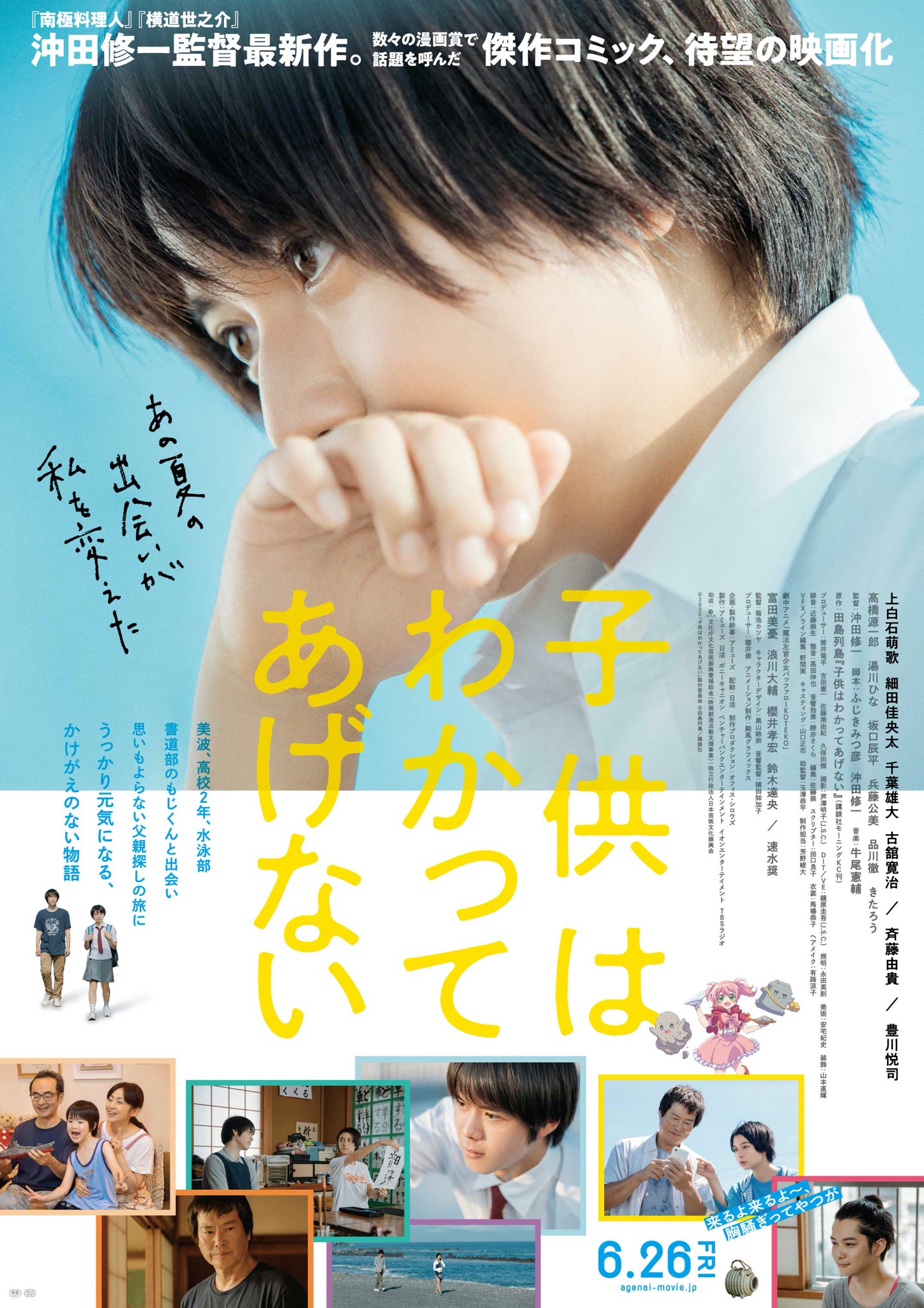
“One man’s not enough to make a difference, you learn something and pass it on” the heroine of Shuichi Okita’s One Summer Story (子供はわかってあげない, Kodomo wa Wakatte Agenai) is told, learning about life from her philosophical, slightly defeated birth father. Adapted from the manga by Retto Tajima, Okita’s teen drama is in many ways a typical “summer story” in which a high schooler goes on a quietly life changing journey during one of the last summer breaks of their adolescent lives, but it’s also as much of his work is an empathetic plea for a kinder world built on mutual understanding and acceptance. 

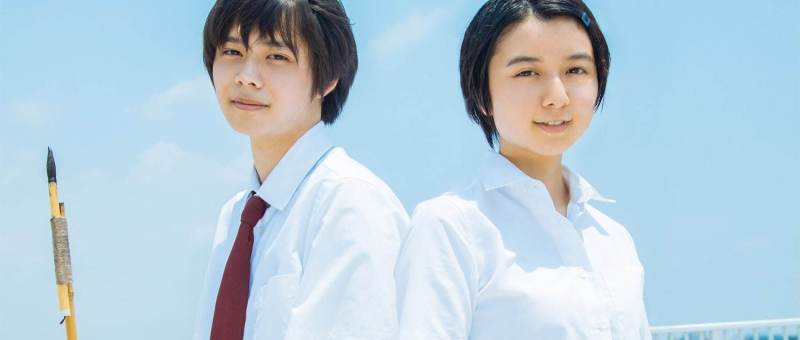
Okita signals as much with his animated opening, taken from the heroine’s favourite show, Koteko, in which a magical girl plasterer helps “Count Cement” repair his relationships with his estranged children, Mortar and Concrete, from whom he had withdrawn in shame realising that without water he is nothing while his kids could still make something of themselves through becoming bridges and houses. Koteko is something of a touchstone for Minami (Moka Kamishiraishi), a regular high school girl and member of the swimming team moved to tears by the opening song which preaches that walls aren’t something to be overcome but a canvas on which you can plaster your dreams. At the pool one day, she spots a boy on the roof painting a picture she quickly recognises as Koteko, rushing up there to befriend him as a fellow fan. In addition to being a Koteko-lover, Moji (Kanata Hosoda) is the son of a prominent calligraphy family and it’s at his house that she finds a vital clue, a talisman which matches the one she got from her birth father for her last birthday. 

Immediately following the end of the opening anime sequence, Okita shows us a happy family scene in which Minami’s stepdad (Kanji Furutachi) hands her tissues while she cries to the ending theme, joining in with the dance while her mum (Yuki Saito) cooks in the background and her live-wire half-brother runs round in his pants. Her family setup might still be considered unusual in conservative Japan, in fact one of her friends even exclaims that they’d never have guessed that her stepdad isn’t her birth father on hearing her mother was married before, but they are clearly very close and loving, ordinary in the very best of ways. Minami isn’t unhappy or lonely at home, she isn’t really thinking too much about her birth father even if perhaps on some level curious but the talisman becomes a thread to tug on, sending her on a quest of self-discovery seeking some answers about her past as she begins to come of age. 

To do this, she enlists the help of Moji’s older sibling Akihiro (Yudai Chiba), a transgender woman disowned by the conservative, traditionalist family of calligraphers and now living above a bookshop while working as a “detective”. As the pair find out, it’s less high crime than missing moggies that are Akihiro’s stock in trade but she’s moved to have a go helping to find Minami’s dad after looking at her bankbook containing her life savings, not for the amount but because she remembers saving up herself at Minami’s age to fund her reassignment surgery. Invoicing her later, Akihiro bills her zero yen telling her merely to make sure she uses her money to help others when she grows up, echoing the film’s pay it forward philosophy as advanced by Moji who teaches kids calligraphy at his dad’s school, advising Minami that people can only pass on skills they’ve learned from others and so perhaps she could teach someone to swim. Her birth father Tomomitsu (Etsushi Toyokawa), a former cult leader who lost faith in himself for being unable to teach his innate mind reading ability to his followers, eventually tells her the same thing, that what’s important in life isn’t grandstanding, trying to change the world all on your own, but sharing what you know in a gentle process of continuity and change. 

Ironically enough and in true teenage fashion, Minami finds new security in family after lying to her mother about going on a school trip to find her dad, later realising her mother is only slightly hurt about the lying and not at all about her reconnecting her birth father. Through her extended stay with him at the seaside she begins to find the courage step into herself, accepting the position of teacher in helping a lonely little girl learn to swim, while also processing her growing feelings for the equally shy Moji who leaves her space to complete her quest on her own but chases after her when he thinks she really might be in danger. A gentle summer story Okita’s breezy drama has a pleasingly timeless, occasionally retro feel, full of summer warmth in its spirit of acceptance and mutual support as its surprisingly carefree youngsters come to an appreciation of themselves and each other as they push forward into a more adult world with confidence and compassion. 


One Summer Story screened as part of Camera Japan 2020.

Teaser trailer (English subtitles)

Mirai (未来のミライ, Mamoru Hosoda, 2018)

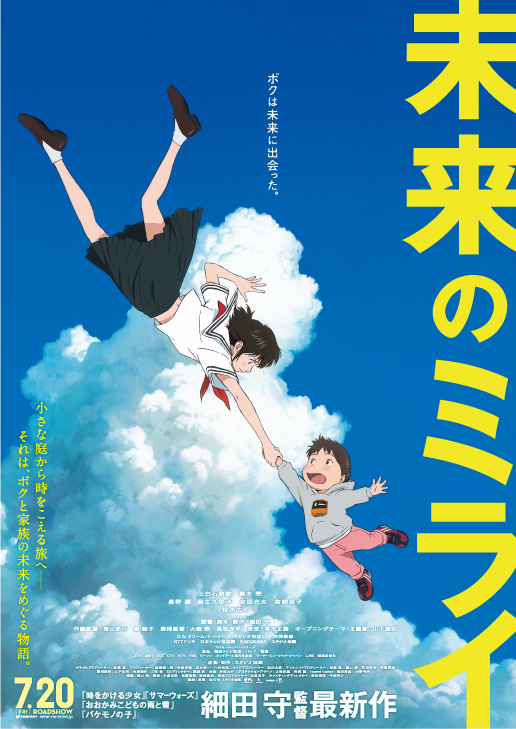
Mirai posterIn Mamoru Hosoda’s Wolf Children, a young woman experiences heartbreak when the love of her life is cruelly cut down, leaving her alone with two small children whose particular needs send her off in search of a new way of living. Hosoda’s filmography is filled with family drama, of how difficult and painful the relationships between parents and children can be. Wolf Children was the story of a mother’s tragedy in that she has to set her children free in order to see them grow. The Boy and the Beast was a young man’s struggle to make peace with his father. Mirai (未来のミライ, Mirai no Mirai) presents an altogether less “complicated” vision of family life, steeped in authentic detail and gentle warmth.

The hero of the tale is Kun (Moka Kamishiraishi) – a train obsessed four year old suddenly presented with a new baby sister later named “Mirai” (Haru Kuroki). Having been an only child used to receiving all of his parents’ attention, Kun is intensely resentful of the various ways his life has changed. Feeling pushed out, he begins to throw tantrums, become argumentative, even threaten to run away from home. Meanwhile the family dog, Yukko, looks on with thinly veiled contempt as Kun gets a little of his own medicine in no longer being the centre of attention.

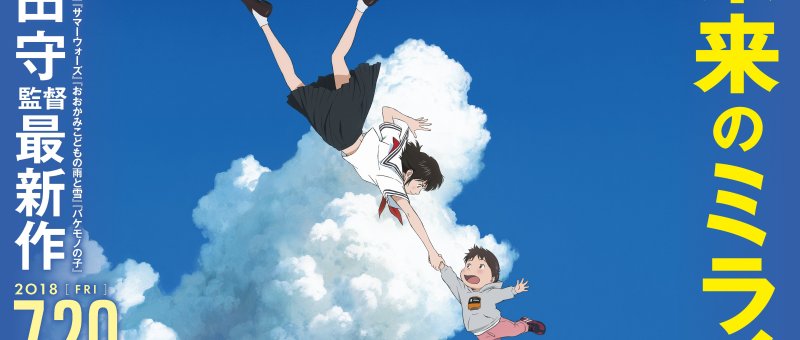
Taking refuge in the front garden which is a major feature of the family home designed by his architect father, Kun begins to receive a series of visitations – firstly from an anthropomorphised Yukko and then by the teenage incarnation of his little sister on an urgent mission to the past to ensure her absent minded father packs the Hina Matsuri dolls away on time lest she end up an old maid, prevented from marrying her one true love because of ancient superstition (and her father’s forgetfulness). After interacting with the older Mirai, Kun travels off on further flights of fancy to observe his mother at his age and even his late great grandfather – a dashing, motorcycle riding hero who walked with a limp thanks to a lucky wartime escape.

Snatched from vague comments overheard from his parents and grandmother, Kun’s adventures teach him new and valuable ideas about the world. He learns that it’s alright not to understand everything right away because that’s what life is for. As someone later puts it, there’s a first time for everything and once you’ve learned one thing you’re halfway way to knowing everything else. Meeting his mother as a youngster shows him that she was once a messy toddler too and that all things come in time.

Kun still doesn’t quite understand, but comes to a new appreciation of his home and his family as a part of something far larger of which he is merely a mid-point on an ever expanding scale. Mirai shows him his “family tree” as manifested literally in the one in the family garden. Somewhat oddly for a girl from the future, Mirai likens it to a card index like the ones at the library (perhaps one of her old fashioned preoccupations like the Hina Matsuri superstitions) filled with personal stories in which no one is ever really forgotten. Having gotten himself into quite a fix and wound up at a very futuristic looking Tokyo train station, it’s family which eventually sets Kun on his way back home, having remembered who he is in relation to others.

Yet Kun’s family is also intensely modern and going through changes of its own. Kun’s mother will be going back to work soon after Mirai’s birth – something still somewhat unusual in traditional Japan while in an even more seismic leap towards equality Kun’s father, who will be working from home, has committed to sharing responsibility for the domestic realm in looking after the children during the day as well as taking care of the cooking and the cleaning while Kun’s mum works. Kun’s mother might bristle at her husband’s eagerness to accept praise for only doing his fair share while struggling with ordinary day to day tasks, but the couple have soon found a happy equilibrium in embracing the joys and anxieties of building a family. Another beautifully profound tale from Hosoda, Mirai is a lovingly rendered exploration of what it is to live a life among lives with all the rewards and responsibilities that entails.


Screened as part of the 2018 BFI London Film Festival.

International trailer (English subtitles)