Green Rain (草雨 / 초우, Chung Jin-woo, 1966)

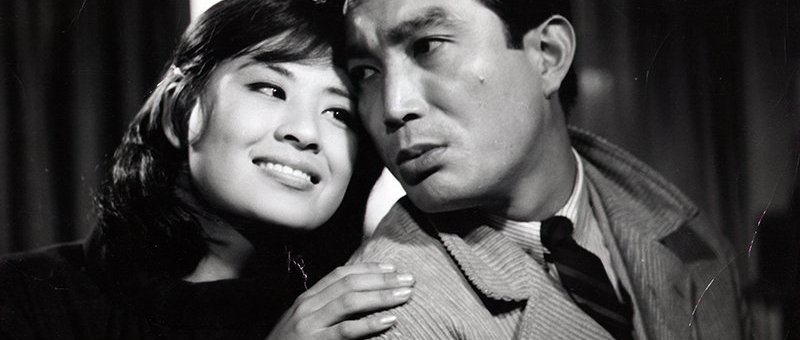
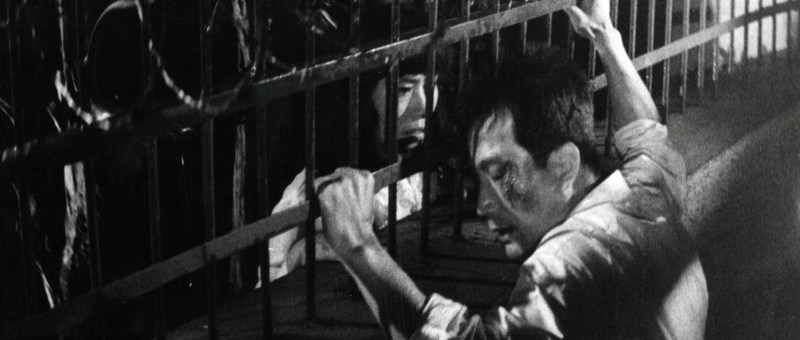
The false promises of the post-war era are brought home to two romantic youths dreaming of an illusionary future in Chung Jin-woo’s Green Rain (草雨 / 초우, Chou). At that time the youngest director to debut at just 25 years old with 1963’s The Only Son, Chung was a proponent of the “Cine Poem” movement which, in direct contrast to the literature film, sought to communicate through image alone minimising dialogue as much as possible. Heavily influenced by the French New Wave, particularly Godard’s Breathless and Louis Malle’s Elevator to the Gallows, Green Rain is essentially an anti-romantic melodrama in which each of the lovers deceives and is deceived only to be awakened to the final truth that romantic salvation is nothing more than a childish fantasy. 

Chung opens with an excitable sequence in which the heroine, Yeong-hui (Moon Hee), introduces us to her “home”, which is in actuality that of a diplomat who has just been appointed Ambassador to France and so is currently living in Paris. Yeong-hui had hoped that the family would take her with them, but Mrs Kim and her daughter who is suffering from an otherwise unexplained illness and uses a wheelchair, have been left behind alone and she with them. Yet Yeong-hui loves everything about the idea of Parisian sophistication, overexcited when a package arrives from abroad that turns out to contain the latest French fashions for the two Kim ladies. Yeong-hui looks on wide-eyed, but the daughter is petulant and resentful. She doesn’t want her father’s presents and views them as insensitive because it’s not like she has anywhere to show off nice clothes when she’s stuck at home ill. The two women debate giving the clothes away but can’t decide who best to give them to before Mrs. Kim casually offers Yeong-hui the stylish raincoat which is in its own way about to change her life. 

As she later puts it, putting on the raincoat turns her into someone else. She waits eagerly for a rainy day and steps into a hip jazz club, somewhere she wouldn’t usually go, where she attracts instant attention precisely because of the coat. The women look on with scorn, noting the mismatch between the coat and the rest of her appearance, while the men swarm on her unpleasantly. Luckily, Cheol-su (Shin Seong-il) comes to her rescue and offers to drive her home believing that Yeong-hui is the ambassador’s daughter while she fails to disabuse him. He meanwhile tells her he’s a chaebol son, but really he’s a mechanic and sometime university student currently in a compensated relationship with a stylish older woman who we later learn to be some kind of gang leader. 

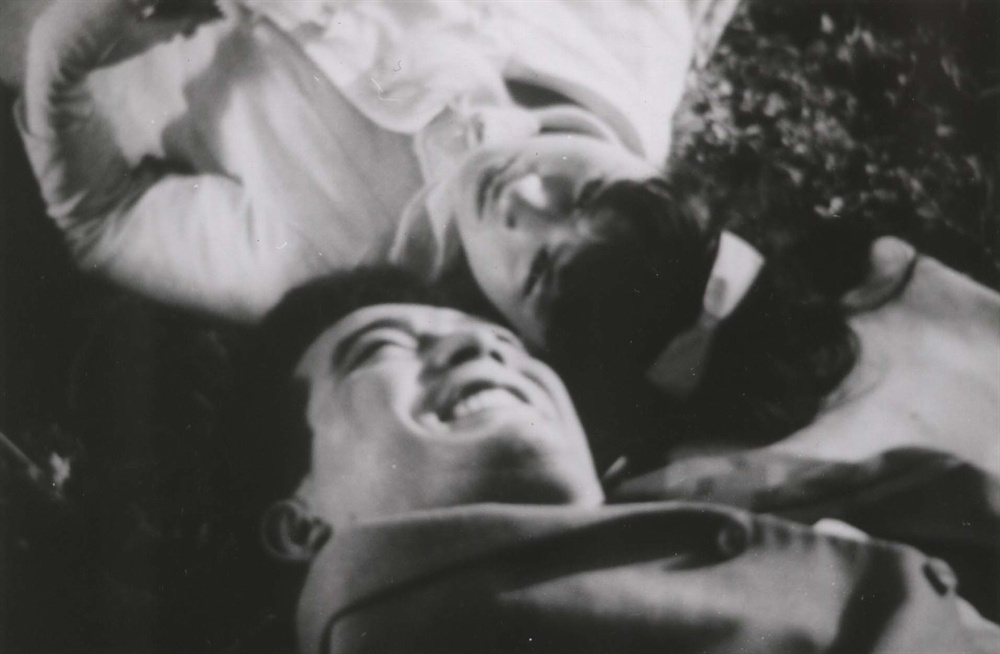
They fool themselves into thinking they’re falling in love, deceiving themselves as well as each other in playing at innocent romance. They meet every time it rains and go on charmingly innocent dates to parks and boating lakes shot with a dreamy romanticism, but also, in contrast to Barefooted Youth, indulge in stereotypically “low” forms of entertainment such as boxing and horse races without ever managing to blow their covers as they simultaneously both pretend to like Tchaikovsky because they’re trying to live up to an image of upperclass sophistication. 

Yet, there are cracks in their connection. They talk idly of the kind of future they’ll have with Cheol-su wanting an “enormous concrete home” while Yeong-hui claims she’s fine with somewhere small so long as there’s sunlight because she wants her life to be “real, not for show”. It’s an ironic statement under the circumstances, one which is perhaps brought home to her by the otherwise kindly old washerwoman across the way who is forever complaining about her “fake” coal that won’t light and moans about “fakes passing themselves off as the real thing”. Yet she continues to believe in her fairytale romance with Cheol-su, even while declaring it to seem “like a dream”, terrified that he’ll find out she’s just a maid and leave her. He, meanwhile, is less invested in the idea of romantic love, describing her first as a “business opportunity”. On their first meeting he finishes with the older woman, drops out of the “third class uni” he thinks is more trouble than it’s worth, and continues to push his luck with his boss by repeatedly “borrowing” customers’ cars because he thinks he’s on to a sure thing with the ambassador’s daughter and no longer needs to worry about keeping the job. He presses his friends for money, pawns everything he can get his hands on, buys a fancy suit and tries to convince Yeong-hui he’s upperclass only to be pushed into a corner when she declares she wants fancy crockery in her simple home. To get his dream life, Cheol-su commits a robbery only to be surrounded by an angry mob a la Bicycle Theives and receives the first of many beatings. 

This sense of frustrated humiliation might explain the unexpectedly traumatic closing scenes which contrast so strongly with gentle romanticism with which the film opened. Cheol-su risked everything for a mistaken ideal and he’s failed. He realises Yeong-hui has been deceiving him too, but rather than a cute romantic resolution that returns them both to the grounding of their original social class, he reacts with hypocritical rage and anger. Yeong-hui reemphasises that she loves him anyway, clinging fast to her dream of love, but he ruins her, consumed by toxic masculinity in his sense of hopelessness and inferiority as a working class man with no prospect of improvement now that his dream of marrying up has dissolved. In another film he might be the hero, reinforcing duplicitous ideals of societal misogyny, but in this one he is the fool and the villain. “Without an ounce of sorrow I understood what it was to be a woman” Yeong-hui adds bitterly, finally understanding her romantic fallacy for what it was, learning a painful lesson in naivety and self-deception and striding boldly back to her old life, wiser if perhaps less hopeful whereas Cheol-su runs away still chasing an easy fix to a more prosperous future. At once a criticism of the increasingly consumerist society, its deeply entrenched social inequalities, and its patriarchal social codes, Green Rain is most of all an anti-romantic melodrama in which love is nothing more than childish fantasy incapable of offering salvation in a world of constant impossibility. 

The Starting Point (원점, Lee Man-hee, 1967)

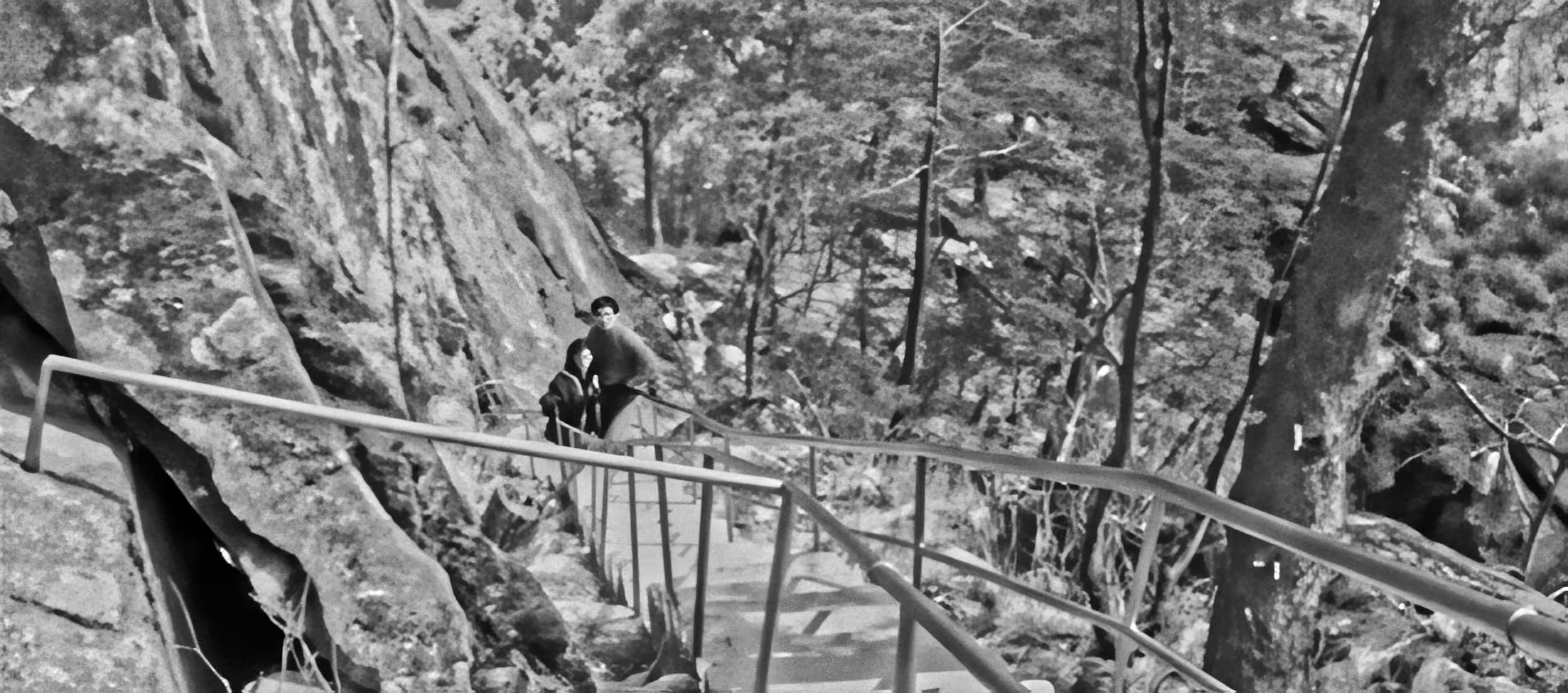
A hired thug and a sex worker dreaming of a new life are set on a collision course at mountain retreat in Lee Man-hee’s noirish thriller, Starting Point (원점, Wonjeom). A melancholy existential drama, the film nevertheless has a darkly comic absurdity and becomes for a time almost a satire of changing sexual mores and the anxiety surrounding the post-war population explosion while simultaneously hinting at corporate corruption in economically straitened times. 

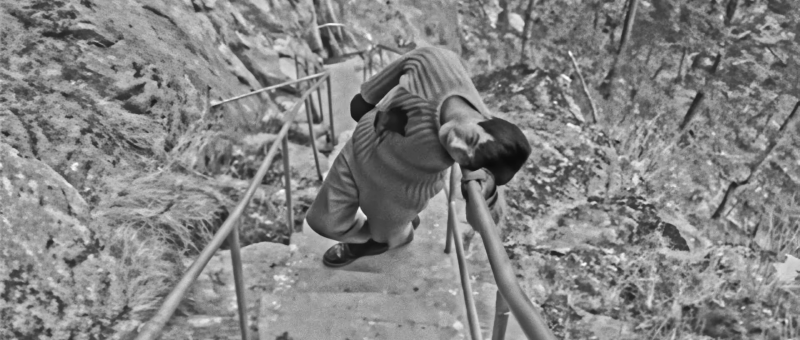
Played in near total silence, the opening pre-credits scenes find the otherwise unnamed (the name given in the promotional material is never spoken) lackey (Shin Seong-il) raiding an office building with the intention of retrieving some mysterious documents the people who hire him later claim threaten to expose their “seven-year-secret”. The Lackey takes time to smoke a cigarette and read through some of the papers before putting them into a briefcase to make his escape but is soon met by a man with a rifle who challenges him. A fight ensues on the staircase from which the Lackey is able to escape, activating a rolling gate to get out of the building. But the other man keeps coming after him, managing to cling on the briefcase while his neck is crushed by the unstoppable motion of the shutter. 

Mirroring him, the unnamed Sex Worker (Moon Hee) is also intruded in a wordless sequence shot with the kind of realism seen in American independent and European arthouse cinema as she stares forlornly at the pretty dresses behind the glass in a small boutique before sadly making her way towards a streetlight near the Choseon Hotel where she wordlessly picks up a customer through suggestive looks and gestures. 

The Lackey knows too much, which is why his bosses want to take him out but for unclear reasons Mr Choi comes up with a bizarre and convoluted scheme which involves hiring the Sex Worker to pose as the Lackey’s wife during a honeymoon getaway to Mt. Seorak. What the Lackey thinks is going on or why the mountain is important is never really explained just like the nature of the seven-year-secret, but once there the film changes tack becoming a kind of ensemble mystery as the various guests each become suspicious of one another while the Lackey and the Sex Worker slowly fall in love for real perhaps bonding their mutual sense of existential peril and outsider status. 

In the liminal space of the mountain, both fear rejection by those around them who come to represent mainstream society, the Lackey because he has killed and Sex Worker because of her profession. Ironically, one of the other guests is a dodgy gynaecologist who makes a point of saying that most of his clients are sex workers from around the Choseon Hotel at least implying that he regularly performs abortions. He recognises the Sex Worker as a previous patient and tries to take advantage of her sexually but commits a breach of medical ethics by leaking her profession to the rest of the group who then shun her. When the planned camping trip encounters a snag seeing as only two tents have been provided and the obvious solution is for men to take one and the women the other, the women all immediately leave on the Sex Worker’s arrival refusing a share a space with a “fallen woman” in case they are somehow tainted by her shame. 

But then, the goings on at the mountain inn are strange in themselves. A middle-aged man who inexplicably doesn’t seem to have encountered a transistor radio before accidentally tunes into a news broadcast discussing the effectiveness of the contraceptive pill while the young people dance with wild abandon to music they don’t really understand. Meanwhile, the gynaecologist wades in when another of the women experiences terrible stomach pains insisting that he is “familiar with women’s issues” and informs the husband that his wife is pregnant which is confuses him because they only married the day before and he’s been a good boy so the news is perplexing. He spends the rest of the film counting dates on his fingers and at one point attempts to hang himself certain that his wife must have slept with another man before their wedding instead of maybe considering that the dodgy gynaecologist may be mistaken.  

When the couples are divided into separate tents, one guest quips that it’ll be good for keeping the birth rate down hinting at an anxiety about a new sexual freedom among the young coupled with the impact of the ongoing baby boom and its economic implications. The gynaecologist’s wife is the first to join in with the youngsters, but she’s also a rabid penny pincher making sure the newlywed husband pays for her husband’s treatment of his wife while intensely jealous constantly trying to keep the randy doctor’s attention off the other women. The sense of economic anxiety is echoed in the Sex Worker’s melancholy longing onto looking into the shop window while dreaming of opening her own hair salon though sex work is the only way she can support herself and leaves her with intense shame that like the Lackey exiles her from mainstream society. 

As she says while embracing her covert identity as a cheerful newlywed, she’s been looking up all her life and would like to look down for once which she ironically does atop the stairway on which the Lackey fights his existential battle with Choi and his minions. They each want to find a way to get off the mountain and return to the world, but are prevented from doing so by the forces that pursue them and will not let them go. Finally questioned, the Sex Worker is forced to admit that she knows nothing about the Lackey, not his name or where he lived or what he did for a living, only that he did not hate her which is as close to a declaration of love as it might be possible to get in this cold and dark world of exploitation and violence. Lee films with a noirish intensity and melancholy fatalism as the pair attempt to fight back against the forces which constrain them with the pureness of their love but later discover that, as they feared, all that is left to them are painful memories of momentary happiness. 


Ilwol: The Sun and the Moon (일월 / 日月, Lee Seong-gu, 1967)

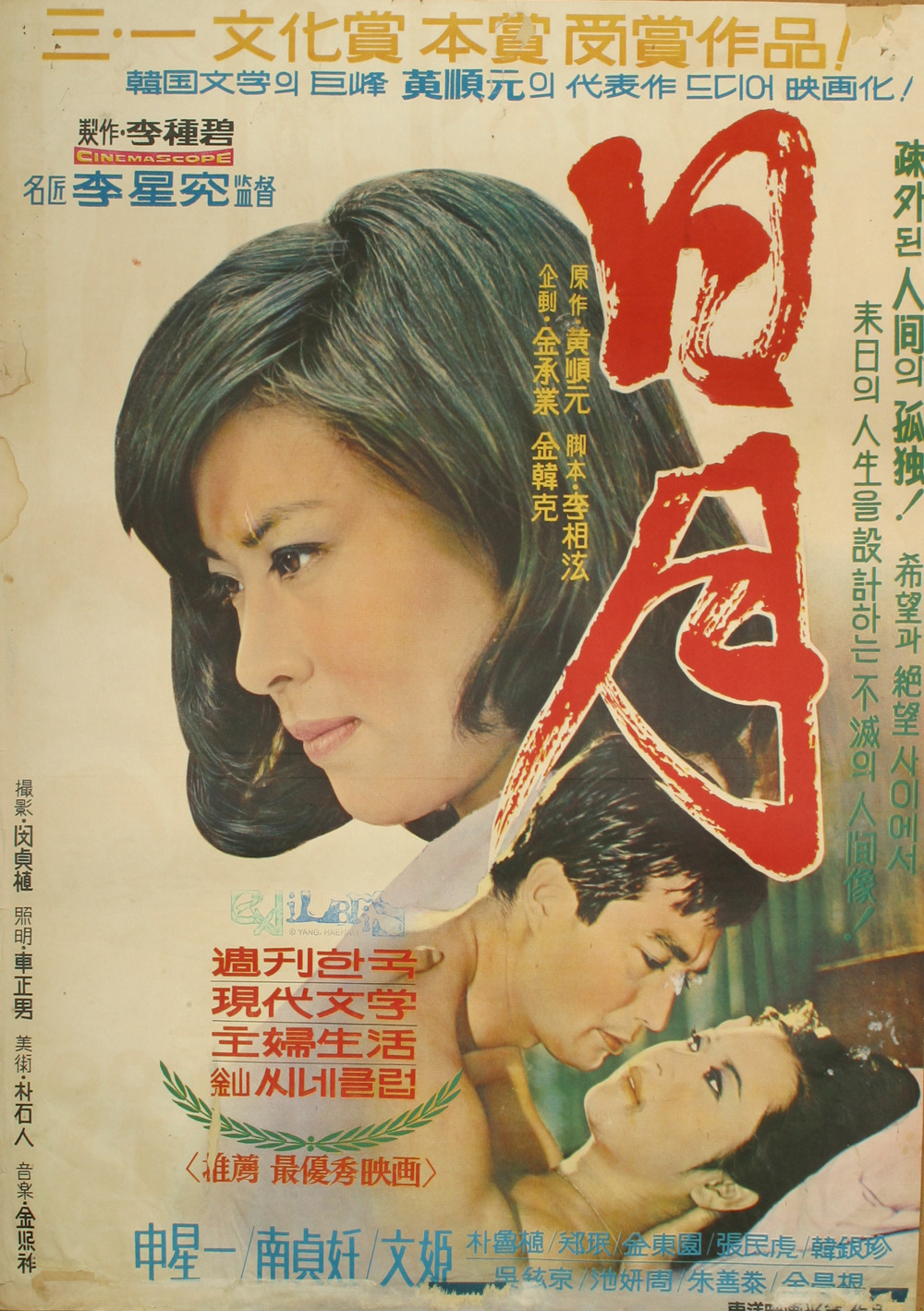
Sun and Moon posterOld habits die hard in Lee Seong-gu’s Ilwol: The Sun and the Moon (일월 / 日月). The feudal past refuses to ease its icy grip even in the new “democratic” era in which freedom and prosperity are promised to all. Lee Seong-gu, closely associated with the Western Modernist movement, flexes his Literary Film muscles with an adaptation of Hwang Sun-won’s novel. Mixing a standard melodrama narrative with an exploration of “outdated” social prejudices and the gradually fracturing psyche of a man who learns a “dark secret” regarding his personal family history, Lee isolates the individual within a changing society as an ordinary man finds himself unable to move forward despite his own desire to be free of the superstitious past.

Lee opens with a scene more in keeping with a romantic comedy. Aspiring architect In-cheol (Shin Seong-il) meets drama student Na-mi (Nam Jeong-im) at an upscale ski resort and is instantly smitten. After spending time with her, In-cheol goes home and visits a childhood friend, Da-hye (Moon Hee). Da-hye is quite obviously in love with In-cheol – a fact of which he is obviously unaware or just completely insensitive since his purpose in coming is to tell her about Na-mi. Despite her personal pain, Da-hye is a good friend and gives In-cheol the appropriate advice regarding his romantic endeavour, reminding him that many of his previous relationships have failed because he was too diffident and he let them drift away.

Meanwhile, In-cheol is called into his father’s study to meet his dad’s new business contact who, it happens, wants a house designed. In a piece of near dynastic finagling, In-cheol gets a new job and, surprise surprise, the house turns out to be for Na-mi who is the daughter of the bank manager In-cheol’s dad wants a loan from. Everything is working out just fine, but then In-cheol’s brother – the Mayor of Gwanju (Jang Min-ho), turns up in a state of agitation and tells them he’s being blackmailed. Someone has discovered their dark family secret – In-cheol’s dad ran away from his family because they were butchers, a near “untouchable” class even in the Korean society of 1967. In-cheol thinks this is all very silly, who cares about things like that anymore? But on another level the discovery profoundly disturbs him in what it says about him as a person and about the society in which he lives.

It does seem ridiculous to stigmatise such commonplace occupation in a supposedly modern society, but In-cheol can’t seem to move past it. He pays a visit to a slaughter house which is just as awful as he’d expected it to be as he watches a once powerful cow twitching helplessly on the floor while other workers dismember the corpses of animals, pulling out entrails and severing heads ready for keener butchery. Still, In-cheol reminds himself it’s just a job and resolves to meet his cousin, but his cousin, insisting that he has no relatives, won’t talk to him. In-cheol takes this for rudeness or rejection, but really his cousin is attempting to protect him. In having internalised the constant abuse he suffers – even once being arrested by the police when a murder took place nearby solely because he is a butcher and had no alibi, In-cheol’s cousin avoids contact with those outside of his group and does not want to taint him with the butcher brush. Yet In-cheol keeps pushing, only for his cousin to roundly tell him to leave it alone unless he has the courage to accept his butcher blood fully for all it is.

The problems are manifold. In-cheol’s father’s first engagement was broken when the bride found out he came from a butcher family, while his wife (who married him without knowing) became a religious obsessive after learning of her husband’s origins. In-cheol’s marriage prospects are almost certainly off the table if anyone finds out, but even if someone agrees to marry him knowing the truth should he really invite them to do so knowing that they (and their children) will share his shame?

Unable to speak, unable to move forward or back, In-cheol spirals into a depressive cycle of inertia and suffering. Da-hye tries to talk to Na-mi to get him to wake up, but Na-mi tells her she’s not much bothered about In-cheol’s mental state and has only been messing around. Nevertheless, she finally draws closer to him as means both of assuming the leading role in her relationship, and as a way of annoying her father whilst potentially getting herself involved in a small scale scandal. Meanwhile, Da-hye who had pointed out that In-cheol’s problem was his passivity, ironically reveals that she too has been waiting for him to wake up and realise her feelings for him, only now realising she has probably missed her chance. The melodramatic device of the love triangle becomes a symbol of In-cheol’s ongoing psychological fracturing as he finds himself caught between two women and realising he can choose neither of them because his “ancestral curse” has effectively disqualified him from living in the modern world.

Using innovative editing techniques, Lee dramatises the tragedy of an isolated generation, supposedly living in a “modern” society but unable to escape the outdated social codes of the past. Rather than attempt to free themselves from irrational and superstitious ways of thinking, they choose self-exile and willingly accept their unhappiness in an otherwise altruistic intention of preventing the spread of a contagion. Melancholy yet urgent, Ilwol: The Sun and the Moon uses the ridiculous survival of an ancient prejudice to lay bare a dark secret at the centre of its own society but finds only tragedy without sense of an escape.


Ilwol: The Sun and the Moon is the first film included in the Korean Film Archive’s Lee Seong-gu box set. (Not currently available to stream via the Korean Film Archive’s YouTube Channel).

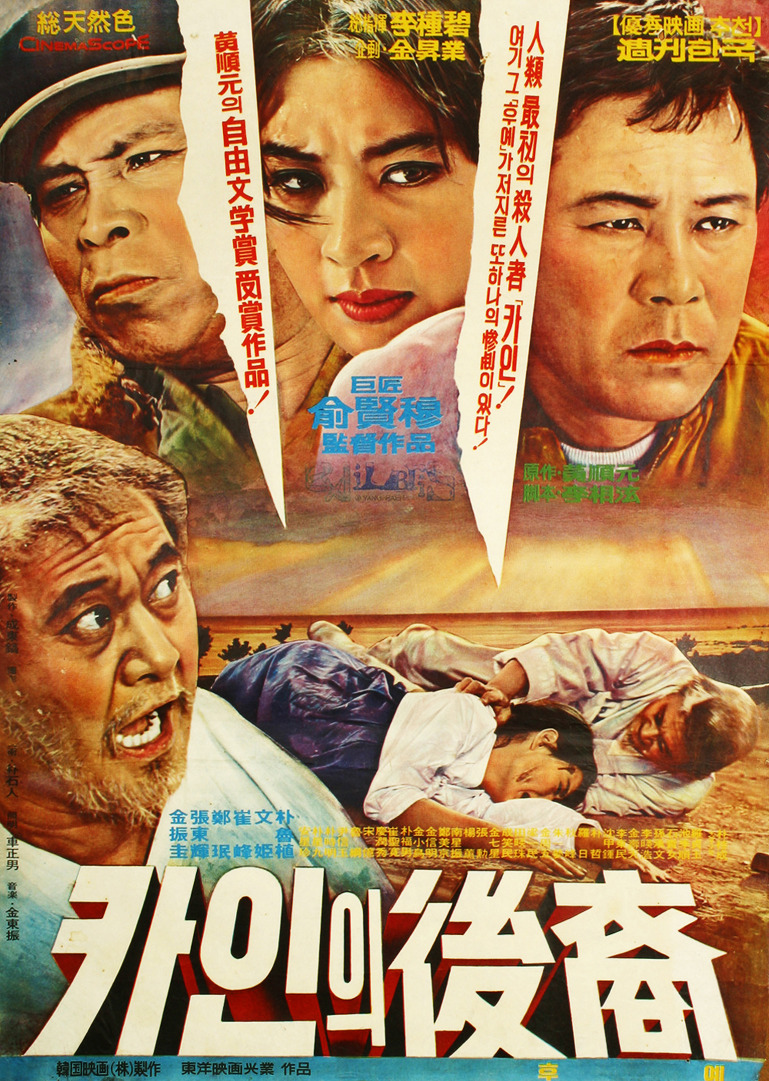
The Descendants of Cain (카인의 후예 / 카인의 後裔, Yu Hyun-mok, 1968)

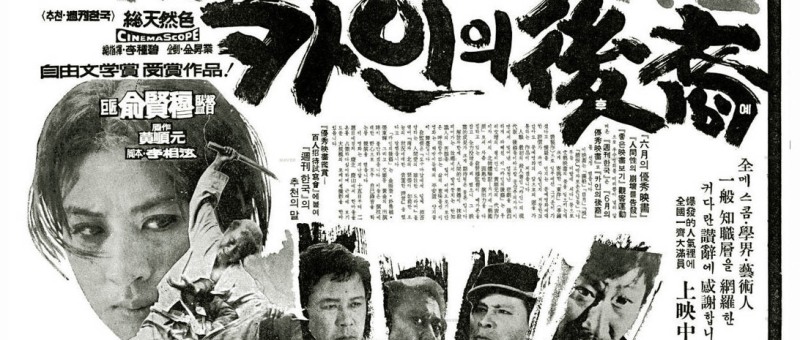
Descendents of Cain poster 1Yu Hyun-mok, often regarded as among the more “intellectual” of film directors in Korea’s Golden Age, is also among those to have been arrested for violation of the Anti-Communist laws. Yu was later exonerated and went back to filmmaking as before but it remains true that Yu betrays a little more ambivalence to the anti-communist message so often required than many of his colleagues. That is to say, Yu often leans economically left in his frequent criticism of social inequality and his anti-consumerist stance, but remains socially conservative if with a strong desire for social justice. The Descendants of Cain (카인의 후예 / 카인의 後裔, Kainui Huyea), adapted from a novel by Hwang Sun-won, is as anti-communist as they come, but also offers its share of ironies in painting “communism” as a kind of disease born of greed and self-interest which thrives on fear and eventually consumes those who are seduced by its false promises.

Irony is indeed our starting point as our cheerful villagers enjoy a raucous celebration in honour of Independence Day only for the communists to suddenly turn up and spoil the party. Worst of all, one of the communists is a long lost son of the village – Choe is the absentee husband of Ojaknyeo (Moon Hee), a maid, who has developed an affection for her boss, the nephew of the local landlord, Park Hun (Kim Jin-kyu). The communists’ first action is to close down the school that Park Hun opened to provide education for the peasants and co-opt it as their base. Park knows he’s in a dangerous position and has little power to resist, opting to wait it out and see how far the communists really intend to go. The peasants, however, are becoming excited hearing about the land redistribution programme and are starting to forget everything that Park and his family have done for them over the generations, swayed by the false promises of the communists who preach equality while insisting on deference.

The central conflict is, in many ways, between the feudal past and the “democratic” future. Set in what would shortly the “the north” in 1946, Descendants of Cain positions itself on more than one kind of dividing line with the lingering spectre of tragedy always on the horizon. High on a ridge there’s a large stone slab erected as a memorial to the late Park, Park Hun’s grandfather, whose solicitous care for the villagers had earned their eternal respect and perhaps their love. The Parks are “good” landlords. They take their “feudal” responsibilities seriously as evidenced by Park Hun’s school and his father’s desire to finish construction on the local reservoir which is both his legacy and an important failsafe precaution against draught which is in the interests of all. By all appearances this is a well functioning village where no one is hungry or alone. The peasants have not felt “oppressed” or been unhappy, which is not to say they don’t want to better their lot but they have no burning desire for revolution and have nothing in particular to rebel against.

This leaves the communists with a problem – they have little leverage over happy peasantry which has never acknowledged its own oppression let alone longed for freedom from it. Their approach is therefore one of divide and conquer. Cynical in the extreme, the communists set about exploiting petty village disputes to foster discord between people – something which eventually contributes to a murder which they also manipulate for political gain. The “landowners” are of course a prime target, but their judgement must be at the hands of “the people” by means of a farmers’ trial. Having recruited something close to a former village leader, the communists assume they will have the villagers on side but they all (bar two) refuse to indict the Parks. The communist leader, fond of irony, gestures towards towards his armed men and reminds the villagers that no one here is “impinging on their freedom”. That is, their freedom to express the views they are required to express or suffer the consequences.

Threatened with violence and intimidation, feudal deference bends or perhaps shifts to a different master. The villagers, losing their attachment to the Parks, salivate over the possibility of “redistribution” and of being handed “free land”. Their desires are material and not political. Thus when the Parks’ estate is “returned” to the people, they simply walk in and start taking things. Not the most sensible way to redistribute wealth concentrated in the hands of the elite – the fast get horses, the indecisive dented pans which sounds like a recipe for rancour and discontent. When the old village chief becomes disillusioned with his choices and smashes the memorial to old Park, a small fight breaks out among villagers keen to snag the large pieces of stone for various other projects. Happy peasants who once shared everything and wanted for nothing, are now fighting with each other over rubble and trinkets.

The communists, far from fostering collective spirit, have become the evil feudal lords they rail against, oppressing the peasants with their rules and regulations while wilfully creating an atmosphere of fear in order to better oppress them. Their hypocrisy is rammed home early on by the slimy Cheol who complains about his wife’s supposed faithlessness while molesting a barmaid and smugly repeating the story of a large scar he has on his forearm. His superior, believing he got the scar during a labour dispute at a mine, promoted him for his communist spirit, but Cheol really got the scar in a scuffle over a girl (not his wife, incidentally).

Cheol is “a” force which comes between the two lovers, Ojaknyeo and Park Hun, as both are too morally upright to pursue a full romance when Ojaknyeo is still married to another man, even if the other man’s first action on seeing her is to throw her to the ground and begin kicking the living daylights out of her. Later Ojaknyeo gets another, more serious, beating from her father but this time because she’s chosen the wrong side in refusing to step away from the feudal world in her responsibility to Park Hun and his household, even if that responsibility is partly romantic desire. Yet Park Hun and Ojaknyeo are also separated by the feudal world’s rules in their obvious class difference. Communism is supposed to break down these barriers, not to mention removing the “patriarchal tyranny” of marriage, yet the communists would rather award Ojaknyeo to her former husband, little caring that he is abusive and neglectful. Ojaknyeo, at least, will not be freed from her oppression any time soon.

If Yu is making a mild defence of paternalistic feudalism as a metaphor for compassionate government, it is probably a little ambitious given the times in which he lived. Following a regular pattern, Yu paints the world as a terrible place where fear and self interest trump all, only to find small rays of light in the closing moments when an act of violence provokes a series of unexpected epiphanies and reconciliations. He ends on a note of hope in which an older man sacrifices himself for a younger one but is then rewarded with the possibility of salvation and a happier future with the woman he loves (and is now unafraid to pursue) south of the border. Communism seduces and betrays, whereas liberal democracy at least affords the “freedom” to be miserable with personal integrity.


Screened as part of the Korean Novels on Screen season at the Korean Cultural Centre London.

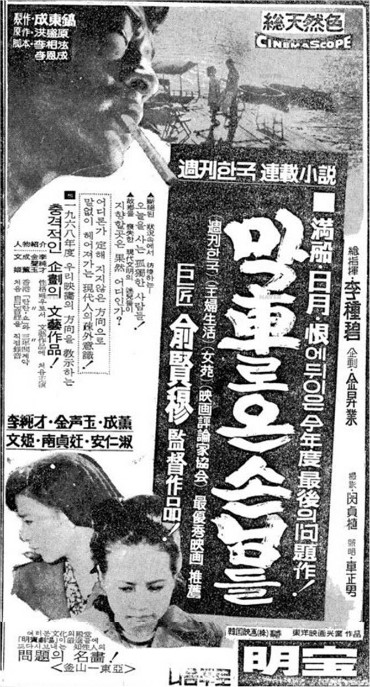
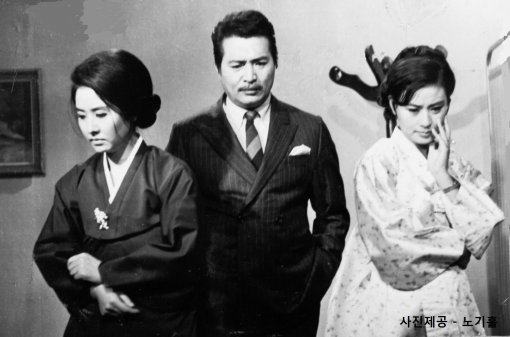
The Guests of the Last Train (막차로 온 손님들 / 막車로 온 손님들, Yu Hyun-mok, 1967)

guests who came by train 2Despite ongoing social and political oppression, the Korea of the 1960s was an upwardly mobile world in which increasing economic prosperity and global ambition was beginning to offer the promise of financial stability and a life of comfort to millions of young men and women, albeit at a price. Yu Hyun-mok, often thought of as among the most intellectual of “golden age” film directors, was a relatively infrequent visitor to the “literary film” but Guests of the Last Train (막차로 온 손님들 / 막車로 온 손님들, Makcharo on Sonnimdeul, AKA Guests Who Arrived on the Last Train), adapted from a novel by Hong Seong-won, is perhaps comfortably in line with his career long concerns in its focus on those who for one reason or another have been running to catch the rapidly departing train of modernity, pulling themselves on board just it prepares to pull away. A disparate tale of three men and their respective love interests, Yu’s film once again rejects the consumerism of the modern society in its cold and lonely search for soulless acquisition and finds comfort only in the fragile connections between the lost and hopeless.

The film opens behind a train station where a young woman, Bo-yong (Bo-yong), staggers and stumbles, grasping for something to hold on to but hardly able to stand. Eventually a man, Dong-min (Lee Soon-jae), turns up and tries to hail a taxi. Noticing the distressed woman, he manages to get her into a car and when she tells him she has nowhere to go, takes her home with him. Dong-min is currently off work with an illness which turns out to be terminal lung cancer and has only a few months left to live as a second opinion from his doctor friend, Kyeong-Seok (Seong Hoon), makes clear. Kyeong-seok is also facing a problem with a female patient, Se-jeong (Nam Jeong-im), suffering a nervous complaint after losing her wealthy husband and subsequently being hounded by her relatives over the inheritance. When Se-jeong leaves the hospital the pair end up having an affair but the money continues to present a problem – neither of them want the hassle of dealing with it. Meanwhile, Dong-min and Kyeong-seok reunite with another old friend, Choong-hyeon (Kim Seong-ok), who has just returned from Japan apparently having become fabulously wealthy. Choong-hyeon has pretensions of becoming an avant-garde artist, but is unable to get over his ex-wife who has left him to become a famous actress.

Each of the three men is in someway arrested, unable to move past something towards the future rapidly rolling away from them like a train leaving the station. Dong-min’s depression and listlessness is understandable given that he’s facing a terminal illness and knows that he has already reached the end of the line. Yet his ennui began long before. Kyeong-seok, describing his friend to a colleague, disapprovingly remarks that he used to be a mild-mannered bank teller but left to become a freelance translator and journalist. Unable to put up with the stringent, high pressure world of work Dong-min removed himself from it to try and grasp his freedom only to remain dissatisfied and eventually defeated by a cruel and arbitrary illness. Even so he retains his human feeling as demonstrated by his decision to help Bo-yong rather than leave a vulnerable woman alone to suffer on the streets. Staring blankly at the calendar on his wall, avoiding tearing off the sheets which serve as an all too obvious symbol of his limited time, he falls slowly in love with the woman who remains at his side whilst knowing that his existence is futile and doomed only to tragedy.

Kyeong-seok, by contrast, is merely disaffected. Dragged into a relationship with Se-jeong originally unwillingly, what he resists is responsibility. He wants to help her, but he does not want to get involved with her complicated familial and financial problems. As so often in Yu’s films, money is the root of all evil, presenting barriers between people where there should be none. Neither Kyeong-seok or Se-jeong are very interested in the money for its own sake, they want only simple lives of adequate comfort and emotional fulfilment – something which the hassle of dealing with other people’s money hungry machinations will actively destroy.

Money has also, in a sense, destroyed Choong-hyeon’s hopes though more through his misplaced faith in its ability to buy him back what he’s lost. His relationship with his wife is clearly over, she has chosen something else which is her right and privilege, but Choong-hyeon can not accept it and continues to look for her in all he does. Attempting to become an “artist” himself, he uses his money to get himself a show featuring his avant-garde pop art creations but neither of his friends rate his work or is careful enough about his feelings to avoid criticising it. Choong-hyeon spirals out of control, becoming dangerously obsessed with a schoolgirl he somehow wants to imagine as his wife. Dong-min and Kyeong-seok suspect that he will kill himself, but by this point they aren’t sure if they should care. What would they be saving him for? There is no possible salvation – no one can save anyone else, and no one can save themselves. Each is an individual and can offer no excuses. Love and friendship are but scant comfort in a cold and lonely world.

Meanwhile, the women continue to suffer in silence. Yu chooses to focus on his trio of male misfits rather than the pair of unlucky women whose story lies at the centre of the narrative. Se-jeong married an older man for apparently legitimate reasons but the marriage was unsuccessful and also ruined her friendship with her husband’s daughter who, unsurprisingly, turns out to be Bo-yong. Looking for love and not money, Se-jeong is only holding on to her inheritance in the hope of someday reconciling with Bo-yong and handing it all to her. Meanwhile, Bo-yong has been on the run from her former life. Once an air stewardess, Bo-yong dropped off the radar when a former fiancé planted drugs in her suitcase and got her sent to prison. Like Se-jeong she is looking for support and companionship and finds it in the kind if melancholy Dong-min, vowing to stay by his side even if she knows their time it limited. The two women are eventually “reunited” at a wedding, but the crowd keeps them apart, breaking into factions fighting over the inheritance that neither Se-jeon or Bo-yong actually want.

Yu declines to tell us whether the women are eventually able to meet and repair their friendship, but he does make clear that both have rejected the superficial comforts of wealth in asking for a small and simple life with their respective partners. In this he offers both hope and despair. The couples are rejecting the new future their nation has planned for them, yearning for small comforts and an end to their loneliness and struggling to find it in an increasingly alienated world. Bo-yong, at least, steps forward to grasp her chance at happiness however small it maybe, waiting for the train and seeing red lights change to green only when her gesture of sincerity is finally accepted.


Available on DVD as part of the Korean Film Archive’s Yu Hyun-mok boxset. Not currently available to stream online.

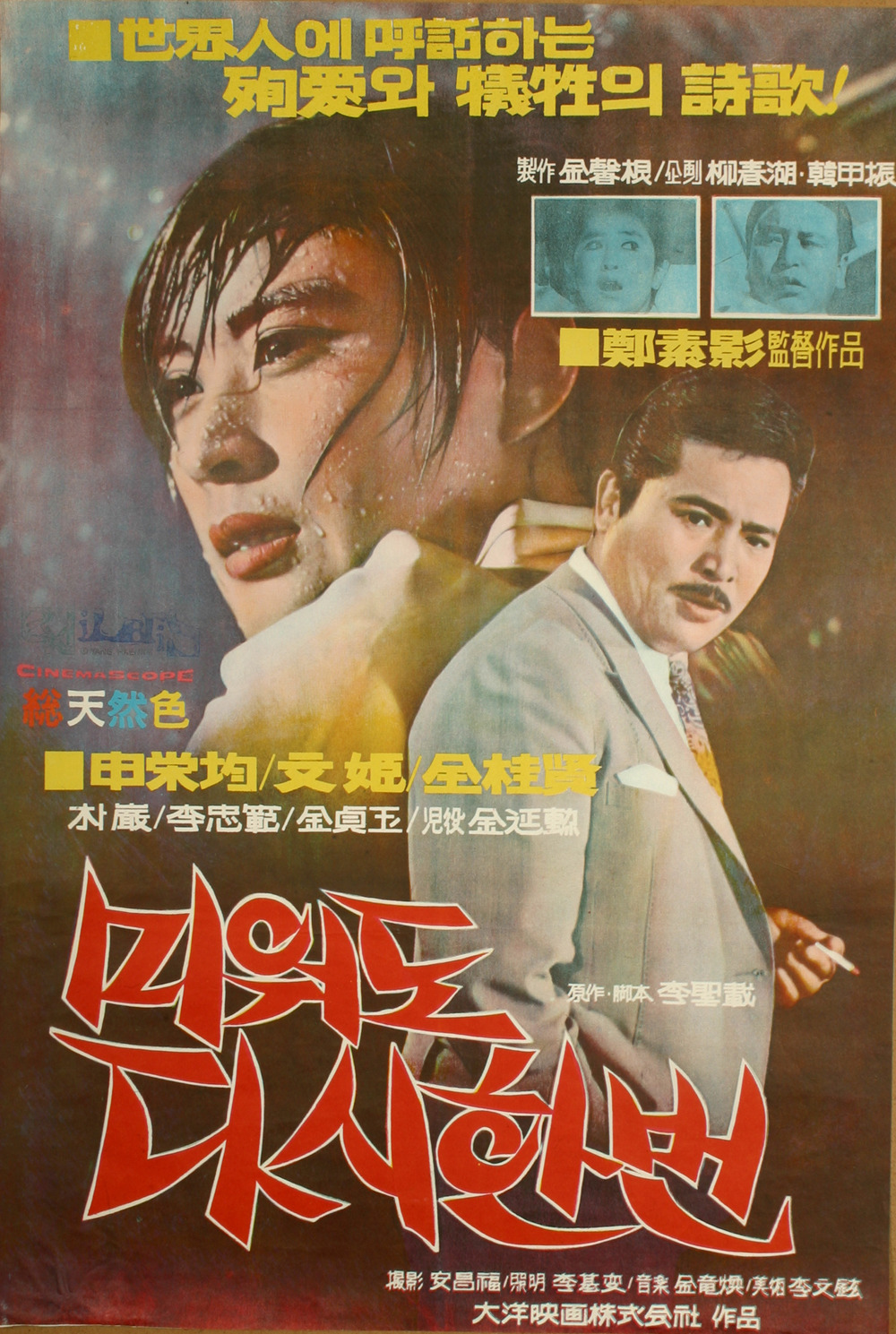
Love Me Once Again (미워도 다시 한번, Jung So-young, 1968)

love me once again posterBy the late 1960s, Korean society was caught in a moment of intense social change. Though under the oppressive authoritarian regime of Park Chung-hee, the strict censorship regulations of the early 1970s had not yet taken effect and the 1962 Motion Picture Law which encouraged a shift towards commercial cinema intended for mass entertainment created a fertile ground for melodrama which itself enabled subtle commentary on modern society. The first in what would become a long running series with two sequels and a number of remakes stretching into the 1980s, Love Me Once Again (미워도 다시 한번, Miweodo Dasi Han Beon) is a prime example. A box office hit and pop culture phenomenon, Love Me Once Again is a somewhat unusual entry the melodrama canon in its broadly sympathetic treatment of adultery and attitude towards children born out of wedlock.

The film begins in the present as family patriarch Shin-ho (Shin Young-kyun) enjoys a pleasant family Sunday fishing with his son and picnicking with his wife (Jeon Gye-hyeon) and daughter but the scene is quickly interrupted by a servant who comes to fetch Shin-ho to greet an urgent visitor to the house. The visitor turns out to be an old friend of Shin-ho’s who has a distressing message for him – Hye-young (Moon Hee), a young woman with whom he had an affair eight years previously, is back in town and would like to meet.

Flashing back eight years, Hye-young is a young kindergarten teacher living in the lodging house where Shin-ho is staying while working away from home. The pair become friends and everyone seems to assume they are a couple, though Shin-ho insists Hye-young is just a friend. Nevertheless, he eventually begins an affair with her leading Hye-young to turn down a marriage arranged by her parents. Though Shin-ho discourages her to do this, Hye-young has no idea he is already married with two children and believes he will marry her at some point in the future. Shin-ho plans to tell Hye-young about his wife but can’t bring himself to do it, allowing her to find out in the worst possible way when his wife arrives with both kids in tow. Realising she’s been duped and feeling in the way, Hye-young takes off without warning leaving only a letter wishing Shin-ho well and letting him know that she is pregnant with his child and intends to raise it alone.

Hye-young is certainly a very “modern” forward thinking woman though she is also morally upright, only embarking on a relationship with Shin-ho because she believes he is the man she will spend her life with. Her family had arranged a marriage for her and express their frustration with Hye-young for not returning home immediately in a letter which also makes plain that they will suffer embarrassment if she refuses the marriage altogether – which she does. When she returns home pregnant with Shin-ho’s child, her brother (who seems to be the head of the family), throws her out. Hye-young’s mother seems more sympathetic, but is powerless to help. Hye-young will have to manage on her own without the assistance of friends or family.

Eight years on she has a lovely little boy, Young-shin (Kim Jung-hoon), whom she has raised alone in hardship but not unhappiness. Encouraged by her brother and seeing how Young-shin looks on enviously at other little boys playing with their fathers on the beach, Hye-young begins to wonder if it might not be better to have Shin-ho raise Young-shin alongside his other two children in a middle-class family home. As Shin-ho’s son he would have a life of material comfort, a paternal input, and be free of the stigma of being the illegitimate child of an unmarried single mother.

Though the situation is difficult, it is handled with calm and maturity on all sides, not least from Shin-ho’s wife who takes a while to think hard on the situation and then agrees to look after Young-shin but only as a full adoption. She asks that Hye-young refrain from writing to or seeing her son, leaving him entirely in the family’s care. Hye-young has made her decision and agrees that may be for the best, even declining the offer of written updates from Shin-ho’s best friend. Once Young-shin has become a part of Shin-ho’s family, his wife truly does her best to make him feel at home as the third of her children, treating him kindly and taking the older two to task for teasing their “baby brother”. The children however are not quite so accepting with Shin-ho’s eldest son particularly hostile, bullying little Young-shin mercilessly even though he has done nothing to provoke his anger other than try to be friends with him. Getting a new little brother is perhaps particularly hard for the children who now have to share everything with a virtual stranger, but despite the efforts of Shin-ho’s wife, she just can’t seem to make them accept him.

Shin-ho, feeling awkward and guilty, is not quite as committed as his wife is to making the new family work. He tries to treat Young-shin as his son, but never quite connects with or makes him feel at home. The major problem is that the family all insist Young-shin must forget about Hye-young and commit fully to his new family as they are committing to him but that’s a lot to ask for an eight year old boy who quite fairly misses his mother and does not understand why he is not allowed to see her. A crisis occurs when Shin-ho angrily confiscates a locket Hye-young had given Young-shin containing her photo as a memento, sending him off on a long journey trying to find a way back to his mother. Being only eight, Young-shin has no idea how to go about finding her bar knowing the name of the town where he used to live. Roaming around the city all alone calling his mother’s name, Young-shin stays out all night. Shin-ho and his wife are sick with worry, searching for him in the pouring rain, but when he finally returns drenched and miserable, Shin-ho treats him only with anger and not with tenderness.

Meanwhile, Hye-young is struggling to come to terms with her decision to “abandon” her son, having bad dreams that Young-shin is being mistreated or is miserable, missing her as much as she misses him. Obeying the family’s request to stay away, Hye-young cannot resist coming to visit and observing from far away, hoping to catch a glimpse of her son and find out if he is well and happy. Unfortunately she turns up just as he’s gone out looking for her and spots him cowering outside Shin-ho’s house, drenched in the rain. Afraid to go near him she urges him to go inside, calling out from the shadows only to be spotted by Shin-ho as she makes her escape.

Rather than wallow in misery, Jung does not refuse the inherent melodrama of the situation but addresses it realistically and with a degree of maturity and patience most real life situations can only aspire to. Hye-young believes that Shin-ho hates herself and her son and will never be able to accept them as members of his family, but even so he does appear to have developed at attachment to Young-shin and hopes that he can maintain contact with him even if it remains clear Young-shin cannot remain in their home. Shin-ho’s wife too makes a point of not blaming Young-shin for her husband’s mistake and displays compassion for Hye-young who meant her no harm and has incurred only suffering as a result of her involvement with Shin-ho. Where most melodramas would punish Hye-young for her transgressions, Jung is kinder to her, never condemning her for her “immoral” behaviour in sleeping with Shin-ho before marriage and making it clear that her decision to live independently as a single woman and raise Young-shin alone is not only valid but correct and to be supported. A controversial attitude for the Korea of 1968 but one which declares itself on the side of modernity rather than adherence to traditions which more often than not create more problems than they solve.


Available to stream for free via the Korean Film Archive’s YouTube Channel.