Wedding High (ウェディング・ハイ, Akiko Ohku, 2022)

“Today is the best day of our lives” a couple exclaim seconds before taking their marital vows, but if you think about it, isn’t that just a way of saying that it’s all downhill from here? Even the determined wedding planner at the centre of Akiko Ohku’s ensemble comedy Wedding High (ウェディング・ハイ) admits that a good wedding day doesn’t amount to a good marriage and it’s certainly true that almost everyone in attendance has rather overhyped the occasion insisting that it’s a grand turning point in their lives even if they aren’t the ones swearing eternal devotion at the altar. 

Groom Akihito (Tomoya Nakamura) didn’t even really want a wedding, they are after all expensive and time consuming, but is paranoid that not having one, or having one that’s not quite right, will eventually poison his relationship with his soon-to-be wife Haruka (Nagisa Sekimizu). For him the day has to go well, or at least Haruka has to feel as if she’s had the best day of her life, or their marriage will get off to a bad start. Meanwhile they’re under pressure from friends and family members trying to decide on a guest list especially considering that key guests are expected to handle entertainment with both sets of fathers and an eccentric uncle keen to get in on the action while it’s also customary to invite one’s boss to give a brief speech at the reception. 

Akihito’s boss Zaitsu (Katsumi Takahashi) doesn’t exactly try to steal the day but does invest it with a surprising degree of personal significance, oddly touched that Akihito has asked him despite his having been disgraced at work because of a sleazy scandal in his personal life. Zaitsu sees the wedding speech as a chance for a comeback, obsessively studying standup comedy determined to deliver a genuinely funny routine that will make everyone laugh and perhaps conclude that he’s not such a bad guy after all. For Akihito’s schoolmate Shinji (Akiyoshi Nakao) the wedding becomes something similar, allowing him to regain his creative mojo after hating himself for being trapped in variety television having dreamed of becoming an arthouse movie director when Akihito tasks him with directing a wedding video to be shown at the reception. Even one of Haruka’s friends from high school dance club launches into a story about how this is their big chance to make up for their final performance being cancelled due to injury by performing it again at Haruka’s wedding.

A subplot sees Haruka’s uni ex (Takanori Iwata) decide this is his big day too, planning to storm the ceremony and win her back. He’s convinced himself they only broke up because he reacted in the wrong way when she mentioned her parents’ wanted to introduce her to a guy for an arranged marriage and thinks she’s sent him a coded message that she’s being pressured into an unwanted union and needs rescuing before it’s too late. Somehow Maho (Ryoko Shinohara) manages to keep everything running smoothly, springing into action when the couple’s big day gets derailed by competitive speech making and pretty much everyone else trying to have their moment, yet as her colleagues remind her it’s the next couple’s big day too and the last thing they want to do is spoil that by trying to save Akihito and Haruka’s wedding from falling into complete chaos. 

Like most Japanese ensemble comedies, the resolution turns on the team pulling together to make everything work out. In this case, Maho’s speed wedding strategy leads to something genuinely beautiful and better than the original plan in allowing the couple’s friends and family who may not have known each other before to present a united front of support that neatly symbolises their union as a couple and makes their special day a little more special than it might have been if everything had gone smoothly. Almost everyone does indeed get something from the big day even if it wasn’t what they originally thought they wanted, seizing the chance for a new beginning or to put the past behind them. Asked to boil her speech down to the bare minimum a high school teacher (Hairi Katagiri) offers the simple advice “be happy” while Maho reflects on her role in the proceedings admitting that a good wedding day doesn’t necessarily mean you’ll have a good marriage but at least you’ll have a few good memories if it all goes wrong somewhere down the line. 


Wedding High screens at Japan Society New York on Nov. 11 as part of The Female Gaze: Women Filmmakers from JAPAN CUTS and Beyond

Original trailer (no subtitles)

Images: © 2022 Wedding High Film Partners
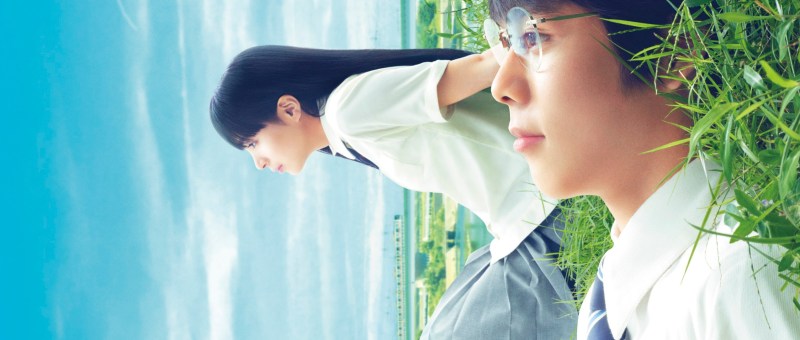
Almost a Miracle (町田くんの世界, Yuya Ishii, 2019) [Fantasia 2019]

MNS_MAIN_B1_0311_ol“Being nice to everyone means hurting someone” the wounded heroine tries to explain to the perpetually confused hero of Yuya Ishii’s Almost a Miracle (町田くんの世界, Machida-kun no Sekai). After adapting a book of poetry and topping the Kinema Junpo list with the melancholy romance of urban ennui The Tokyo Night Sky is Always the Densest Shade of Blue, Ishii returns to the lighter fare which inspired his earliest work with a whimsical adaptation of the manga by Yuki Ando in which a goodly young man begins to realise that sometimes being nice to everyone can create additional complications.

The titular Machida (Kanata Hosoda) is one of those people who seem to be exclusively composed of goodness. He truly believes that each and every person in the world is precious and loves them equally, so when he sees someone, anyone, who seems unhappy or in need of help he comes running (literally). Everything begins to change for him, however, when he injures himself during an art lesson and is sent to the infirmary where he meets sullen delinquent Inohara (Nagisa Sekimizu) who bandages his hand in the absence of the nurse. Entirely unused to people doing nice things for him, Machida is struck by this unexpected act of kindness and resolves to make a friend of Inohara who seems lonely and claims to hate people – something Machida is incapable of understanding.

Indeed, nicknamed “Christ” by some of his more cynical classmates, Machida sees only the world’s beauty and just wants people to be happy. He assumes that’s the way everyone else feels too and so it doesn’t really occur to him that some people are just mean. Even when he meets someone acting badly he has a knack for spotting the unhappiness that lies behind it and the desire to help them heal. Thus he alone sees the accidental self-loathing and pathological need for acceptance that have led pretty boy model and popular kid Himuro (Takanori Iwata) to become a self-centred jerk who thinks sincerity is for babies and that “taking things seriously only makes everything harder”. He may have a sort of point in that it’s much easier to keep pretending nothing, especially other people’s feelings, is very important but it’s Machida alone who is perspicacious enough to remark on how sad it is that all of his “friends” have forgotten something he told them just a few minutes ago and instructs him that he needs to be kinder to himself rather than hanging out with vacuous people who don’t care about him at all just for the kudos of superficial acceptance. 

In fact, much of Machida’s laidback superpower is geared towards getting people to be more comfortable in themselves so that they can in turn accept others. Ironically, that’s mostly because he hasn’t yet quite accepted himself and thinks he’s the worst human of them all which is part of the reason he’s so nice to everyone as a means of repaying the kindnesses he’s been shown in the past.

Where Machida sees only the world’s beauty, cynical failed writer Yoshitaka (Sosuke Ikematsu) sees only its ugliness. His lofty literary ambitions having fallen by the wayside, Yoshitaka has become a tabloid hack and occasional paparazzo whose wife is beginning to lose faith in him as he sinks deeper into the morass of scandal rag “journalism”. Yoshitaka justifies his actions with the rationale that the world is rotten, filled with “evil” and home to only self-interested people who revel in the suffering of others. Several random encounters with Machida, however, force him to revise his opinion – if someone that good and that pure really exists then what does it say about the rest of us?

Then again, Machida’s guileless goodness can often make him accidentally insensitive as he tries to balance one person’s expectation of happiness against another’s. Thus he gets himself mixed up in an odd kind of love triangle with Himuro’s old girlfriend Sakura (Mitsuki Takahata) and the lovelorn Inohara who is becoming increasingly exasperated by Machida’s mixed signals, unable to figure out if he’s just being “kind” or actually might like her. Unfortunately, Machida doesn’t quite know himself as, ironically seeing as he’s so keen on emotional honesty in others, he is remarkably out of touch with his own feelings. In any case, his desire for “sincerity” in all things sees him steer clear of saying something which isn’t true to make someone happy even if he finds himself unable to express the truth plainly when it really counts.

Machida’s superpower, however, blows through the world like a gentle breeze spreading goodness wherever it goes. Proving it really does come back around, all the people that he’s helped eventually come running to help him so he can achieve his romantic destiny on the most romantic of days. A whimsical celebration of the infectious power of unguarded goodness, Almost a Miracle is a beautifully pitched counter to nihilistic cynicism in which kindness becomes a kind of superpower, saving the world one lost balloon at a time.


Almost a Miracle was screened as part of the 2019 Fantasia International Film Festival.

Original trailer (English subtitles)