In Search of Mother (瞼の母, Tai Kato, 1962)

The toxic hyper-masculinity of the yakuza world conspires against a sensitive young man who longs to reclaim his place in society through reuniting with the mother who was forced to abandon him at five years old in Tai Kato’s hugely moving jidaigeki, In Search of Mother (瞼の母, Mabuta no Haha). Adapted from a kabuki play by Shin Hasegawa, Kato’s wandering tale is perfectly tailored for post-war concerns situating itself in a world of mass displacement, economic inequality, and lonely regret in which the secrets of the immediate past have become a threat to the promise of the near future which may then in itself prove unrealisable. 

As the film opens, 25-year-old Chutaro (Kinnosuke Nakamura) is trying to stop his hot-headed friend Hanji (Hiroki Matsukata) from taking revenge on a rival gang on behalf of their boss who is to them something like a father figure. Chutaro reminds Hanji that he has other ties and should think about the mother and sister who wait for him in his hometown to whom he should return and attempt to live an honest life, the possibility of which Chutaro is deprived because he is an orphan with no home or family to turn to. His pleas fall on deaf ears, Hanji reminding him of the code by which they live. “What’s going to happen to my pride as a man?” he exclaims, later telling his mother “I’m not a man if I don’t accept their challenge”. “If that’s the case then don’t be a man” she counters, physically preventing him from leaving as if Hanji were a still a child but to him it seems life is not worth living if you are not accounted a proper “man” by the values of the society in which he lives. When Hanji’s sister Onui (Hitomi Nakahara) attempts to plead for him, the gangsters explain to her that they are trapped too, they cannot return without fulfilling this debt of honour. “That’s not how it works miss, if we let him go after he attacked our boss we won’t be able to survive in our world.” 

Just as Chutaro searches for his long lost mother in order to reclaim his place in mainstream society, he is pursued by the gangsters desperate to redeem themselves through revenge. Eventually arriving in Edo by winter, he adopts the rather unscientific tactic of stopping every middle-aged woman he comes across and asking her if she might once have had a son. The first of these is a blind shamisen player whom he witnesses being cheated by man who makes a point of dropping the coin he was to give her back in his own pouch to make it sound like he paid when he didn’t and then getting indignant when he she calls him on it. The woman gives her age as 50 though looks 20 years older and relates her own sad story of widowhood and a son she had to give up but is not Chutaro’s mother. In any case he gives her a large amount of money out of a kindness he might hope someone would show to his own mother were they in his position. 

He does something similar with the next woman, Otora (Sadako Sawamura), a sex worker, like him ostracised by the world around her, who had a son who died in infancy and is now rejected by a judgemental society for doing the only thing she can to survive. Kato films each of these poignant moments in long unbroken takes tinged with the desperation and loneliness of two people looking for something from the other which in the end they are not able to give each other only find relief in their shared sorrow. Nevertheless the encounters also expose the difficulties faced by women in this era in which they must be dependent on men, the shamisen player suffering in her widowhood and Otora left with no choice than to engage in sex work which then exiles her from society at large just as Chutaro is rendered an outcast because of his yakuza past yet as he later explains what else could a child without parents have done?

This is something which might press heavily on the minds of a post-war audience in which the plight of war orphans and otherwise displaced children was all too familiar. In terms of cinema, the yakuza is often presented as a surrogate family in which orphaned boys can replace unconditional love with the mutual solidarity of a brotherhood defined by highly codified existence. Yet Chutaro longs to repair his connection to mainstream society by finding his mother, carrying around money he has saved in order to help her should he discover that she, like Otora and the shamisen player, is living in poverty. What he did not consider, however, is that she may reject him. Acting from a tip off from Otora he pays a visit to a local store run by Ohama (Michiyo Kogure) who unlike the other women has been able to build an independent life for herself and is preparing to marry off her daughter Otose (Keiko Okawa) to a wealthy merchant’s son. When Chutaro first appears, she assumes he is a conman fed information by Otora, admitting that she once had a son by his name but was told he had died in an epidemic when he was nine. Just as we’d seen her reject Otora lest she expose her sex worker past, she rejects Chutaro in fear that his yakuza ties will ruin her reputation, wreck her daughter’s marriage, and disrupt the comfortable life which she worked so hard to create just at the moment of its fruition. 

“You are suspicious of people because you have wealth” Chutaro points out, making plain the various ways in which economic inequality continues to disrupt the bonds between people. As we discover, Ohama was forced to abandon him because his father was abusive. In that era it would not have been possible to take her son with her and so she made her peace with leaving him but despite herself is now conflicted on witnessing him crying in front of her like a child while afraid to acknowledge him lest it disadvantage her daughter. The problem here is not that her past is shameful or a secret, Otose knows she had an older brother, but the fact that Chutaro has become a yakuza with judgment unfairly placed upon him for simply doing what he could to survive without parents to care for or guide him. Too late, Ohama realises she has made a terrible mistake. She and Otose go out to look for Chutaro but either too hurt by the rejection or having come to believe that he cannot escape his yakuza past, he lets them pass him by resigning himself to the fate of a lonely wanderer. Shot entirely on stage sets more often from mid-height rather than his characteristically low perspective and with additional fluidity mimicing Chutaro’s restless sense of displacement, Kato’s take on this classic tale is a profoundly moving examination of the effects of oppressive social codes on even the most essential of connections. 
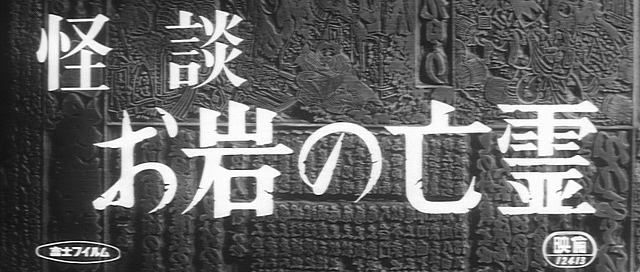

The Tale of Oiwa’s Ghost (怪談 お岩の亡霊, Tai Kato, 1961)

Yotsuya Kaidan is among the most well-known and enduringly popular of Japanese ghost stories. Originating as a kabuki play first staged in 1825, it has inspired countless film adaptations though Tai Kato’s The Tale of Oiwa’s Ghost (怪談 お岩の亡霊, Kaidan Oiwa no Borei) from 1961 is accounted among the most faithful despite the variation in its title. Usually regarded as a cautionary tale about a man whose ruthless ambition destroys his humanity earning him supernatural retribution, Yotsuya Kaidan is also a tale of female vengeance as Kato’s slight refocussing makes plain. In this version of the tale, all of Tamiya Iemon’s problems are, aside from the offscreen murder for which he has already been exiled from his family before the film begins, caused by female subjugation.

Having married into Oiwa’s (Yoshiko Fujishiro) family, Tamiya (Tomisaburo Wakayama) is in a rueful mood even as the film begins. After randomly killing a man in a fight some time previously, Oiwa has left him because, quite reasonably, she does not want to be in a relationship with a murderer nor do her family wish to be associated with someone stained with such a serious crime. Noticeably ragged, Tamiya swears he’s going to get Oiwa back because he’ll “never find another woman with such a beautiful body”. He wants her firstly because she has rejected him and his pride is wounded, secondly to regain his status, and thirdly because for the moment she is a glittering prize though he’ll later come to tire of her. 

Tamiya is hanging around because he wants to talk to his father-in-law about reinstatement but he is currently meeting with a “masseuse”, unbeknownst to Tamiya planning to sell his second daughter Osode (Hiroko Sakuramachi) to a brothel in order to pay a debt. He has been assured that his daughter will not be expected to participate in sex work but will be running a toothpick stall near the temple. Needless to say, both he and Osode are very much mistaken and once the money has changed hands Takuetsu (Atsushi Watanabe), doctor and owner of the brothel, can do whatever he likes. Tamiya doesn’t much care about Osode, encouraging his lusty friend elixir pedlar Naosuke (Jushiro Konoe) who declared her the more beautiful of the sisters to buy her body that very night. You wouldn’t think Naosuke could afford it but he decides to do just that, only to be gazumped by Osode’s conflicted fiancé Yomoshichi (Sawamura Sojuro) who is about to depart for Edo with the lord for a year the very next day. Rather than save her, Yomoshichi merely takes her virginity and asks her to wait for his return in a year’s time, leaving her in the brothel. 

Both Oiwa and Osode are essentially made to pay for their attempt to refuse male subjugation. Naosuke has “bought” Osode’s body and feels entitled to have it, attempting to rape her while she violently refuses him. His resentment leads him to plot Yomoshichi’s murder, but he mistakenly ends up killing his friend instead while Tamiya takes the opportunity to kill his father-in-law and reunite with his wife under the pretext of revenge for a crime he himself committed, essentially gifting Osode to Naosuke as a kind of reward. But Tamiya isn’t satisfied because he remains poor and lowly. His wife may be from a previously well respected samurai family, but he’s having to resort to making umbrellas to get by and now that Oiwa has given birth to their child he no longer finds her so “beautiful”. Bearing out the misogyny in their society, the men joke that Tamiya had been hoping his wife would die in childbirth so he’d be free of her at last. 

It’s at this point that he is offered an opportunity. Oume (Yumiko Mihara), the daughter of the wealthy Ito family of merchants fell in love with Tamiya when he returned her comb to her after a tussle in the square. Moving in nearby, the Itos are keen to persuade Tamiya to marry Oume but he has a wife and child already. The source of Tamiya’s heartlessness is it seems a kind of toxic masculinity, his intense sense of insecurity and a need to prove himself through promotion that fuels his obsession with advancing up the ranks to serve the shogun. As much as this is about inhumanity, it’s also about a society in flux. Unlike Naosuke, Tamiya is a samurai. The Itos are members of a new middle class whose increasing wealth is beginning to threaten the social order of the tightly regimented feudal society. Mr. Ito wants to make his daughter happy, or so he says, but marrying her to a samurai and therefore into the ruling class even if that ruling class is impoverished and possessed of only illusionary power is certainly advantageous. It is however somewhat irrational to encourage a man to murder his first wife so he can marry your lovestruck daughter, it does not bode well for her future safety. In any case, Tamiya is aware that “one’s reputation affects one’s promotion prospects” and so is unwilling to simply kill Oiwa without “a good reason”, later deciding to try and frame her for adultery which would make her death not only permissible but in fact socially mandated.  

In this age a woman’s life has no value, as Oiwa eventually sees. Tamiya gets the adultery idea after catching sight of the bodies of a samurai woman murdered for having an affair with a servant, marking her double transgression against the social order in both advancing her own agency over her body and her love for a man who was not of her own social class (assuming of course that there was any kind of relationship at all and they haven’t simply been killed on pretext by a man like Tamiya). Oiwa’s ruined face, caused by poison disguised as medicine, is symbolic of her social disfigurement, turning her into a “monstrous” woman who vows revenge on the man who has so maliciously wounded her. She asserts her own agency only in her death, choosing to pursue her vengeance from beyond the grave.

Yet it’s not only Tamiya who must pay, but the Itos too for their attempt to cheat the class system. Unlike other retellings, there is little suggestion that Tamiya’s torment is psychological, he is quite literally haunted, taunted into ruining his bright future by exorcising the demon of crime. Unusual for a Toei programmer of the time, Kato’s camera has New Wave verve, replete with handheld photography and swooping zooms while making use of his characteristic low angle composition but the final confrontation precipitated by a literal storm and earthquake which implodes the transgressive world Tamiya and the Itos are forging, is realised with expressionist ferocity. Tamiya tries to atone by taking refuge in a temple, but is undone not perhaps by guilt but by regret in realising he has destroyed his much hoped for chance of advancement and thereby rendered his existence meaningless. 

Returning the play to its roots, he dreams his relationship with Oiwa as kabuki dance until woken by the sight of her ruined face, demanding to be freed from his torment. Yet vengeance comes in realer terms and it is Osode who strikes the blow, striking back on behalf of her sister and herself as a representative of all wronged women, while Naosuke can only lament that “this life had nothing good in it” as he too pays for his transgressions. Osode reclaims her mother’s comb and with it restores the social order while simultaneously rejecting her subjugation at the hands of duplicitous men, laying Oiwa’s unquiet ghost to rest as she leaves the venal past behind for a (presumably) less inhuman world. 


Original trailer (no subtitles)