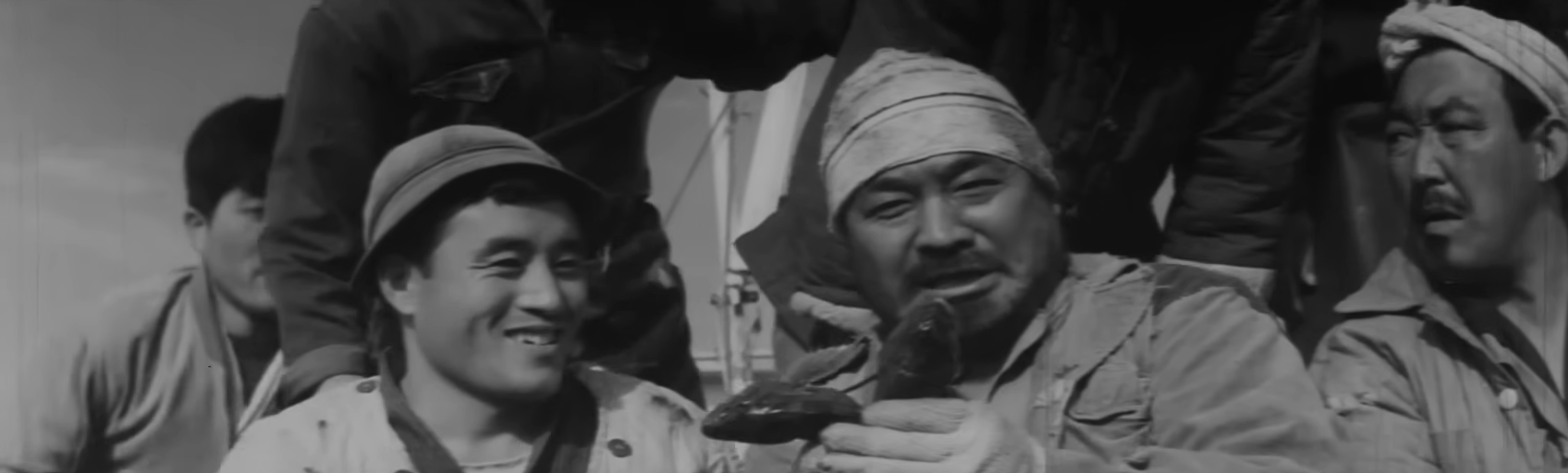
Full Ship (滿船 / 만선, Kim Soo-yong, 1967)

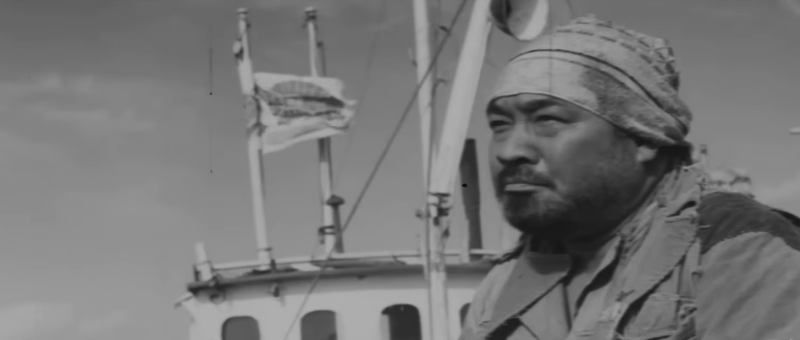
Released two years earlier, Kim Soo-Yong’s The Seashore Village had focused on the lives of women left behind while their husbands went to sea. Full Ship (滿船 / 만선, Manseon), meanwhile, more closely examines the lives of the men themselves along with the increasing pull towards modernity as this very traditional way of life becomes ever more precarious. Based on a play and another of Kim’s literary films, it nevertheless flies close to the wind in subtly challenging the effect that feudalistic capitalism has on each of these men’s lives as they find themselves dependent on the whims of the shipowner.

As Gom-chi (Kim Seung-ho) says, he’s fifty years old and he’s spent his life captaining someone else’s boat. Yet, he’s spent a lot of it toadying for the shipowner and justifying his reluctance to pay the fisherman by citing the shipowner’s expenses which include fuel for the boat, paying the union, and mending nets. The shipowner claims that he lives off debts and the fishermen actually owe him because he’s been lending them money and expects them to pay him back. Some of the other men suggest holding a gut ritual in his honour, but it’s unclear whether the shipowner is really as strapped as he says or merely hoarding all the money for himself. He dresses in fancy hanbok and looks more like a feudal lord than a contemporary business owner. When the fishermen do indeed come in with full boats and expect they’ll finally be getting what they’re owned, they receive only sacks of rotten hulled barely rather than rice. Still, most of them feel they have no choice than to suck up to the shipowner with even Gom-chi agreeing there are expenses to pay while drunkenly letting slip that he has savings and plans to buy his own boat only for the shipowner to find out and ban him from going to sea until he pays up what he owes.

Which is all to say, they’re between a rock and a hard place though “sea-crazy” Gom-chi holds tight to this way of life and has become estranged from his oldest surviving son Do-sam (Namkoong Won) who refuses to become a fisherman while Gom-chi’s wife, who has just given birth to a late baby though already in middle age, is opposed to letting their newborn grow up to go sea. They’ve already lost two sons to the waves, while Gom-chi’s father and grandfather were taken by the waters. To his mind, a fisherman dying at sea is merely going home and Do-sam is a failure and a coward for not following the tradition. 

He blames this on the fact that Do-sam left the island to do his military service and has become corrupted after seeing a different way of life on land. Another man who escaped the island, Beom-soe (Park Noh-sik), has returned wearing a suit and looking like a successful businessman, though as we later discover he’s on the run for a crime committed in the city, symbolising what the end results of this urban corruption may be. Seul-seul (Nam Jeong-im), Gom-chi’s daughter, is also tempted by the city while travelling there to sell goods though almost run over by a bicyclist on her arrival demonstrating its many dangers. People stare and laugh at them, as if the island women with their old-fashioned hanbok had emerged from another world. They laugh at Seul-seul too when she gives in to temptation and gets her hair set and styled into a beehive paid for by her boyfriend Yeon-cheol (Shin Young-kyun) who has also resisted the sea in favour of starting an innovative pearl farming business which is starting to pay off, though Gom-chi still seems resistant to their marriage. Beom-soe is taken with Seul-seul’s island innocence and tries to convince her to come with him with fancy presents from the city of soaps, perfumes, and silk, but she continues to resist him as if sensing that his urban success is not to be trusted. 

But, on the other hand, some seem to think it would be better to take their chances on land than continue with this harsh way of life. The film opens with a funeral in which a half-crazed old woman asks why they’re burying her son when he told her in a dream that he was alive just lost at sea. After a storm, Gom-chi comes back shouting of full boats, but they’re full of dead men drowned by the shipowner’s greed though he only complains about the damage to his vessel. Even the shamaness is a little bit corrupt, telling Do-sam’s mother that it would be inauspicious for him to marry because she’s having an affair with him herself, though prayers and rituals to the Dragon King are all they really have to protect them. Trapped between the sea and encroaching modernity that promises only more exploitation and misery, they have, as the poetic bookending narration suggests, only the life-giving, life-taking waters to turn to.
A Princess’ One-Sided Love (公主님의 짝사랑 / 공주님의 짝사랑, Choi Eun-hee, 1967)

“Those are the rules of the palace for a princess” the rebellious heroine of Choi Eun-hee’s second directorial feature A Princess’ One-Sided Love (公主님의 짝사랑 / 공주님의 짝사랑, Gongjunimui Jjaksarang) is told, though the “palace” is really the society and the “rules” those which all women are expected to “endure”. Quietly and perhaps subversively feminist, Choi’s humorous tale draws inspiration from Roman Holiday but unexpectedly engineers a happier ending for its lovelorn heroine who is permitted to transcend the constraints of her nobility if not quite of her womanhood. 

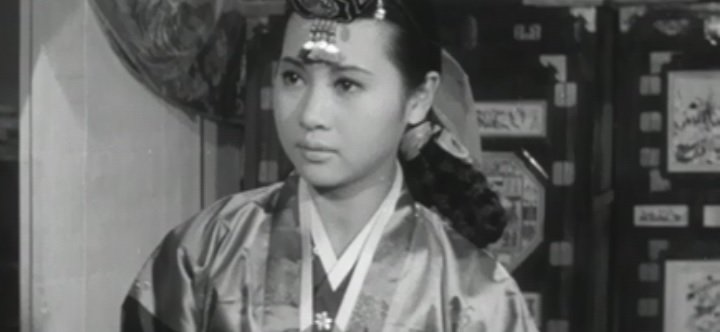
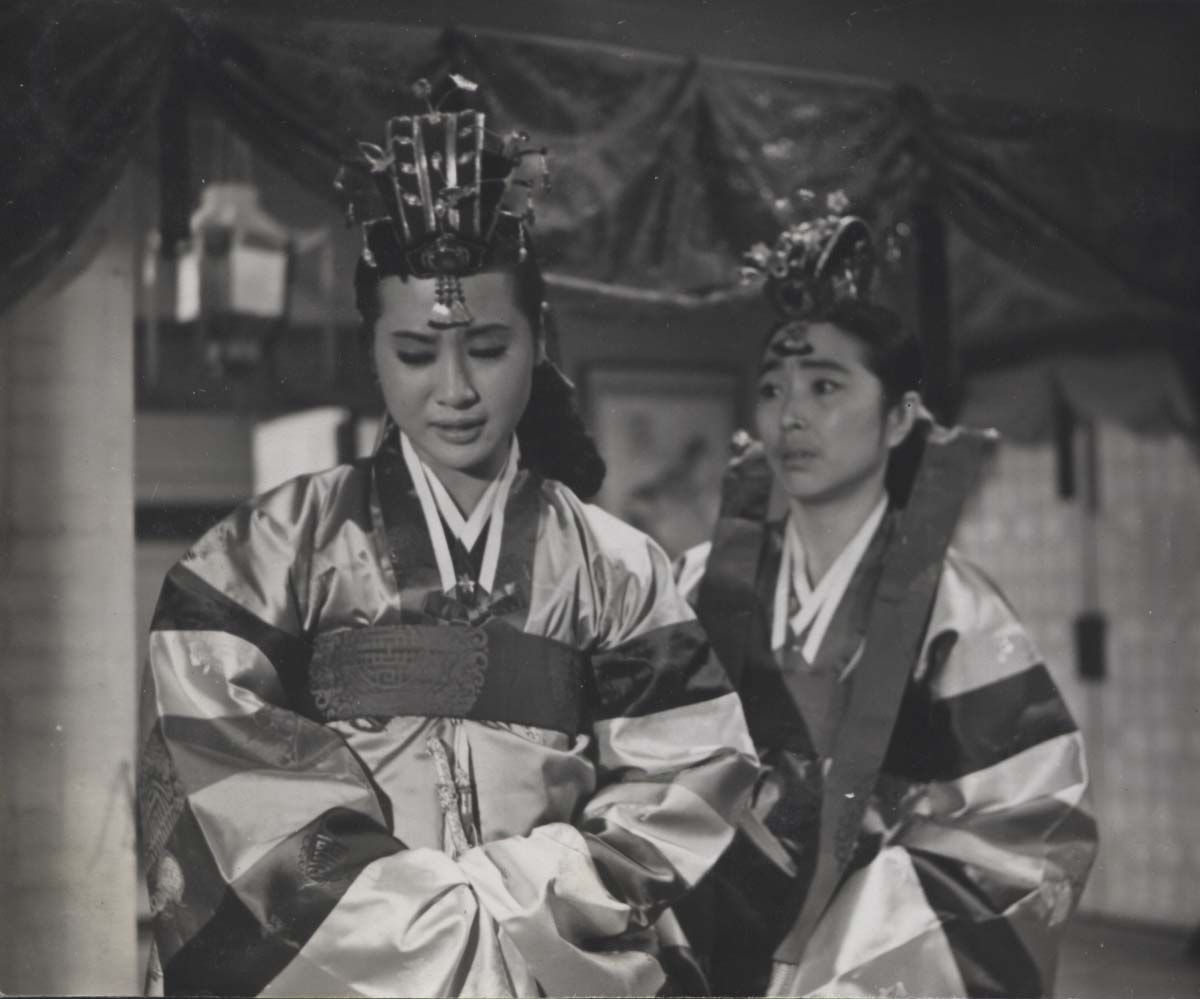
Tomboyish princess Suk-gyeong (Nam Jeong-im) is the youngest of six princesses and the last to remain at home in the palace yet to be married. Consequently, she is infinitely bored all the time and continually up to mischief in part because as a princess she is not permitted to leave the estate and has a natural curiosity about the outside world. That curiosity is further sparked when she lays eyes on handsome scholar Kim Seon-do (Kim Gwang-su) who picks up a shoe she had dropped while inappropriately running on the day of her mother’s birthday celebrations. Possibly the first young and handsome man she has even seen, Suk-gyeong cannot help but be captivated by him and manages to convince her sisters to help her escape the palace to venture in search of her probably impossible love under the pretext of visiting her grandparents whom she has apparently never visited before.  

Like Audrey Hepburn in Roman Holiday, what Suk-gyeong wants is a break from the “tedious and pathetic” life of a princess, but soon discovers herself to be entirely naive as to how the “real world” works. Her sisters agreed to help her in part because they acknowledge how difficult it was for them when they married and had to leave the palace with no understanding of how to live outside it. Having left in the clothes of a servant, the first thing that Suk-gyeong realises is that the outside world is governed by a different set of hierarchies and even if she’s a princess she is still a woman and therefore presumed to be “inferior” to men to whom she is expected to remain subservient. Her grandfather, who has never met her before, wastes no time exerting his patriarchal authority in his own, comparatively humble, home. “A woman, once married, must abide by the rules of her new family, the confucian ethics, and respect your father and husband and become a wise and obedient wife” he explains, striking her across the calves with a cane to teach her a lesson for her imperious tone in failing to pay him the proper respect. 

Failing to use appropriately polite language with those around her, forgetting that she should now be deferent both to men and to those who exceed her in age, gets her into constant trouble. Nevertheless, a trip to the marketplace gains her a further understanding of the extremes in her society firstly when she misunderstands a rice cake seller’s patter and assumes he intended to gift her some of his produce as he might to a princess, and secondly when she bumps into a woman with a baby on her back and breaks the pots she was hoping to sell to pay for her husband’s medical care. Introduced to such desperate poverty, the undercover princess knows not what to do but later gifts her a jade pin hoping perhaps to at least cure the husband’s malady, only to wander into another dangerous situation when she is mistaken for a sex worker by a trio of drunken noblemen who pull her into a drinking establishment which is in fact a brothel. Naively drinking with the men she mocks them for their attempts to play on their names each boasting of their famous fathers and personal connections to men she knows to be elderly cranks and obsequious fools. Shocked to discover what goes in establishments like these she tries to make her escape but is almost assaulted by one of the men, Shim, who is later posited as an ideal match by her unsuspecting mother laying bare another patriarchal double standard as Shim plays the part of the gentleman in order to effect his advancement. Luckily, she is saved by Seon-do who happens to be passing but mistakes her for a boy because of the disguise she is currently wearing. 

Selfish in her naivety, Suk-gyeong is warned that her impossible crush might end up harming Seon-do’s hopes of making it into the elite through success in the state exam while he, once made aware of the truth, immediately does the right thing by kindly rebuffing the princess’ inappropriate interest leaving her with a poetic love letter claiming he’s gone off to a temple for a spell of intensive study. Perhaps improbably it’s the love letter that eventually saves them, touching the king’s heart and convincing him to acquiesce to his sister’s wishes of escaping the gilded cage of nobility. Suk-gyeon’s pleas to renounce her royal title might also stand in for a desire to renounce womanhood in that it “stops us from doing anything we want. We are matched up with an unknown husband and we spend our youths in misery for our lives are tedious and pathetic”, reminding her brother that as a king but in truth as a man he cannot understand even while he reminds her that these are the “rules” endured by countless ancestors. The king is moved, he breaks with tradition and frees his sister yet he does so to allow her to become a wife even if he has also granted her the freedom to choose her husband and live in the outside world unconstrained by the strictures of nobility but nevertheless bound by oppressive patriarchal social codes. Nevertheless, it’s an unexpectedly progressive conclusion advocating for change and personal happiness over the primacy of duty and tradition. 


A Princess’ One-Sided Love streamed as part of the Korean Cultural Centre UK’s Korean Film NightsFilming Against the Odds 

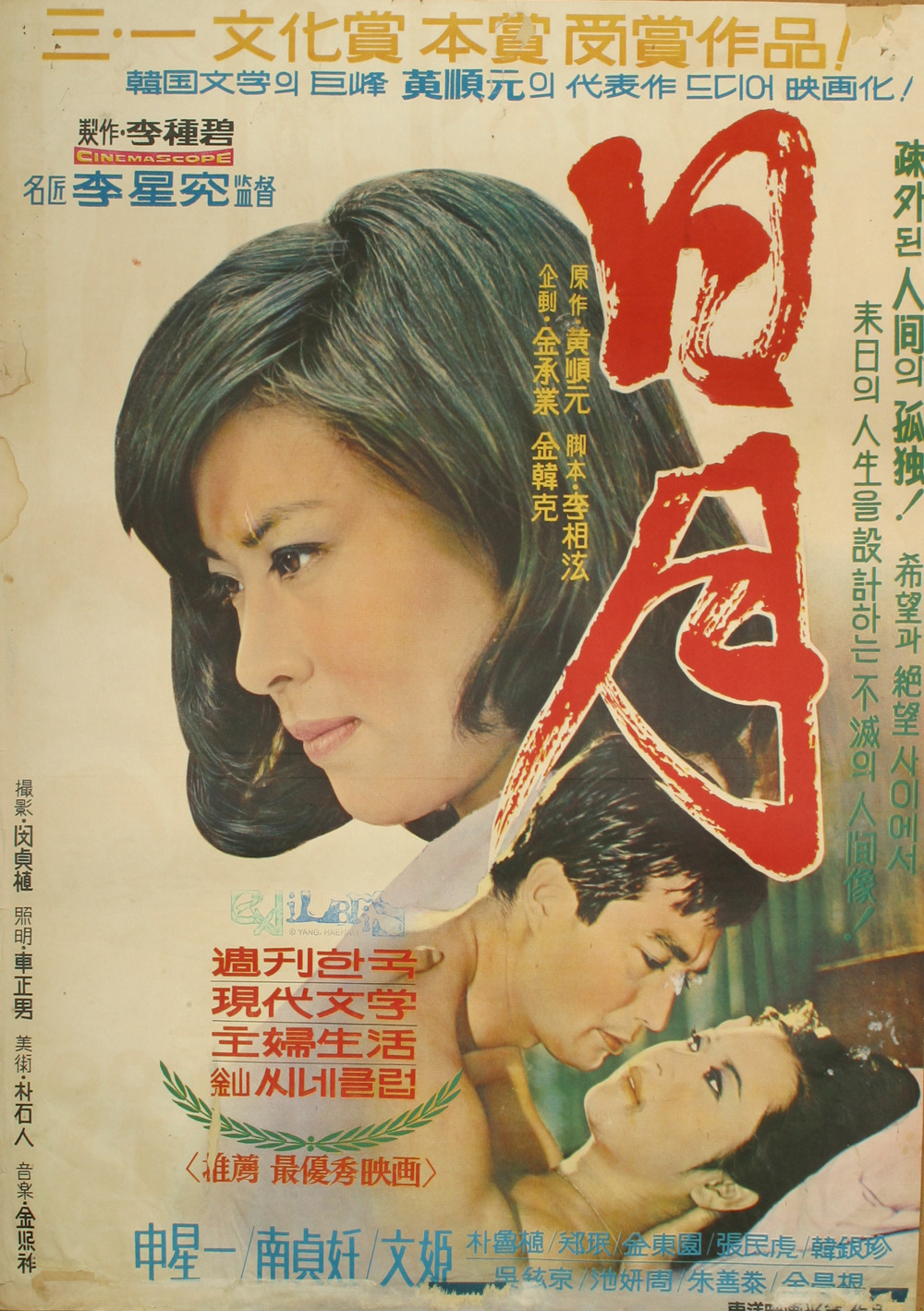
Ilwol: The Sun and the Moon (일월 / 日月, Lee Seong-gu, 1967)

Sun and Moon posterOld habits die hard in Lee Seong-gu’s Ilwol: The Sun and the Moon (일월 / 日月). The feudal past refuses to ease its icy grip even in the new “democratic” era in which freedom and prosperity are promised to all. Lee Seong-gu, closely associated with the Western Modernist movement, flexes his Literary Film muscles with an adaptation of Hwang Sun-won’s novel. Mixing a standard melodrama narrative with an exploration of “outdated” social prejudices and the gradually fracturing psyche of a man who learns a “dark secret” regarding his personal family history, Lee isolates the individual within a changing society as an ordinary man finds himself unable to move forward despite his own desire to be free of the superstitious past.

Lee opens with a scene more in keeping with a romantic comedy. Aspiring architect In-cheol (Shin Seong-il) meets drama student Na-mi (Nam Jeong-im) at an upscale ski resort and is instantly smitten. After spending time with her, In-cheol goes home and visits a childhood friend, Da-hye (Moon Hee). Da-hye is quite obviously in love with In-cheol – a fact of which he is obviously unaware or just completely insensitive since his purpose in coming is to tell her about Na-mi. Despite her personal pain, Da-hye is a good friend and gives In-cheol the appropriate advice regarding his romantic endeavour, reminding him that many of his previous relationships have failed because he was too diffident and he let them drift away.

Meanwhile, In-cheol is called into his father’s study to meet his dad’s new business contact who, it happens, wants a house designed. In a piece of near dynastic finagling, In-cheol gets a new job and, surprise surprise, the house turns out to be for Na-mi who is the daughter of the bank manager In-cheol’s dad wants a loan from. Everything is working out just fine, but then In-cheol’s brother – the Mayor of Gwanju (Jang Min-ho), turns up in a state of agitation and tells them he’s being blackmailed. Someone has discovered their dark family secret – In-cheol’s dad ran away from his family because they were butchers, a near “untouchable” class even in the Korean society of 1967. In-cheol thinks this is all very silly, who cares about things like that anymore? But on another level the discovery profoundly disturbs him in what it says about him as a person and about the society in which he lives.

It does seem ridiculous to stigmatise such commonplace occupation in a supposedly modern society, but In-cheol can’t seem to move past it. He pays a visit to a slaughter house which is just as awful as he’d expected it to be as he watches a once powerful cow twitching helplessly on the floor while other workers dismember the corpses of animals, pulling out entrails and severing heads ready for keener butchery. Still, In-cheol reminds himself it’s just a job and resolves to meet his cousin, but his cousin, insisting that he has no relatives, won’t talk to him. In-cheol takes this for rudeness or rejection, but really his cousin is attempting to protect him. In having internalised the constant abuse he suffers – even once being arrested by the police when a murder took place nearby solely because he is a butcher and had no alibi, In-cheol’s cousin avoids contact with those outside of his group and does not want to taint him with the butcher brush. Yet In-cheol keeps pushing, only for his cousin to roundly tell him to leave it alone unless he has the courage to accept his butcher blood fully for all it is.

The problems are manifold. In-cheol’s father’s first engagement was broken when the bride found out he came from a butcher family, while his wife (who married him without knowing) became a religious obsessive after learning of her husband’s origins. In-cheol’s marriage prospects are almost certainly off the table if anyone finds out, but even if someone agrees to marry him knowing the truth should he really invite them to do so knowing that they (and their children) will share his shame?

Unable to speak, unable to move forward or back, In-cheol spirals into a depressive cycle of inertia and suffering. Da-hye tries to talk to Na-mi to get him to wake up, but Na-mi tells her she’s not much bothered about In-cheol’s mental state and has only been messing around. Nevertheless, she finally draws closer to him as means both of assuming the leading role in her relationship, and as a way of annoying her father whilst potentially getting herself involved in a small scale scandal. Meanwhile, Da-hye who had pointed out that In-cheol’s problem was his passivity, ironically reveals that she too has been waiting for him to wake up and realise her feelings for him, only now realising she has probably missed her chance. The melodramatic device of the love triangle becomes a symbol of In-cheol’s ongoing psychological fracturing as he finds himself caught between two women and realising he can choose neither of them because his “ancestral curse” has effectively disqualified him from living in the modern world.

Using innovative editing techniques, Lee dramatises the tragedy of an isolated generation, supposedly living in a “modern” society but unable to escape the outdated social codes of the past. Rather than attempt to free themselves from irrational and superstitious ways of thinking, they choose self-exile and willingly accept their unhappiness in an otherwise altruistic intention of preventing the spread of a contagion. Melancholy yet urgent, Ilwol: The Sun and the Moon uses the ridiculous survival of an ancient prejudice to lay bare a dark secret at the centre of its own society but finds only tragedy without sense of an escape.


Ilwol: The Sun and the Moon is the first film included in the Korean Film Archive’s Lee Seong-gu box set. (Not currently available to stream via the Korean Film Archive’s YouTube Channel).

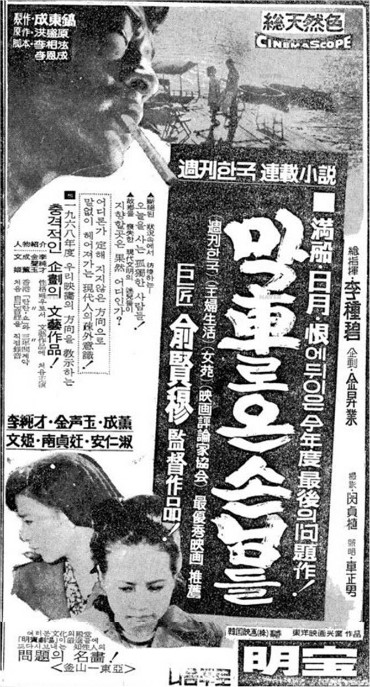
The Guests of the Last Train (막차로 온 손님들 / 막車로 온 손님들, Yu Hyun-mok, 1967)

guests who came by train 2Despite ongoing social and political oppression, the Korea of the 1960s was an upwardly mobile world in which increasing economic prosperity and global ambition was beginning to offer the promise of financial stability and a life of comfort to millions of young men and women, albeit at a price. Yu Hyun-mok, often thought of as among the most intellectual of “golden age” film directors, was a relatively infrequent visitor to the “literary film” but Guests of the Last Train (막차로 온 손님들 / 막車로 온 손님들, Makcharo on Sonnimdeul, AKA Guests Who Arrived on the Last Train), adapted from a novel by Hong Seong-won, is perhaps comfortably in line with his career long concerns in its focus on those who for one reason or another have been running to catch the rapidly departing train of modernity, pulling themselves on board just it prepares to pull away. A disparate tale of three men and their respective love interests, Yu’s film once again rejects the consumerism of the modern society in its cold and lonely search for soulless acquisition and finds comfort only in the fragile connections between the lost and hopeless.

The film opens behind a train station where a young woman, Bo-yong (Bo-yong), staggers and stumbles, grasping for something to hold on to but hardly able to stand. Eventually a man, Dong-min (Lee Soon-jae), turns up and tries to hail a taxi. Noticing the distressed woman, he manages to get her into a car and when she tells him she has nowhere to go, takes her home with him. Dong-min is currently off work with an illness which turns out to be terminal lung cancer and has only a few months left to live as a second opinion from his doctor friend, Kyeong-Seok (Seong Hoon), makes clear. Kyeong-seok is also facing a problem with a female patient, Se-jeong (Nam Jeong-im), suffering a nervous complaint after losing her wealthy husband and subsequently being hounded by her relatives over the inheritance. When Se-jeong leaves the hospital the pair end up having an affair but the money continues to present a problem – neither of them want the hassle of dealing with it. Meanwhile, Dong-min and Kyeong-seok reunite with another old friend, Choong-hyeon (Kim Seong-ok), who has just returned from Japan apparently having become fabulously wealthy. Choong-hyeon has pretensions of becoming an avant-garde artist, but is unable to get over his ex-wife who has left him to become a famous actress.

Each of the three men is in someway arrested, unable to move past something towards the future rapidly rolling away from them like a train leaving the station. Dong-min’s depression and listlessness is understandable given that he’s facing a terminal illness and knows that he has already reached the end of the line. Yet his ennui began long before. Kyeong-seok, describing his friend to a colleague, disapprovingly remarks that he used to be a mild-mannered bank teller but left to become a freelance translator and journalist. Unable to put up with the stringent, high pressure world of work Dong-min removed himself from it to try and grasp his freedom only to remain dissatisfied and eventually defeated by a cruel and arbitrary illness. Even so he retains his human feeling as demonstrated by his decision to help Bo-yong rather than leave a vulnerable woman alone to suffer on the streets. Staring blankly at the calendar on his wall, avoiding tearing off the sheets which serve as an all too obvious symbol of his limited time, he falls slowly in love with the woman who remains at his side whilst knowing that his existence is futile and doomed only to tragedy.

Kyeong-seok, by contrast, is merely disaffected. Dragged into a relationship with Se-jeong originally unwillingly, what he resists is responsibility. He wants to help her, but he does not want to get involved with her complicated familial and financial problems. As so often in Yu’s films, money is the root of all evil, presenting barriers between people where there should be none. Neither Kyeong-seok or Se-jeong are very interested in the money for its own sake, they want only simple lives of adequate comfort and emotional fulfilment – something which the hassle of dealing with other people’s money hungry machinations will actively destroy.

Money has also, in a sense, destroyed Choong-hyeon’s hopes though more through his misplaced faith in its ability to buy him back what he’s lost. His relationship with his wife is clearly over, she has chosen something else which is her right and privilege, but Choong-hyeon can not accept it and continues to look for her in all he does. Attempting to become an “artist” himself, he uses his money to get himself a show featuring his avant-garde pop art creations but neither of his friends rate his work or is careful enough about his feelings to avoid criticising it. Choong-hyeon spirals out of control, becoming dangerously obsessed with a schoolgirl he somehow wants to imagine as his wife. Dong-min and Kyeong-seok suspect that he will kill himself, but by this point they aren’t sure if they should care. What would they be saving him for? There is no possible salvation – no one can save anyone else, and no one can save themselves. Each is an individual and can offer no excuses. Love and friendship are but scant comfort in a cold and lonely world.

Meanwhile, the women continue to suffer in silence. Yu chooses to focus on his trio of male misfits rather than the pair of unlucky women whose story lies at the centre of the narrative. Se-jeong married an older man for apparently legitimate reasons but the marriage was unsuccessful and also ruined her friendship with her husband’s daughter who, unsurprisingly, turns out to be Bo-yong. Looking for love and not money, Se-jeong is only holding on to her inheritance in the hope of someday reconciling with Bo-yong and handing it all to her. Meanwhile, Bo-yong has been on the run from her former life. Once an air stewardess, Bo-yong dropped off the radar when a former fiancé planted drugs in her suitcase and got her sent to prison. Like Se-jeong she is looking for support and companionship and finds it in the kind if melancholy Dong-min, vowing to stay by his side even if she knows their time it limited. The two women are eventually “reunited” at a wedding, but the crowd keeps them apart, breaking into factions fighting over the inheritance that neither Se-jeon or Bo-yong actually want.

Yu declines to tell us whether the women are eventually able to meet and repair their friendship, but he does make clear that both have rejected the superficial comforts of wealth in asking for a small and simple life with their respective partners. In this he offers both hope and despair. The couples are rejecting the new future their nation has planned for them, yearning for small comforts and an end to their loneliness and struggling to find it in an increasingly alienated world. Bo-yong, at least, steps forward to grasp her chance at happiness however small it maybe, waiting for the train and seeing red lights change to green only when her gesture of sincerity is finally accepted.


Available on DVD as part of the Korean Film Archive’s Yu Hyun-mok boxset. Not currently available to stream online.

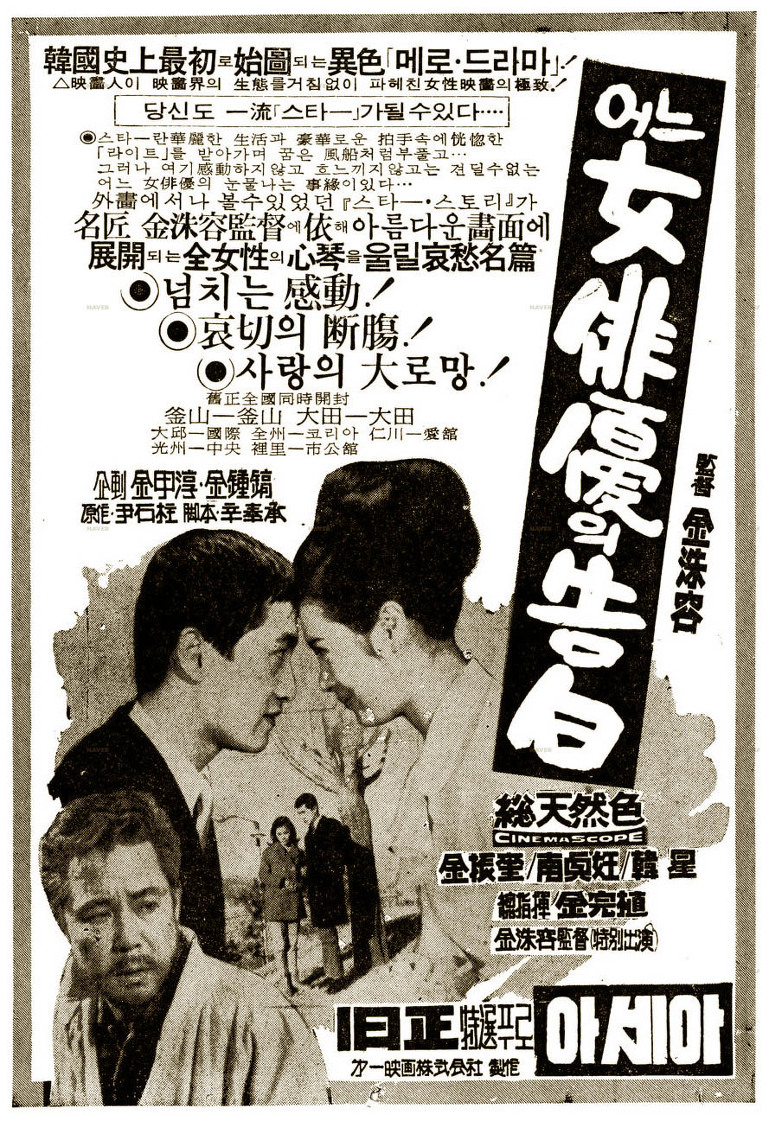
Confession of an Actress (어느 여배우의 고백 / 어느女俳優의告白, Kim Soo-yong, 1967)

Confession of an actress posterKorean filmmaking of the 1960s is sometimes referred to as a “golden age”, but the reality is that films were often churned out at a rapid pace for immediate distribution. Producers got an advance from local distributors, picked a scenario, assigned a suitable director and slotted in big name stars they already had under contract. For this reason production values are often low, but performance standard high despite the fact that many stars are bouncing around from one film to another shooting a scene here and a scene there. Director Kim Soo-yong filmed 10 features in 1967 – including his masterpiece Mist. Confessions of an Actress (어느 여배우의 고백 / 어느女俳優의告白, Eoneu Yeobaeu-ui Gobaek), inspired by a novel by Yun Seok-ju, is the kind of straightforward melodrama that was going out of style – a virtual remake of Chaplin’s Limelight with a little Phantom of the Opera thrown in, but Kim neatly repurposes it as a meta take on the Korean film industry of the day.

Kim Jin-kyu (played by the actor of the same name) was once a famous movie star, but heartbreaking tragedy ruined his career and now he’s a washed up drunk dreaming of the past. Hearing the dreaded “hey mister, didn’t you used to be somebody?”, Jin-kyu wanders into a film shoot and is thrown back to a happier time when he starred in prestige pictures with his regular co-star who was also his lover. Sadly, Miyong died of an illness leaving their last picture unfinished. The studio producers wanted to replace her and complete the movie, but Jin-kyu wouldn’t have it. They sued him for obstruction and his career was ruined. Jin-kyu was told that the child Miyong was carrying had died, but unbeknownst to him, a daughter was born and Miyong asked her friend Hwang Jung-seun to give the baby up for adoption and save it from the stigma of being illegitimate. Running into Jung-Seung at the shoot, Jin-kyu finds out his daughter is alive and determines to turn her into a great star – the only thing he can do for her as her father now that he is in such a sorry state.

Almost all of the characters in the film are named for their actors, though they are obviously not playing themselves in any biographical sense. Nevertheless, there is an intentional reflexivity in Kim’s decision to shift away from his literary source to towards one more immediately cinematic. Much as in Chaplin’s Limelight which does seem to provide a blueprint for the narrative, the arc is one of tragedy and redemption as Jin-kyu attempts to make up for lost time by imparting all his professional knowledge to the daughter he never knew and ensuring her success even at the cost of his own. Ashamed to introduce himself to her as a father given that long years of lonely drinking have reduced him to a broken old man, Jin-kyu gives his advice via letter and avoids seeing Jeong-im, longing to embrace her but afraid he’ll bring shame on her growing fortunes.

When Jin-kyu gets Jeong-im into show business, Kim gets a chance to put the Korean film industry on screen. He starts with a mildly sleazy producer and the established star who’s getting too old for ingenue roles but is desperate to hang on to her leading lady status. Nevertheless, she does have the option, as she points out, of a dignified escape through marriage should her career fail – something that is not an option for her male co-stars. As a young hopeful with no experience and nothing to recommend her beyond a pretty face, Jeong-im’s entry into the world of film is a baptism of fire. Rushed through makeup with its uncomfortable fake eyelashes and into an unfamiliar costume, Jeong-im’s rabbit in the headlights performance does not endear her to the director or more particularly the producer who is looking on from the wings in exasperation quietly calculating how much all of these extra takes are costing in wasted film. Nevertheless, the film is a success and, thanks to Jin-kyu’s careful tutoring, Jeong-im is on track for stardom.

Kim fetishises the camera, the process of filming with its bright artificial lights, tricks and techniques from the ice cold studio shoots to the difficult trips out on location. He makes full use of the relatively rare colour format utilising frequent superimpositions and montages, overlaying the bright neon lights of Seoul with the interior journey of our leading lady as she begins to find her voice. Making a final self cameo, Kim gives in to the inherently melodramatic quality of the underlying narrative but he does so somewhat ironically, rolling his eyes at the need for overly dramatic emotionality while actively embracing it, and lamenting the hardships of filmmaking while churning out his third picture in as many months. Confession of an Actress is not the salacious exposé promised by the title, but it is an illicit look at the decidedly unglamorous side of film production a world away from the bright lights and glossy magazines. 


Available on DVD as part of the Korean Film Archive’s Kim Soo-yong box set. Not currently available to stream online.