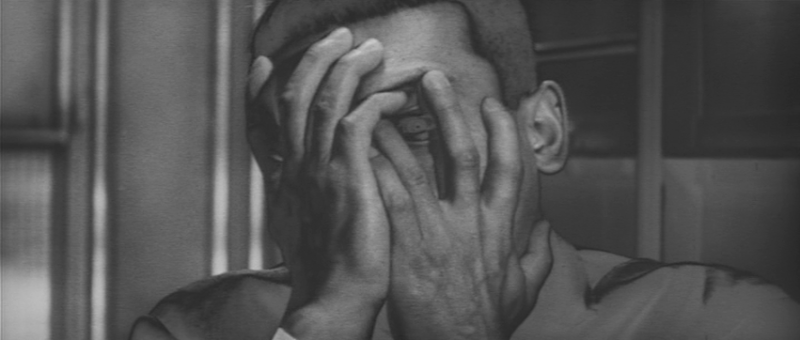

The building at the centre of Koji Shima’s dread-fuelled horror noir Pit of Death (怪談おとし穴, Kaidan Otoshi Ana) is said to be haunted by the spirits of the many people who died during its construction. In his opening voiceover, anti-hero Kuramoto (Mikio Narita) likens the city to a hornet’s nest, the salaryman drones mindlessly buzzing around the business district as if driven by some supernatural force. In that sense, the office building itself becomes an eerie place, the nexus of the salaryman dream which in the end drags all to hell.
Largely a retelling of Yotsuya Kaidan for the mid-20th century with a little A Place in the Sun thrown in, the film finds Kuramoto an ambitious man deluded by consumerism and resentful of the classism and snobbishness which limit his prospects as a man who has otherwise been able to pull himself out of poverty. His boss pointedly speaks of his talents which include the ability to speak several languages despite only having attended night school rather than university while it’s unusual for a man of his background to hold this kind of position even if he’s only a secretary and not yet an executive. Nevertheless, his boss clearly sees him as a potential successor and plans to marry him to his daughter (Mako Sanjo) who has in some ways inexplicably developed a crush on him.
But Kuramoto is already in a relationship with typist Etsuko (Mayumi Nagisa). In fact, the reason the boss is so pleased with him is largely down to her in that he asked Etsuko to sleep with their foreign client, Mr Hancock, to seal the deal which she duly did. Kuramoto plans to throw her over in order to pursue his dream of taking over the company so he can look down on those who once looked down on him. He tells Etsuko that the marriage will be in name only, that he isn’t attracted to the boss’ daughter Midori, and their relationship will continue as before only to be confused when Etsuko is not totally on board with the plan. She tells him she’s pregnant with his child though he callously points out it could be Hancock’s and insists on an abortion thereafter determining he must kill her so that he can fulfil his destiny by joining the executive class.
His desires are obvious when he steps into Midori’s home and gazes at a painting crassly asking how much it’s worth, admitting that he’s the kind of poor person who has a fascination with luxury. His forward propulsion is driven by a fear of poverty, the trauma of the hard life he’s had and the futility he felt in his inability to escape it. Yet it’s also a kind of class rebellion motivated by resentment for the prejudice held against him as a man without means in a highly stratified society. Paradoxically, he will do anything and everything to be accepted as a member of the elite class including murdering Etsuko, the symbol of the working class past he fears will drag him down.
Etsuko does indeed drag him down eventually in her own revenge against his callousness and the double standards of a patriarchal society. Her relationship with Kuramoto seems to be a secret in the office while he uses and discards her when no longer useful to him. She too is trapped within this building of a newly corporatised society but can rise no further alone and is in a fairly bleak position without Kuramoto for she has already thrown away her only bargaining chip by entering a sexual relationship with him. Should she attempt to raise his child alone as a never married single mother, her life would be very difficult indeed if not actually impossible. Nevertheless, she does have real power over Kuramoto in her ability to expose the affair and ruin his chances of career advancement through dynastic marriage destroying any possibility of his future success.
In Kuramoto’s mind, Etsuko cackles like a witch or evil spirit. Her hair billows out into the wind like a vengeful ghost, though the first few times Kuramoto only imagines her death. He sees himself push her off a roof, only to be surprised to see her still standing over him. Etsuko haunts Kuramoto while alive as an image of his destruction all while he silently plots hers. He plans to use the building against her, hiding her body inside it where he assumes no one will see. In the end, it’s as if this building, an edifice of soulless corporatising capitalism, consumes them both, drawing them in with their unfulfilled desires until they fall into the bottomless pit of post-war ambition. Shima makes frequent use of solarisation and film noir lighting to destabilise Kuramoto’s world as his mental state starts to fracture along with innovative use of split screens to lend the space a sense of eerie continuity but ultimately posits the salaryman society as a kind of death trap beckoning greedy souls towards their demise with an inexorable fatalism.
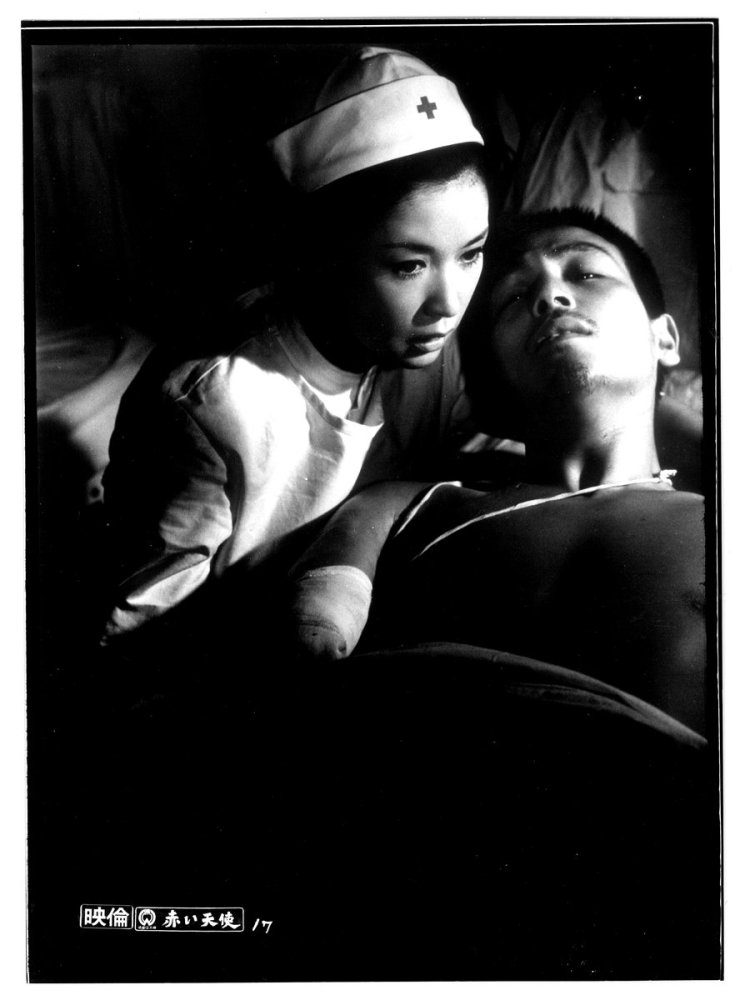 Red Angel (赤い天使, Akai Tenshi) sees Masumura returning directly to the theme of the war, and particularly to the early days of the Manchurian campaign. Himself a war veteran (though of a slightly later period), Masumura knew first hand the sheer horror of warfare and with this particular film wanted to convey not just the mangled bodies, blood and destruction that warfare brings about but the secondary effects it has on the psyche of all those connected with it.
 Windows on Worlds