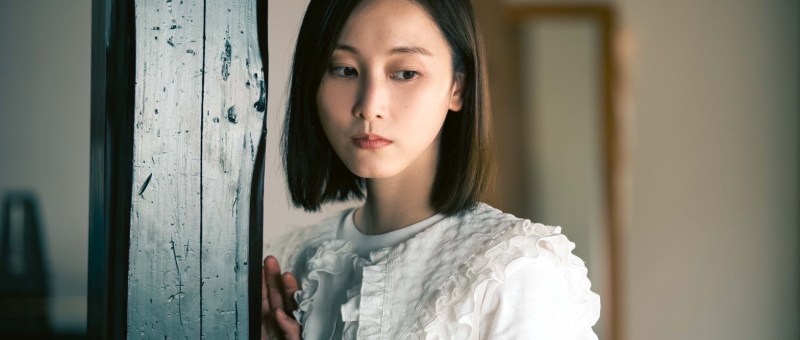
Saga Saga (緑のざわめき-Saga Saga-, Aimi Natsuto, 2023)

Three women contending with a legacy of patriarchal failure and male violence circle around each other in the picturesque hot springs resort of Ureshino in Aimi Natsuto’s etherial drama, Saga Saga (緑のざわめき, Midori no Zawameki – Saga Saga –). Less playful than Natsuto’s previous film Jeux de plage, the oscillating action takes on a poetic, mystical direction as the forces which bind the three women together eventually become clear while each in their own way tries to overcome a lingering sense of displacement and loneliness. 

The first of them, Kyoko (Rena Matsui), left Ureshino to become an actress in Tokyo but has given up performing and resettled in nearby Fukuoka where she runs into an old hometown boyfriend, Sotaro, who is currently sort of dating Eri, a woman he met on a dating app. Despite telling Kyoko he can’t stay long after reconnecting because he has a date with someone who is “not quite” his girlfriend, Sotaro ends up going to a love hotel with another woman, Naoko (Sae Okazaki), who frequents the bookstore where he works. Though it originally appears that Naoko is jealous of Kyoko and fears she’s missed her chance with Sotaro, we soon realise that she is in fact semi-stalking her for unclear reasons but actually wants to get in touch with someone else and eventually forms a telephone connection with Anna (Sara Kurashima), a high school girl currently living in Ureshino with her aunt, Fumiko (Asuka Kurosawa). 

In a way, they are all looking for something that seems to be missing in their lives. For Kyoko it seems to be something like the concept of home as she struggles with a series of sudden changes from the death of her mother two years previously to a brush with cancer in the form of an ovarian tumour she has recently had removed. Fumiko, who was a friend of her mother’s, tells her that she’s on a journey of self-reconciliation and there is indeed something in that as she works over the mysteries of her past while looking for new directions in her future. 

Meanwhile, she is plagued by strange dreams of being lost in a forest later telling a friend that she was once sexually assaulted in the woods when she was in high school and has the feeling the person who is chasing in her in her dream may be her father who left the family when she was a child. When she was receiving treatment for the tumour on her ovary, she began to ask herself why she had been born a woman forever subject to threat and patriarchal oppression. On her return to Fukuoka, she undergoes a very strange job interview in which she’s repeatedly assured that “being a woman” she won’t be asked to do anything “difficult” while it seems that being “attractive” is enough to get by in the beginning. Also they warn her that they don’t offer “great maternity leave or anything like that”. 

The lives of each of the women have been in one way or another overshadowed by male violence, but it’s Anna’s would-be-boyfriend Toru who is eventually victimised when he’s assaulted by a woman who wanted to bring back a problematic local festival cancelled because of a sexual assault. Toru had been in the forest to consult with some kind of mystic man trying to get him to conduct a ritual to get Anna to like him only to be told it doesn’t really work like that and you wouldn’t want it to anyway. After the assault it’s Toru’s life which spirals out of control when he’s blackmailed into acts of petty crime by the witch-like woman who forced herself on him, while Fumiko too is later forced to pay the price for having kept her secrets and for compassionate reasons attempted to hide the truth from those who most wanted to know.

Finally brought together on solving their individual mysteries, the three women settle on creating a home they can each return to, anchoring themselves as a family as a means of finding stability in a world which is so often in flux in defiance of the destructive forces which connect them. Even Eri admits that in reality she may have been looking for self-affirmation in her desire to find a dating app soulmate as her friends reflect on their terrible romantic experiences which, ironically, include being stalked. In the depths of its mysticism and eeriness, the film nevertheless ends on a note of serenity and the promise of moving forward if paradoxically by making a return. 


Saga Saga screened as part of this year’s JAPAN CUTS.

Original trailer (no subtitles)

Musicophilia (ミュジコフィリア, Masaaki Taniguchi, 2021)

What is “music”? Adapted from the manga by Akira Saso, Masaaki Taniguchi’s Musicophilia (ミュジコフィリア) finds its heroes grappling with a series of conceptual insecurities attempting to draw lines around what the what word might mean while torn between conservation and innovation as they struggle to find their own voices. Yet as the hero comes to realise, you can’t make music on your own letting go of his resentment and childhood trauma to remember his natural love of sound while repairing his relationship with his estranged half-brother in the wake of his father’s death. 

Gifted the talent of synesthesia in the ability to perceive shape and colour in the sounds of nature, Saku (Kai Inowaki) harbours a deeply held resentment towards “music” which he believes destroyed his family life, his mother (Misuzu Kanno) having been seduced by well-known composer Kishino (Kanji Ishimaru) as a student and thereafter forced to give up her dreams of becoming a professional cellist. Though he had contact with his father in his childhood, his stepmother never missed the opportunity to make him feel inferior while her own son, Taisei (Ikusaburo Yamazaki), became his father’s protege. Saku was not even allowed to touch his piano as if he were somehow unworthy of his artistic legacy. Having enrolled in art school in Kyoto, he nevertheless ends up being adopted by the contemporary music club which practices avant-garde and experimental techniques only to re-encounter his brother who is now in the third year of a PhD and an unpleasant elitist privately insecure about his musical talent. 

Everyone agrees that Taisei’s playing is technically perfect, but somehow dull lacking the individual spark of a true creative genius merely a carbon copy of his father’s teaching. Saku’s new friend Nagi (Honoka Matsumoto) compares Taisei’s skill unfavourably with the untrained talent of his brother, insisting that Saku’s music has the colour of joy and shape of kindness while Taisei’s sounds like notes arranged by a machine. Taisei is indeed cold and arrogant, snapping back at Saku’s question “what is music?” with the reply that music is what he’s played, as if he owned it and it only belongs to him. He even breaks with protocol and insults his professor claiming that his criticism is down to “internal politics” because he and his father did not get on, publicly criticising his translation of a German textbook on music telling him to “grasp the fundamentals of language” while his professor urges him to master the fundamentals of composition rather than arrogantly insisting his playing is unimprovable because it is the definition of “music”. Of course, some of this is his own insecurity afraid he can’t match up to his father and worried that in the end all he is is a poor imitation. For his part, Saku is often less than kind to Taisei, Nagi trying to point out to him that he’s better that but simultaneously finding him heading in the same direction as he tries to overcome an internal insecurity in order to rediscover his musical voice while unfairly lashing out at those around him. 

Taisei sucks the joy of out music, and indeed everywhere else, through his arrogant perfectionism his treatment of violin-playing girlfriend Sayo (Noa Kawazoe) approaching the abusive as he consistently runs her down and blames her for his own sense of dissatisfaction, while Nagi meditates on how freedom can make you lonely, herself seemingly the only one who thinks she’s in a musical, as the youngsters find themselves isolated by their own desire for artistic expression. Yet what the two men discover is that their father may have intended something else for them and that his desire was that they’d rediscover the innocent connection they’d had as children able to help each other should they become stuck either in life or in music. Saku’s natural talent is born of being immersed in the world around him realising that this too is “music” while Taisei struggles to move forward too obsessed with technical perfection to allow his music to breathe only rediscovering his humanity after an immense humbling that allows him to re-immerse himself in the natural world. At heart a coming-of-age tale in which two young men learn to put their differences aside and rediscover their childhood bond, Taniguchi’s gentle drama also offers a mild critique of academia and the tendency of institutions to exploit and manipulate talent only to wash their hands of it if something goes wrong placing funding above ethical concerns but eventually discovers that music is everywhere if only you’re willing to listen.


Musicophilia streamed as part of the 14th season of Asian Pop-Up Cinema.

Trailer (no subtitles)

Kamata Prelude (蒲田前奏曲, Ryutaro Nakagawa, Mayu Akiyama, Yuka Yasukawa, Hirobumi Watanabe, 2020)

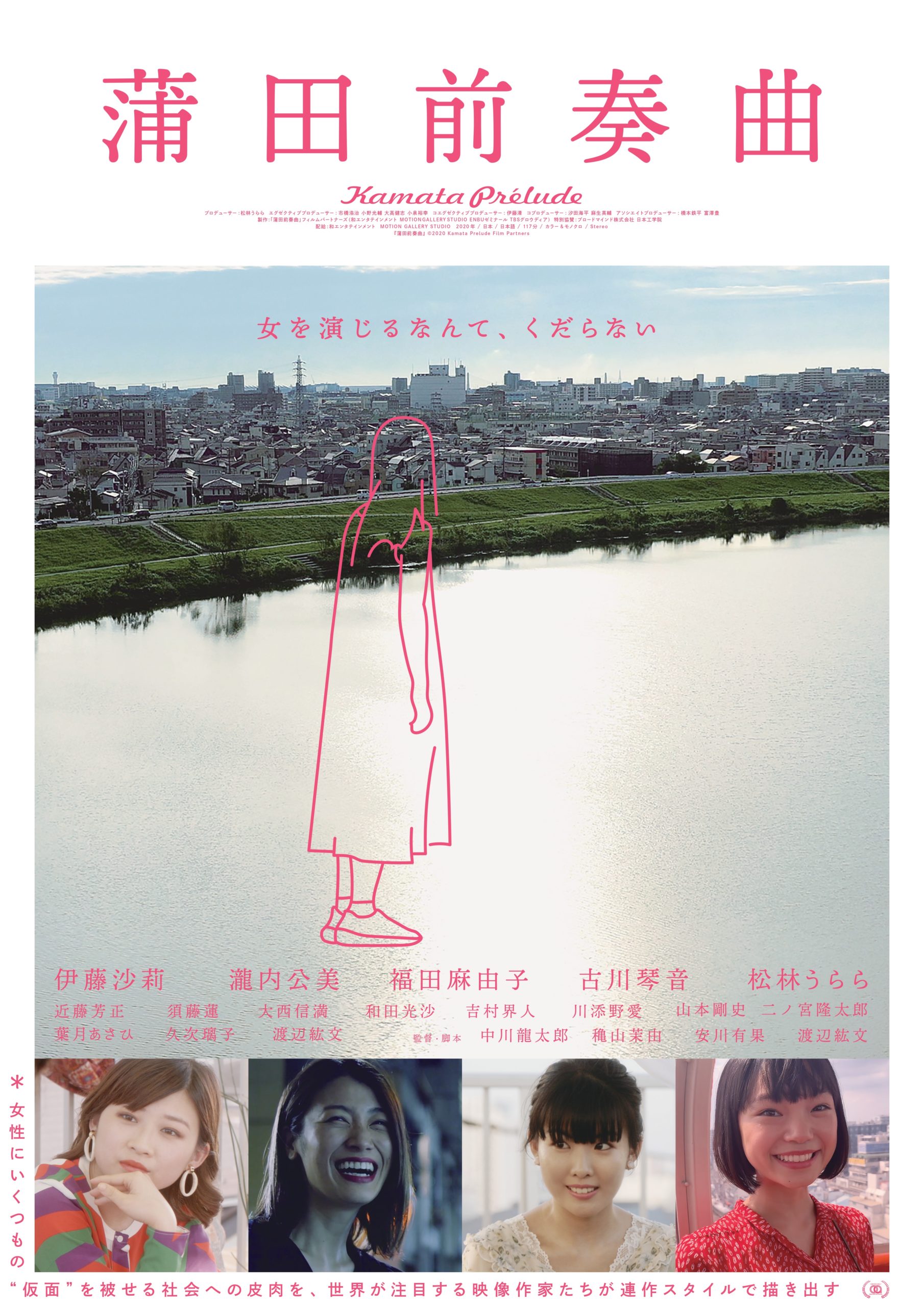
A quiet suburb of Tokyo, Kamata is in someways the birthplace of modern Japanese cinema home to Shochiku’s prewar studio where the “Kamata Style” which aimed to introduce a note of cheerful naturalism to an artform defined by shinpa gloominess was forged. Produced by actress Urara Matsubayashi who hails from the area and stars in three of the four segments, omnibus movie Kamata Prelude (蒲田前奏曲, Kamata Zensokyoku) asks some tough questions about what it means to be a woman and an actress today in the contemporary capital as the heroine, “Machiko Kamata”, contends with various demands from the economic to the emotional. 

Directed by Ryutaro Nakagawa, the first segment finds Machiko (Urara Matsubayashi) introducing herself as she takes part in a strange audition dressed in an inappropriately short cosplay-style nurse’s outfit. After the audition is over, her agent tells her to say “hi” to the director, a theme which will recur in the third chapter as Machiko finds herself feeling uncomfortable, forced to ingratiate herself in order to get ahead. Annoyed after the eccentric director asks her out for dinner, she can’t help asking him why she has to wear the suspiciously skimpy nurse’s outfit provoking him into a worryingly violent outburst. At home, meanwhile, her world is rocked by her younger brother’s revelation that he’s got a girlfriend who is, ironically, a nurse at local hospital. Jealous and resentful, Machiko can’t warm to Setsuko (Kotone Furukawa) who seems improbably sweet and innocent, almost as if she came from another time (the mid-August dating and ornaments for the Bon festival might clue us in as to why). Spending a day bonding with her, however, the two women generate a kind of sisterhood which pushes Machiko into a realisation of the emptiness she feels in her life of constant struggle as an aspiring actress supporting herself mainly with her part-time job at a ramen bar. 

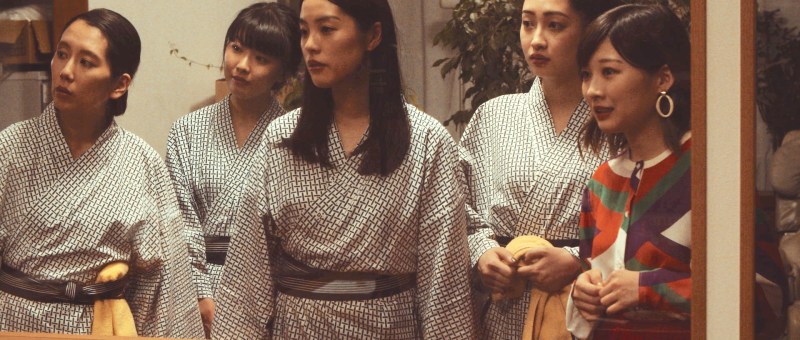
The themes of alienation and insecurity are only depend in the second segment, directed by Mayu Akiyama, in which Machiko reunites with a group of high school friends who are each less than honest about the state of their lives and their unfulfilled desires. Machiko gives the impression that she’s just been in a major movie with a big star, but it turns out she only played a corpse while the rest of the group are scandalised by the bombshell that their friend Marippe (Mayuko Fukuda) has got engaged to a guy from work she’s been seeing secretly for only six months. Besides being somewhat hurt not to have known she was seeing someone, the gang have different reactions to the news with hard-nosed career woman Hana (Sairi Ito) put out by Marippe’s traditional view of conventional gender roles in which she intends to let her career slide to concentrate on being a wife. A trip to a hot spring (the same hot spring seen advertised on Machiko’s T-shirt in part one) brings things to a head with a possibly cheating boyfriend eventually offering the excuse that he is merely a hot spring enthusiast sharing his hobby with a friend of the opposite sex rather than a two-bit louse indulging in the patriarchal double standard. 

Patriarchal double standards are out in force in part three, directed by Yuka Yasukawa, in which Machiko attends another odd audition where she and the other auditionees are asked to outline an episode of sexual harassment they have personally experienced. In fact, we have already seen her be inappropriately propositioned by a middle-aged producer who ran out on her in a coffee shop after she turned him down leaving her with the bill, but the episode she recounts is darker still. As she feared they might, the men in the room quickly figure out who she might have been talking about but proceed to put the blame on her implying that she sleeps around to get ahead and was only offended by the producer’s actions because he wasn’t powerful enough to be useful. It’s another woman however, Kurokawa (Kumi Takiuchi), who kicks things into gear by relating that she was assaulted by a man in a club whom she later reveals to have been the director himself only he doesn’t remember her. The director brings both women back and makes them re-enact Machiko’s tale of being inappropriately propositioned in a producer’s office, increasingly exasperated that the situation seems “too scary” as if he’s entirely missed the point of his own exercise or is actively getting off on the actress’ discomfort. The male cameraman (Ryutaro Ninomiya) is the one who eventually points out that the audition itself has descended into a protracted act of sexual harassment, seemingly conducted solely for the entertainment of the director and his assistant. 

Largely disconnected from the other three chapters, the fourth does not feature Urara Matsubayashi and is in fact set not in Kamata but in director Hirobumi Watanabe’s familiar Tochigi. The opening of his segment, characteristically filmed with static camera and in black and white, finds him once again playing a version of himself ranting about not knowing what to do with this unusual project he has taken on for the money even though he doesn’t generally make shorts, has never done an omnibus movie before, and remains suspicious of the concept. He relates all of this to his 10-year-old niece Riko (star of I’m Really Good), who says absolutely nothing while he continues to treat her as if she were the most famous actress in Japan. Somewhat poignantly, a photograph of Watanabe’s late grandmother sits on a stool off to the side, implying perhaps that little Riko has in some senses taken over her role as silent observer. The main thrust of the action follows Watanabe as he attempts to film a sci-fi movie about an alien invasion with local non-actors, but is finally linked back to the omnibus by Riko’s cheerful letter to Machiko in which she states that she wants to become an actress just like her. Ending on such an upbeat moment seems to imbue a sense of hope for the future that was perhaps previously absent, implying that the hopes and dreams of a little girl at least are worth fighting for if only to live up to her sense of expectation for the magic of the movies. 


Kamata Prelude streamed as part of this year’s Nippon Connection.

Original trailer (English subtitles)

My Dad is a Heel Wrestler (パパはわるものチャンピオン, Kyohei Fujimura, 2018)

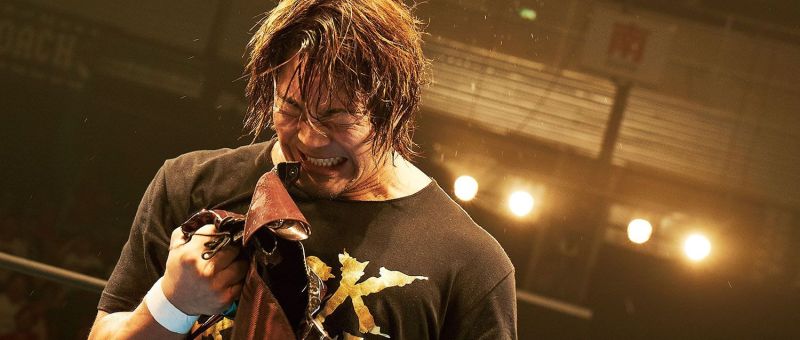
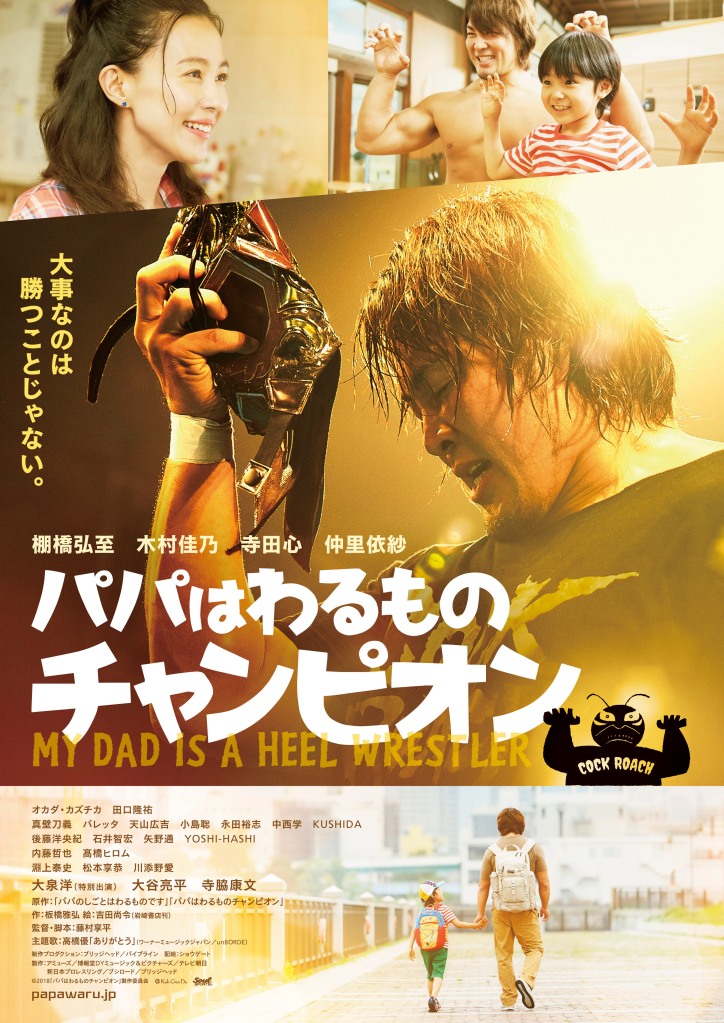
“Your job embarrasses me” little Shota (Kokoro Terada) coldly tells his actually quite lovely father, slowly closing the door on his well meaning attempt at connection. Self evident from the title, My Dad is a Heel Wrestler (パパはわるものチャンピオン, Papa wa Warumono Champion), Shota’s dad Takashi (real life wrestler Hiroshi Tanahashi) is a former champ reduced to playing the “heel”, a masked villain fans love to hate whose signature move is comic relief. Like all little boys, Shota really looked up to his father and wanted to be just like him, and so he gets a dose of paternal disappointment a little earlier than expected in realising that he is in a sense a professional loser with a degree of internalised shame regarding his failure to get back in the ring under his own identity. 

10 years previously, just before 9-year-old Shota was born, Takashi was a champion but a knee injury cost him his career. To stay in the game and provide for his family, he decided to become a heel as a temporary measure until he was well enough to return to being a “face”. A decade later however he’s still “Cockroach Mask” working with “Bluebottle” as a comedy villain known for pulling all sorts of unscrupulous tricks like using “Roach Spray” on his opponents or extracting gadgets from a Doraemon-esque interdimensional portal in the shape of a garbage can. Ashamed of himself, Takashi has avoided telling Shota what exactly it is he does for a living, promising that he’ll explain everything when he’s older. 

But Shota’s at the age when everyone at school is boasting about their dads and it’s niggling at him that he doesn’t really know, especially when one of his friends jumps to the conclusion he must be a yakuza. Determined to find out, Shota does some detective work and secretly follows him, only to wind up surrounded by beefy guys backstage at the ring. Bumping into a wrestling obsessive classmate (Maharu Nemoto) there with her father (Yasushi Fuchikami), Shota is horrified to realise his dad’s that jerk that everyone hates so when she somehow jumps to the conclusion that his dad’s her idol, reigning champ Dragon George (real life wrestler Kazuchika Okada), he doesn’t bother to correct her. 

The irony is, Takashi is a genuinely nice guy. He’s desperate to make it to Shota’s parents’ morning at school, but misses it because he stops on the way to help an old lady who was struggling with her shopping. When the kids are asked to compose a speech about their dreams for the future, Shota says that he wants to get big and strong like his dad in the hope that being big will also make him kind. Shota, however, is still too young to understand the way that wrestling works. He only sees his dad degrade himself, do “bad” things to win, and act in an underhanded, dishonourable way that is completely at odds with his offstage personality. Yet as much as it is that he’s disappointed to think his dad’s a “loser”, the real cause of his resentment is seeing that he’s not being true to himself. Shota’s mother tells him that wrestling is Takashi’s passion, but he pointedly asks her if his dream was being a heel, which it obviously wasn’t. 

While Shota picks up on his dad’s internalised sense of shame over the failure to achieve his dreams, he indulges in a little subterfuge himself in keeping up the pretence that his father is not the hated Cockroach Mask but the universally loved Dragon George. Failing to clear up the misunderstanding makes him an unexpected class hero, but it also unbalances the social hierarchy with snooty rich kid and all-round popular boy Yuta irritated at Shota stealing his thunder. When some of his friends start to doubt his story, it’s not the fact that Takashi is Cockroach Mask that upsets them only that Shota lied. Having a pro wrestler dad is cool in itself, he didn’t need to worry about what people would think and he shouldn’t have anyway because he should have stuck by his father rather than rejecting him completely and changing his dream to boring salaryman like the odious Yuta. 

Takashi, meanwhile, needs to think through why he’s doing a job that he’s essentially ashamed of. Bluebottle, his partner, who entered the trade as a heel and loves the strange thrill of being booed by the crowd, is offended at his insinuation that being a heel is somehow embarrassing. Michiko (Riisa Naka), an eccentric journalist and wrestling obsessive, tries to explain to Shota that the heel is an essential part of the game – you can’t have a fight without a villain after all, but Takashi still wants to be the face and regain his rightful place as a champion. He can’t let go of past glory and struggles to accept that there are new ways to win. “Wrestling’s not about winning or losing, it’s a way of life” an exasperated Michiko tells her editor (Yo Oizumi), trying to get him interested in the soap opera drama by way of investment in Takashi’s struggle. You don’t have to win, all you have to do is keep getting back up and make sure you put on a good show. Shota figures out that just because his dad’s a “bad guy” doesn’t make him a bad person, while Takashi figures out the only way to be the champ is to embrace his inner roach. Turns out, what wrestling’s all about is authenticity, just not quite in the way you were expecting it. 


Screened as part of the Japan Foundation Touring Film Programme 2020.

Hong Kong release trailer (English/Traditional Chinese subtitles)