Nightingale (鶯, Shiro Toyoda, 1938)

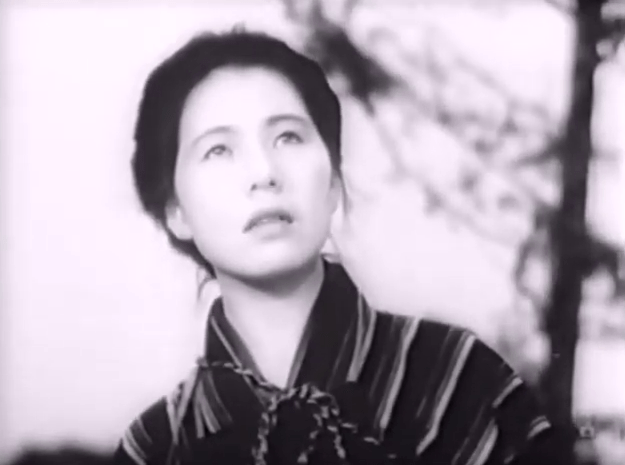
Set in a quiet northern town, Shiro Toyoda’s Nightingale (鶯, Uguisu) finds the nation still struggling to emerge from the feudal past into the modern era. The film opens with a scene in the local train station, yet we’re also told that it is literally cut off from prosperity because the express train does not stop there and so it is relegated to the status of provincial backwater. Physically trying to flag the train down, the Mayor has been trying to get the town placed on the fast track but has had no luck so far.

The ticket man, who’d been more or less ignoring him, suggests they can’t put the station on the express line because the population of the town is decreasing presumably as young people migrate to the cities in search of work. One of the people waiting there is a man with two sons who tries to get the younger to pretend he’s younger than he is so he won’t have to pay for his ticket, though the ticket man refuses to give him a discount leaving the man with only the option to leave one of the boys behind while the family can no longer survive in the town. He explains that he’s been financially crippled by the medical fees to care for his now late wife and is clearly at his wits end trying to find a way to support his children.

The costs of medical treatment seem to be a direct driver of poverty and crime. Shifting to the local police station, we’re introduced to a man who’s become a serial chicken thief having begun stealing neighbour’s birds to pay for doctors to treat his sickly wife only she eventually left him for another man because he was always away conducting poultry heists so she thought he’d abandoned her due to her illness. His problem is compounded by the fact he had not formally registered their marriage intending to wait until the first child was born leaving him without a leg to stand on.

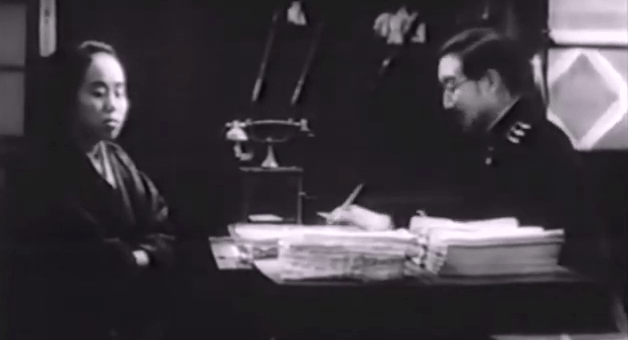
An official doctor later jokingly complains that he’s losing custom because no one in the area can afford modern medical care so they’re turning to dubious snake oil-style miracle cures proffered by a “fake priest” the police are about to arrest for fraud. Meanwhile, they’ve also arrested a middle-aged woman (Haruko Sugimura) who assists with births for violating the medical practice law. Branded a midwife she is really more of a wise woman who is well respected in the local community as someone who had had many children herself and also offers advice about folk remedies for various illnesses. She never claims to be a doctor and does not regard it as a job, merely as helping people even if she perhaps also enjoys the sense of being needed and important, and is unable to understand how that could ever be a crime. Unlike the priest, she takes no payment and uses her own resources though people sometimes give her small compensatory gifts such as parcels of rice as a thank you. When a woman goes into labour and the “official” midwife is not available, the policeman is unwilling to let her in but hearing the woman’s distress she runs to help her kicking all the policemen out of this very personal female space.

Her confusion bears out that within the general society as people struggle to adjust to a more ordered modernity and the encroachment of urbanity which is what the police themselves represent. Then again, they are presented as being more compassionate certainly than the staff of the railway and seemingly have a duty of pastoral care for the local area which is separate from their role in enforcing the law. A secondary drama that began at the train station involves a young woman who is being sold into sexual slavery by her father against her will. She is eventually rescued by an earnest school teacher who says the sale isn’t valid because she also signed a contract to become a teacher, convincing her father to change his mind with the help of the police who remonstrate with him that it’s wrong to sell your child even if the practice had been somewhat normalised which plays into a propagandistic element about the importance of moving on from “backward” rural practices still mired in the feudal era. The police also have access to a fund which can be used to get the broker out of the way in an effort to stamp out this morally indefensible situation in which parents sell their children into indentured servitude for reasons of poverty. 

They also agree to help an old lady who’s arrived in search of a child she fostered a decade previously who was taken back by her birth mother and sold to a circus. Like the chicken thief, the old woman was caught out by the modern convention of paperwork. She had been led to believe the adoption had been processed and the child placed on her own family register, but was illiterate and therefore easily deceived. The old woman also becomes a victim of the dodgy priest and the disease currently spreading because of his problematic cure-alls which people have turned to out of desperation in their poverty.

But despite the police’s apparent altruism, the arrival of a young woman selling a captive nightingale reveals the irony that she’s come there because it’s the only place anyone has any money. Unfortunately it turns out that capturing a nightingale has also been ruled illegal, even if one of the policeman was interested in buying it if only it could sing, so she’s come to the wrong place and if she doesn’t release it she’ll end up with a fine. The nightingale’s song is later replaced by that of a flute player who had been arrested for being drunk and disorderly having spent some money he was given towards the funeral of his baby on drink. 

The police are in some ways a disruptive influence, trying to bring a new urban order to this rural place which has its own laws and customs often at odds with those of the city. Their efforts tie in to a persistent message of modernising for the good of the nation which was particularly current in the late 1930s though the film is equally sympathetic towards the plight of the rural poor who are not after all being given very much support as the youngsters move to the city leaving the old behind, trapped on the slow line cut off from the benefits of modernity while otherwise expected to simply adapt to new visions of civility in a society still trying to emerge from the feudal past. 

Avalanche (雪崩, Mikio Naruse, 1937)

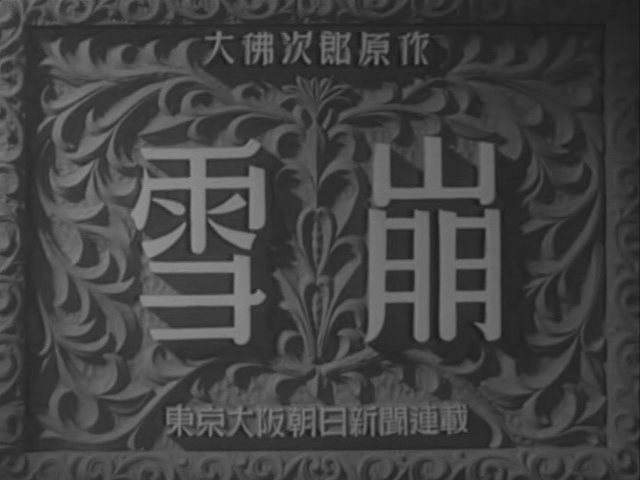
Naruse Avalanche title cardDespite his broadly progressive outlook, it would perhaps be unfair to describe Mikio Naruse as a political filmmaker. Yet filmmaking in the late 1930s was an inherently political act if only by omission. 1937’s Avalanche (雪崩, Nadare), adapted in collaboration with left-wing intellectual Tomoyoshi Murayama from a serialised novel by the quietly anti-authoritarian Jiro Osaragi, seems to be almost in dialogue with its times as its hyper-individualist “hero” engages in a series of discussions with his humanist father about the new philosophies which for him at least spell the future.

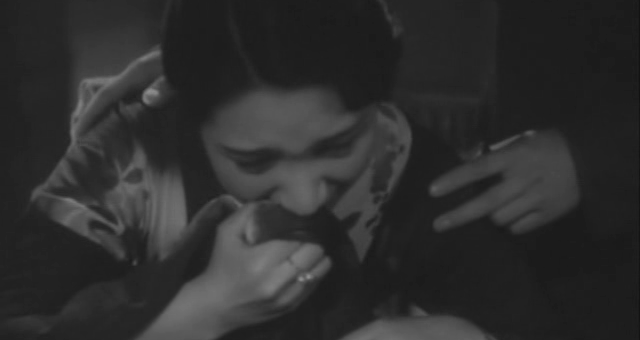
Naruse opens, however, with the heroine – sweet and innocent bride Fukiko (Noboru Kiritachi ), dressed in kimono and sporting a traditional married woman’s haircut as she gazes lovingly on her wedding photo sighing softly that a year has gone by already. Flashing back, we realise that Fukiko eloped with wealthy scion of the Kusaka family, Goro (Hideo Saeki), who apparently forced the disapproving parents to accept the union by persuading Fukiko to accompany him to a hotel in Nagoya from which they were collected by Goro’s kindly father (Yo Shiomi). Though Fukiko remains deeply in love with Goro, it is obvious to everyone else that the marriage is not happy. Having reconnected with childhood sweetheart Yayoi (Ranko Edogawa), Goro wants a divorce, justifying his actions with the rationale that it will be better for Fukiko to end things now rather allow her to suffer years of a loveless marriage that is destined to end in separation.

Goro’s father, a little fed up with his wayward, increasingly psychopathic son, feels differently. He thinks that Goro has made his bed and must now accept his responsibility, committing to caring for Fukiko as a husband should regardless of whether or not he has romantic love for her. Goro, however, insists that this is a matter which only concerns himself and rejects any responsibility towards Fukiko, insisting that would be cowardly and dishonest to go on living with a woman he doesn’t love under the pretence that he does. Exasperatedly pointing out that one lives as a member of a society and cannot always be free to do as one pleases, Goro’s father tries to awaken him to social responsibility by reminding him that he only thinks he has the luxury of choice because he is the heir to the wealthy Kusaka family and would likely feel differently if he were just a regular salaryman. Goro doesn’t quite deny it, but (ironically) also condemns the hypocrisy of social propriety, avowing that he will not live a life of lies like those respectable married couples with lovers on the side.

Goro’s father asks if he’s not being overly literal, seeing as life is rarely as black and white as he’s painting it for the purposes of his argument but Goro counters that his father is “bound by old morality” of which he believes himself to be free. Later, trying to win back the heart of Yayoi, he reveals himself to be a hyper-individualist who believes that the only true path to happiness lies in indifference to the suffering of others. It seems that Goro’s decision to elope with Fukiko was part rebound, his ego bruised by a minor rejection by Yayoi who is also in love with him and had always believed that they would marry only to find herself disillusioned with the institution of marriage. Her sickly brother Keisuke (Akira Ubukata) worries that she turned down Goro because of him, knowing that should he die she would need to find someone to marry into their family and continue its name – something impossible for the oldest son of a noble family like the Kusakas.

That was not, however the reason. Yayoi resents her lack of options, that when a woman’s marriage is arranged people say “it’s settled” as if an unmarried woman is a problem in need of a solution. She resents that she is obliged to entrust her future to a stranger, wondering how it is she is supposed to trust one man for the rest of her life. It is this feeling that created distance between herself and Goro despite her obvious love for him. He accuses her of being “condescending” and hiding her true feelings, blaming her for the predicament they now find themselves in despite the fact that it appears to be entirely his own fault. Yayoi thinks it’s now too late for them, immediately sympathising with Fukiko who has been unfairly dragged into an awkward situation, but Goro scalds her again by insisting that she thinks too much about others when they need to be “strong” and think only of themselves.

Yayoi is half won over by Goro’s frighteningly fascist world view, but finds herself conflicted. She recognises her privilege and originally feels nothing but guilt because of it, that lack of purpose has left her with nothing but emptiness. Goro has her wondering if she’s got things backwards, that she ought to embrace the fact that she is allowed the luxury of life without worry. Putting it to Keisuke he partially agrees, affirming that happiness is only possible when one wilfully ignores the suffering of others. Yet Yayoi is dragged back towards humanism, remembering the “people left behind in the darkness” but fearful that Goro’s philosophy may win her over in the end.

Goro seems to be a perfect encapsulation of the growing evils of the age in his hyper-individualist desire to disregard the thoughts and feelings of others. The opening text, taken from Jiro Osaragi’s novel, paints Goro as the “hero” as it over-explains the film’s title by insisting that the “avalanche” we are talking about is “some sudden unknown force” present in this “precarious world” which can knock even the strong willed off their feet. The “hero” of Naruse’s film, by contrast, is clearly Goro’s kind hearted father who finds an unexpected fan in Fukiko’s dad (Sadao Maruyama) who claims to hate rich people and had no intention of marrying his daughter to one but thinks Goro’s father is one of the good ones and proves that there were some good things in the old feudal system.

Strangely reactionary as it may be, he has a point. Goro’s father is the soul of benevolent paternalism. He worries for his “desperate” son, and laments that the misfortune of the younger generation is “knowing things without understanding them”. He baits Goro, making him a mild ultimatum that if he wants to go on with his “immoral” philosophy then he’ll have to do it on someone else’s dime. Cowardly, Goro relents and chooses his wealth over his freedom but his psychopathy only deepens. To get back at his dad, he decides on a double suicide with Fukiko, before realising that there is no need for him to actually die so long as it looks like he meant to and he makes sure Fukiko goes first. This is the avalanche the film has been building to, but it’s not the one the titles teased in that it drags Goro back from an abyss towards something more human. He gives up on his plan when Fukiko, innocent as she is, is overcome with emotion on realising that she has been “wrong” about his feelings for Yayoi seeing as he has chosen to die with her. Is it love, or perhaps innocence, or just pure communication that is that “sudden unexplained force” which knocks Goro off his feet and drowns him in human feeling?

It’s a strangely “upbeat” ending for a Naruse film considering Avalanche’s overriding darkness, providing an awkward resolution as Yayoi, in an abrupt closing scene, claims something like independence in stating that she intends to remain with her brother rather than waiting for Goro or looking for a marriage. As such it reads as a rebuke of the fascistic ideology which played into, if not quite aligning with, militarist austerity as its various heroes find themselves once more returned to more responsible philosophies and authentic human connections. Cutting against the grain of the times, Avalanche is nevertheless a strange piece which seems entirely at odds with the opening statement, allowing the hero to find salvation rather than destruction in the sudden onrush of emotion.


Humanity and Paper Balloons (人情紙風船, Sadao Yamanaka, 1937)

Humanity and Paper Balloons

That Humanity and Paper Balloons (人情紙風船, Ninjo Kami Fusen) would turn out to be the final film of its director is just one of its cruel ironies. Sadao Yamanaka was one of the most promising young directors of the 1930s, but his career was ultimately cut short by historical circumstance as, despite his leftist views, he found himself drafted into the army and dispatched to the Manchurian front where he later died in a field hospital at only 28 years old. The film both begins and ends with suicide – an acknowledgement of the crushing hopelessness of the feudal society in which humanity itself is as fragile, transient, and often overlooked as a paper balloon. Necessarily bleak, but not absent of humour (at least of the gallows kind) Humanity and Paper Balloons neatly reframes the Edo era not as one of a glorious lost past where honourable men presided over a carefully controlled social order but one where the elites were absent, crime was rampant, and and promises were always “a series of possibilities”.

The scene opens with panic. A down on his luck samurai is dead by his own hand. So destitute was he, that he’s hanged himself – armed only with a bamboo sword he couldn’t even die in a manner befitting his social class. People are beginning to wonder if this is an “unlucky” street – this has been the third such suicide of recent times. Meanwhile, barber and upstart Shinzo has been conducting secret gambling sessions in local kingpin Yatagoro’s territory so his guys are out for blood. Neighbouring ronin Unno, whose wife manufactures the titular paper balloons, is convinced that a low level samurai who owes his status to the support of Unno’s now deceased father will help him as soon as he reads the letter his father wrote on his deathbed. Mori, however, is in no way interested and is currently in negotiations to “adopt” the daughter of a local merchant so she can be married to a noble samurai who otherwise would lose face in marrying down. Said daughter, Omoka, is not happy about this arrangement as she is in love with her father’s clerk, Chushichi. When Shinzo decides to kidnap Omoka, getting Unno involved by hiding her at his house, a series of unfortunate consequences ensue.

The world of the jidaigeki is often an idealised one. Centring on the higher echelons, they paint a picture of noble warriors bravely standing up for honour and justice whilst displaying fearsome loyalty to their feudal lords. This is no such idyll – this is a slum where the social classes mingle freely but with invisible barriers still dividing one from the other. The samurai were already in decline and so it was not unusual for the men who grew up in rarified halls to suddenly find themselves cast down into the lower orders without the means to support themselves. The former samurai who hangs himself at the beginning has had enough, evidently, having sold even his sword he finds himself unable to go on.

Unno is in a similarly desperate situation, reliant on the pittance his wife earns making the paper balloons. He still thinks Mori will obey ancient social codes and repay his father’s kindness by supporting him, but Mori has no use for him now and no inclination to follow the ideals of honour which underpin the samurai word. Unno is experiencing a rude awakening to Edo era hypocrisy. In making a rash decision to go along with Shinzo’s scheme, he damns himself in every conceivable way – by dishonouring himself as a samurai, by indulging in illegality, and in merely being a party to someone’s else’s underhanded scheme. “Samurai are wicked these days” say some of the neighbourhood women, not noticing Unno’s wife is just returning from a few days away, unaware of what her husband has been up to in her absence.

The verdict on the samurai class is damning. Honourable men without honour, they use and misuse each other but are entirely unwilling to help out even one of their own fallen on hard times. Yet men like Unno are also victims of their class, suddenly ejected from a life of comfort but with no skills to survive in world of “normal” people. Single men can become wandering ronin, drinking, fighting and whoring their way through life but married, mild mannered men like Unno are left with nothing to live on but resentment.

Yamanaka’s final feature is once again far ahead of its time more resembling the films of twenty years later than those of the mid 1930s. Aiming for a highly detailed approach closer to naturalism than the general trend of the time, Yamanka paints a vivd picture of a claustrophobic world, alive with the struggle of those desperately clawing over each other in order to survive while the landlords enjoy a life of ease in vast mansions surrounded by peace, quiet and open air. Pointedly a comment on the present more than the past, Yamanaka is getting away with much more than you would think possible in the highly pressured world of 1937 following the previous year’s failure of a complex military coup seeking to return power to the emperor in the hopes of a return to feudal style paternalistic socialism. Humanity here is a paper balloon – cheap, fragile, and often unnoticed. That it exists at all is something to be thankful for, but like a paper balloon, humanity requires careful construction and committed maintenance. The plea to the people of 1937 was clear but it is often hard to recognise the importance of so commonplace an object let alone ensure its survival.


Unsubbed clip:

https://www.youtube.com/watch?v=N8fhHuy401o