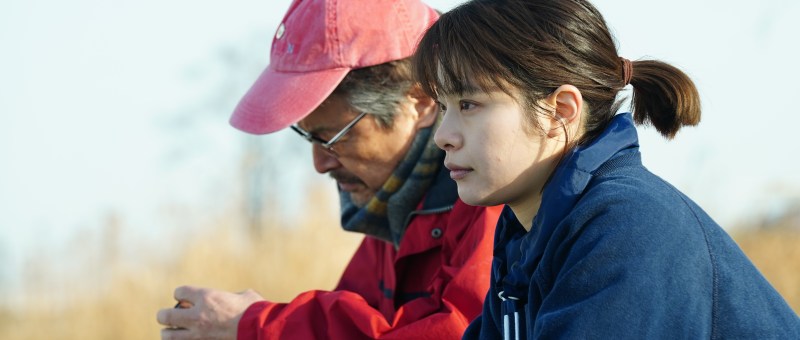
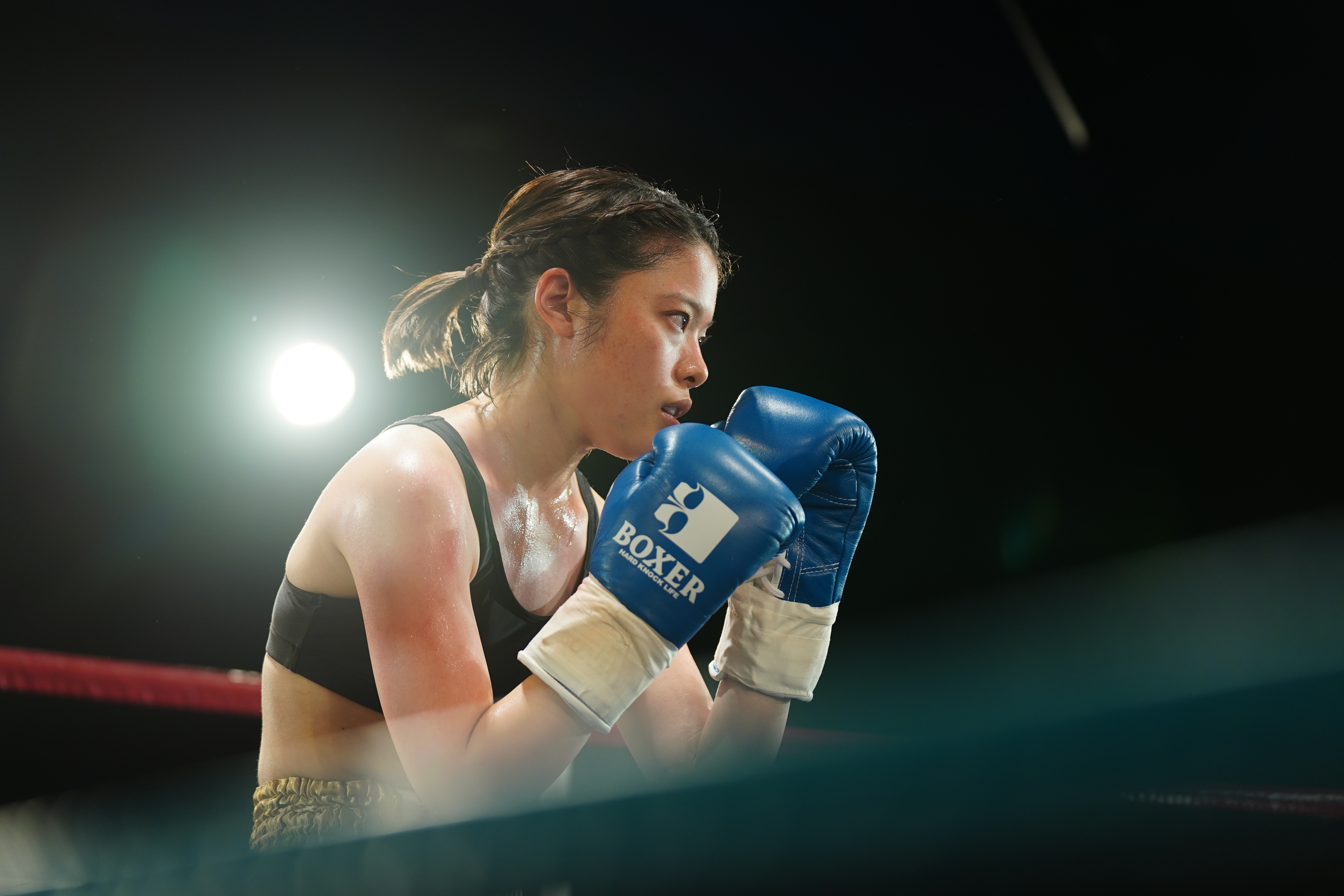
Part way through Sho Miyake’s empathetic character study Small, Slow But Steady (ケイコ 目を澄ませて, Keiko, Me wo Sumasete), an older man visits a doctor and is told that though he may think there is nothing really to worry about at the moment, a tiny drop of water falling steadily can soon make its mark in stone. It’s in one sense the small, slow, but steady stresses of everyday life that have eaten away at the soul of Keiko (Yukino Kishii), an aspiring boxer who is fast losing the will the fight. Yet it is also a small, slow, but steady process that allows her to begin moving again, climbing a new hill towards the next bout no longer so afraid of leaving the safety of the familiar.
Deaf since birth, Keiko became a professional boxer two years previously and makes ends meet with a part-time job in housekeeping at an upscale hotel. Miyake often positions her as in a way free of the frenetic nature of the noisy city, unaffected by the shouts of rude passersby and unlike the men at her boxing gym never subjected to angry rants from her coaches. Yet it’s also at times as if she feels a kind of loneliness in the minor rejections of an indifferent society which often fails to cater to her difference. Few people are able to sign, even those at her gym haven’t learned, while others are sometimes impatient in her attempts to communicate. The restrictions of the coronavirus pandemic meanwhile only make things worse for her given that constant masking means she can no longer rely on lipreading nor can she hear the public health messages being blasted out in public spaces reminding citizens that there is a state of emergency in place and they should restrict their journeys to the barest of essentials.
Then again, in the gym, she obviously cannot sign because the gloves her impede her ability to communicate. Nor can she hear the session bell or words of encouragement and advice from her coaches and the crowd. The chairman of the boxing club (Tomokazu Miura) admits in an interview that deafness is potentially fatal for a boxer, but that what Keiko may crave is a kind of internal peace in the surrender to the purely physical which allows her to empty her mind of everyday troubles. She may have taken up boxing as some say after being bullied as a child because of her disability, quite literally fighting back against a conformist society she refuses to beaten by, but has also found something reassuring in its slow and steady rhythms that allows her to reorient herself blow after blow.
The chairman also says, however, that it’s not a matter of having a preternatural talent so much as a steady work ethic and above all a big a heart, describing her finally as simply “a really nice person”. “Why don’t you have your guard up properly?” another of her coaches asks her, while her brother having noticed there is obviously something bothering her tries to get her to talk, only for her to point out that “talking doesn’t doesn’t make a person any less alone”. With rumours the pandemic, along with the boss’ failing health, will finally take the boxing gym too, Keiko fears losing this final safe space but finds herself unable to stand up and fight for it. Though she had struggled to find a gym who would accommodate her disability, she is ambivalent when a new solution is found in an empathetic female coach (Makiko Watanabe) running a modern training facility who is learning sign language and keen to empower her in her own decision making rather than patronise or railroad her. Afraid of getting hurt, she takes a step back unwilling leave the security of the past for the possibility of the future.
As Keiko reminds herself in her diary, self-control is the most important thing and the force she struggles with, suddenly losing her concentration in the middle of a match because the thoughtless referee keeps telling her to listen to him when he calls stop. In the end, it’s something quite trivial that sets her back on the path, a kind yet seemingly meaningless moment of acknowledgement from an unexpected source. Shot in a richly textured 16mm, Miyake captures Keiko’s isolated everyday with stunning clarity finding her alone amid the noisy city staring into space and looking for direction. Using intertitles to translate sign language his composition mimics that of a silent movie and lends an almost elegiac quality to the moribund boxing gym as it becomes an accidental victim of its times but ends on a note of quite resilience in the small, slow, but steady rhythms of gentle forward motion.
Small, Slow But Steady screened as part of this year’s BFI London Film Festival.
Original trailer (no subtitles)
 When AnimEigo decided to release Hideo Gosha’s Taisho/Showa era yakuza epic Onimasa (鬼龍院花子の生涯, Kiryuin Hanako no Shogai), they opted to give it a marketable but ill advised tagline – A Japanese Godfather. Misleading and problematic as this is, the Japanese title Kiryuin Hanako no Shogai also has its own mysterious quality in that it means “The Life of Hanako Kiryuin” even though this, admittedly hugely important, character barely appears in the film. We follow instead her adopted older sister, Matsue (Masako Natsume), and her complicated relationship with our title character, Onimasa, a gang boss who doesn’t see himself as a yakuza but as a chivalrous man whose heart and duty often become incompatible. Reteaming with frequent star Tatsuya Nakadai, director Hideo Gosha gives up the fight a little, showing us how sad the “manly way” can be on one who finds himself outplayed by his times. Here, anticipating Gosha’s subsequent direction, it’s the women who survive – in large part because they have to, by virtue of being the only ones to see where they’re headed and act accordingly.
 Windows on Worlds