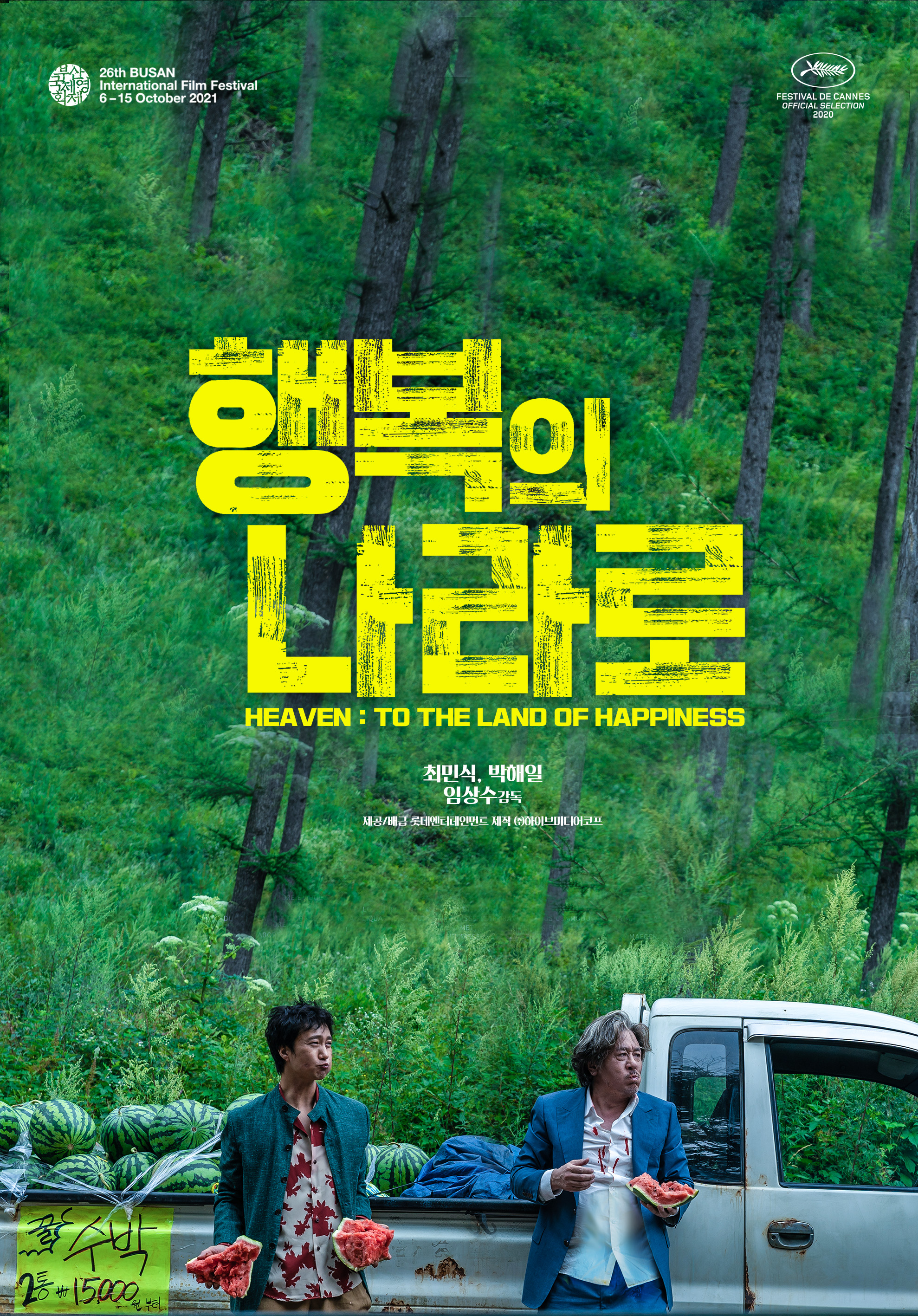
Heaven: To the Land of Happiness (행복의 나라로, Im Sang-soo, 2021)

A chronically ill thief and a “poetic fugitive” find themselves on the run from a “philosophical gangster” whose money they unwittingly stole after driving off with his hearse in Im Sang-soo’s playful existential drama, Heaven: To the Land of Happiness (행복의 나라로, Haengbokeui Nararo). In one way or another, all of our heroes are sick or dying, pushed into a moment of introspection which forces them to consider how it is they wanted to live and what for them night constitute a good death while pursued by pettiness and injustice squabbling over the most meaningless but equally impossible to live without thing imaginable, money. 

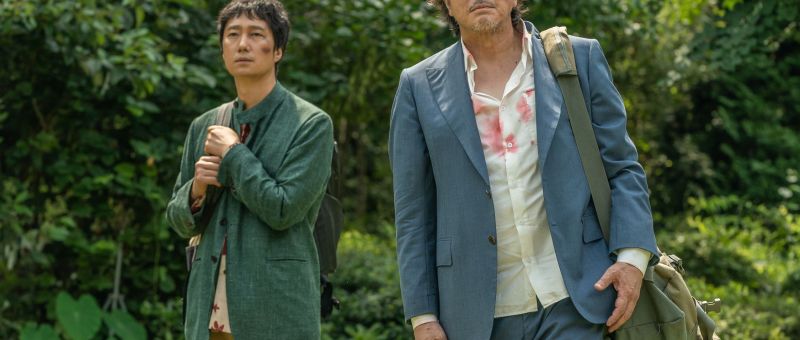
Our narrator, Nam-sik (Park Hae-il), is a youngish man suffering with a chronic illness which has forced him into a life of wandering taking menial jobs at hospitals in order to steal the medicine he needs to treat his condition which otherwise costs more than the average annual salary for a month’s supply. On the day his cover’s about to be blown, he runs into Prisoner 203 (Choi Min-sik) who has been brought in by the local prison only to be told that his brain tumour is now inoperable and in their estimation he has as little as two weeks left to live. Unwilling to die behind bars and longing to see his estranged daughter again, 203 manages to mount an escape attempt with the help of Nam-sik who ends up on the run with him after getting accidentally tasered. 

Not only are Nam-sik and 203 each suffering from life-limiting medical conditions, but even the elderly female gang boss, Madame Yoon (Youn Yuh-jung), is also bedridden and apparently at death’s door while in an extreme irony the casino money the guys have accidentally run off with was stored inside an ornate black coffin. Rich man or thug we’re all the same when we die, 203 remarks as he and Nam-sik prepare to bury the coffin before discovering what’s inside, hinting perhaps at the utter pointlessness of the gangsters’ quest to retrieve it. After, all you can’t take it with you and 203 has little need of vast riches now which is another irony seeing as he’d been in prison for embezzlement. 

All of those around him constantly describe 203 as a “decent man”, his guard quickly shutting down the outlandish suggestions of a bumbling cop that he may have murdered the owner of an abandoned truck by exclaiming that 203 isn’t the sort of person who would do something like that. In fact, Nam-sik and 203 are responsible fugitives, often giving away large sums of money to those they meet in exchange for the use of a vehicle or some other kind of assistance. 203 doesn’t even want his share of the loot, partly because he rightly assumes it’s only going to bring them trouble, and partly because he no longer has need for it. Nam-sik meanwhile seems to relish the idea of being rich, but quite literally needs money to survive in order buy his medication (as well as potentially help out the impoverished mother who rings him asking for financial assistance). Even Madame Yoon seems to want the money as a kind of survival mechanism, suddenly reviving after hearing her stylish but inept gangster protege daughter (Lee El) report she’s found the missing cash while otherwise explaining to her that she needs to be “tough, persistent, and almost merciless in order to beat the insignificants and become rich”. 

But you can’t buy your way out of death with money, even if as the philosophical gangster says everyone has to go some way, don’t take it personally. Caught in existential limbo, the two men generate a kind of absurdist brotherhood, a wandering Vladimir and Estragon, or the Rosencrantz and Guildernstern of Stoppard’s play blinking in and out of existence while caring for each other altruistically for no other reason than the connection they’ve developed in shared mortal anxiety. “It was warm and it made me feel happy” Nam-sik reflects somewhat incongruously on a death that was in its own way good and just amid so much injustice. Swapping the provocation which defines much of his earlier work for cheerful melancholy, Im’s strangely moving existential dramedy suggests that happiness lies in simple human connection and the power of redemption while money only leads in one direction. 


Heaven: To the Land of Happiness screens in Chicago on March 13 as part of the 14th Season of Asian Pop-Up Cinema.

International trailer (English subtitles)

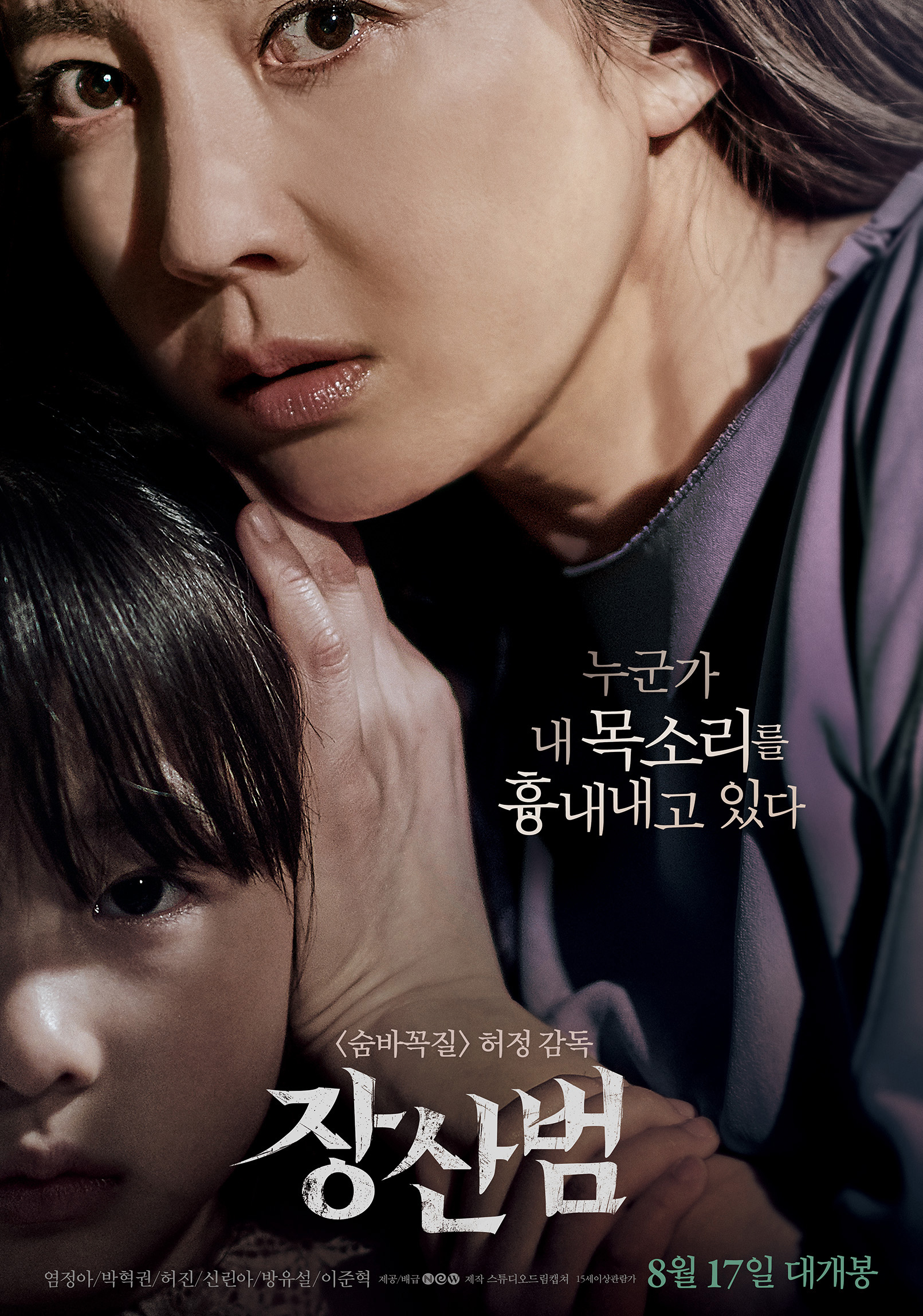
The Mimic (장산범, Huh Jung, 2017)

The mimic posterFears of changeling children and their propensity to become cuckoos in the nest is a mainstay of folklore horror, but in recent times the creepy kid has crept his way in from the cold as the current monster of choice. The Mimic (장산범, Jangsanbum), though apparently completed some time earlier, has a few superficial similarities to Na’s The Wailing in its use of powerful, ancient myths and shamanic lore to conjure its particular brand of evil. If Na’s film was sometimes criticised for its obtuse ambiguity Huh has the opposite problem in failing to properly support his internal mythology with an appropriate level of consistency.

Hee-yeon (Yum Jung-ah) packs up her life including husband (Park Hyuk-kwon), mother-in-law (Heo Jin) suffering with dementia, little girl Jun-hee (Jang Liu) and a box of painful memories and moves to Mount Jang – her mother-in-law’s hometown. The move is intended to help the family put the past behind them and move on after Hee-yeon’s son disappeared without trace five years previously, but it’s not long before Hee-yeon is catching sight of small boys in ragged clothes on the streets around Mount Jang and convincing herself she’s seen her little boy despite the distance from the place where he disappeared and that he’d now be five years older than the version she has stored in her memory.

With Hee-yeon’s mental state already strained, she runs into trouble when a pair of earnest children arrive hoping one of the dogs in the kennel facility the family are running might be their missing puppy. It isn’t but their search leads them to a creepy walled up cave where they’re attacked by a malevolent entity. While her husband is helping the children and investigating the cave, Hee-yeon comes across a strange little girl (Shin Rin-ah), apparently lost, and dressed in an old fashioned velvet dress with a lace collar. The girl disappears while the Hee-yeon and her husband are busy with the police but later turns up at the couple’s home and worms her way inside, eventually claiming that her name is Jun-hee too, just like Hee-yeon’s daughter.

The central conceit is that the malevolent entity existing around Mount Jang mimics the voices of (usually dead) loved ones in order to convince its victims to surrender themselves voluntarily. Huh sets up Hee-yeon’s mental instability early on as she nervously guzzles pills to help her regain her grip on reality, but there after abandons it, never questioning the real existence of threat or Hee-yong’s relationship to the little girl whom she at times strangely believes to be her son. The little girl remains a typically creepy kid, originally mute and then mimicking Jun-hee but apparently unthreatening in and of herself. The cuts and bruises across the little girl’s back might explain her silence with her immediate adoption of a Jun-hee persona a kind of rejection of her original personality, but the film has already lost interest in rational explanations.

Hee-yeon, despite a degree of distance towards her daughter, immediately takes to the little girl, bringing her into the house with an intention to keep her despite her husband’s reservations. The desire to save this lost little girl is, of course, a kind of reaction to the loss of her son whom she seems to see in the little girl even without her supernatural gift of mimicry. Hee-yeon blames herself for the unknown fate of her little boy who disappeared after she left him with her mother-in-law (already suffering with dementia) in a busy foodcourt. Granny may have more clues, but if she has they’re irretrievably locked inside her fracturing mind. Having grown up in the surrounding area and being aware of the legends since childhood, granny is also a good person to ask about the strange goings on – only no one does because they assume she is not mentally stable. Hence when she alone knows to cover up mirrors and is suspicious of the little girl, everyone thinks it’s the dementia talking.

Symbolically the choice which is presented is between past and future, life and death, in the knowledge that the two are mutually exclusive. The liminal space of the cave becomes its own purgatorial courtroom in which Hee-yeon, and the other victims, must decide for themselves who or what they believe and which sort of existence they wish to embrace. For Hee-yeon her trial involves the abandonment of another child as a final goodbye to her long absent son, pulling at her fragile maternity and testing each and every aspect of it (though not, perhaps, that related to her remaining daughter who seems to have been temporarily forgotten). Huh makes fantastic use of soundscapes and intriguing use of mirrors, but even the high quality photography and committed performances can’t quite overcome the hollowness of his mythology, robbing his dark fairytale of its essential power.


Screened at London Korean Film Festival 2017. Also screening at Showroom Cinema, Sheffield, 15 November 2017, 8.30 pm

International trailer (English subtitles)