Back To That Day (幕が下りたら会いましょう, Seira Maeda, 2021)

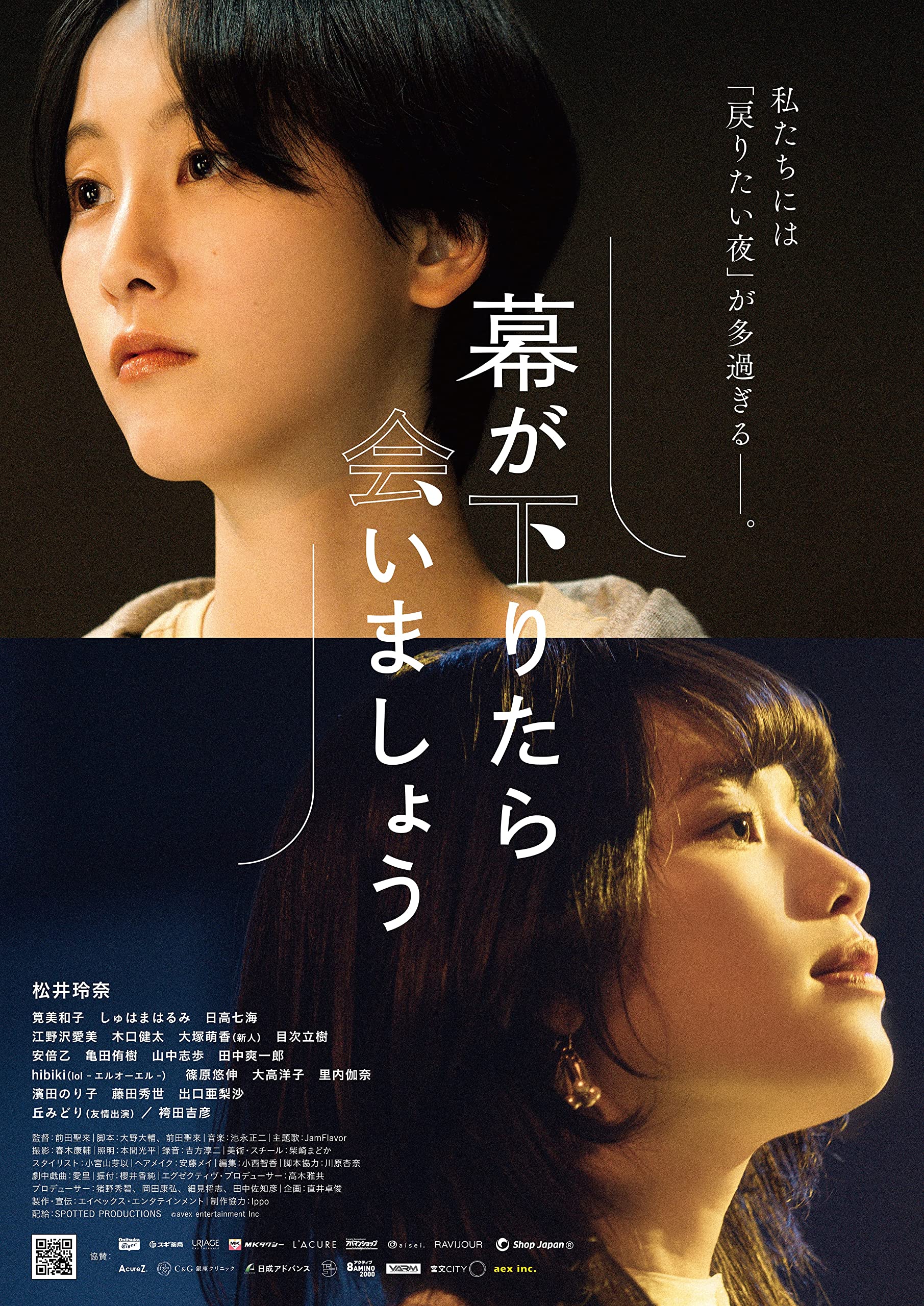
A young woman facing a life crisis is forced to reevaluate her relationships with art, friends, and family after learning that her estranged younger sister has suddenly passed away in Seira Maeda’s indie drama, Back to that Day (幕が下りたら会いましょう, Maku ga Oritara Aimasho). Facing a patriarchal society, the young women at the film’s centre wonder if it’s better to chase your dreams even if they won’t come true or contend with the unfair demands of contemporary salaryman culture in the hope of achieving conventional success and a comfortable life. 

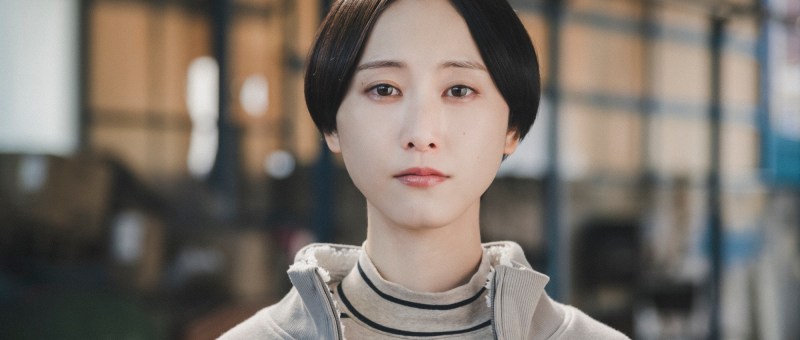
At around thirty, Manami (Rena Matsui) is beginning to lose patience with herself feeling that she’s achieved little in her career as a theatre director in the last 10 years while continuing to work part time at her mother’s hair salon. Her younger sister, Nao (Miwako Kakei), left abruptly for the city some time previously and the pair have hardly spoken since partly as we discover because of a high school falling out that continues to play on Masami’s mind in undermining her sense of confidence in her art. 

The two women have in many ways chosen different paths, Nao striking out by heading to the city and getting a regular office job and Manami staying at home trying to make it work in theatre but finding herself treading water. On the night that Nao dies, the sisters mirror each other each black out drunk collapsed in the street but only one of them is alone which in the end perhaps makes all the difference. Out to dinner with members of her theatre troupe celebrating an engagement, Manami has far too much to drink, much more than than anyone else or than is really appropriate becoming embarrassing in her belligerence as she lays into even her closest friends while others wonder why they bother with the troupe at all now that most of them are ageing out of their carefree days, have full-time paying jobs and growing familial responsibilities to take of. 

Nao, meanwhile as we discover, was pressured into drinking more than was wise by her boss at a semi-compulsory work do, an all too common form of power play in the contemporary working culture. Carrying her own share of guilt, Manami is alerted to this hidden source of her sister’s suffering by one of Nao’s colleagues, Mihashi (Manami Enosawa), who alone attended the funeral. Facing the same continued harassment, Mihashi is determined to confront her boss with the help of Niiyama (Kenta Kiguchi), an activist working on behalf of employees experiencing workplace bullying, but is later blamed herself with the implication that Nao drank on her behalf while she perhaps should have stayed to make sure she was alright before leaving for the last train. Her colleagues insist that Nao seemed cheerful and engaged with the party, while Manami and her actress friend Sanae (Nanami Hidaka) wonder if she wasn’t just playing the part, that in feeling disconnected from her family she wanted to feel accepted by those around her. 

In an unexpected turn of events, however, Manami decides to not to take Nao’s employer to task or attempt to change a dangerous and outdated workplace culture but to try and make peace with difficult relationship they had through restaging the high school play that set them apart which as it turns out was actually written by Nao but for which Manami had taken credit. Along the way she’s led towards a more commercial path by the duplicitous Niiyama who turns out to be a bit of a sleaze and not much better than those he claimed to be challenging. What she discovers is that restaging Nao’s play may not be the best way to honour her, gradually working through her grief and guilt by writing an original piece inspired by their relationship while reconsidering herself and her life up to that point. Of course, in one sense, she reduces Nao to a plot device in the mere motivation for her own creative rejuvenation while partially letting herself off the hook in discovering a family secret that explains a lot about her difficult relationship with her mother but does at least allow her come to terms with her sister’s death in letting her burn out bright just as in the alternate ending she’d crafted for Anna Karenina as a woman driven to extremes by the strictures of her society. 


Original trailer (no subtitles)
Bu Su (BU・SU, Jun Ichikawa, 1987)

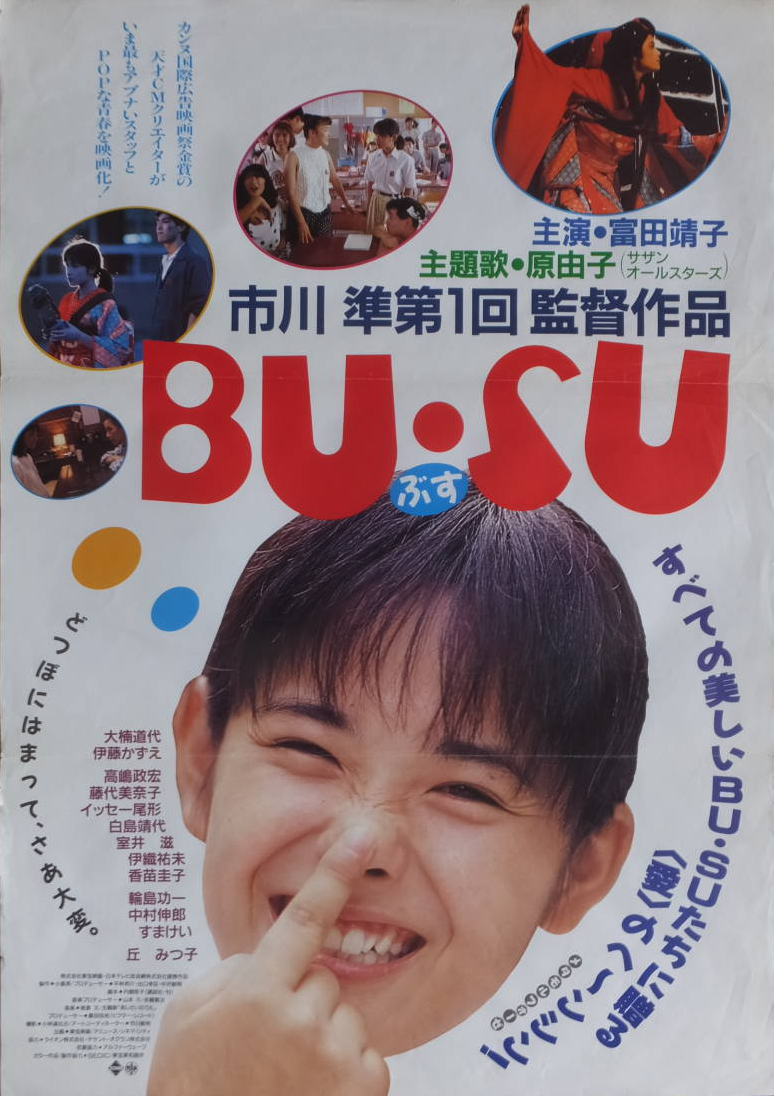
Busu poster 2Already a well respected and much in demand director of television commercials Jun Ichikawa released his debut feature, Bu Su (BU・SU), in 1987. “Bu Su” is, loosely translated, pejorative slang for a woman who is not considered to be attractive. The closest equivalent, in British English at least, would be something like “a dog”. It’s especially ironic then that the movie was conceived as a vehicle for a popular idol whose success was perhaps dependent on a perception of attractiveness, or at least of “kawaii” innocence. Yasuko Tomita was at that time at the height of her fame having shot to stardom through open audition leading to an award winning role in Aiko 16 Sai. Two years later she starred for Nobuhiko Obayashi, who was originally slated to direct Bu Su, in Miss Lonely, but even in comparison to Obayashi’s melancholy heroines, Bu Su’s Mugiko (Yasuko Tomita) is a particularly moody teen, the “ugliness” here apparently relating to her emotional isolation.

For reasons we never quite understand, Mugiko leaves her island home after a traumatic incident and moves in with her aunt in Tokyo with the intention of becoming a geisha. It seem’s Mugiko’s mother was once a famous geisha herself until she met Mugiko’s late father and left for a more conventional life in the peaceful countryside. Mugiko’s flight then has a peculiarly perverse quality in being both to and from her mother with whom she seems to be on bad terms despite her mother’s obvious affection for her. Unfortunately Mugiko is not a fantastic fit for the world of the geisha, being somewhat innocent and childishly clumsy, not to mention her ongoing grumpiness. Nevertheless, everyone at the geisha house is keen to help her if only out of loyalty to her mother.

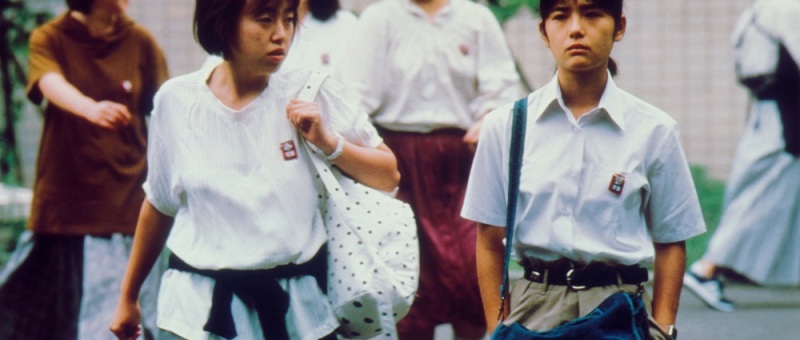
At school, meanwhile, Mugiko is nervous and withdrawn, barely audible during her introduction to her new classmates and with her eyes permanently on the floor. Her teacher, taking her aside, adds to the mystery in remarking that she’s certainly been through a lot back in Izu and that she should leave all that behind and try to make a new start. Nevertheless, she remains sullen and isolated, barely speaking to anyone yet perhaps examining the dynamics of the people around her. Maybe that’s why she alone finds the strength to stand up to a popular kid bullying another girl (Yuriko Hirooka) considered to be “plain” with a mean trick teasing a nasty surprise lurking in a box which turns out to be nothing more than a hand mirror.

Mugiko might not be quite sure what it is that’s worrying her, or at least we can’t be sure because we don’t know exactly what happened in Izu, but the rest of her classmates have their own insecurities to deal with from Sakurako’s preoccupation with her perceived lack of looks to boxing enthusiast Tsuda (Masahiro Takashima) who knows he’s not much for studying but is less than convinced of the possibility of living off his fists. What they’re going through is the normal teenage process of figuring themselves out, which they begin to do through the time-honoured fashion of the school cultural festival which is an extra special event this year because it’s the school’s centenary. Goaded into it by the mean popular girl who meant to embarrass her by outing her as a geisha, Mugiko agrees to dance the dance of Yaoya Oshichi who was prepared to burn the world in the hope of meeting her love.

Yaoya Oshichi was burned at the stake for arson, and though Mugiko’s path eventually ends in flames they’re of a much less threatening variety. When she first arrives in Tokyo we see her taking in some of the iconic sights of the city, crossing at Shibuya Scramble and taking a stroll through upscale Ginza before taking a bite out of a fast food hamburger as if she were about to taste some famous local delicacy. When not training with the other geisha we see her wander through the city alone, sullen but also taking pleasure in exploring her new environment. It’s here that we hear the film’s title uttered, crudely, by a sleazy middle-aged man who picks Mugiko up and takes her to a coffeeshop where he embarks on weird chat up lines about the beauty of the local railway before trying to drag her into a love hotel. Luckily, Mugiko manages to get away from him only for the man to shout “busu” after her, implying that he didn’t want her anyway but also that her refusal is in someway arrogant.

By Ichikawa’s logic, Mugiko’s “busu”ness is not because she’s “ugly” but that she’s so sour faced, permanently sulky and angrily keeping a deliberate distance from everyone around her. We see her spikily refuse her mother’s tearful attempt to see her off to the train, and then speak rudely to her on the phone, while remaining aloof from most of the other geishas save her aunt’s daughter, primed to take over the business but unbeknownst to most longing for a more conventional life with a boring salaryman husband. Yet through all of these encounters, some friendlier than others, her heart finally begins to open and she’s no longer so closed off or aloof, eventually able to laugh along with her mother and pithily dismiss her questions with the generic answers that Tokyo is “fun” and yes she’s going to school. Mugiko’s path is certainly a meandering one, taking the scenic route through the charms of bubble era Tokyo, but it has its charms and even if she takes her time she gets there in the end, smiling at last having rediscovered the joys of being alive.


Short clip (Japanese subtitles only)

https://www.youtube.com/watch?v=1PDPc0W-kr8